

Soil Test Results - April 2017
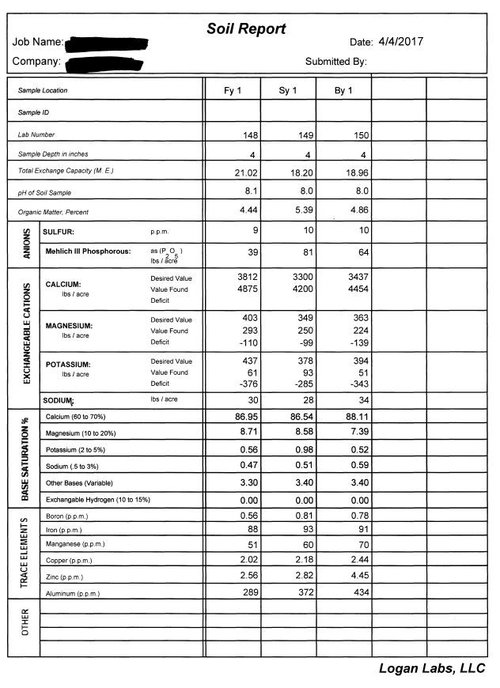
Hi there, been on this forum for quite some time, Citrus, Lawn Care, Indoor gardening, hot peppers and Irrigation. This is my first time getting a soil test, and first time taking a stab at getting my lime in prime shape. I'm hopeful that I can get some advice and general guidance on improving my soil.
Located in South western Ontario. 6b. I cut as high as my mower will go and I water Y1 deep an infrequent (1" per week all at once). B1 and S1 only get water during droughts,.
Y1 was renovated in June last year (worst time I know) with KBG, CRF, PRG. It is my only lawn with irrigation. KBG definitely dominates in the wide open sunny spots The CRF seems to dominate under the tree, although everything in the tree seemed to kind of stop growing/thin out late in the summer last year.
S1 and B1 are just a generic Sun/Shade mix that I overseed every fall.
all 3 yards were last fertilized at the bag rate 30-0-3 in November.
My goal is to put in the work now and get my lawn as close to perfect as possible. Once my soil is optimal, I will systematically reno each lawn.
I'v read a bunch of good stuff on Milo but can't get it where I'm at, so I'll most likely have to go other routes on OM. hard work is not a concern, and financially I can spend some money but within reason (not going to import Milo from us at $250 a bag on Amazon)
Comments (29)

bmelz
Original Author9 years agoThank you for your in depth analysis Ridgerunner.
I have read through it once or twice but am definitely going to need to study it a bit more to totally absorb it all.
Triple Fertillizer - I have a 15-15-15 available
TripleSuperphosphate - I have 0-45-0 available
Sulphate of Potash - is available, not sure on the number but can get.
Milorganite - Unfortunately it is nearly impossible to get in my area. I am headed to the states this weekend and plan to ask Canadian customs on the way back if I'm able to import it. Otherwise, I may need a substitute.
Starters - I have a variety - 25-25-4 seems to be common.
I'm still processing the bit about my inflated PH. Kind of bums me out because it sounds like I'll be able to keep my lawn healthy ONLY by giving it a cocktail of fertilizers all summer every summer and won't be able to rely on organics.
Related Professionals
Clarksville Landscape Architects & Landscape Designers · McAllen Landscape Architects & Landscape Designers · Hartford Landscape Architects & Landscape Designers · Augusta Landscape Architects & Landscape Designers · Flagstaff Landscape Architects & Landscape Designers · Fredericksburg Landscape Contractors · Harrisonburg Landscape Contractors · Escanaba Landscape Contractors · Modesto Landscape Contractors · Grand Junction Landscape Contractors · Victoria Landscape Contractors · Stamford Home Builders · Dubuque Home Builders · Santa Rosa Home Builders · Del Rio Home Builders- 9 years agolast modified: 9 years ago
Triple Fertillizer - I have a 15-15-15 available
That will work. Easiest, simplest, but not most effective with limited ability for application adjustment. You'd apply at at rate of 1#/k N (or 5# of product per k)
TripleSuperphosphate - I have 0-45-0 available
Effort intensive, but gives greatest ability to adjust application rates and timing. Allows for applications at the same time with N and or K like a T-NPK and allows solo application when a N application may be detrimental to the turf. Infinitely adjustable app rate.
Sulphate of Potash - is available, not sure on the number but can get.
Same disadvantages and advantages as TSP above.
Milorganite - Unfortunately it is nearly impossible to get in my
area. I am headed to the states this weekend and plan to ask Canadian
customs on the way back if I'm able to import it. Otherwise, I may need a
substitute.It is expensive in the States. Cost prohibitive and labor intensive. The 5-4-0 is a very good starter fertilizer substitute with the advantage of 20% or so of P being in a slow release organic form.
Starters - I have a variety - 25-25-4 seems to be common.
Convenient as it is easy to find almost anywhere. Ease of use as you can apply N and P in one pass. In conjunction with SOP, allows higher rates of P application with limitless adjustment for K app. Application is limited to times when a N application may not be harmful to the turf.
I'm still processing the bit about my inflated PH.
Your Ca, TEC and possibly Mg are inflated due to the extraction process used by the lab. Your pH is NOT inflated. It is what it is-High.
Kind of bums me
out because it sounds like I'll be able to keep my lawn healthy ONLY by
giving it a cocktail of fertilizers all summer every summer and won't be
able to rely on organics.Yes, it is a PITA, that to insure that your turf has a continuous stream of nutrients (mostly just N and P though) that you'll need to spoon feed nutrients continuously unless something dramatic happens.
No one said you wont be able to use organics.
I've been trying to avoid this discussion on this site, but it appears unavoidable. For the most part, to the greatest extent, Plants can only absorb/take up nutrients in inorganic form. Plants take N up in the form of NO3 or NH4, P in the form of H2PO4 or HPO4 and K, in the form of K.
Synthetic fertilizers provide nutrients in inorganic forms which are readily converted (by simple hydration, chemical interaction or microbe intervention if not already in plant useful status) into the inorganic forms listed above for plant uptake. Organic sources provide the same inorganic forms of nutrients primarily through a series of conversions/processing by soil microbes. This takes time. It is dependent on temperature and moisture conditions and the actual quantity of an inorganic nutrient available at any given time are indeterminate. Other than praising OM's benefits in improving soil texture, eventual influence on CEC and as a source for the slow release of an unknown quantity of nutrients, I'm ill equipped to make organinic fertilizer recommendations for plant health or soil balancing. It's above my pay grade. :/
I wish at least one of the people who continuously recommend organic fertilization would step up and fill this void, or at least provide a source for Organic NPK values. ;)
I encourage you to develop and use an organic program. Apply organic fertilizers in some combination that reflects the proportions of your nutrient deficiencies (NPK) in some regular application amount that you estimate will be sufficient to meet the turf needs for the growing period and either use saturated paste or your own observations to make adjustments.
Anywho, let me know what path and fertilizers you'd like to use and we'll try to go from there.
- 9 years ago
I don't know how accurate this is, but it is a list of NPK of "everything". I myself use a combination of synthetic and organic fertilizer (mainly Milorganite for organic). I have used cornmeal and cracked corn in attempts to ward off brown patch before it forms (it helped). There is some NPK in them but not much. I am intrigued by the idea of using brewery waste but not brave enough to try it (the smell, I've read, is terrible). It could be a free resource from your local brewery. Coffee houses will give away coffee grounds. I mulch mow lots of leaves in the fall and consider that a contribution to feeding earthworms and a way to add organic matter, not as a fertilizer. Leaving your grass clippings on the lawn helps supply nitrogen and organic matter. One thing to consider with organic fertilizers is that they will probably be slow release, which could be an advantage or disadvantage depending on your needs.
- 9 years ago
Thanks Becky. Any suggestions on what organic amendments he could use on a continuous basis that would meet his nutrient needs/deficiencies for the long term maintenance program and avoid synthetics?
bmelz
Original Author9 years agoI just want to thank you again for you taking the time to write such an in depth analysis.
Thanks to Becky as well for offering some additional info.
Sorry, I haven't had much time to give a well thought-out reply yet.
I'm definitely not against using synthetics at all. Based off of all the reading I've been doing over the winter, I was hoping that I'd be able to tweak and balance my soil for optimal turf growing conditions. I probably probably did not articulate my words well enough in my first response. I guess my results just surprised me bit.....
But moving on from that and moving forward on a plan.
I like the flexibility of going with a TSP plan. Based on my soil, would you recommend TSP over SOP?I'm good with making amendments every other week if needed. I think I've read somewhere that you can cut your nitrogen applications in half and spread twice as often, sort of thing.
- 9 years ago
My recommendation on organic fertilizer would be to see what is available locally at a reasonable price and go from there. If Milorganite is not available, I think it would be hard to go totally organic. An organic feeding could substitute for a synthetic one.
My impression of the soil test is that there are cation exchange sites galore capable of holding lots of nutrients and there is an adequate supply of most everything except phosphorus and potassium, so it would make sense to use a balanced fertilizer (like 10-10-10 or 15-15-15) when it makes sense to fertilize. There are enviable levels of organic matter. I don't know the climate in Ontario. When is late spring and summer and fall? How hot is the summer? I avoid anything on cool season grass in summer but maybe your grass isn't as stressed as it is here. CRF doesn't like much fertilizer (do less under the tree). Avoid potassium after early fall (can contribute to snow mold). An organic feeding could substitute for a synthetic one but do it while the soil is warm and microbes are active. The last fertilization should be a quick release nitrogen after the grass has stopped growing but before the ground freezes. If you're up for feedings twice a month, that's great. Do half the rate. A small steady supply of nutrients is the best way to feed. Iron is a bit low. If you can't get Milorganite (which has iron), you could use a foliar spray of iron to improve color for a few weeks at a time. Maybe there is something else that would supply iron?
- 9 years agolast modified: 9 years ago
N.P. I hope you found it useful.
Another person's read of the test might come to a conclusion more in line with your expectations. I just can't get there, sorry.
TSP (triple super phosphate 0-45-0) is a phosphorous fertilizer and SOP a potassium fertilizer ( potassium sulfate or sulfate of potash 0-0-50) You need both, so it's not really a one over the other situation. Because of the state of your soil, you need both, phosphorous is your big issue and potassium is less of a problem. Considering the size of TEC there is a decent possibility that K could balance (to at least low optimal levels) within a couple of years or sooner leaving just regular maintenance apps of N and P in the future. Or am I misunderstanding the question?
I should stop using TSP as someone is going to mistake it for tri sodium phosphate which would be a big mistake.
You will also need/want a pure N fertilizer like urea (46-0-0) or an ammonium N (21-0-0).
And yes you can divide the apps in half and apply every two weeks if you wish, It's a lot more effort and it does get a bit hard to get even coverage as the amounts get smaller. How big is the yard?
EDIT: TSP- apply 2#/k ASAP, apply 1#/k May, June, July, August, September, and October 1.
EDIT: SOP- Apply 2#/k ASAP with the TSP, Apply 1#/k June 1, Apply 2#/k September 1.
N- Apply 1#/k June 1, September 1, October 1 and 1-2#as a winterizer when the grass has stopped/slowed growing in mid November.
Water all apps in -slowly to avoid run-off or puddles.
Mulch mow and Add OM at your discretion.
Retest next year, maybe we'll be pleasantly surprised. :)
bmelz
Original Author9 years agoMy yard (front yard) is 2500sq ft, the side yard is maybe 1000 and the back yard would be about 500.
A quick question on the application rates just do I don't mess this up.
When you say something like 1#/k SOP, if I had 0-0-50, I would put down 2lbs of that per 1000 square feet, right?
Also I see that you aren't recommending any N until June. Even with my kbg Reno last season, do you think adding N earlier could/would be harmful?
I think Becky is spot on that the crf doesn't like much fertilizing. It really thinned out last year around my tree. It's okay because I am going to be purchasing some shade tolerant kbg to overseed and hopefully take over the crf (but that's a whole other discussion)
To answer Becky, summers can get mid to high 80s from late June to late August. Very humid where I'm at. We have feed stores that carry 50lbs bags of conrmeal, alfalfa pellets etc. I may check the link you posted earlier and see if there are any comparable alternatives. This area is weird, for example , it's literally snowing right now but calls for 73 degrees on Monday. Someyears we don't get much of a fall but this year we didn't freeze till late November. I am in Canada but only about an hour drive from Detroit Michigan, so similar to their climate.
- 9 years ago
My Bad for not clarifying. I used to make recommendation in the form of quantity of elemental nutrient like 1#/k of K or P and leave it to the person to calculate. That didn't work out so well. :( The recs I made are for pounds of product, so 3#/k of SOP would be three pound of SOP product per thousand sq feet. No calculations needed for SOP and TSP. The 1#/k of N does require you to calculate how much product will need to be applied to result in 1# of N per thousand sq feet. After next years test, adjustments can be made for next year if necessary.
Sorry about that.
I forgot about the recent reno. Yes, Spoon feeding N every two weeks would be recommended starting as early as late April. You can also spoon feed the the "ASAP" TSP and SOP in that area. Otherwise do the ASAP feedings in one dose for the other established areas so it is down and working its way into the soil for the turf to wake up to.
If you can find a sulfur coated N fertilizer use it for the October feeding for the whole lawn to bump S (could be used for the early spring feeding for the reno area too if it has some % fast release).
As per Becky, an Iron source would also be desirable.
- 9 years ago
I am just an amateur and Ridgerunner seems to have had professional experience so go by his advice. It seems like a lot of phosphorus to me but he is basing it on something. He determined a yearly number for your type of soil for each nutrient and then split it up into the various monthly applications. That's a lot more precise than my "they need some." Good luck with the CRF. It's hard to kill. You have to kill it before it goes dormant (in Virginia it's dormant now until October). Or maybe you can dig it up. I have done that.
- 9 years agolast modified: 9 years ago
bmelz,
Before I forget it again, for your next (and future) soil tests ask that they do an ammonium acetate test for the major cations. I think it is an additional $3 but it will produce more accurate numbers.
beckyinrichmond,
Please don't undersell yourself. I have no professional experience, just a lot of self taught knowledge from a lot of reading and looking at every soil test I could get my hands on over the years, but thanks for the unintended compliment. :)
Your contributions are beneficial and hold considerable weight from my perspective.
Regarding the phosphorous, TSP is 46% P2O5 equivalent (or 0.2lbs of elemental P). One pound of TSP product would be equal to applying starter fertilizer at half rate. Total annual app is 5# P2O5 or equal to applying starter fertilizer at bag rate for five applications. This is higher than what would be required to raise the P to 200lbs per acre, but necessary to offset the binding. In fact, I expect due to the binding, next years test will only show a small to moderate increase in P.
I'll see if I can find an example that reflects this.
- 9 years agolast modified: 9 years ago
Well this isn't the best example due to the extreme Ca and TEC, but it reflects what commonly occurs with P in high pH calcareous soils rather dramatically. I'll keep an eye out for a better one or search for tests from Texas on your own.
Look at the pH, the P2O5 level and the amount of starter fertilizer that was recommended for 2016:
http://forums2.gardenweb.com/discussions/3451466/logan-labs-soil-test-in-austin-tx
Take a look at the 2017 soil test levels for P:
http://forums2.gardenweb.com/discussions/4502367/logan-labs-soil-test-2017-austin-tx?n=16
- 9 years ago
Ridgerunner, thanks for the explanation. You're recommending extra P because it's going to get bound up quickly with calcium in a high pH, high calcium soil. Some P each month will get taken up by the plants before it gets bound up. I looked into my notes on Carrow's book. For low CEC acid sands (which are the most suspectible to P deficiency) he recommends 2-6 apps a year at .25-.5 lb P2O5/K. For low CEC calcareous sands, he recommends less frequent apps at .5- 1 lb/k. Total of 2-3 lb/k adequate for either acid or calcareous sands. For sandy loams and finer textured (which bmetz's would be), 2-4 apps at .5-1 lb/k are preferred over one high rate app/yr. So the range for a year's worth of P2O5 applications would be 1-4 lb. 5 lb just seemed high to me. But you're planning on a lot being unavailable. For cool season grass he recommends applying in late winter/early spring and late summer. Also after nematode, disease, or insect damage. Here's something else interesting: P in organic form can make up 15-80% of total P in soil. Soil tests only measure inorganic P, not organic P (the inorganic P measured is what's available to the plant). So there can be lots of P around but it can be tied up in organisms (living ones use it themselves) or bound up to other minerals. The organic P gets turned into the plant available inorganic form by decomposition.
- 9 years ago
Becky Sandbagging me. :)
I have a great deal of respect for Carrow. He has done a lot of work with PACE regarding turf nutrients.
Life calls so it will be a while before I can get back today, but could you do me a favor and clarify something to see if we are talking apples or apples and oranges?
The P comments you made above that you attributed to Carrow, does he identify that "P" as lbs of elemental P?, lbs of P2O5?, or lbs of a particular P fertilizer product?
Thanks.
- 9 years ago
I am looking at notes I took while reading (book was from interlibrary loan and had to go back). I wrote down lb P2O5/k. He must have been talking about rates of P2O5. In another section on alkaline soil, I have these notes: "In alkaline soil, P can be precipitated as calcium phosphates, so P may be needed. Use 2-3 apps over course of year instead of one app. Iron deficiencies can be corrected with foliar Fe .4-1 lb/acre (0.12-0.23 lb/k). Granular Fe ok but varies with local climate and soil conditions." Another note: "Application of high P to an alkaline soil can induce Zn or Fe deficiencies. B deficiency possible as pH goes from 7.0-9.0. Mo toxicity possible but rare. Calcite deposits on surface can potentially limit water. Some pesticides less effective at high pH. Many alkaline soils do not show these problems because of higher nutrient levels."
- 9 years agolast modified: 9 years ago
I was looking forward to continuing this discussion, unfortunately my time is limited for the foreseeable future.
We are talking apples.
Yes, based on the characteristics of bmelz's soil, I elected to recommend the higher application rate for for P continuing maintenance purposes. The additional annual 1# is to test the soil's fixation capacity to determine how amenable his soil might actual be to balancing and see if we can meet bmelz's "perfect as possible" goals. I have my doubts, but after all, his TEC and major Cations numbers are somewhat inflated using M3. So, it may be possible. Next year's test will tell. I'm not particularly concerned with any Zn deficiency (the most likely micro to be affected) as grasses have a very low demand and this soil has optimum range Zinc values. If bmelz shares your concerns, he could drop the July application and cut the June in half. Be assured that I don't just pick numbers out of thin air. There are considered reasons I recommend what I recommend.
EDIT: BTW, the purpose of the increased Spring and Fall apps is to increase availability of P during the Spring and Fall root growth periods.
- 9 years ago
Bmelz, I see that you've gotten an analysis from Andy too so now you have some choices. Ridgerunner's recommendations for separate products of NPK will allow you to apply P in the summer without also applying N and K in the hottest months. It will also allow you to do N and P in October without doing K (K not advisable after early fall). Since you see this as a hobby, you may enjoy tailoring your nutrients like this. One possible disadvantage is that you may find it hard to get even coverage when you're applying small amounts of a product (especially if you do biweekly instead of monthly). You will either be applying each product separately or mixing them together and hoping your mixture is even. Be sure to water after applications. One other option if you go with Ridgerunner's plan: spoonfeed the N biweekly when you want N but do the P and K on a monthly basis (as he specified). Ammonium sulfate (21-0-0) will lower your pH a bit more than other N fertilizers and give you some sulphur. Don't worry too much about your pH. It will probably always be high no matter what you do. Main problem is it makes some nutrients less available (like P and Fe). So you give it more.
bmelz
Original Author9 years agoHi Becky,
You hit the nail on the head. I like the idea of separating the nitrogen so I can spoon-feed that, while dropping the recommendations of others as according to plan.
Also a really good call on ammonium sulphate vs urea. I am most likely going to go that route but possibly use the urea to winterize ( still need to do a bit more research).
I will also look at improving my boron level with Andy's recommendations.
TBH , I felt bad about using two different forums to get an analysis, I didn't want to seem as if I'm wasting people's time . This is all new to me and I figure the best way for me to learn what will work best from me is to listen to a couple different approaches.
It is unfortunate about the high PH. I've done a bit of research on lowering it and realize it's usually expensive and futile. So I'm not going to worry about it too much, but when I can, I will take it into consideration ie. Ammonium sulphate vs urea.
- 9 years ago
Not a problem with getting two analyses. On the boron, if you do that, Andy tells you to mix it with Milorganite. You can't get Milorganite so you would need another approach to applying it. Ridgerunner said your boron level was fine. You must be careful not to overdo it as it is toxic if you put too much on. Do some research and make a decision.
- 9 years ago
By the way, did you take the soil sample by Andy's instructions (only the inch between 3 and 4) or did you do it from 0-4 inches?
- 9 years ago
@Becky
What are your thoughts on the two sampling methodologies(3"-4" vs 0"-4")? I did both and results were quite different:
http://forums2.gardenweb.com/discussions/4115234/updated-soil-test
- 9 years ago
I think it should be done 0-4, removing thatchy stuff and anything obviously organic (roots, worms, etc.). You are testing to see what there in 0-4 and how can you tell what's actually there if you exclude 3/4 of it? There are amendments in the upper inches that haven't worked their way down. Shouldn't you know what's there? If you only send in that one inch, you really ought to report it as 1 inch instead of 4. The lab reports what's in that one inch as if it were representative of the whole 4 inches if you report it as 4. But that one inch isn't necessarily representative of the whole 4 inch profile. Andy's reasoning (and he can explain it better himself) is that he is most interested in that particular inch (3-4) as it's where a lot of the roots are. He then projects shortages over a 6 inch profile, in effect saying if it's short in that one inch, it's short over 6 inches and we should make amendments for the 6 inch profile. He and I disagree on this. He's got his way and it works for him. The rest of the world does it the conventional way (0-whatever depth you're testing) and it makes sense to me to do it 0-4. The labs' calibrations for making recommendations (when you ask them to make recommendations) assume it's done the conventional way.
- 9 years ago
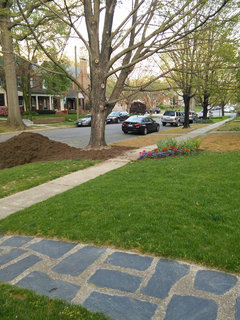
Bmelz, maybe you'd like to see how awful creeping red fescue is in Virginia. Here is a photo of my front yard looking toward my neighbor. All he has is creeping red fescue and weeds. The creeping red fescue was green until a couple weeks ago and now it's dormant and will be brown until October. The mulch is my project for the week. Not used to all that much physical labor! I got 15 cubic yards, most of it going into backyard beds.
bmelz
Original Author9 years agoReally ? What's the point if it's gong to be brown/dormant till October?
- 9 years ago
The neighbor never does anything to his lawn and CRF is what survived. I'll give it that, it hangs on when everything else dies. The problem, if he ever wanted to do something to get better grass, is he can't kill it with glyphosate until it comes out of dormancy. I used to have a lot in my yard close to his and I dug it out. There is still some there.
- 9 years ago
bmelz,
I'm terribly sorry, but due to an error on my part, I have needed to change the recommendations. Please see the bolded edits above for TSP and SOP.
Again, my apologies.
bmelz
Original Author9 years agonot a problem Ridge, thank you for the update. I should be picking up all supplies and getting started this weekend.










User