Software
Houzz Logo Print
amcdonal86

Soil Retest-need advice!

9 years ago
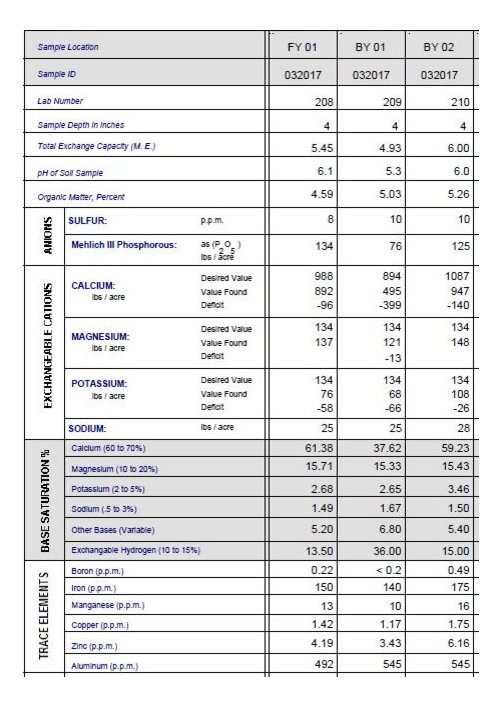
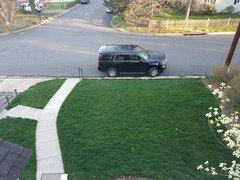
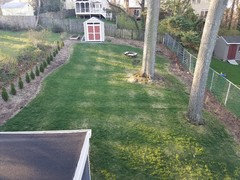
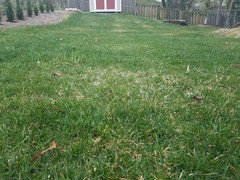
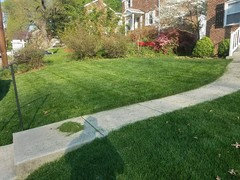
I renovated my lawn in the fall of 2015 with 100% elite KBG varieties. The front yard is doing tremendously, but the back yard looks kind of thin and weedy and never really took off.

I just had my soil retested, and I have the results here:


For reference here is my previous post.

http://forums2.gardenweb.com/discussions/3304796/need-help-with-lawn-renovation-in-northern-virginia?n=64


Thanks for any help you can provide!!


Comments (22)

  • 9 years ago

    Looks like beckyinrichmond and dchall helped you before. They're both active.

  • 9 years ago

    VA Tech did the 2015 test? I guess you followed Morpheus's recommendations for fall of 2015 and spring 2016. Logan has your cation exchange numbers lower than VA Tech. It usually doesn't change. It's on the low side in both tests, meaning your soil has limited capacity for holding nutrients and you just have to add them more often. Also it takes less product to make a change and the changes are short-lived. So in general you should spoon-feed nutrients: small amounts often.

    Backyard 01 could use another application of lime. Using 9 lb of a quick acting lime like before is fine (don't go over). The other two areas are okay. You could add a bit to them but they are already in a good pH spot and you don't want pH to go over 6.5. I'd leave them alone (on lime). Phosphorus and potassium are low. Do you like using Milorganite? That would supply nitrogen and phosphorus. You could do an application in early May and then a couple in the fall. Do them while the soil is still warm and microbes are active. Some people use it in summer too but the summer is such a stressful time for grass here, I leave it alone (applying only water as needed). If you still have SOP, you could do a small application this spring and then in early September and early October (1 lb/K). The last fertilization of the year should be a quick release nitrogen after the grass has stopped growing but before the ground freezes.

  • 9 years ago

    Your boron in FY01 and BY01 is low. Morpheus would have recommended some borax mixed with Milorganite as a carrier. Do a Google search of "boron Milorganite" and you'll come up with one of his threads that describes how much to use and how to mix. Morpheus, by the way, is not posting here now. Hopefully he will return. Ridgerunner is better qualified than me but he seemed to indicate dchall or I should do this one and dchall doesn't do interpretations so I gave it a shot. If you do Milorganite for N and P, use a higher rate than bag rate. Bag rate usually supplies about 3/4 lb of N. Aim for 1 lb of N per application. What is NPK of Milorganite? I just looked and it could be 6-2-0 or 5-2-0. Divide the N number into 100 and that gives you how many pounds per K to use. That's not going to be a lot of phosphorus. Starter fertilizer wil have more. Maybe do one application of starter fertilizer and the others Milorganite. If you might be overseeding in early fall, that would be a good time to use starter.

  • 9 years ago

    I've found another (arguably easier and better) way to apply boron using sand as a carrier. Use 4-5 cups of sand and 3 tablespoons of borax per thousand sq ft . Add the slightly moistened sand to a can/plastic container, then the borax and mix. Because the grain size of the sand and borax are similar they will mix very well, and the borax will also stick to and coat the moistened sand. Then just walk the area sprinkling the sand out of your hand, takes about 5 minutes to spread and should result in more even coverage than the milorganite method.

  • 9 years ago

    Your back yard may be too shady for the KBG varieties you are using. All the pictures you posted were taken with the sun low in the sky. Does it get much shade from those tall trees during the day?

    Did you follow through with monthly apps of Milorganite?

    Did the mossy areas clear up?

  • 9 years ago
    Thank you all for your advice. BY01 needs lime, is that 9lbs per 1000sf? or just 9 lbs total?

    Since 2015 I had the two southernmost large oak trees taken down so I think most of the backyard is getting plenty of sun. However, now the problem back there seems to be that the slope of the yard combined with the hot afternoon sun in the summer (and perhaps the calcium deficiency) is making grass hard to grow in spots.

    Last year I did 72 pounds of milorganite every month throughout the growing season until about October when home depot stopped selling it. I also did occasional treatments with Tenacity (I have noticed a moderate poa annua problem this spring in isolated spots) and it looks like the back yard is very weedy but not as bad as last year because I applied weed b gon last month. I may do another application today.
  • 9 years ago

    Sorry about that. Yes, 9 lb per 1000 square feet, not 9 lb total.

  • 9 years ago
    last modified: 9 years ago

    I changed my mind. Some lime for the other two areas would be good. You're in the okay range (between 6.0-7.0 pH) but at the lower edge. My thinking had been that some of the lime you put down in 2015 and 2016 would still be hanging around. I didn't want to recommend lime and then you jump to over 7.0. But now I thinking I don't want you to drop under 6.0 and there is room to add some lime. Maybe you'll end up in the sweet spot of 6.5. The Encap label says add 6 lb/k at pH 6.0. So maybe do that for FY 01 and BY 02 or just a tad less, like 4-5 lb/k. You weigh stuff, don't you? I use my bath scale. Stand on it holding an empty bucket and get my weight, then put material in the bucket and weigh myself again holding the bucket.

  • 9 years ago
    last modified: 9 years ago

    Becky,

    Lime recs based on reported VT buffer pH:

    Edit:

    Sorry, Wrong link

    http://soiltest.vt.edu/content/dam/soiltest_vt_edu/PDF/lab-procedures.pdf

    Right one (see chart pg 94):

    http://soiltest.vt.edu/content/dam/soiltest_vt_edu/PDF/recommendation-guidebook.pdf

  • 9 years ago

    Se Edit above.

  • 9 years ago

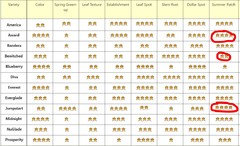
    As you soil folks push towards nutrient availability nirvana at pH 6.5, there's another thing to consider in KBG lawns: summer patch is most severe at 6.5 and higher. A more acidic soil (say 6.0) can greatly reduce the severity of the disease. Another factor to think about in the grand scheme.

  • 9 years ago

    Ridgerunner, what would be your recommendation? I looked at the VA Tech booklet (thanks!). in 2015 VA Tech said amcdonal's soil had a buffer pH of 6.03 so they likely recommended 125 lb of lime per K (no more than 50 lb/k per application), if they went with the target of 6.5 pH. Morph recommended 18 lb/k of Encap or MagiCal in two applications (fall 2015, spring 2016) and I guess amcdonal did those. You do use less lime with the faster acting limes like Encap (quicker change but probably not as long lasting). The Logan test doesn't give a buffer pH. What would you recommend as a target pH and how much of what kind of lime should he use? VA Tech calculates a lime credit for lime applied in the past two years. How much lime credit should he get for his 18 lb/k of lime in 2015 and 2016? I'm not very comfortable making specific recommendations and I'm not going to jump up volunteering to give reads on soil tests (I was sort of pushed into this one). In my opinion we should stop saying post your soil test and we'll tell you what to do--people should use their state university lab or something local and follow the recommendations given. But Logan Labs has been pushed as a good lab to use and they don't give recommendations with the test results, so what are people to do?

    Thanks J4 for the summer patch warning. I have tall fescue so brown patch is my problem. Never had to deal with summer patch.

  • 9 years ago
    last modified: 9 years ago

    I don't want to run you off, but I intend to push you. You've got a good knowledge base, an interest and I think the desire. Don't be so timid. Make recs and If it would help, tell people to wait until I give the "ok." I think you've got a tough enough skin for constructive "criticism" and it wont take long for you to get the hang of it. :) But tell me to back off and I will.

    Before we can help the OP with any lime recs we need to know what he applied, how much, when and when the soil samples were taken. Even then we'll stay conservative and cut the calculated amount in about half. Like 50-60lbs for the year. To be determined later.

    Yes "fast acting" limes are only faster because they are ground so finely that they dissolve faster (unless they cheat and add calcium oxide which some DO) so a little reduction in max single app rates is prudent to reduce adverse nutrient and microbe health problems.

    j4c11,

    So, you'd recommend diabetics avoid treatment as studies have shown a reduced incidence of ingrown toe nails post amputation? :) :P

  • 9 years ago
    last modified: 9 years ago

    @rdigerunner

    I believe your analogy is faulty. It illustrates a situation where one would perform an action with potentially devastating consequences in exchange for very little gain. That would be an irrational act, as the benefit-cost ratio is very low. Whereas what I'm proposing is the opposite, that you give up a small increase in nutrient availability - an action with very little negative consequences, in exchange for increased resistance to a potentially devastating disease. This has a high benefit-cost ratio. Nice looking straw man though :-)

    A more accurate analogy would be taking half an aspirin or a blood thinner to prevent a stroke. There's some minor inconveniences, but the upside is huge.

  • 9 years ago

    Here's some info on summer patch and its relation to pH:

    http://archive.lib.msu.edu/tic/gcnew/article/1992nov15.pdf

    http://www2.turffiles.ncsu.edu/PDFFiles/004201/Summer_Patch.pdf

    Personally I'd start by researching the genetic resistance to summer patch of the KBG cultivars. If they have high resistance to brown patch, lime away. If not, I'd apply some lime in the BY 02 area and no lime in the other two areas. I stopped liming my yard (which tested at 6.2 last year) for the very same reason.

    amcdonal86 thanked User
  • 9 years ago

    OK Becky.

    j4c11, I didn't spent much time composing that. I just wanted to yank your chain. :) BTW, Did you read the paragraph about nutrients and summer patch in the link you posted?

    amcdonal86 thanked User
  • 9 years ago

    I just wanted to yank your chain.

    Forum is full of trolls I tell ya' :-)

    Did you read the paragraph about nutrients and summer patch in the link you posted?

    It's a given that if a plant is weakened from nutrient deficiencies, it will succumb to disease more easily. But I don't think you can really talk about low pH induced nutrient deficiencies at 6.0-6.2.

  • 9 years ago
    last modified: 9 years ago

    Thanks for all the feedback, guys. I believe I did do two applications of lime (a total of 18lb/K of Pennington Fast Lime in Fall of 2015 and Spring of 2016). Last weekend I put down about 9lb/K of lime in BY01 and approximately 2lb/K of lime in BY02 and FY01.

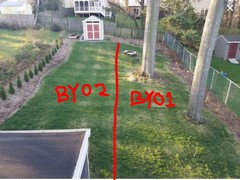
    FY01 is pictured below--looking very nice and almost completely weed free. BY01 and BY02 are a different story, but they also seem to not have come out of hibernation quite yet (whereas FY01 never seemed to go to sleep in the winter).

    Do I need to apply more lime or should I be OK now?

  • 9 years ago

    Also, the varieties of KBG I have are approximately in equal proportion: Award, Bewitched, Sudden Impact. Bewitched doesn't seem to have very good summer patch resistance, but the other two do.


  • 9 years ago

    amcdonal86,

    This is starting to get way too muddy. In addition to the following issues, you're shooting first, then asking questions.

    The 2015 VT was two tests, I can't tell what area each was for.

    Your new test is for three areas, FY1--got it, but why BY1 and BY2, I'm assuming that it was broken into two tests due to some visual difference.

    If you didn't use proper sampling methods, results could be misleading and there is no basis provided as to why there may be such a pH discrepancy for BY1.

    The best thing as things currently stand, is to make lime additions for BY1 only based on the buffer pH provided by the VT test. Total recommendation is approximately 110lbs/k of 100cce AG lime for a 6-8" depth. Ignoring CCE adjustment, I'd adjust to a 4" depth, so 74lbs/k total lime. To reach the 6.2 target: Apply 74lbs/k minus total amount of lime you have applied since the VT test. 74-45lbs?=29lbs/k more this year. With fast action lime, apply an additional 9lbs/k now and 20lbs/k this Fall to BY1. For the rest of the yard, 2lbs/k wont do much, try 5lbs/k or an additional 3lbs to the 2 you did.


  • 9 years ago
    last modified: 9 years ago

    Ridgerunner, you are correct--the only reason I split up BY01 and BY02 this time is because of the visual difference. BY01 has two large oak trees (two oak trees had been cut down since the VT test) that compete for water/nutrients. BY01 also is sloped quite a bit which I think may be causing a lot of the lawn products to simply run off.

    I'll have to check my records to see how much lime I have applied since the VT test.


Sponsored
Peabody Landscape Group
Average rating: 3.5 out of 5 stars8 Reviews
Columbus' Reliable Landscape Design & Contracting