Software
Houzz Logo Print
ben_schley

Any ideas on type or age?

9 years ago
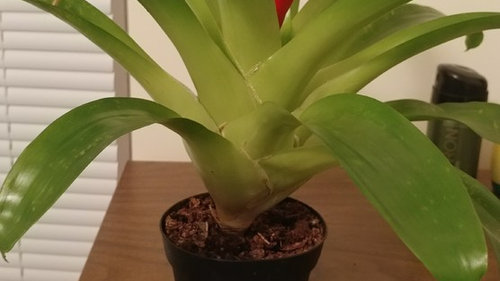


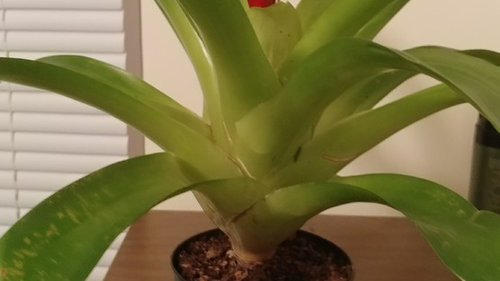
I just bought this bromeliad at Walmart this week. It is the first plant I've ever owned, so I've been trying to do my research but I'm sure I'm still sorely lacking. I would greatly appreciate any help anyone can give a beginner.

I was wondering if anyone has any insight into what type of bromeliad this is? As far as I can tell, the closest thing I've come across is a Vriesea, but I have no idea if that is correct. The tag and item description from walmart just said "Bromeliad" and nothing else about the type of plant. I would like to have a better idea so I can get more solid ideas on what conditions it needs.

The other thing I was wondering was if anyone could tell me how close to blooming it is. I've read about the life cycle, how it only blooms once and then grows offshoots, so I was just curious if it was possible to tell how close to blooming it is, and how much longer it will be alive.

It does have spots on the leaves, and one of the leaves I think is in trouble. That is partially from what was present when I bought it, and what happened when the walmart employee put it in a bag and bent the leaves.

I can add more pictures if needed.

Comments (2)

  • 9 years ago
    last modified: 9 years ago

    I would guess Vriesea as well. It blooms on that red bract growth. The actual flowers are likely not very interesting. It's the red bract spike that is the 'main event'.

    As for care, much information can be found online. I would just say that the more sun it gets indoors, the more humidity it will need. Better to keep in lower light indoors. Keep water in the 'cup'. Soil can be allowed to dry out quite well between watering, in fact you don't really need to worry too much about the soil -- just don't keep it wet-wet. You can feed the plant in the summer by spraying with fertilizer-water diluted to a quarter of the recommended strength or less, in water, primarily spraying the leaves.

    I have one and it goes outside in a tree for the summer after nights are consistently mild (55+ degrees F), where it gets dappled shade - never full sun.

  • 9 years ago

    Hi everyone.

    Ben – Your plant is in fact a Vriesea and judging by what
    you say, it’s one of the many thousands mass-produced annually by tissue
    culture for sale as an alternative to cut flowers. These usually just have a
    generic name tag of “Bromeliad” and sometimes a few basic cultural notes on the
    back of the tag.

    These plants were originally mass-produced mainly in Belgium and Holland
    in their millions for distribution (in flower) to countries all over Europe where the outside environment isn’t suitable to grow these plants without an expensive temperature
    controlled green house. This idea eventually spread to many other countries around the world who are now "doing their own thing", such as U.S., Australia, China and several South East Asian countries to name just a few.

    The idea is that you buy the plant as an alternative to
    a bunch of flowers; after the flowers have died and the bract colour has faded,
    the plant is tossed in the bin and a new one purchased. This is a much more
    attractive financial proposition than
    buying a bunch of flowers as the bract colour of these plants usually lasts
    several months as opposed to the life of cut flowers which is just a couple of
    weeks.

    Your plant is one of the two different main types of
    Vrieseas and is the plain leaf type that is sold primarily for the flowers. The
    other type that does not produce showy flower spikes usually has interesting
    foliage and is commonly known as patterned foliage Vrieseas. It is rare that a
    Vriesea would have both unique foliage and a distinct flower spike.

    The sites below have some basic information about your
    type of Vrieseas and the type of care required.

    http://www.bromeliads.info/bromeliad-vriesea/

    http://www.balconycontainergardening.com/plants/220-grow-care-vriesea-bromeliad

    As for your other question about blooming, it’s a bit
    hard to say as each plant is an individual; but to complicate the issue even
    further, with these mass produced plants, they have been treated with either a
    liquid or gas to make them come into flower at a specific time (usually to coincide
    with special days such as Valentine’s Day, Mother’s Day etc. and because this
    causes interference with the genes of the plant things don’t occur as they
    normally would if grown naturally).

    Just looking at the development of the bracts on your plant,
    and based on what I’ve experienced with these types of plants myself, it seems
    to have a bit more growing to do yet; but just how much is hard to say. This is
    due to the fact it has been chemically manipulated which as well as speeding up
    flowering, can also sometimes cause problems within the natural development and
    the blooming time of the actual flowers
    by sometimes slowing down the flowering time or even sometimes producing
    deformed flowers.

    The main selling point of these plants are the colourful
    bracts; these aren’t the flowers as many people believe, the flowers will
    appear one or a few at a time along the length of the bract (See pictures below). They do come in different colours although the main colour is usually yellow.


    The flowers themselves are short lived and only last for
    a couple of days or so, after which they die and change to a dirty grey colour
    and then to black which detracts somewhat from the bract colour. (See picture below)


    To keep things
    looking tidy, it is possible to “pluck” these dead flowers from the bracts with
    a small pair of forceps; it doesn’t harm the plants and does improve the
    appearance.

    As for the spots on the leaves, we really need a picture (or
    several), preferably close-ups so that we can give accurate advice on whether
    it’s just some sort of physical damage or perhaps an insect pest.

    One final piece of advice; never leave your plant standing in a saucer of water as it will
    cause the potting mix to become water-logged and possibly start your plant
    rotting.

    All the best, Nev


    Ben thanked splinter1804
Sponsored