Software
Houzz Logo Print
conifer50

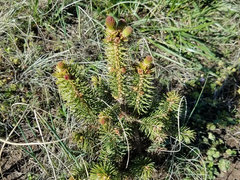
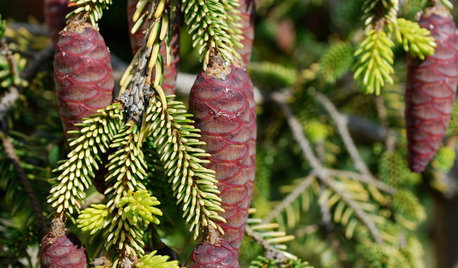
Abies species?

9 years ago
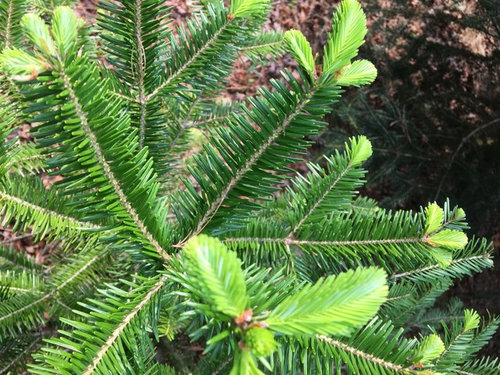

Supposedly found close to China/Russia border near tidewater.

Seems to break bud early!

Comments (19)

  • 9 years ago
    last modified: 9 years ago

    Yeah, if it's a current pic, it's still cold on that border. You can see where the Russian/Chinese border is on the Pacific below:

    http://www.natice.noaa.gov/pub/ims/ims_gif/DATA/cursnow_asiaeurope.gif

    So, since you're the expert, tell us what fir (or spruce) grows there?

  • 9 years ago

    Supposedly purchased as Abies nephrolepis "plugs" from "Tree Haven" quite a while back!

  • 9 years ago

    OK, it's in your garden.....

    I think it's pretty early even for north GA. My A holophylla got zapped by a late freeze here last mid-May!

  • 9 years ago
    last modified: 9 years ago

    I'm glad I got some stuff from treehaven when I did. The seemingly random deaths I'm seeing now with various high elevation Pinaceae/Abies suggest there's a variable genetic component to root rot susceptibility in Eurasian species. Versus a not very random, pretty consistent susceptibility in western US ones!

    So for example...all the western ones I tried from him die, but, for example, all of the Abies alba, 4 I think, are still going. 1 out of 3 purported Abies delavayi died...they are right next to each other so I would presume the root rot organisms were present for all 3.

    Do you see a similar varability conifer50? Your soils may not be as infested with root rot organisms as mine. According to a now deceased old timer/neighbor, the people who owned my house in the 50s-60s were also into horticultural, and spent a lot of money bringing in nursery specimens. Which would have brought all of the cosmopolitan species of Phytophthora in, too.

  • 9 years ago

    beng12; A holophylla has always been a problem for me because it seems to always break bud earlier than any other Abies I've Grown!

  • 9 years ago

    david 28; I don't know that any Abies species I've experimented in a attempt to grow was/is victim of disease or just lack of being adaptable to different growing mediums...soil types and moisture vary considerably

    Black Bears have destroyed many of my rarest conifer specimens with Abies being the species of choice!

  • 9 years ago

    What kind of soil do you have conifer50? I'm surprised that you could grow so many firs in Georgia. What firs would you say do the best there? Just for fun anyone what to guess what tree this is?

  • 9 years ago
    last modified: 9 years ago

    FWIW, North Georgia at altitudes just above 1500' has summer nights cooler than coastal New Haven, CT. So it's not too surprising things like ironclad rhodies or certain tougher firs can grow there.

  • 9 years ago

    Does Fraser Fir typically do well in mid Atlantic garden settings? I know it's native to the region, but I'm curious how it does when taken out of the benign conditions it naturally grows.

  • 9 years ago

    "Fraser Fir typically do well in mid Atlantic garden settings"

    no not at all, only in the mountains

  • 9 years ago

    Mmm, there must be some similarity between our climate and the mountains of eastern U.S. Similar climates; much different views. Fraser does very well here.

  • 9 years ago
    last modified: 9 years ago

    It's not as though your summers are as cool as England or Seattle...but the summer averages are just a little lower up there, enough to keep the peak soil temps lower. I suspect you are less likely to have ridiculous deluges of rain from tropical storms: those are what often finishes off rot sensitive plants for me. For example, one Sept. there was 14 inches of rain in 2 days, which killed a beloved Eucalyptus lacrimans. Hot, wet soil lets phytophthora thrive. I'm have some success with should-be-very-difficult rhododendron cultivars here now, experimenting with merely growing them on mounds of builders sand. So...also could be soils too...if they have clay soils up there, hard to believe they are the same composition as the muck red clays found in the southern part of the mid-Atlantic like the DC area and NoVA. I'm right on the dividing line between those soils and the better silty/shale clays of SE PA and the Delaware Valley. (but mostly having the latter, fortunately - both based on what I observe and what the USGS soil maps say I should have) But the openness of the soils is probably tied to ability to remain oxygenated, which somehow helps avoid phytophthora. Maybe if I built an enormous sand mound, I could grow an own-root fraser fir!

    But why bother...if I really wanted one, just graft onto Abies firma which need reasonable draining but doesn't mind heavy soil and hot summers. My Abies procera grafted onto Abies firma is doing fine, albeit growing slowly because it is variegated. I think plain seedling Abies procera would quickly perish here, because that's what happens to all the other western firs I tried on their own roots.

  • 9 years ago

    Yup, it can get warm and humid here, but not nearly to the extent you have. Evenings are generally cooler as well, which would help to keep soil temps lower. The odd thing about rain is we've seen some very unusual deluges over the past five or so years. The Duluth area received 17" over a 24-hour period, which did extensive damage. This has occurred too frequently throughout the region over the past few years, which is hopefully a short-term phenomenon. A 4" rain used to be a big deal, but not so much anymore.

    I have sandy and sharply drained soils, which A. fraseri seems to do just fine with. This is perhaps the biggest surprise to me. It handles our droughty soils much better than the native A. balsamea. I don't know how far south before the increased air and soil temps overtake Fraser's ability to handle dry, sandy soils, but we seem to be in a sweet spot for this tree.

  • 9 years ago

    David, maybe you should try balsam fir. Maryland has a big one (assuming it isn't misidentified) on the grounds of Salisbury University?!?:


    http://www.mdbigtrees.com/tree_detail.aspx?tree=TR20130529201533320


    And one in Baltimore!


    http://www.mdbigtrees.com/tree_detail.aspx?tree=TR20121025212925183

  • 9 years ago

    Let me get this straight, A. balsamea doing great near coastal MD and A. Fraseri as well in sandy z4 WI? How bizarre.

  • 9 years ago
    last modified: 9 years ago

    Yeah, maackia, the balsam fir on the torrid MD coastal plain (and even in Baltimore) is a mystery to me too, unless it's a mussed ID -- easy to happen w/firs. There were large firs 80-90' tall at the Antietam Battlefield Cemetery (Sharpsburg, MD) labeled balsam firs which were obviously Nordmann and concolor firs.

  • 9 years ago

    Yeah I would be somewhat skeptical about the ID. They could even be hybrids with a Eurasian fir that is tougher. OTOH, the sandy soil on the eastern shore would help prevent root rot.

  • 9 years ago
    last modified: 9 years ago

    "So I wouldn't decide I was having complete success with a true fir until it had stayed healthy for quite some time."

    True...for example my lot had a somewhat large 45' Abies concolor that had lasted 45 years or so (rough count of tree rings) , but looked ratty or 'picturesque' for all of the time I owned it. The hot and alternately droughty/deluged summers of 2010, 2011 and 2012 finally finished it off...I was about to do so myself. But presumably it looked ok for the first 15 years of its life. Still incredibly unusual to see one this low in latitude and elevation on the east coast.