Software
Houzz Logo Print
aronstewart

Fertilizer and Topdressing Questions

9 years ago
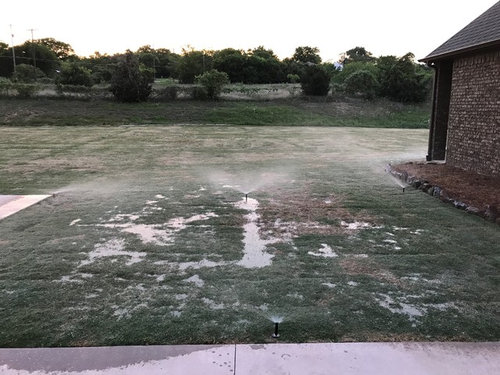
I laid about 50k sq ft of Tif 419 bermuda grass last October. I live in Aledo, Texas (North Texas)

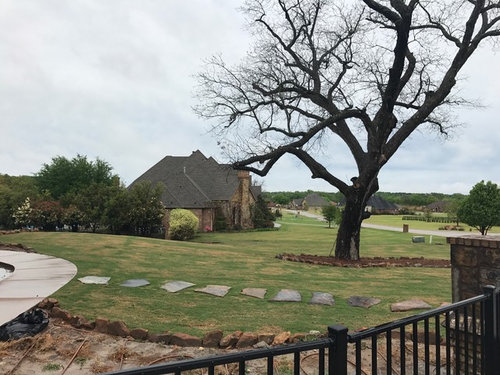
Our house is newly built and this is the first yard. We did an awesome job with the with final grade, but the irrigators did a terrible job of covering up their trenches so I have a lot of low spots where the trenches settled. I'd like to fill them in, but I don't know how. Not sure if I need to use some type of topsoil or just go with what my local material yard calls "topdressing sand" which is basically a sand with no clay content, or at least that is how it was explained to me. Here is a pic of one affected area. You can see where the water is collecting in the low trenches. So many people say different things about repairing these low spots it is hard for me to decide what to do.

I also have another problem. I had ALOT of weeds late winter/early spring since I was advised to not put down a preemergent last fall since the turf was so new. I used Round Up to kill those weeds.


That was a mistake!!!


I guess the turf was coming out of dormancy even though it still appeared to be 100% brown. The Round Up killed my new grass where I sprayed it. So now I have a lot of green grass, and a lot of dead spots. I think the dead spots will come back since there are hints of green turf poking through, but I have no idea how long it will take to recover. Is there some type of fertilizer that I could use to speed up this recovery process, or do I just need to wait?


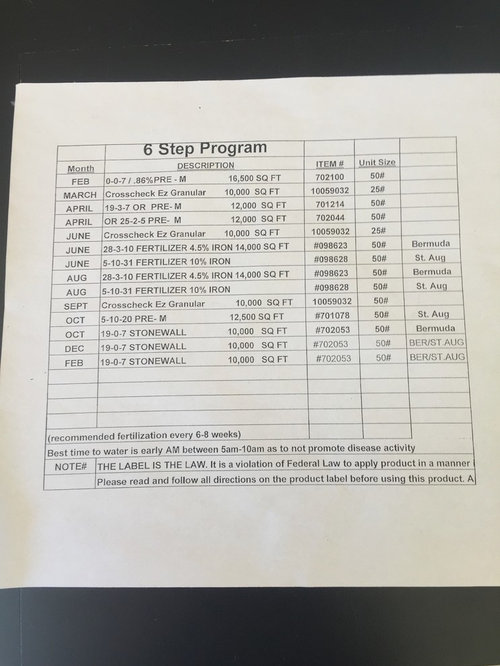
I have been purchasing fertilizer form my local Site One (formerly John Deere Landscapes). They have put me on a 6 step program. here it is...

I put down the 25-2-5 Pre-M on March 18th. They are not recommending another fertilizer application until late May/June. Could I hit the lawn with a fert that has a lot of nitrogen to help out with the dead spots? My local feed store has a 28-0-0 with 14% slow release nitrogen. Site one has a 32-0-3 with 2% iron but it is a fast release product. I'm wondering if I could apply either one of these ferts to help green up my brown spots. Then in June jump back on the 6 step plan pictured above.


I have been mowing 1x per week at 1" with a new John Deere zero turn I bought. Even thought the yard is bumpy I am not getting excessive scalping, although some is present in a few areas. However the ruts are large enough to make the mower ride VERY rough. In the next few weeks I will be buying a Tru-Cut reel mower. The goal is to keep the larger portion of the yard at 1" with the zero turn, but keep the areas immediately surrounding the house cut lower with the reel mower. I am also going to keep a 20x40 area in the middle of the backyard cut very short too so I can hit golf balls off of the turf. I am shooting for that golf course look... thick carpet-like turf.


What can I do to get my yard looking the best in the shortest amount of time? I'm new at this and need a little guidance. Any educated input would be appreciated.


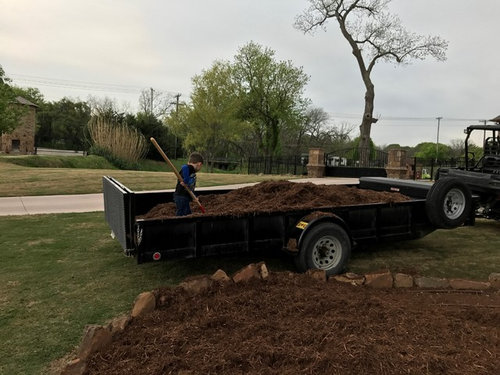
My yard is huge. Here are a few pics that were taken several weeks ago. I wish I had more. I'll post some later. these two pics are of the front yard. The first pic in this post is of the side of my house, but shows some of the back yard.


Comments (5)

  • 9 years ago
    last modified: 9 years ago

    First of all, and most importantly, DON'T use the Crosscheck EZ unless you see insect damage. Your soil absolutely relies on a healthy population of beneficial insects. Most people go for decades without using any insecticide, so they are just trying to sell you stuff. I'm going on 50 years and 8 different lawns without ever using an insecticide. If you wipe out all the insects three times a year, every year, your soil will really suffer. There are ways to inspect to see if you have insect problems. Otherwise the rest of that program looks okay. The exact numbers of the fertilizer could be tuned up by getting a soil test ($25 at Logan Labs in Ohio, not TAMU). That test will help adjust the P and K numbers. If you get it, post the results as a new topic here for more advice. Bermuda, especially excellent bermuda, needs lots of nitrogen on a monthly basis. I would delay the first Pre M application until at least the end of Feb. Usually we apply that stuff when the forsythia bloom in the neighborhood. Forsythia is a natural indicator of spring green up and future weeds. This winter the forsythia did not work for many because of a warm Feb followed by a cold March.

    Secondly, and this would have been first if you didn't have the Crosscheck thing there, That's a great setting! Beautiful. Too bad about the sprinkler goof up, but it can be fixed. You are going for the ultimate turf, so get ready for some work.

    Bermuda sprayed with RoundUp seems to take longer to recover than it should. Just be patient and it will come back, but watch for weeds. Spot spray broad leaf weeds any time with Weed-b-gon or Weed-b-gon Chickweed, Clover, and Oxalis Killer or equivalent. Hand pull grassy weeds from now on.

    What you want to do is called leveling the surface. You are not necessarily making it level, but you are smoothing out the holes. Golf courses are not level, they are profiled, but we call it leveling. It requires a little equipment and a lot of sand. I'll explain it and you can decide whether you want to do it yourself or hire it out. First wait until late June when the bermuda is growing fast. Then fertilize and water deeply. Mow it as short as you can - less than 1/2 inch (scalped) is good. Spread sand and drag that around with a drag like they use on baseball diamond infields. You can make one with a 2x4, rope, and some chain link fencing. Drag that around either by hand or behind your riding mower until you are happy with the surface. It should be absolutely perfectly profiled. Then water it lightly to settle the sand down into the holes. Low spots will appear. Let the water drain a little and add enough more sand to fill the low spots. Water again to settle it. New low spots will appear. Sand, drag, and water until you are happy that it's not settling any more. Then leave it alone. The grass is already moist and fertilized, and it won't need to be mowed for the next month, so leave it to grow up through the sand. The people who have done this have been ecstatic with the results. And then they become absolutely nuts about minor imperfections in their lawns. Sometimes they will redo the entire leveling process to fix that last imperfection. I would caution you to wait at least a year to see if the entire yard continues to settle. Generally disturbed soil takes 3 full years to settle, so you might see those sprinkler pipe trenches reappearing over time.

    You seem to understand mowing and fertilizing. Here's more on watering.

    Watering: Deep and infrequent is the mantra for watering. This is for all turf grass all over the place. Deep means 1 inch all at one time. Put some cat food or tuna cans around the yard, and time how long it takes your sprinkler(s) to fill all the cans. Memorize that time. That will be the time you water from now on. My hose, sprinkler and water pressure takes 8 full hours to fill the cans. Your time will likely be less. I like gentle watering. As for watering frequency, that depends on the daytime air temperature. With temps in the 90s, deep water once per week. With temps in the 80s, deep water once every 2 weeks. With temps in the 70s, deep water once every 3 weeks. With temps below 70, deep water once a month. Note that you have to keep up with quickly changing temps in the spring and fall. This deep and infrequent schedule works in Phoenix and in Vermont, so it should work for you. The reason for deep and infrequent is to grow deeper, more drought resistant roots and to allow the soil to dry completely at the surface for several days before watering again. If it rains, reset your calendar to account for the rainfall.

    One more thing...I would either add a dose of organic fertilizer or substitute organic fertilizer for one of the chemical fertilizers at least once a year. The organics helps keep those beneficial insects and other microbes healthy from year to year. I have gone completely to organic fertilizer. My favorite is alfalfa pellets (rabbit chow) with ordinary corn meal a close second. The application rate is 15 pounds per 1,000 square feet. Other people like soybean meal and/ore Milorganite. You can get it all at your local feed stores.

  • 9 years ago

    Both my brothers in law are from Aledo, believe it or not! Sand is the ticket for levelling, any nitrogen will green it up & I'm jealous because my golf pad is nowhere near that big... I have a 6.5 horse 20" 7 blade mclane for sale cheap if you're interested in trying a cheaper version before a tru-cut. I can meet ya half way in Waco? Anyway, congrats on all that bermuda!

  • 9 years ago
    last modified: 9 years ago

    Thanks for the replies!

    So is there any disadvantage to using the quick release fertilizer I have purchased? I know most guys recommend a slow release, but I'm not sure I fully grasp the difference.

    The dead spots from the round up are killing me. Is there anything I can to to help them along? Maybe fill them with a rich topsoil or something?

    Here are some pics...


  • 9 years ago

    At this point all you can do is suffer. Round Up is a serious herbicide. The TV ads make it look easy to use and good for any purpose, but it should be used only for very specific reasons. In the future if you want to kill grassy weeds in bermuda, either hand pull them or mask the surrounding grass to protect it from overspray. If you have broadleaf weeds like dandelion or clover, use a product like Weed-b-Gon or Weed-g-Gon Chickweed, Clover, and Oxalis Killer.

    Bermuda can use all the fast release fertilizer you can give it, so use it. Water it in after you apply so the morning dew does not cause it to burn the blades.

  • 9 years ago

    I use fish fertilizer to speed up regeneration of dead spots. A gallon of Alaska brand from Lowe's will last you a long time, spray as often as practical & the green will be back quickly. Be careful putting soil on those spots, if it's not dead the soil may shade it out but if it is dead, the new soil will help the surrounding Bermuda spread & fill it in--double edged sword there...

    For herbicides, never ever ever use roundup, even when the bermuda is dormant. Now you know why. The 2 best herbicides for Bermuda are sulfentrazone (grassy weeds and crabgrass) & 2,4d based products (broadleaf weeds) but the 2,4d product should be used at half strength or you will get damage. I actually prefer to hit everything with sulfentrazone first as it kills some broadleaf species, then follow up with a spot spray of broadleaf killer only on the survivors. In your case, that may not be practical so if you decide to blanket spray 2,4d, do it at quarter strength or less. A good pre emergent will be your best friend, probably prodiamine WDG is most cost effective for your lot size. The cheapest sulfentrazone product I've found is ortho nutsedge killer, its .05% & can be diluted further to cover more area. 2,4d is easily found in most 3way mix herbicides