Software
Houzz Logo Print
hairmetal4ever

Soil and ph

9 years ago

So…first year growing tomatoes in the ground at the new digs.

My concern is the soil, mostly the pH. Soil test revealed an overall pretty good soil, with the only deficiencies being a moderate calcium deficiency, fairly severe Phosphorus deficiency, and the pH being low at 5.2.

I’ve got some compost (purchased, finished) to turn in, plus calcitic pelletized lime and bone meal, plus, I’ll use a high P granular to side-dress with.

However, the lime won’t work immediately. My understanding is that it’ll take a year to fully work, and won’t make noticeable changes for at least a month. So if I plant my tomatoes in a soil that is initially too acidic, will they do OK as the pH will improve over the growing season? Also, if I add about 20% by volume compost, which has a pH of 7.3, will that have a noticeable (even if temporary) effect on the native 5.2 pH in that soil?

Soil is a loam that leans almost towards the sandy side a bit, and is, if anything, almost too well-drained.

My other idea was to buy some commercial bagged “topsoil” or “garden soil” and make holes about the size of a 3-gallon pot and fill them with the bought soil, and plant the tomatoes in that. I realize the roots will eventually extend beyond that, but by that time, hopefully the lime will have had at least some effect. I’m not worried about drainage issues or the “bathtub effect” of putting a different soil type inside my native soil in a “bowl,” as my native soil drains extremely well. To the point that, one day after a 3” rain, it’s quite moist, but very workable and not “mucky” or saturated.

I don’t have the time, energy, or resources for raised beds at this stage of the game, nor do I think they will be necessary going forward. So growing in-ground, how will I likely fare?

Comments (11)

  • 9 years ago

    Formally, tomatoes are known as an "acid soil loving plant". As in, pH 5.5-7. That being said, my soil is pH 8.3, and my tomatoes grow like crazy. So you might want to avoid overthinking it, and just plant tomatoes and enjoy. The phosphorous deficiency is more serious than the pH. Fruit yield goes way down with low P. Look for purple-tinged leaves. Compost will help.

  • 9 years ago

    The compost pH comes from the testing done on that particular brand (it’s LeafGro, produced in Maryland from curbside leaf pickup), so I’m pretty confident on the accuracy.

    I do have some woodash in our fireplace, I can try that. It’s probably not enough for the entire garden, though.

    In hindsight, I wish I would have tilled in some lime at least last fall. We bought the house last spring, and were so consumed with doing stuff INSIDE the house (the house was built in the 70s and never renovated) that we didn’t do much outside until just now.

    Dan – I’m not that far off from the 5.5 minimum pH for tomatoes, so I might eek by just from the initial effects of compost, etc, plus some wood ash.

    I will say the broccoli I planted (which is more acid-sensitive than tomatoes) is doing great so far, with just the compost, lime, bonemeal, and some Shake n Feed that was turned in only a few days before I planted out the transplants. It’s been about a month since then.

  • 9 years ago

    From What the labs have indicated to me, pH of 5.6 up to 7.2 is ok for tomatoes. But like most garden vegetables a pH of 6.7 ( +/- 0.2) is perhaps optimum.

    I agree with PC on wood ash. Not only its effect is immediate , it also is rich in K, P, Ca,.

    Other amendment I recommend is Dolomitic Lime, also called quick acting lime. That is what they use / recommend for container growing with plain soil less mix.That is also a good source of Ca and Mg.

    Now it might be a difficult task to amend a large garden. What you can do is to amend the planting holes, one by one. Then at the end of season do the whole garden and let it rest over the winter. JMO

    Sey

  • 9 years ago

    I'll say it again. I have pretty alkaline soil, and my tomatoes grow fine. My 8-foot tall (and growing fast) cherry tomatoes will argue that for me, as well as my 6-foot Big Beefs. Don't get distracted by pH. Your problem is P.

  • 9 years ago

    Dan, what is the pH of your soil ?.

    Like I said before, my main garden pH was reported @ 7.2, I think. And they did not recommend anything to lower it.

    The only recommendation I got was to add something like 21-0-0, since P and K is in abundance but N was too low. . This is in NC. In WA state, last year their literature said pH 5.6 to 7.2 if fine for tomatoes.

    Sey

  • 9 years ago

    Most plants will tolerate a pretty wide range of soil pH but have a preferred range. The preferred range for tomatoes is, as mentioned above, quite broad - 5.5 -7.5.

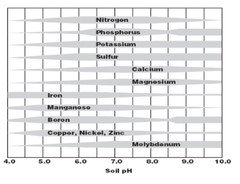
    The linked chart provides the preferred range of pH for a variety of vegetable plants. But when in doubt, a slightly acidic soil (6.0-6.8) will work for just about anything. And if you can assess and provide the nutrients that may not be as available with an improper pH, you can get by growing them outside their preferred or even tolerated range. But that gets a lot trickier :-))

  • 9 years ago
    last modified: 9 years ago

    My garden soil is upwards towards pH of 8. My tap water is pretty alkaline as well so, since that is used for irrigation, soil acidification is like spitting into the wind. I don't grow blueberries. So what is supposed to happen to tomatoes in alkaline soil? Stunting sure ain't it for me. Everyone says to acidify alkaline soil for tomatoes (without saying why) but, sorry, I just don't see it.

    It is certainly the case that in alkaline soil, P, Mg, and micronutrients can become less available, but that's an issue not just of pH, but also of soil nutrient content. A blanket statement that high pH is bad for tomatoes may be simplistic. My soil happens to have high P and Mg.

    P.S. This, I fear, is one of those gardening "rules" that is a "rule" just because everyone says it. Over and over. But the reason for the rule, or the study that establishes it, is lost and forgotten about. Lots of "rules" like that, I'm afraid. It's a rule-by-repetition. Some skepticism about rules-by-repetition is justified. I'll bet there are good reasons why acid soil is good for tomatoes, but I'll bet they are loaded with caveats.

  • 9 years ago

    Let me add that, re availablility of soil nutrients, there is a nice plot in http://www.soils.wisc.edu/extension/materials/fert_mang_tomato_pepper.pdf.

    There is, it can be seen, a "happy range" of soil pH from 6.5-7 where major nutrients have maximum availability. So sure, everyone should shoot for pH 6.5-7 if all of these nutrients are important, and if you don't have a clue how much of these nutrients your soil has. Yes, I should be fighting iron chlorosis, if all I knew was this chart. But I'm not. The caveat is that my soil has plenty of ionic iron.

  • 9 years ago

    Like Dan my native garden soil is very alkaline at 8+ but we've been growing in it for 50+ year and the only truly noticeable issue is low potato production and the low-magnesium symptoms I get now and then.

    I pull it down with as much compost as possible.

    Dave

  • 9 years ago

    Let's back up. I don't want to hijack this thread. My point to the OP is that the issue to work here on is phosphorus. Let's not get distracted by a pH that one could assert is slightly non-optimal.

Sponsored
Landscape Management Group
Average rating: 4.9 out of 5 stars33 Reviews
High Quality Landscaping Services in Columbus