Software
Houzz Logo Print
njpsychdr

skip laurel care

9 years ago
last modified: 9 years ago
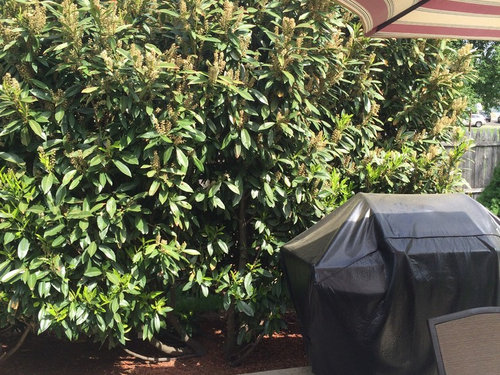
You can feed Schip (Skip or Schipkaensis) Laurels as you would most other evergreen shrubs. I fertilize laurels after they bloom in spring with a well-balanced "shrub and tree" or "azalea, camellia rhododendron" type fertilizer. If you have a deer problem consider using Milorganite fertilizer. It works great, is totally non-burning, and repels deer. I always use a granule fertilizer as opposed to a liquid water soluble one. Follow instructions on the product label for application methods and rates. A late summer or early fall feeding can be done if the foliage looks a little lighter green than it should. Sometimes I might supplement with chelated iron or soil sulfur if the leaves are very pale or yellowing.

Spread the fertilizer around the perimeter of the plant as this is where most of the feeder roots are. If there is thick mulch you might want to rake this back to apply the fertilizer on top of the ground, then replacing the mulch. Mulch should be no thicker than two inches and be kept a few inches away from the trunk of the plant.

Comments (10)

  • 9 years ago

    I live in a wooded area of southeastern PA and it is well known to all landscapers. Garden nurseries such as Snipes in PA, or in NJ Vincentown Nursery that sell the varieties of laurel (though most prefer the easier Schipkaensis laurels, that annual fertilizing of the shrubs is recommended in Spring to maintain as well as to promote good foliage and growth. Winters here are not exactly a predictable trend, and even this past season, the leaves in some of the middle sections have turned brownish or yellow. The plants are not completely deer-proof even after they get dense and quite tall. So my posting is based on my own experience as well as those professionals whom I have been in contact with. The soil can be whatever it is but laurels are an acidic fertilizer loving plant like a blueberry, azalea, or rhododendron, and most evergreens as the Holly. So I hold to my comment about fertilizers and schedule. Not many ever commented on their care in the past on the web. Others had similar problems with the laurels dating back to 2006, and not one comment appeared until 2012. So thanks for the reply and concerns. If yours are doing good then good for you. Mine are quite dense, lush and full bearing with flowers, berries, and new leaf growth. Of course every Spring, there is always a very small amount of spent leaves.

  • 9 years ago

    You can feed Schip (Skip or Schipkaensis) Laurels as you would most other evergreen shrubs.


    ==>>> imo no shrubs ever need be fed .. period ...


    ken


    ps: of course .. pH adjusting is a soil amendment .. not food ..


    pps: I live in a wooded area of southeastern PA and it is well known to all landscapers.===>>> never heard of it ....

  • 9 years ago
    last modified: 9 years ago

    "but laurels are an acidic fertilizer loving plant like a blueberry, azalea, or rhododendron, "

    I'm sorry but the information you have or have been given is incorrect. Laurels, Prunus laurocerasus, are NOT an acid loving shrub. They are members of the rose family (so not at all ericaceous) and in fact, they are not picky about soil pH at all and will grow just about as equally well in acidic soils, neutral or even slight alkaline soils. Therefore they do not require an acid based fertilizer, either. To take it further, they do not require any sort of routine fertilization - as ken mentioned, few shrubs or trees established in the landscape ever require fertilizing. This is pretty much a myth promulgated by the fertilizer manufacturers, not by anyone who knows much about plants :-))

    FWIW, I have been a member of these forums since before the Millennium and I have responded to care requests and advise on various laurel cultivars numerous times over that period. If you do a search on this forum you will find pages of discussions.......

  • 5 years ago

    My skip laurels are developing round holes on the leaves. What can I do?

  • 5 years ago

    @HU-297596717, do some research on shot hole disease. It is a very common problem with Prunus laurocerasus with some cultivars being more susceptible than others. HERE is a link to previous discussions of this issue.

  • 5 years ago

    gardengal48 (PNW Z8/9) I recently planted a row of schip laurel as a boarder hedge. I live in SE Pa with heavy clay soil. Very poor drainage. My question is how often should I water them? I'm concerned about root rot because of the poor drainage.

  • 5 years ago
    last modified: 5 years ago

    If it's too wet they won't succeed. And you may have to put in a drainage line in order to get the site to accommodate anything other than swamp plants. Otherwise water the new planting often enough to keep it moist during dry periods, same as with all other new plantings. Poke around in the soil to keep track of how moist it is if you can't tell otherwise.

    All fertilization should be based on particular knowledge of existing soil mineral content on each site being considered for treatment. With soil sampling and testing being the repeatedly recommended way to check. And One Size Fits All fertilization recommendations being therefore bad advice. That when followed for a long enough period of time could easily result in overapplication occurring, a toxicity being produced. Commonly overdone phosphorus applications for instance have the nuisance aspect of P leaching very slowly, so that a toxic buildup has to be corrected by excavation and replacement of affected soils.

  • 5 years ago

    Thanks for that info. The surface soil isn't swampy but Ive pulled out of the ground other plants in the area and since its a clay soil even though the surface of the soil seemed not too moist the roots were wet.

  • 5 years ago
    last modified: 5 years ago

    the roots were wet

    = swampy for all practical purposes unless it was due to recent watering