

Help With Puya Alpestris
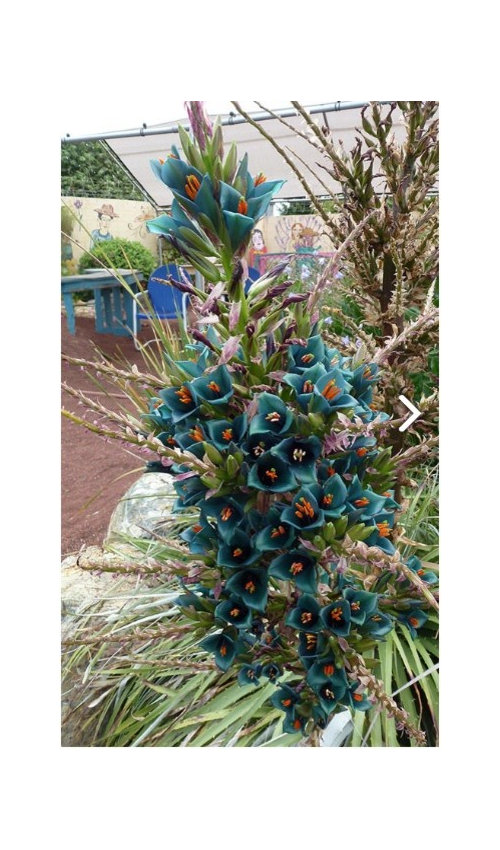
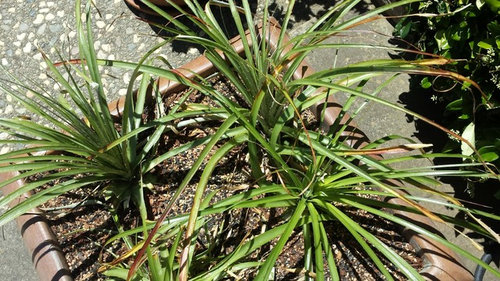
I have four Puya Alpestris that were growing slowly in a shaded area, so I transplanted them into a large concrete planter with direct sun. I put them into a structured soil, using filtered redwood bark, lava rock, and turface (water-absorbant clay). I also added some time-release fertilizer.
One of the four plants has its tips rapidly turning brown. See the attached photo. Any theories about why this plant is dying and is there anything I can do to save it?
The photo with the flowers is what the mature plant looks like in bloom. It is one of the most beautiful desert plants in the world.
Comments (50)
westes Zone 9b California SF Bay
Original Author9 years agoSo your idea is that the plant that is browning is getting a kind of sunburn, and it just has not learned to handle direct sun yet. If that is true, then I guess the plant will survive and later growth will become more sun tolerant?
Chilensis is also an extraordinary plant, but it is more like a tree, and I think it takes 15 years to bloom. Hopefully, you have a big property with a sun exposed area to grow such a huge plant. I am experimenting with structured soils + fertilizer for all my succulents and plants that grow in desert environments. There are long threads in the container gardening forum on "gritty mix" and that explains the theory behind such soils.
A larger plant that is similar to Alpestris is the Puya Berteroniana. I have four of those and I think they are going to get too big for my yard soon. Maybe put some Berteroniana and Alpestris interspersed around the base of some Chilensis. That would be a very space age looking garden!
Related Professionals
Fort Smith Landscape Architects & Landscape Designers · Danbury Landscape Architects & Landscape Designers · Potsdam Landscape Architects & Landscape Designers · Altoona Landscape Architects & Landscape Designers · Orangeburg Landscape Contractors · San Jose Landscape Contractors · Dover General Contractors · Effingham General Contractors · Elgin General Contractors · Brainerd General Contractors · Hudson General Contractors · Tucson General Contractors · Temecula General Contractors · San Angelo General Contractors · Hilo General Contractors 9 years ago
Also puyas generally don't like to be transplanted, so your plant could be stressed out because of the transplant, more so if they were in the pot for a long time and were pot-bound. But they should eventually recover even if they don't look as good for a while, they are pretty tough. I have some mature puya mirabilis that are now recovering from frost bites, others from transplanting as you did : (. I started puya alpestris this winter from seeds. They are coming out nicely but are still seedlings, at least 2 to 3 years from blooming. Mirabilis blooms much earlier but like chilensis not as dramatic as alpestris.
Kara, would be happy to give some away on your next trip south Bay. But again, they are just babies...
 9 years ago
Totally Alain! I would love one. Maybe when they get a little bigger:). How much do you guys water in the summer? Any winter tips?
Westes- just keep your eye on them. If you leave them in the same spot they will probably burn a little more. Then get use to where they're at.
I they were mine I would put a chair in front of the plants around lunch time to block some of the sun, but idk your schedule. You would do that for a week or so and then start putting the chair in front to block around 2pm. Then the next week they should be able to handle all day sun. I just gave you a chair as an example because that's what I use.
 9 years ago
I agree with it looking like sunburn. Great choice with the puya! I hve venusta and berteroniana. Assuming you took that top picture at Annie's Annuals in Richmond, have you seen any of the puyas at the UC Berkeley Arboretum or the SF Botanical Gardens? The berteroniana patch is spectacular in bloom.
westes Zone 9b California SF Bay thanked Josue (Zone 9b, Central, inland California)westes Zone 9b California SF Bay
Original Author9 years ago@josue I have never been to the Berkeley or SF botanical gardens. What are some of the standouts for those collections? The flowering photo is Annie's.
- 9 years ago
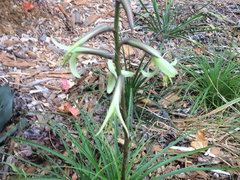
I certainly don't have the best habits when it comes to watering :( I have everything on automated drip systems during the summer as I am often out of town for long periods. I continuously adjust the frequency from May to October and it's out in the winter. So difficult to say how much. This being said puya mirabilis is very tough. Grew them from seeds too and had too many so I transferred some directly into the ground, i.e. bad clay soil!. They got all the rain from this winter and are just doing fine. I protect them from frost by putting like a milk crate and window screen mesh over it when there is night frost (I missed a few nights though:(. But they come back from light frost nicely. The one in pots are better protected from frost in the winter, watered sparingly but never let them fully dry like for cactus and other succulent. Here is the bloom I got late last summer
- 9 years ago
Wooooow! That first pic of the alpestris blooming is amazing. This just went on my list...
westes Zone 9b California SF Bay thanked Sue - 9 years agolast modified: 9 years ago
westes. If you moved this plant from the ground into a container of the mix you described, it's thirsty. It's not mentioned often and I've seen growers turned off of gritty mixes because of it but that transition is actually pretty drastic. So you will have to water the plant nearly every day for a time ( one week or maybe even two, depending on where you are and if it is hot, as well as the kind of plant it is. Basically it will have to be nursed until it gets used to such an airy and fast-draining substrate.
Sunburn on plants normally show up on exposed surfaces not just of leaf tips.
I hope the planter has drainage.
westes Zone 9b California SF Bay
Original Author9 years ago@Pagan, can you elaborate on that a bit? So is the idea here that the plant has all of its internal chemistry evolved to take water and nutrients out of the soil at a slower pace because it is used to being in a soil that retains moisture? Once the plant goes into a fast-draining soil, it takes weeks for it to change the rate of uptake from that soil, in order to get the moisture out of it more rapidly?
The planter drains very well.
I will start watering it daily and let's see if that helps.
- 9 years agolast modified: 9 years ago
I'm going to over-simplify (and please, botanists in the crowd, help me out if I get anything wrong in the process). If you've ever been buried in beach sand, you know that the weight of wet sand creates a push against your body, right? This same pressure kind of works the same way on plant roots. Water and the nutrients they carry get pushed into the roots. Some plants even have valves in their vasculature to have some degree of control of how much water gets pushed in. This is how giant tall trees get water all the way to the top, which is pretty cool! They probably also absorb moisture from the air but I know less about that part. SO as the plant loses water through transpiration, it creates space at the root for more water molecules to get pushed in. I've read it being called "negative pressure" but someone still has to explain to me how pressure can be negative. I'm guessing it's just the pressure difference between two things.
Anyway. Imagine you moved the plant from the high pressure environment of the ground into the much less dense gritty mix. That will be a huge difference the plant will have to adjust to. On top of that, it got pulled out of the earth and its root system got disengaged, maybe losing a lot of its tiny root network in the process. It will have to regrow its root network and adjust to the absence of soil and the multitude of nooks and crannies it used to have access to.
In the meantime, it won't be able to find water as it used to. So you have to help a bit by watering more often than we normally think we have to. I'm totally ignorant of puya plants and I don't know how dry it has to be. SO you'll have to figure out how often is often for this plant. I haven't repotted one either so I don't know how long it takes for it to transition. I'd check your plant and see if it has anchored or not. Or if it has new growth. you have experience in gritty mix, it sounds like, so you know that ultimately it's better for most plants if they're in containers. It's just that during the transition, they do get ratty and it requires more nursing to get them through sometimes.
I hope this helped.
westes Zone 9b California SF Bay
Original Author9 years agolast modified: 9 years ago@Pagan, I follow you and I'll try to water more frequently. The nursery where I bought it thinks it might also be getting over-watered, but I think they clearly don't understand the concept of the gritty mix and why over-watering is not really possible with a well-structured soil.
Do you have any opinion on the use of a structured soil similar to gritty mix for plantings in the ground? I want to put in rhododendrons around my home, and we have a very hard clay soil. Several rhododendron nurseries have told me that they love being planted in pure redwood bark. I was thinking of making a structured soil from filtered douglas fir bark and turface and then planting the rhododendrons into that soil, which would then be surrounded by the native clay soil. On one hand the structured soil will let the roots breathe. On the other hand, I worry that during a heavy rain the clay will act as a water barrier and the entire structured soil basin will flood with water that will only drain into the clay slowly. I don't know if that might harm the plant or not. Most people who don't understand structured soils advise you to mix the bark in with the native soil, but then it is not a structured soil any more. Most people who understand structured soils tell you to use them in containers only, but there is never a clear reason given for that.
- 9 years agolast modified: 9 years ago
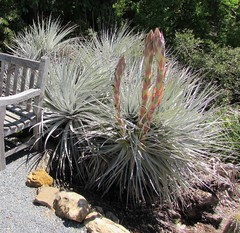
Puya venusta at UCB last week when I was there.
- 9 years ago
Hoping someone can get there when bloom are opened and post a pic :)
 9 years ago
Alain, I was curious as to where you purchased your Puya Alpestris seeds from. Also, how did you sow them? What media did you use? How was the germination rate? It seems that this beauty is a tough one to find so I was considering purchasing seeds instead. I appreciate any information you're willing to share or advice you can impart.
Thank you,
Tyler
 9 years ago
https://www.pressreader.com/canada/the-hamilton-spectator/20170506/281530815931802
I hope the link works. When I read the article in the paper this morning, I was sure I had seen "Puya" somewhere recently. You are not likely to find them in gardens around here .
- 9 years ago
Tyler, I got the seeds on line from the Cactusstore. I have been very happy with this seed source in general. They sale a 25-seed package, there were 31 in it and got 29 that sprouted within 2 weeks! My first try from another store, I got much fewer germination and they turned out to be puya mirabilis, lol! I used very standard sowing methods like for most succulents, i.e. sterile and moist C&S soil in a small covered pot, then transferred into larger pots about 2 weeks post germination. In my experience, they don't like to be transferred as they become more mature so the trick is to then do it before they become root bound and avoiding to disturb the roots as much as possible. Good luck.
- 9 years agolast modified: 9 years ago
Westes: I've been thinking of this. I've never actually planted anything in the kind of soil you describe. But if your soil gets compacted, that's probably why it's being suggested that you use the bark as an amendment---just to break up the clay and keep it from solidifying.
I'm thinking of it like a buried pot which will not have the advantage of being elevated from the ground or being physically separate from the surrounding soil. Water will just seep into the spaces of your gritty mix and carry clay with it. So basically, you will end up using it as a ground soil amendment anyway, not so much as an exclusive substrate for your rhododendrons.
Maybe you can elevate your planting locations? Like raised beds instead of using gritty mix at ground level or in-ground, in this case. Also, I'd try digging a test pit wide and deep enough for planting a rhododendron and water it in just to see exactly how fast or slow it drains. In fact, leave it open and see how it copes during the flood season.
- 9 years ago
Alain, thanks for sharing. I'll give them a try.
Tyler
- 9 years agolast modified: 9 years ago
I've received the Puya Alpestris seeds that I ordered! They also sent me 31. Man, are they tiny! Picture below with a regular sized (small) paper clip for scale. It sounds like if I sow them they way I did the Adenium obesum seeds I sowed last year (MINUS the soaking) I should be alright. I guess I'll need to sterilize my medium as well. I have grow mats now that I didn't have before so hopefully that will help. Sounds like once they have germinated is where the greater challenge will come in transplanting & making the transition from inside to outside keeping them alive to see the beautiful flowers. How long until they flower, again?
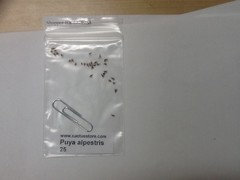
Tyler
- 9 years ago
In my experience, transplanting the seedlings is pretty straightforward, it's when they are getting older that they are more challenging. Best is to find their final spot (pots or ground) before 8 to 12 months. Have done 2 transplants in that time frame in the past with no problem. 2-4 weeks after germination and at about 4 month to a mid size pot making sure they are not pot bound at transfer and unlike for most succulent without disturbing the root ball. On average the first blooms is around the 3rd season! Good luck!
- 9 years agolast modified: 9 years ago
Tyler-I don't know if you do this, but mark the seeds with beads. I got the idea from this forum:). A couple of days ago I planted some seeds of Ferocactus reptispinus and Astrophytum ornatum. I usually never mark the seeds, I'm not that patient/organized, but the seeds are so small. Plus I'm interested to see how many germinate. I planted 28 of each. So we'll see. Just an idea:).
- 9 years agolast modified: 9 years ago
Thank you Alain & Kara.
Kara, I'm not sure what you mean by marking with beads. Are you saying to place a bead near where the seed was sown? So I know where it I put it? Can you please explain?
Thanks, Tyler
- 9 years ago
Yep that's exactly what I mean. I think what would work best is to use a bead you can really see and hot glue it to a toothpick. I used a small bead and just dropped it next to the seed. I think over time the little beads are gonna move around. Next time I will use a little bit bigger bead, and glue I to a toothpick. Then just push the beaded Toothpick next to the seed.
I wonder what's easier? Putting the bead in the soil first then the seed or seed first then the bead. Next time.
Did that make sense:)?
- 9 years agolast modified: 9 years ago
Yes, it sure did. Perfectly. I think it might be easier for me to put the seed on the substrate 1st then put the bead down? Just don't take my eyes off that itty bitty seed! I think handling the seeds are going to be difficult enough for me. Not sure I'd be able to drop the seed right by the marker.
I guess we'll see! Thanks for the tip!
Tyler
- 9 years agolast modified: 9 years ago
This is the first time I've done it. Just outta curiosity I wanna see how many come up and which ones do. Sort of like quality control.
I made a mistake by using tiny beads that are clear red for my Ferocactus. I can hardly see them. Sometimes I swear;)...
- 9 years ago
@westes re: the gritty mix, is there a reason you used lava rock instead of granite? On some of the gritty mix discussions on GW, I've read that the lava is more water retentive than granite, and only recommended as a substitute for granite if you want it to hold more water longer. Also, the size of that pot looks rather large, which could increase the amount of time it takes to dry in the core of the pot. So, it may be holding more water than intended. Based on some of the comments in this thread so far, folks are suggesting it needs more water now, post-transplant.
Just wanted to ask about the lava, as it could be causing the problem with the leaves, or in the future when the plants don't need so much water.
westes Zone 9b California SF Bay thanked Urbanviews - 9 years ago
Seeing that all the Puya aficionadoes seem to be here, any of you heard of Puya weddelliana? I've pictures of many of the Puya species, but it's probably my favorite.
Very similar to Alperstris and Baratrami(?) (B something, the other "blue" Puya species), but the flowers are more of a sky-blue and the sterile inflorescence perches are a silvery-blue color. Absolutely gorgeous.
I don't know of anyone who sells them, which is a pity, because I would kill to get my hands on one. Guess it's going to join my list of white whales, with Tillandsia carlsoniae and Griffinia hyacinthina. - 9 years ago
Bought another Puya today. Still out of the ones I want, but I got a Puya mirabilis. At least I won't have to wait a decade to see it bloom. Unlike my P.chilensis:).
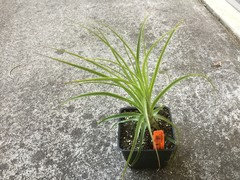
- 9 years ago
Sorry thezombies I have not seen weddelliana seeds nor plants but it was not on my radar. You might have to go to Bolivia for that one :) You could ask the people at SacredSucculent, they have puyas from Perou and Chile and might be able to connect you with a good source.
westes Zone 9b California SF Bay
Original Author9 years ago@urbanviews, I used the lava just because it was an odd lot hanging around and I wanted to get rid of it. I have not noticed that this soil retains moisture all that well. I go down about 10 inches to a filter screen, then below that it is just granite. I didn't want to waste a huge amount of expensive soil on the bottom of a pot when the roots were not likely to go that low. How low do the roots on Alpestris grow when the plant reaches maturity? I may need to replant at some point.
- 9 years ago
Kara, I was going to PM you but don't see that you have it turned on.
I don't know why I didn't think of this before. I stopped by the nursery where I got my Puya Alpestris from. They have about 8 or 10 for $12.99 in a 1 gallon. If you're interested, I could pick one up and send it to you. Just reimburse me for the cost of the plant and shipping. Not sure what USPS Priority from San Diego to San Francisco is, or if there is a USPS Propority Flat Rate box that it would fit in including the pot and soil.
Let me know.
Tyler
- 9 years ago
Idk how to turn on the PM. I haven't turned it off on purpose. If anybody knows how to turn it on let me know please:)
- 9 years ago
Gosh, someone walked me through it when I 1st joined but danged if I can find it now or remember how!
Tyler
 9 years ago
To enable private messaging:
1. Click on 'Your Houzz'
2. At your profile, click on the 'Edit' button.
3. Once you are at the edit page, you should see an 'advanced settings' label on the left of the page.
4. Click that, and it will bring you to another edit page. The second to last item on that page should be the the private messaging status.
- 9 years ago
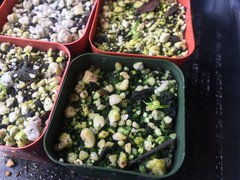
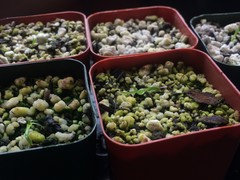
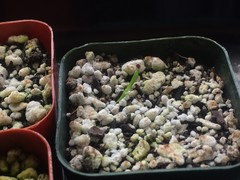
After TOTALLY giving up on these seeds that I sowed on Mother's Day in May 2017....WHAT!!! Could it be....? YESSSSS!!!!!
10 seeds sown and finally 4 decided to make an appearance. Never give up! Hope I didn't lose any while I was ignoring them. I opened the ziplock bag to give them some air...Now what? Hate to lose them now after all this time. CRAP!!!
Tyler
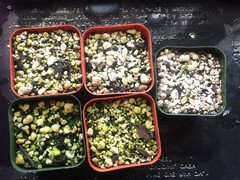
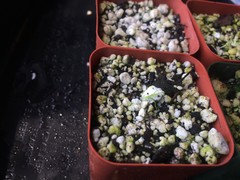
- 9 years ago
Congrats, maybe it was too hot for them over the summer. I started mine in winter and they germinated within 4 weeks!
- 9 years ago
Hmmm...maybe. Now I'm up to 5. 50% germination! I'll take it!
Tyler
- 8 years ago
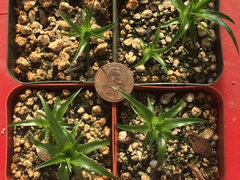
6 of the 10 Puya Alpestris seeds I sowed in May germinated. Just took this picture of the seedlings today. 2 of the 1 inch pots have 2 seedlings. I'm wondering if I should divide them or just leave them be for now. Suggestions?
Thank you, Tyler
- 8 years agolast modified: 8 years ago
I can’t find much info on Puyas. That’s the problem.
In the past month mine have put on growth. Didn’t do much in the summer.
This little guy Alain gave me. It’s grown a lot lately. Same story. Stayed tiny in the summer. I thought I was going to kill it, but it survived.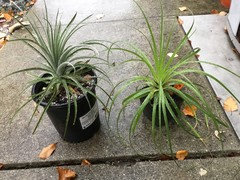 I have a feeling for me they will be fall/spring growers. They would have probably done fine in the summer, but I don’t water enough so they just stayed still.
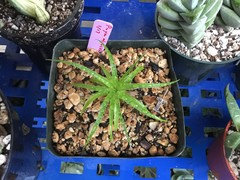
So about your question. I would keep them in the same size container, but just one in each pot. They look big enough to be by themselves. You’ll just need to repot two. Make sure you repot the bigger ones, and keep the smallest ones alone. Keep them warm of course.
Puya raimondii another to put on the list of Puyas I need in my life:).
Pic from Google obviously;).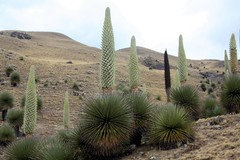
- 8 years agolast modified: 8 years ago
Oh ya forgot to say these things are so sharp. They just hook into you. Every time I have to move them I’m cursing them to hell;).
- 8 years agolast modified: 8 years ago
Thank you, Kara. Yes, to the growing period. I sowed seeds in May, they finally germinated and emerged above the soil where I could seem them in September and have grown quite a bit between September and November. ...and the babies now have stickers. Started out smooth on the edges. You can see that the smallest one (shared pot in upper left) doesn't have any stickers yet. It was a late sprouter. I'll be sure to repot next weekend.
The plant I got on Mother's Day has grown quite a bit too, recently it seems. I have it in a sunny spot on the front porch where it gets sun from morning through mid afternoon and watered it every couple of weeks or so throughout the Summer.
Off topic: is that a stacked Crassula I see in the upper right corner of your picture? Sure looks fat and sassy.
Tyler
- 8 years agolast modified: 8 years ago
It's a Crassula Moonglow:). Another one that has enjoyed the rain;).
With cactus I can usually avoid getting poked if I handle them with kid gloves, but with Puya doesn't matter how you handle them they will just hook into you. Glochids I try to stay away from;).
They call Puya chilensis the Sheep-Eating Plant. Here's a quote from I science times: " The plant, Puya chilensis, native of Chile, grows to 10 feet and is colloquially known as the sheep-eating plant for its bizarre methodof eating. Sheep and other animals get caught on its sharp spines, then starve to death. When the animal decays, the plant absorbs the animal's nutrients, like a fertilizer."
I know most plants absorb nutrients from the ground, but those hooks have to be there for a reason. They're to evil not to have a purpose;). I could totally imagine getting stuck in a big one and then not being able to get out. Especially if you're covered in wool;).
- 8 years ago
Same experience here too, not much happening during summer, growing and blooming spring or fall mainly!
Puya chilensis gets very big, you need a big backyard for that one, and a few sheep too so they don't feed on you!! Puyas are one of the plants that draw the most of my blood for sure.
 8 years ago
The whole 'sheep eating' bit is considered to be apocryphal.
- 8 years ago
Yeah. Aside from the fact that by that reasoning, any large, really spiny plant could be considered protocarnivorous, most carnivorous plants develop in nutrient poor soil, (there are some epiphytes, but again, no nutrients from the soil). And they're so intolerant of soil with normal mineral levels that in cultivation, they have to be watered with distilled water or rainwater.
Also, carnivorous plants prey on insects, if for some reason they do get animal meat, it's usually not good for them because they aren't built to break it down and absorb it.
There are is one bromeliad that is thought to be carnivorous, catopsis berteronia, but aside from that, not so much, and it's basically another variation of pitcher plant. If any other bromeliad were going to be carnivorous, it would probably be a tank-type epiphyte.
- 8 years ago
Come on Nil and zombies! You're ruining all the fun! Stop being so practical. The sheep eating story is way more fun to visualize. We don't need no stinkin' facts!
Tyler






Kara 9b SF Bay Area CA