Software
Houzz Logo Print
antiguamarie

Ficus rescue - do I repot after pruning?

9 years ago
Comments (11)

  • 9 years ago

    It's best to prune after repotting unless you're cutting the roots back really hard, then you can prune and repot at the same time. You CAN prune first and wait to repot until back-budding is well under way, if you like. My comments are taking into consideration the distinct difference between potting up and repotting. The later includes root-pruning and a change of soil and eliminates the effects of congestion in the root mass. Potting up ensures the congestions and the limitations are perpetuated until such time as the grower physically gets his hands into the root mass and corrects the problem(s).

    I'd be looking for a way to reduce the heaviness (thick branching) at the top of the tree and creating a new leader from a finer branch. You can do that any time, but mid-June would normally be the best time if you live more than 20* N of the equator.


    Al

  • 9 years ago

    Appreciate your advice, Al. (I mistakenly posted this at least twice and two others also have good advice but I can't find them any more, thanks to them as well)

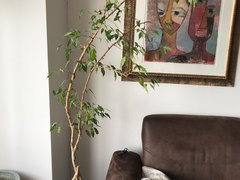
    in terms of reducing the heaviness at the top, I'm hoping to keep the height as well as the curved, "weeping" shape it has which I like a lot. Eventually I hope to have it kind of in a corner near my fave spot on the couch so that the top weeps down and I feel like I'm sitting under a tree.

    Any suggestions how/if this could be done?


  • 9 years ago

    Also, based on your advice and since I already did a fairly hard prune, I'll wait till mid June after back budding to totally repot and root prune. I think it would need a smaller pot as well since two thirds of the original plant has died.

  • 9 years ago

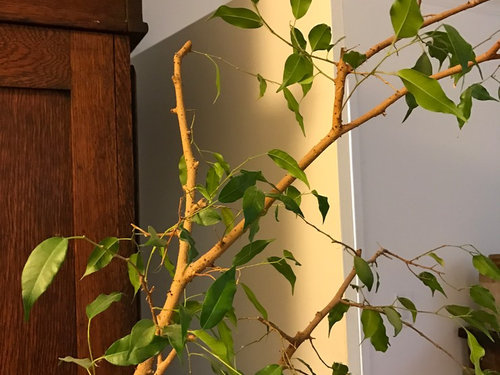
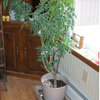
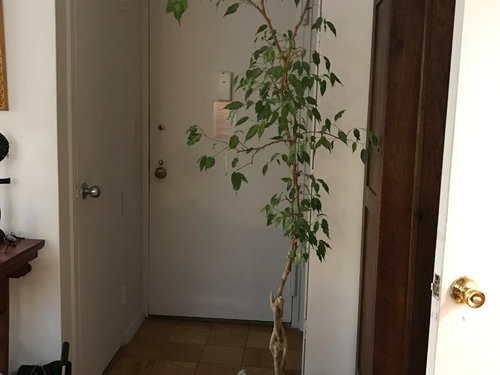
    Are the images of the plant AFTER the pruning you did?


  • 9 years ago

    Yes, all the pics are right after, this is what it looks like now. There were tons of dead branches and a lot more slender branches with a leaf or two.

  • 9 years ago

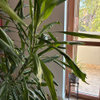
    Let's use your second picture, the closeup, for this discussion. The larger branch that sticks up from the dominant trunk has to go, so cut it off flush with the trunk with a fine saw, then paint the wound carefully with waterproof wood glue. The glue seals the wood, prevents it from drying, prevents a large scar that takes a long time to heal, and helps the callus tissue that forms at the edge of the wound to roll over the wound without resistance. As you follow the trunk line up, you come to another branch that sticks up, then has a branch that moves off to the right. That stays, but the little stub that sticks up gets the same treatment I described for the first upright branch off the trunk.

    The branch underneath the higher branch that moves to the right and looks like a continuation of the main trunk line and appears parallel to the upper branch should be removed. Your trunk will move to the right, then move upward a short distance, then continue to the right. That little 'crook in the trunk line adds interest. The reason the lower branch should be moved is, it competes with your eye as the apex. Even though the trunk line your keeping is higher than the branch, it still confuses your eye.

    All the branches on the subordinate trunk should move to the right, but no branch should be directly above another. The lowest branch should move right and toward you. The next should move right and be in line with the trunk, the third branch should move right and toward the back.

    There should be no branches on the dominant trunk that move to the right. Coming off the dominant trunk, you should have 3-4 branches arranged alternately that move to the left. These should be longer branches to offer visual balance (so the tree doesn't look like it's going to fall over to the right).

    There is a branch that is growing off the really short stub that sticks up where the dominant trunk line makes a jog. It appears to be growing to the left. That is a key branch. Train it so it grows toward the front and moves left.

    No branches should grow directly toward the front of the composition, so they look like they want to poke you in the eye.

    Did you get all that?

    FWIW, I'm a bonsai judge, and 30 years of practice at bonsai allows me to see the tree in the tree. It also allows me to see problems and offer plans that allow the grower to work around the problems or in some cases turn them into a feature.

    Comments?


    Al

  • 9 years ago

    Hi Al,

    I got the theory and practicum of the first part and have done the two main cuts plus the very small stub.

    I got the theory of the second part about left and right - but still have to "study" it to be sure I don't mess it up. I'll come back with questions, I'm sure

    I've done dozens of searches in the past and looked at YouTube tutorials to better understand how to train plants based but so far haven't grasped all the talk about apical and auxiliary buds! Yours looks very down to earth and I should be able to follow

    Very happy to be tutored by a bonsai judge and appreciative that you're sharing your expertise so willingly with me and everyone else.

    I have a monster fiddle leaf ficus that I've cut back a few times, I will post some photos in a few days for guidance on controlling the shape better, if you have the time

    Thank you!!

    marie


  • 9 years ago

    Hi Al,

    I took some time with the instructions fortune subordinate branch and understand what the big picture is (or rated, will be) and did what I thought you suggested, the photo below shows the latest prune of the subordinate trunk

    Question about training the young branch, the key branch to be trained: you mean to wire it in that direction, right? I started bending it but think I should wait a bit as it seems in danger of breaking off


    There is a branch that is growing off the really short stub that sticks up where the dominant trunk line makes a jog. It appears to be growing to the left. That is a key branch. Train it so it grows toward the front and moves left.

  • 9 years ago

    Sorry the photo of new prunes is here

  • 9 years ago
    last modified: 9 years ago

    I sort of take wiring branches and bending very thick branches/trunks up to 1.5" thick for granted. You can also tie branches with string to position them. I often wire every branch on a tree - especially if it's the first step. I use braces, and guy wires liberally, too. See how the tree has been almost completely defoliated? This increases back-budding and ramification (leaf/branch density).

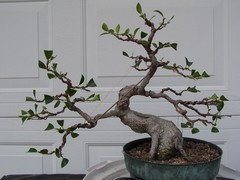
    These are trees that have been around for a while, but are very new to training:

    See below for before work.

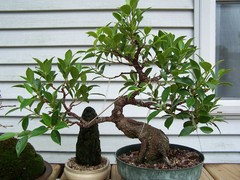
    Another ficus:

    Ficus B branches are very flexible. If you do wire, try to make sure you don't put any pressure on the point where the higher order branch attaches to the lower order branch. If you do all your bending at least 1/2" away from that attachment point, you have a lot of leeway. BTW - branches are much more flexible and easier to bend if you do the work when the plant is quite dry.

    Al