Software
Houzz Logo Print
vexemary

Buff Beauty needs your help
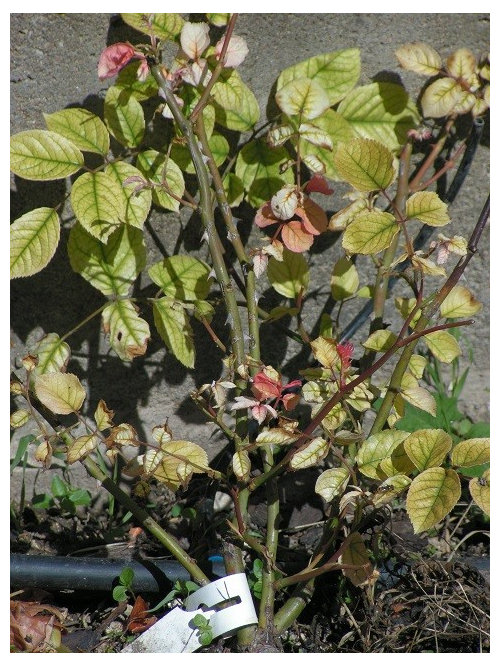
Hello everybody, I'm new on this forum and I would appreciate your help with my Buff Beauty.
It
was planted in October and it leafed out much later than the other
roses in my garden zone 8. The leaves are chlorotic, they were almost
white in early spring. 5 feet to the left I have a lovely Reine des Violettes planted the same day which grows just nice. Then it suffered an attack of red spiders and I
got rid of them quickly, but it didn't help the poor thing. I applied
some iron (twice since April), fish mix some four days ago, Epsom salts (just once and I
really only sprinkled a tiny quantity, since my garden soil is very
alkaline. It's not even blue in the test tube, but purplish) but it doesn't react at all. I don't really know what to try
next. It has a full day sun exposure. Could you help please?

Thanks in advance :)


Comments (17)

  • 9 years ago

    I recommend you buy a pH meter to help diagnose mineral deficiency because some nutritional deficiencies will correct when the pH is fixed. The availability of minerals in the soil is dependent on pH. You probably gave too much iron or your pH is too high.

    If pH is not too high then give some manganese. Ground cloves are a good source of manganese. I use cinnamon instead because it is cheaper and I have an excess of it.

    According to StrawChicago (check out her profile for useful threads:

    Manganese Deficiency Caused by:
    - High pH & Soil high in organic matter.
    - usually High levels of Iron, Chloride or heavy metals & Waterlogged soil.

    Signs:

    - Newer Leaves become yellow or near-white between their veins. Discoloration is more intense than Iron deficiency.
    - Grey spots, especially near the base of the leaves.


    moira p (z8, North France, alkaline clay soil) thanked totoro z7b Md
  • 9 years ago
    last modified: 9 years ago

    Thanks totoro,

    I've just ordered a ph meter, to see just how
    alkaline my soil is knowing that it must be above 7; I deliberately
    applied very low dose of iron, since leaves in this state might easily
    burn if the dose is too high, so the iron couldn't have caused this.

    Manganese on the other hand could be deficient as we had almost one
    month of rain in my region. But then again, the other roses aren't
    affected. My Ena Harkness has dark green leaves and it is only 10 feet
    away, blooming happily and Reine des Violettes is healthy and full of
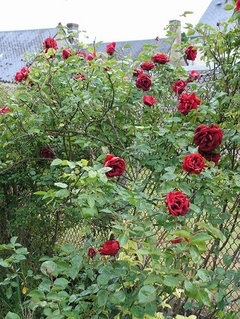
    buds and only 5 feet away. This is Ena Harkness planted in the same bed:

  • 9 years ago

    My Buff Beauty is also showing signs of chlorosis, but it is only in the newest leaves and the rest of the plant appears healthy so I haven't bothered to try to correct it yet. When it first leafed out this year, the leaves on the newest growth were almost white and these eventually died back. I also have my BB partnered with Reines des Violettes a few feet away in the same bed, which is growing well so far, but it is a new bare root this year and still small. Darcey Bussell on the other side also is not showing any signs of chlorosis. Perhaps BB is just extra sensitive to higher PH conditions, especially perhaps as an own root (which mine is).

    moira p (z8, North France, alkaline clay soil) thanked arlene_82 (zone 6 OH)
  • 9 years ago

    Great arlene, thanks so much :)

    I hope that it will be able to get stronger, I only can offer a heavy alkaline clay in my garden. It is the only rose I've got so far that has this kind of reaction. if it doesn't get better I'll have to replace it, the soil is certainly not going to change to fit BB. I wish I knew it was kind of sensitive before I took it.

  • 9 years ago

    I've had some luck watering with very diluted vinegar solution.

    moira p (z8, North France, alkaline clay soil) thanked zz top Northern Illinois 6a
  • 9 years ago

    At this point, I'm ready to bath her in the vinegar :) .

    I'll try that. How much vinegar should I pour in the water, zz top?

  • 9 years ago

    a tablespoon per gallon or half that? I think I use 1/4 cup in a 2 gallon watering can.

    moira p (z8, North France, alkaline clay soil) thanked zz top Northern Illinois 6a
  • 9 years ago

    You can change the soil pH locally by amending a large planting hole when you place a rose. Mixing peat into the soil when planting should help lower pH in that area.

    moira p (z8, North France, alkaline clay soil) thanked K S
  • 9 years ago

    Thank you so much guys,

    That is a wise council Moses and I understand what you mean.

    As soon as I get the ph meter I'll check the exact values and I'll come back with that piece of information. I've done the first soil test this morning just around its roots with the simple testing set, I'll check around as well. The soil showed values higher than 7 but it is difficult to say how high since the system is based on colors and it only measures up to ph 7, which is blue and neutral. The color went way beyond that, somewhere in between the purple and pink tones.
    I am worried that the leaves which are fragile might burn with the rise of the temperatures. We had some really cool weather up to now (I live in north of France), but it is getting warmer and the bottom leaves burned couple of days ago when the temperature rose to 26°C /78 F which is not really hot.

  • 9 years ago

    Straw has alkaline clay. She saves acidic rain water for her plants that like more acid. Also she says that cracked corn makes water acidic so you can water with that or just put it on top dressing. It is a great organic fertilizer too.

  • 9 years ago

    Last year my first year Buff Beauty had leaves like that too. My soil is acidic. I think I gave some Miracle Gro bloom booster which has a bunch of minerals in it it. It eventually grew lot and is fine now covering my rear fence.

    It gets afternoon shade which I think helps the blooms last longer.

    For my camellias which need more acidic soil, I use pure sulphur to gently and slowly lower the pH. Might take a while and constant reapplication. Gypsum will also lower your soil pH, but you need to give to also give K and too much Ca might mess up other minerals.

    moira p (z8, North France, alkaline clay soil) thanked totoro z7b Md
  • 9 years ago
    last modified: 9 years ago

    Totoro is on the right track, so I'll back her up. She is a medical doctor (M.D.) with a toddler. I respect her quoting the original source of info: A Horticultural University site, which I put the link in my Houzz profile thread on nutritional deficiencies in plants.

    My B.S. is in computer science, minor in chemistry so I am focused on accuracy and ACTUAL EXPERIENCE. Re-quote what Molra wrote: "I applied some iron (twice since April), fish mix some four days ago, Epsom salts (just once and I really only sprinkled a tiny quantity, since my garden soil is very alkaline."

    Iron is a trace elements, one need a super-tiny amount, like 0.01 mg .. overdose on that and you'll create a manganese deficiency. My soil in Illinois is heavy clay, pH 7.7 (professionally tested), and University of Illinois stated that in compact & wet clay, there's PLENTY OF IRON, but compact & waterlogged clay creates a manganese deficiency. They did a field study on trees here and found that the iron content is very high, but manganese is low.

    In the blueberry forum, folks who make their soil fluffy with organic matter can still grow a successful blueberry crop, despite alkaline soil. Testing for soil pH won't be accurate, unless one digs deep at the root-zone, and do that twice: after acidic rain, then again after watered with alkaline-tap water, you'll see a difference in pH. If you google "pH of rainwater across U.S", you see a pH 4.5 for my Chicagoland, compared to my tap water at pH 9.

    Buff Beauty is a hybrid musk, which PREFERS LOAMY SOIL. So the problem is not pH-level, but the compaction of waterlogged & dense clay, which chokes roots, so leaves turn pale. Melissa in Italy with 400+ roses, stated that hybrid musk thrive in LOAMY alkaline soil in her garden. I only have experience with 102 varieties of own-roots, so I always research extensively.

    Keep in mind that pH of rain is acidic, so a rainwater-logged soil will be acidic at soaking-wet bottom, while the surface is alkaline. Wood-chips on top decay to slightly alkaline. Also roots secrete acid in "acid-phosphatase", so making the soil loamy helps roots to be more efficient, even when watered with high-pH tap-water.

    I did exactly what Molra did years ago, and destroyed 6 rhododendrons plus 4 azaleas. I gave them iron sulfate, and they went down hill, worsen manganese deficiency. There's an inverse relationship between iron and manganese, UP the iron will PUSH DOWN manganese. Iron sulfate also burns roots in dense clay.

    Epsom salt WORSENS the compaction in clay, there's fun-experiments where folks create crystals with Epsom salt. Epsom salt HARDENS the soil further, thus WORSENS THE COMPACTION, which cause manganese to be less available. Epsom salt is magnesium sulfate, and my alkaline clay was tested EXCEEDINGLY HIGH in magnesium. Magnesium is what makes clay sticky, and deficiency is rare & occurs only in very sandy soil.

    The solution: Dig that up, and mix in pine-bark, which will make the soil loamy & improve drainage. Pine park pH is 4, which will lower the high pH of soil permanently. If it's a wimpy own-roots, the sharp & chunky edge of pine bark isn't best. A better solution for own-root is pine-shavings (light yellow) color, sold at Pet-section at Walmart for $3 for a huge bag, it's used to line the cage of rabbits.

    Mix in peat moss (pH 4) doesn't solve the problem since peat moss is a fine particle and glues up with clay & plus makes it even wetter & denser. Hybrid Musk prefers loamier & lighter soil.

    One year I mixed Pine-Shavings (light yellow) bag into my soil for my tomatoes, and they produced 3 times more fruits, thanks to the pine-shavings aerates the soil, giving oxygen for best root-growth. People don't realize that roots need oxygen for best growth, thus fluffy soil is the solution for cluster-root like hybrid Musk Buff Beauty. Dense & wet compact clay will choke any roots, turning plants yellow.

    I notice the lowest leaves have brown-margin: that's from waterlogged soil. I would dig up the plant and fix the drainage. Hybrid musk like Buff Beauty likes it loamy & well-drained, and won't tolerate wet feet. I would dig down past 2 feet and remove any stones that's blocking water from draining.

    A friend is sending me a rooting of Buff Beauty this week, she rooted that easily in fluffy & coarse sand & alkaline tap water (pH over 8). But sand is not the solution to mix with clay, it would take another thread to explain which roses are best for that solution.

    As to lowering high pH tap-water with vinegar, I already did that many years ago. Doesn't work with French roses (Meilland and Romantica) which prefer alkaline soil, vinegar in tap water burned and wilted roses' leaves in hot sun. A better solution is sulfate of potash/gypsum, which I included the link to that in my Houzz profile picture: https://www.houzz.com/user/strawchicago/__public

    moira p (z8, North France, alkaline clay soil) thanked strawchicago z5
  • 9 years ago

    Thanks for the information about browning edges, strawchicago, I was worried about that. My soil is a clay but it is not choking anything else, so the young lady will have to fight for herself or she'll move away. There are no stones under the roots that I might take away, the soil was well prepared when I planted it. I have some HM Pemberton roses that are doing fine in the same part of the garden (Cornelia and Felicia), and I really hope that BB will be able to deal with the soil conditions when she is more mature.

    After measuring the soil ph with the ph meter this time (special thanks to totoro), the result is between 7 and 8 near the roots. I regularly use iron for my acidophilic plants and there is no way that I have used too much of it. As for the Epsom salts, I've put as much on the ground as one would put on the steak if it were the ordinary salt, I sincerely doubt that it hardened whatsoever in the garden :) .

    My BB is in the same not so pretty state it was one week ago but at least it is not getting any worse. I will observe it for a while before deciding what to do with it and I'll keep posting here if there are any changes, either good or bed.

    Many thanks to all of you who took the time to answer. I've learned something new and I'm richer for the ph meter as well.


  • 9 years ago

    It should be easy to tell if it is iron deficiency, adding chelated iron to the soil should turn the leaves green, if it doesn't, iron is not it's problem. Sometimes a new rose takes a while to settle in, my Buff Beauty, did.

  • 9 years ago

    Straw, thanks for commenting. Sorry I hope I did not force you to comment when you are on hiatus. I learned so many interesting ideas from you.

    Moira, what is the pH of the other roses that are doing well? I am no expert and it seems that there could be a lot of different factors going on. It seems wise to give it some time at least another season. This year my BB has had no chlorosis at all, maybe because the root system is more mature now. But if the mature root system of the rose does not do well with your type of soil, then I totally get why you would not want to coddle it. Good luck either way!

  • 9 years ago

    Excellent post, Straw! That was very nice of you to take the time to provide all of that information, THANK YOU!