Software
Houzz Logo Print
northeastgardener_

Two questions

What do you plant with tomatoes? Also, how much spacing between them? Is 18 inches too much? Can I plant something between or in front? Thanks in advance!

Comments (24)

  • 9 years ago

    That would depend on how you plan on pruning them (or not) or how you are going to support them (or not) or what variety they are.

  • 9 years ago
    last modified: 9 years ago

    ... and 18" is not much

    Cheers

    PC

  • 9 years ago
    last modified: 9 years ago

    You can plant them as close together as you want, but if you want to get optimal production out of each plant, you'll need two feet or more separating them. In principle, the productivity of a plant is proportional to the area of soil nutrients it has access to. So if you plant three plants where one could grow optimally, you'll get the same amount of fruit as you'd get with that one.

    What do you plant with them? "Companion planting" is largely a joke. But it's always nice to have friends around! So smile at them when you're doing your gardening. Why plant anything with them?

  • 9 years ago

    Hahaha @daninthedirt - I have too many plants and only half the beds constructed so it's a matter of space.


    I have early girl, rutgers tomato, yellow cherry and beefsteak.


    I've planted all for now, so I think a follow up question is: is there a trick to transplanting tomato plants?


    Thank you you all for your help!

  • 9 years ago

    And to add to what Hoosier stated, when there is no room in between plants they remain damp and diseases spread rapidly and plants succumb prematurely.

    I train predominantly to one stem and I am fairly comfortable with 22" between plants in a row with rows 28-30" apart. But I use stringline support; could never have rows that close if cages were used.

    One trick to transplanting is to not interplant determinant varieties like Rutgers and indeterminate varieties like the others you mentioned.

    Transplanting can be as complicated as you make it. One way is to punch a hole in the soil with a hand spade, pour fertilizer water in hole, insert plant base and cover or another way is to use a water-wheel tractor pulled planter that does the first 2 steps and then you just insert root ball and swirl soil around the rootball. Those are two common methods I use; one takes about 30-40 seconds per plant and the other about 2 seconds per plant. The "Trick" is to plant most plants using the second method which is a sitting job.

    Northeast Gardener, Central NJ, 7a thanked Barrie, (Central PA, zone 6a)
  • 9 years ago
    last modified: 9 years ago

    Well if you've planted everything already, and used up all your room, you aren't going to be doing a lot of transplanting. I'd just sit back and enjoy. If you want to dig up plants and move them around, I'd take a ball of soil at least as big as the plant. I don't think you're going to be doing that for those mature ones in the picture.

    I actually don't see any cages in your picture. The plants are going to be all over the ground without support.

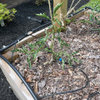
    It appears that you have 18 inches between the plants in the picture, but they're in a line, so they have loads of soil and air accessible to them out perpendicular to that line. They'll do fine. 18 inches on all sides is not optimal.

    Northeast Gardener, Central NJ, 7a thanked daninthedirt (USDA 9a, HZ9, CentTX, Sunset z30, Cfa)
  • 9 years ago

    The brick bordered bed is just 22 inches wide or so with open space on either side of the border - I figured it would be easy access from all sides, and good ventilation since the last couple of years I planted in tiny boxes against a fence. Even though we had tomatoes all summer, the ones in the back were impossibly hard to reach.


    It sounds as though the cages are not ideal then - I can set up stakes and string the way I do with dahlias maybe? It's my first try at a larger kitchen garden since moving to our new home and I want a permanent space that will be planted for all seasons.


    My question about companion planting also comes from a desire for year-round interest. For instance, I planted last year's mums in the ground and they're doing well and I was hoping to move them with these tomatoes (I have peppers, Swiss chard, cucumber, sorrel, and bush beans too). I'd love for the space to be useful and planted in all seasons, and from what I've read about potager gardens, perennials and herbs are planted alongside vegetables and flowers. It's this part that I'm working through now.


    Hopefully, the other sections of the bed will be finished soon and I can transplant so there's more breathing room.

  • 9 years ago
    last modified: 9 years ago

    18" is not too much, if anything, too little. I like plenty of room between them so I can go around them and water easily. But I grow in containers. It's easy pickin' too if you have access all around the plant. If plants feel crowded, they won't grow as big.

    Northeast Gardener, Central NJ, 7a thanked edweather USDA 9a, HZ 9, Sunset 28
  • 9 years ago
    last modified: 9 years ago

    The brick border is pretty low. Unless the border is underground as well, the tomato roots will reach a lot farther out than that brick border, whether you like it or not.

    In the context of having enough space between plants, companion panting, for plant friendship, decoration, or production, will just compete with the tomatoes for soil nutrients. If you want the space to be filled year-round, you might put some shade-tolerant compact perennial herbs in. If small enough, they won't share the same root space with the tomatoes at depth.

    Northeast Gardener, Central NJ, 7a thanked daninthedirt (USDA 9a, HZ9, CentTX, Sunset z30, Cfa)
  • 9 years ago
    last modified: 9 years ago

    I would put in some plants that produce umbelliferous or clustered small flowers all season long, like sweet alyssum, on the side where they'll get some sun even when the tomato plants get big. Those flowers will attract and nurture beneficial predators that will control populations of small, sap-sucking pests. That's the only form of companion planting that I've found works, and it works very, very well.

    As for interplanting, I plant fast- and low-growing, shade-tolerant, shallow-rooted veg like lettuce and other greens, spring radishes, etc. between plants that don't really hit stride until hot weather, like tomatoes, eggplant, peppers. The under-plants require mostly some fertilizer watered into the surface soil from time to time--they won't compete much with the roots of the larger plants, which will be growing deep into the soil. During spring when the main plants are small, these types of small veg and greens grow very very well next to them. When the weather gets hot, they get some shade from the main plants, which they benefit from. It works well as space conservation/season extension, but there's little to no direct benefit for the main crop, so it's not "companion planting" in the sense that you see people talking about it on the Internet. Once the main plants get large enough that they produce solid shade underneath them, it's time to give up on the greens and other smaller veg underneath.

    Northeast Gardener, Central NJ, 7a thanked gorbelly
  • 9 years ago

    Back in PNW I had little raised bed space and used to plant @ 18" spaceing. But kept them up with with stakes and pruned to 3 stems max.

    No in NC , I have planted them @ 24" and 30" between the rows. TOO CLOSE.I have got a jungle. Even though I keep nipping the suckers. and prune lots of leaf branches. It is just inconvenient to walk between the rows.

    Next year I will plant at 36" space and rows spaced at 40".

    sey

  • 9 years ago

    Sey, yeah I like a lot of room to walk and also to allow room for air flow. I plant my rows 5 foot apart. I used to plant 5 feet apart in those rows but have reduced that to 3 so I can cram in more plants. I hope to prune the op varieties to 3 stems if I can keep up. I have around 78 plants this year of which around 42 are op.

  • 9 years ago

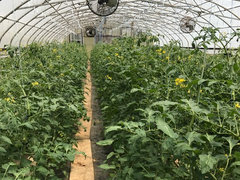
    I have good reason to plant close. With a high tunnel the inside area provides a net gain of 1-2 climate zones so it pays to incorporate as many plants as possible without overcrowding. But I can always move up rows to pick fruits and maintain plants to single stem on stringlines.

    Some fruits are starting to ripen from few of 93 varieties represented in this structure.

  • 9 years ago

    Gorbelly, I LOVE your idea of planting little greens at the base of your tomatoes :)

    Linda

  • 9 years ago

    I would not even mix greens at the base of tomato plants unless you plan to grow without any spray and that causes more issues. If the greens cause you to make a management decision that results in a shortened tomato crop you will have defeated the major purpose of close planting.

  • 9 years ago
    last modified: 9 years ago

    I use Serenade early in the season, then alternate between organic copper and Serenade later in the season. By the time I'm using the copper, the tomatoes give too much shade for greens anyway, plus it's too hot for many greens at that point. I use Serenade early not because of the greens but because my primary problem earlier in the season is speck, and Serenade seems to do a better job of warding it off/controlling it. Later in the season, I deal more with early blight, and copper does a better job with that.

    But this is a good caution for people who use more persistent sprays that pose a greater health hazard. And it's true that emphasis should be on the main crop. But if you can make it work, it's a nice way to maximize garden space. Those of us with small gardens do what we can in this department.

  • 9 years ago

    This year, I planted peas on my tomato trellises early. They're giving me pods now. I plant out tomatoes about now, and they're still small. By the time the tomatoes get large enough that there's a issue, the peas will be done, and I'll cut them down, harvest any tender shoots remaining to eat myself, and use the rest as green manure.

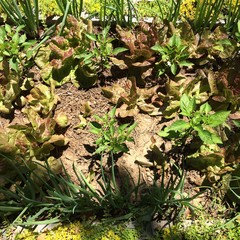
    My interplanting of greens are mostly around my peppers this year. Here's some merveille des quatre saisons planted under my Korean peppers.

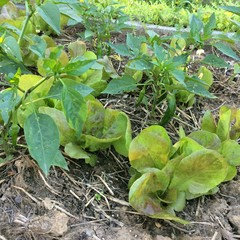
    Here's a neighboring bed, where the peppers are already bearing (this bed gets a bit more sun). This lettuce was sown later and hasn't been thinned yet. I'll use the thinnings like microgreens.

    Despite dealing with herbicide drift from a neighbor and a huge slug population due to a mild winter and very very wet May, things are proceeding apace.

    Northeast Gardener, Central NJ, 7a thanked gorbelly
  • 9 years ago

    Thank gordbelly! I love the photos!

  • 9 years ago

    @Madreselva, a few suggestions about planting tomatoes and please forgive me if I've duplicated someone else's suggestions. I didn't get a chance to read all replies. First, plant in the best soil you can make or buy. My yard is largely clay, so I used raised beds or buckets for planting and mostly use a mix of perlite, peat, and compost for planting (or a high quality potting mix usually with compost added). Second, plant the tomato plants as deeply as is reasonably possible. In transplanting most plants, the advice is not to plant below where the soil met the stem in the previous container. Tomatoes are an exception because they will develop roots from the "hairs" along the stem. So, if you have a lot of stem, pull off any leaves that are low on the stem and bury the plant as deeply as is possible while leaving a good amount of leaves for the plant to use. That will give you more roots to absorb nutrients. Also, be mindful of the orientation of your garden. Indeterminate tomatoes can get quite tall. (Bush type tomatoes less so.) So, be mindful of where the sun will cast their shadows so that you don't block other sun-loving veggies from getting enough sun and so you can, if you choose, use the tomatoes to lend a little shade to plants that can tolerate a bit of shade, like lettuces that will bolt earlier if in too much direct sun.

    Northeast Gardener, Central NJ, 7a thanked Kentucky Gardener
  • 9 years ago

    Nice pics Gorbelly! I don't usually spray so no problems for my greens. I usually get Septoria and Early Blight so I remove the ugly lower yellowed leaves as they happen, grab the tomatoes and run! However, this season looks as if it might be very wet so I might be in more trouble than usual!!!


    Linda

    Northeast Gardener, Central NJ, 7a thanked Labradors
  • 9 years ago

    @Kentuckygardener, thank you for the replanting advice - I expanded the patch and have been moving the plants around a little - your advice is really helpful!

  • 9 years ago

    Btw, these have a prime spot in the garden - dead center with full sun from around 11 until sunset. The outlined area for the veggies is far from any other plant and any shade at all. I've always had good luck with tomatoes and in the last two years, had tomatoes all summer for my family of four even though I planted in a single small raised bed. This year, I hope to be asking for advice on preserving - dreaming of summer tomatoes at Thanksgiving already.

  • 9 years ago

    I actually could have pushed my garden and had fresh tomatoes at Thanksgiving last year if I hadn't decided to try winter cover cropping. But that's probably not something we can assume will be possible regularly... yet.

Sponsored
Schlabach Woodworks
Average rating: 5 out of 5 stars21 Reviews
Franklin County's Reclaimed Wood Professionals