Software
Houzz Logo Print
gemm51

variety advice please

9 years ago

I'm going to attempt a rather ambitious installation. I want to train a plant (inside) up 6ft and then along around 9 ft. With which varieties of hoya (if any) would you experts attempt this?

Comments (10)

  • 9 years ago

    Choosing a species depends on many factors, not just space. What are your growing conditions? Lots of light/low light? High humidity/low? Hot/temperate/cold/frosty? Indoors/outdoors?

    Plenty of species will do well with the space you are offering, but your growing conditions may limit/exclude certain species.

    Also, you need to think about your WANTS:

    *Do you want an early bloomer?

    *Do you want an easy species?

    *Do you want attractive foliage?

    Answer those questions and add your growing conditions/climate, and it will help immensely narrow down what will work for you :)


  • 9 years ago

    Have you grown any Hoyas to date?

  • 9 years ago

    It's for a feature wall inside. Plently of light, but little direct / intense light, fairly constant around 70F and 50% humidity. I've never used a climbing plant indoors, and I'm not in a climate where hoyas can be grown outside. From the indoor climber reasearch I've done it would be a good fit, not keen on anything self supporting. Needs to grow reasonable at a reasonable rate. Just wondered if there's anything between varieties for this...

  • 9 years ago
    last modified: 9 years ago

    If it is for a feature wall, do you plan to have protection on the wall itself? Some species WILL take advantage of gypsum (drywall) and, if happy enough, throw their aerial roots right into the wall, anchoring themselves into it.

    Also, since almost every species benefits from mistings, you'll want to think about how frequent mistings could affect your wall.

    Are you planning on growing a mounted specimen? Or do you plan on using a pot for the root system? If a pot, how do you plan on feeding/watering and changing the potting medium/repotting the plant, when it is time to?

    Most Hoya species (aside from the eriostemmas, lambii, and a couple of others) really enjoy being potbound, so you will also want to make sure whatever pot you are using is a maximum of 2 inches bigger than the root ball. You also need to think about how top heavy a large plant will a small rootball will be, and use a support pot, as necessary.

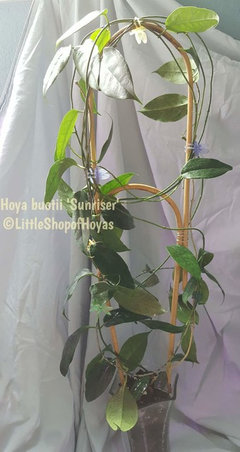
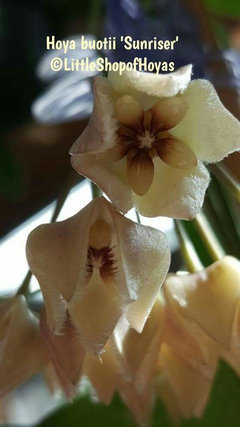
    For example, if I were to unwind my Hoya buotii (a rampant grower), 2 of it's vines are around 6 feet long, and the 3rd is around 12 feet long. But it's rootball easily fits in a large, but narrow, vase (I grow this one semi- hydro, as it is a thirsty species). It needs quite a bit of support, even in the heavy glass vase it is in, to not topple over. So, I put the glass vase in a large pot, as added support.

    My buotii, in it's vase:

    Buotii flowers (not fully reflexed):

    Most species really dislike wet feet, so a well-draining potting medium and a pot with plenty of drainage holes will be necessary. If you plan to use a self-watering pot, you will have to be really careful to not over-water (root rot).

    I would normally not recommend the species I am about to recommend (with the exceptions of #1, #3 and #5), to a novice Hoya grower, but they really are not difficult provided you are able to give them proper care:

    1. Hoya pubicalyx, if you can get a large enough specimen. It's not the fastest grower, nor does it bloom early, but if you get a large enough specimen (6ft vine(s)), you will at least have a starting point. It is going to be the easiest to care for, as it does not care as much about cooler conditions, nor does it require mistings (although, all Hoyas do enjoy mistings, now and then).

    It will require a well-draining potting mix, like 50% 1/4 inch orchid bark 25% LECA (fired, explanded clay aggregate), and 25% #3 perlite (all soaked overnight and rinsed well prior to use). You could also throw in a bit of pre-soaked/rinsed long fiber sphagnum moss (NOT peat moss) for additional moisture. Throw in some time released fertilizer into the mix (Osmocote), to make feeding a breeze.

    Water when the top inch of media feels dry to the touch.

    2. Hoya buotii- if you don't mind a bit of extra care. Skip this suggestion if you have cold drafts- this species likes it consistently warm!

    It's a very fast growing species, and will bloom early, if properly cared for. The 'Sunriser' clone has been my easiest buotii, to date.

    This one thrives being grown semi-hydroponically, so you will need a semi-hydro pot and LECA (kiln fired, expanded clay aggregate- I no longer recommend Growstones as a growing medium; my plants did not fare well, long run, in Growstones). I suggest a clear semi-hydro pot (so you can see the water level) or even a clear (used and cleaned, of course) juice bottle with holes poked or melted 1.5 inches up the sides (NO BOTTOM HOLES), like this:

    First you rinse the rootball of as much dirt/old potting media as you can, gently running your fingers through the root system to loosen any stuck in the middle of the rootball.

    You then fill the juice bottle about 1/4 way with LECA that has been soaked overnight, then rinsed well. Then you place the rootball of the plant in, and add more pre-soaked/rinsed LECA, until the entire rootball has been covered. Water with water soluble fertilizer at 1/4 strength (I use MiracleGrow water soluble tomato feed; cheap and has all the micro/macro nutrients). Water with 1/4 strength fert. again, each time the reservoir of the semi-hydro pot no longer has any water in it.

    Buotii does best given daily mistings and bottom heat (a reptile heating mat or seedling heat mat will do fine and they are pretty cheap).

    3. Hoya australis ssp. tenuipes (or ssp. tenuipes variegated, a.k.a Hoya australis 'Lisa'). Pretty quick growing. Treat as you would pubicalyx, but provide bottom heat from a reptile/seedling heat mat.

    4. Hoya sp. Sarawak (pink or yellow). Very fast growing with large, attractive foliage. Skip this suggestion if you have cold drafts; this species likes consistent warmth!

    Will need daily mistings and bottom heat (from a reptile or seedling heat mat).

    Pot up in media similar to pubicalyx (see above). Do NOT over-water, or your plant WILL get root rot. I only water mine every 15 days or so.

    5. Carnosa. Very slow growing, but care is identical to pubicalyx. I put this last, due to how slowly it grows. You'll want to get your paws on a mature specimen, and even though it is a very common species, it's not cheap.

  • 9 years ago

    I would say pubicalyx, fungii, diversifolia or ingrassatta. All of these grew out of control for me :-) all easy and fast growers at least for me.

  • 9 years ago

    Incrassata would work, as would fungii. Diversifolia may look too "messy" (mine tries gtowing sideways from every node...ugh).

    They all have similar care to pubicalyx.

    Possibly ranauensis, as well. It's a pretty quick one, AND it blooms early and frequently. Nice, light fragrance, too!

  • 9 years ago

    Hehe you're right about diversifolia. Maybe I'd sub it for meliflua. A lil more tame :) ranauensis is a good choice too.

  • 9 years ago

    Thanks so much!! this is exactly what I needed!!

  • 9 years ago

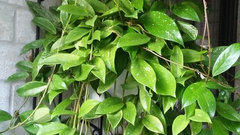
    Gemm, wanted to show you a pic of a large basket of pubicalyx I bought last yr at this time. If you want a hoya wall this one could work!

    when I first bought it
    right now lol same pot

Sponsored
Industry Leading Landscape Contractors in Franklin County, Ohio