Software
Houzz Logo Print
robert_c_finnegan

Spreading Clover

9 years ago

Good morning all...

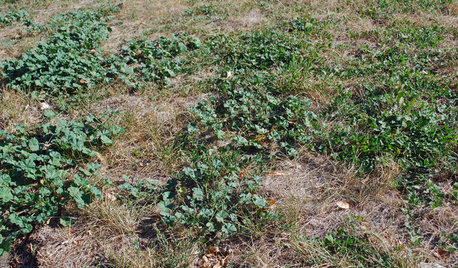
Last summer, I noticed a portion of my lawn had a patch of clover spreading amidst the Kentucky and Fecue blend. I'm in northern NJ and the area gets plenty of sun starting in the morning thru mid-afternoon.

I read the a deficiency of N might be the culprt, so I spread some remaining compost throughout the area and around Labor Day I went a little heavy with the Milorganite. Then later in the season, followed a fall fertilizing plan using urea at 1lb/1,000 sq ft weekly with the last application being 2lbs/1,000 sq ft

I also read, at the time, that clover used to be "lawns" of old and that clover is actually beneficial.. again, something to do with N.

The area of clover has increased and spread significantly. This clover is the type with the white flowers.
I can't say I'm upset with this as it's nice and green but I would rather have the blended seed continue to grow if I had a choice.

If watering has anything to do with, I am trying to follow the deep and infrequent approach.

As for last year's fertilization, Memorial Day, July 4th and Labor Day with Milorganite along with several applications of cracked corn. Limited spreading of compost but there was some. I've never had my soil tested

Any thoughts as to why this might be happening? Right now, it's a curiosity issue for me. If it continues, it could become a real nuisance (or I might love it...?)

Thank you

Comments (14)

  • 9 years ago

    Clover will take over large areas quickly and kill the grass. It is considered a weed. Use Weed-B Gon Clover, Chickeweed and Oxalis to spray it asap, it will begin to die in 7-10 days.

  • 9 years ago

    clover should only be mixed in with cool season grass in low to no maintenance turf. otherwise j4c11 is spot on...triclopyr!

  • 9 years ago
    last modified: 9 years ago

    Good to know and glad I asked.

    Thank you

  • 9 years ago
    last modified: 9 years ago

    N status is not the "culprit". Clover, like any other plant will grow where it has the opportunity. Clover is a legume and is host to N fixing bacteria that create depositories (nodules) of N from the atmosphere on the roots from which the clover (legume) can access N when needed. When the legume dies the N is available for other plants (see no-till farming techniques).

    When I was a child, clover and fescue lawns were common and desired. Clover spreads by seed and stolons so it makes nice coverage and is quite attractive from a distance. It does out-compete grasses and can thin the lawn of grass. Its flowers attract bees and make bare-footing hazardous. :) Once crabgrass herbicides became available, thick monostands of pure grass turf became attainable and the preferred standard. Clover fell out of favor by default as the AI that kills crabgrass also kills clover. Although you can use a pre-m without damaging clover, no post-m (to my knowledge) can be used without killing clover, so a weed-free clover lawn would require a return to the days of hand pulling of weeds.

    Edit: ...and while we're talking the old days, having a lime green lawn color used to be the rage in the 40s and 50s. Adding lime annually was the norm as it resulted in that perfect color. That's probably why some people still think lime should be added yearly-it was common practice for years.

  • 9 years ago

    Good history lesson, RR. I remember it slightly differently. I do not remember a crabgrass killer that worked until much more recently. I remembered the Weed-b-Gon product being the turning point for clover in the lawn. In the 50s, clover was just one of the seeds in a bag of "grass" seed. Back then anyone could but any seeds in a bag and sell them. You had to drive way out of your way to get seed to produce a monoculture grass back then. Anyway I could be wrong about which one came first. Clover has only been considered a weed since the 2,4-d herbicides were developed after WWII.

    Clover lawns are still beautiful. Jumping to the conclusion that clover must be killed out immediately does not leave much room for variety. Generally the problem with clover is that it grows up faster than grass and forms clumps. If the lawn is entirely clover, then it all looks uniformish. It will rarely look manicured, but it does look very lush when allowed to grow up to 4-5 inches. It kills other grasses by growing up fast and providing too much shade for the sun loving grass plants. That is exactly how coarse bladed St Augustine grass can march over the other fine bladed grasses. If you want to kill the grass in a clover lawn, use something like Grass-b-Gon.

  • 9 years ago
    last modified: 9 years ago

    I can't disagree dchall. I played a little lose with the terminology and history. I should have used broadleaf weed herbicide (although I'm not sure it was 2, 4d, seems like it was something that eventually became banned?) instead of crabgrass as the initial catalyst with the later crabgrass herbicides becoming the death knell for clover lawns. Regardless, preventing "weed" infestation remains a problem in clover lawns. I need to research Grass-B-Gone.

    I didn't realize you were that old dchall. You're about 70 or so? or were you referencing the advent of herbicides like WBG in your youth?

  • 9 years ago

    lawn1

    NOUN

    • An area of short, regularly mown grass in the garden of a house or park.

    Origin

    Mid 16th century: alteration of dialect laund ‘glade, pasture’, from Old French launde ‘wooded district, heath’, of Celtic origin. The current sense dates from the mid 18th century.


    Clover is not grass, thus an area of clover does not meet the current definition of a lawn per Oxford Dictionary :-).

  • 9 years ago

    i think an all clover "lawn" would be cool but have never seen one. I have yet to see a showcase lawn with clover as part of the mix. Even microclover is overhyped. From what I've used, it's not appreciably better than regular dutch white clover.

  • 9 years ago

    Awww. You mean lawn is derived from a French word? We need our own word. But for something that is not grass, do you have a suggestion for something to call it? It's a ground cover like many other ground covers.

    You can look here to see what large yards of clover look like.

    About 10 years ago there was a member here who operated two par 3 golf courses north of Lake Erie. He inherited a turf that would bounce a chip shot another 40 feet as if it hit asphalt. He converted to 100% organic care and allowed the clover to move in and share the space with creeping bentgrass. The courses were private and only open on weekends and holidays, so he did not have to have them manicured all the time. With the clover mix he mowed on Friday, Saturday, and Sunday and let it go the rest of the week. He started fertilizing the greens with corn meal but ended up not fertilizing at all, because it didn't seem to need it. The last time we texted his said courses acted like a real golf course and would hold a chip shot with a short hop.

  • 9 years ago

    It might be helpful to read the Wikipedia entry for lawns. Not only does it go into the historical context in some detail, but it clearly indicates that grasses, whatever the type, were not and are still not the only plant species acceptable.

    Also the concept of a "showcase" lawn is a bit of an anachronism in today's modern culture, as they tend to be a major drain on the environment in terms of water usage and as a primary contributor to both air and water pollution. In many areas of the country, the reduction of real estate devoted to a highly groomed lawn in a common suburban garden is highly encouraged. Many urban/suburban gardens in my area have little to no lawns as we commonly consider them.

  • 9 years ago

    there is so much in American culture that can be considered a waste or extravagant. so be it I say.


    Being from Ohio, I tend to value the writings of OSU on everything turf. Please read Pam Sherratt's reasonings for the value of turf:


    http://www.diamondpro.com/Content/downloads/benefits-of-turf.pdf


  • 9 years ago

    Water consumption is only one of the environmental costs of all-grass lawns (the English origin of lawn is "laund," glade or pasture, which embraces a diversity of plants). A monocultural turf generally requires (or is the consequence of) applications of herbicides and fertilizer, whose effects are well known. Clover is nitrogen-fixing, which eliminates needs for fertilizing. It is drought-resistant, reducing if not eliminating need for watering. And it out-competes weeds. I find it does not outcompete grass, but I'm sure that depends on the grass and clover, and the timing and height of mowing.

    Now, as for the opinions. j4c, I take it you are offended that some of us don't agree with your taste, which is often regional or cultural and changes over time. There have been lively discussions here about red bark mulch. It's been a long time since i've seen Wonderbread in markets. You suspect correctly that to me a mixed grass and clover lawn is, well - classier. It evokes an English greensward rather than a Chem-lawn or artificial soccer field. I like the way light and dew reflect from it. i like the cushiony feel underfoot. I like the rabbits nibbling it rather than my flowers, the butterflies flitting. The preference for this kind of of lawn is trending in my area of the country, no doubt aided by the spread of information, ideas and images on forums like this one. I wanted to put it out there for the OP to consider alongside your dictum.

    Mishmosh, I did take the time to read the Ohio State brochure, which is sponsored by the lawncare industry. It endorses turf grass over concrete, asphalt and bare dirt, which I concede. It prevents erosion and sequesters carbon if you don't use power mowers, petroleum fertilizers and herbicides. It says nothing about its superiority to clover, moss, or any groundcovers. I don't disagree with you that much of American culture is wasteful and extravagant, and it's a rare gardener that's immune. Certainly not me.


  • 9 years ago

    i was merely responding to the comment of no lawns. I personally have an area that I overseeded with micro-clover. i do not fertilize it and just mow it about 3x less than i do my more managed main lawn. I do find that in certain areas the clover completely outcompeting the grass...ok because its dark green. i also found other weeds infiltrating the area over the years so you do have to have some tolerance for that.

Sponsored
Snider & Metcalf Interior Design, LTD
Average rating: 5 out of 5 stars25 Reviews
Leading Interior Designers in Columbus, Ohio & Ponte Vedra, Florida