Software
Houzz Logo Print
boris_zakharin

What is this insect?

9 years ago
last modified: 9 years ago
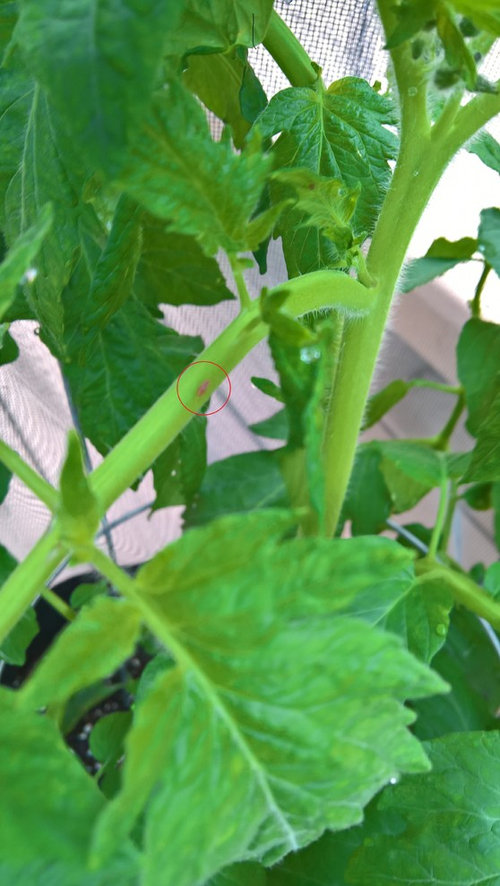
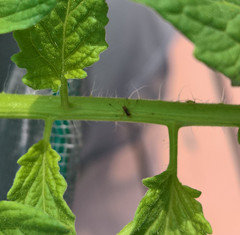
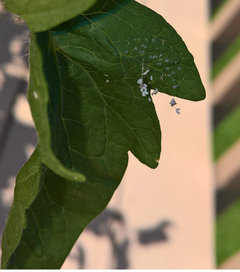
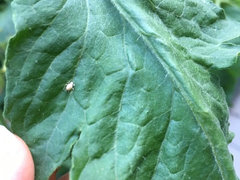
I planted four Rutgers tomato plants about 3 weeks ago in containers on my deck. Today, after a series of rainstorms, I came home to find small brown insects lodged in the leaves of the topmost branches of one of the plants. I was able to take a blurry picture of one that was on the branch itself:

The plant seems otherwise undamaged. Can anyone identify these? Do they pose a real threat and if so, how do I get rid of them?

Thanks

Comments (72)

  • 9 years ago

    If I'm making my own neem oil mixture, does it matter what kind of soap it is? I mean we have Dawn Ultra Escapes cherry blossom and Palmolive classic. Would either of those work ok?

  • 9 years ago
    last modified: 9 years ago

    Yes it matters but most will work. Better stick with 2 tablespoons oil plus a max of only 1 teaspoon of these dish soaps., per gallon, to protect the leaves.

    Just so you know the better retail one is up to a tablespoon of Castile Soap, available at Walmart(link), CVS(link), Target(link), etc., unscented (baby) is best but peppermint, etc. are fine, in the body washes dept. These are insecticidal soaps.

    Start with warm water, disperse the soap well and then patiently mix in the neem oil. If you can't get the Castile soap, see if you can get away with a half teaspoon if using the Palmolive or Dawn (unscented is the better option) - just keep mixing until the oil won't form a separate layer.

    Use the dish soap one with the least amount of additives. Don't spray during hours that the sun can burn the leaves, and just make the amount you are going to use that day. Keep shaken when you spray and cover them, but avoid much dripping waste.

    Cheers

    PC

  • 9 years ago
    last modified: 9 years ago

    Shake up the tank frequently as you spray. And the soap is really just to act as a surfactant/emulsifier, so it really doesn't matter which you use. As PC says, a true soap made from natural fatty acids like a castile soap has the added benefit of some insecticidal qualities for small, soft-bodied pests. But since you're spraying neem oil, I'm really not sure whether it adds much.

  • 9 years ago

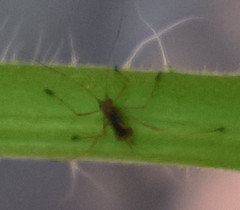
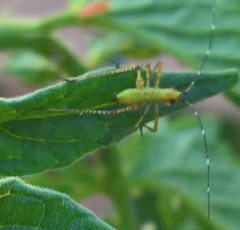
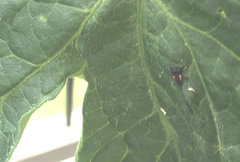
    I've noticed what I believe to be other insects on one of my plants.

    It's bigger and darker than the aphids (there's a green one on the right of the picture for scale).

    Here's a closeup

    Any idea what they are?

  • 9 years ago

    Looks like a miniature version of a crane fly, but I could be wrong.

  • 9 years ago
    last modified: 9 years ago

    neem oil works great as either fungicide or insecticide,. but for bugs, neem (and other various sprays) require multiple short interval applications. the application in most insecticides is every 7-14 days, but if you have infected plants you will have to repeat 3x more frequently. i would recommend every 3 days using neem for 2-3 applications. then maybe every week or two after that.. neem only works in certain stage of the insects life, it does not directly kill.. when you see aphids or other bugs, chances are there is multiple stage/generations, so more frequent application is required at first. typical neem oil extract application rate is 2 tablespoons per gallon. if your problem is bad, i recommend starting at 3 tablespoons for first application then going down to 2, and then 1 tablespoon once a week to keep things "in check".

    honestly, the best way to fight bugs is with water. yep good plain water.
    a decent sprayer of at least 2 gal is what i recommend. i have a 2 gallon sprayer it includes multiple spray nozzles with different spray pattern and the tip of the sprayer is bent on an angle to easily blast the underside of leaves. this is the unit i have: http://amzn.to/2sug6sj
    best garden sprayer you can buy and not too expensive. i suppose you could use a garden hose, but too clunky to maneuver between the vines in my opinion.

    i just recently had a mild infestation of red potato aphids (the aphids you have) on some of my potato leaf plants and i removed almost all of the aphids in a matter of two applications in 2 days with just this water sprayer method. the bugs are born on the leaves so once removed they're too dumb to figure out where they came from and end up dying.

  • 9 years ago
    last modified: 9 years ago

    Boris: Any idea what they are?

    No idea. I'd send in the photo to bugguide.net to see whether anyone can ID, just out of curiosity. If you do, let us know if you get an answer.

    lgteacher: Looks like a miniature version of a crane fly, but I could be wrong.

    I thought it might be a flightless member of the crane fly family at first, too, but none of them seem to have those long antennae.

  • 9 years ago
    last modified: 9 years ago

    Maybe a two word bug guessed on two vowels??? You really need a better picture if you want people to spend time on this!!! Since the crickets are chirping on this one....

    It would be great if it were an aphid predator midge! Though it resembles a fungus gnat. Or even a mayfly? (Are those vertical wings, I can't even tell) Hey you said ideas ...

    Nah, I'm gonna go with a diminutive cricket nymph (chirp-chirp) or katydid nymph. Two words, two vowels :-)

    Cheers

    PC

  • 9 years ago

    I didn't see any wings and they don't seem to be going after the aphids, but it sounds like they are not harming the plant, in fact, they were mostly gone by the time I went to spray the plant again, so I'm going back to trying to get rid of the aphids without outside help.

  • 9 years ago

    Just saw a ladybug near one of my plants. I hope that means they found the aphids because it doesn't seem like the 1% spray is helping at all

  • 9 years ago

    Are your plants absolutely covered, or do you just see a few clusters of aphids here and there?

  • 9 years ago

    There are a lot of them, but I wouldn't say absolutely covered. More than a few clusters, though.

  • 9 years ago

    The 1% spray takes 3 days and rain makes it less effective. What happened with the raw neem oil you were going to spray?

    Cheers

    PC

  • 9 years ago
    last modified: 9 years ago

    I ordered it and last I heard it's in Philly. Should have received it by now, but hopefully tomorrow if it didn't get lost. Maybe if the ladybugs get with the program I wouldn't need it. Yeah, I know, wishful thinking.

    The 1% spray, I had 3-day periods without rain tn the last few weeks and didn't see improvement.

  • 9 years ago
    last modified: 9 years ago

    IMO, the neem extracts aren't that effective against pests. I think the components of neem that are pesticidal rely on the mechanical properties of the oil to work. I never buy any ready-to-use spray in a big box store that advertises neem. I tried one years ago, and it was a waste of money.

  • 9 years ago

    I got my virgin neem oil yesterday. Couldn't use it because of the rainy weather. I'll try tonight, there are at least 3 rain-free days in the forecast and only low chances after that. I'll check for ladybugs first, but if I understand correctly, neem oil only kills them if they are hit directly, and I only saw one yesterday, but it was active on the leaves, so will see.

  • 9 years ago

    It doesn't seem like the neem oil is doing much. I sprayed twice, on the 20th and again the 25th, both times using about 15 oz per plant, the second time using more oil in the mixture than the first. There is actually more activity today as far as the aphids moving around, and I'm seeing more winged ones now. They're camping out on buds and blooms now too., not just leaves and branches, and many flowers have dropped. And the neem oil has scared off the few ladybugs that were on the plants (the maximum I saw at any one time was 3). I am beginning to worry that I will lose my entire harvest. Is there anything else I can do?

  • 9 years ago

    Have you tried insecticidal soap?

  • 9 years ago

    No, not yet. I've also read through some posts which suggest that it's possible to attract or buy ladybugs even for container setups like mine, just not sure how best to do that and how many I'd need.

  • 9 years ago

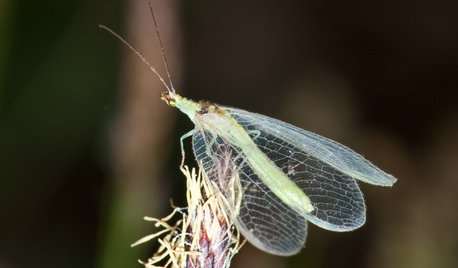
    Purchased ladybugs are unreliable and bad for your local ladybug population. Lacewing eggs are a much better bet because you're getting eggs, so the nymphs that hatch have no choice but to hunt your plants.

  • 9 years ago

    The thread pretty much had all the options pretty clear by the time you got to spraying the raw neem.

    And then there's the unmentionable atomic blasting option. Malathion, yikes! But a combination water spray, neem and insecticidal soap, and tape twiddling fingers combination, should work. Did I mention diatomaceous earth earlier, I've forgotten?

    If you want to take a sledghammer approach which nobody yet dared to
    say, you can try a car vacuum .... carefully ... very very carefully.
    Carefully. Carefully. Not responsible for the results, but you can try sucking them right off the plant with a portable vacuum if you get the knack for not sucking or otherwise damaging the growing tips and flower clusters into it too. But we are reaching the end of the line here.

    For a novel approach, try a hot hair dryer to scatter them off where spraying water apparently didn't work? Just thinking out loud trying to be helpful.

    Cheers

    PC

  • 9 years ago
    last modified: 9 years ago

    If you're considering trying to attract beneficial predators, I linked to an article about that up near the beginning of the thread. But IIRC, you weren't interested in the idea.

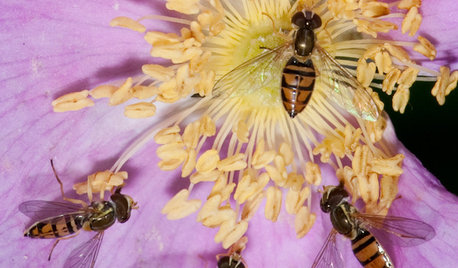
    I find that the most reliable predators of aphids in my garden are hoverfly larvae. These will come out in force if you provide the flowers the adults like to feed from. Second are the parasitoid wasps, which like the same kinds of flowers. I do find some ladybugs and lacewings as well, but not anywhere near the numbers of hoverflies.

    I recently realized how effective they are because I had a couple extra pepper plants and chucked them into a container that I had to put in a part of the yard far away from the flowers I planted for the beneficials. Those peppers have a constant aphid problem. Meanwhile, the same variety of peppers near my beneficial predator flowers have no aphids. The hoverflies are literally constantly swarming all over that part of the garden because they like the flowers I plant for them there.

  • 9 years ago

    @gorbelly It does seem like I was not interested, but really I am just wondering if I can do something like that with a container. How many flowers would I need for four tomato plants?

    Also, @PC's link mentions PredaLure. Is that effective at all? If I do decide to get lacewings, how long do they stay?

    I guess I have to decide on neem oil/soap vs beneficial insects approaches since they are mutually exclusive. Which is more likely to work and quickly enough to save my plants?

  • 9 years ago

    Back in the days of WWll and Victory gardens we dealt with an aphid infection on just a few plants using two methods. First, we squished some of the aphids between thumb and fore finger. It seems to send a signal to the others that danger lurks and some begin to release there 'hold'. This is followed by soaking a large sponge in water and then rubbing an Ivory soap bar all over the sponge heavily and squeezing the soap saturated sponge over the aphid clusters. Best done in the cool of evening. Aphids should be gone by morning. Then give plants a gentle spray washing before the day heats up. I have used this method all these years with success.

  • 9 years ago

    If it's only 4 plants, I'd use a combination of soap spray and manual spray-blasting. You just need to stay on top of it and try to also dislodge as many aphids as you can. Eventually, the populations should decline.

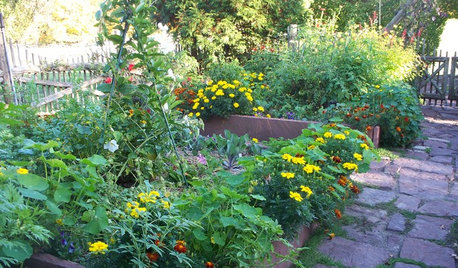
    For a more biological approach, you'd need to plant a few different pots of flowers around to make sure something is always flowering for the predators, but if you use things like sweet alyssum, you should have blooms for most of the season into fall except during the hottest part of the summer. Planting some herbs and letting them bolt should take care of the hot part of the year. Succession-planting pots of cilantro and letting them bolt is also a workable strategy, plus you can harvest the coriander seeds if you want and use them in cooking.

  • 9 years ago
    last modified: 9 years ago

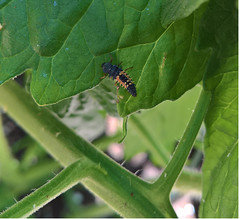
    It looks like some beneficials may have finally found my aphids. Ladybug larvae have been fairly active today

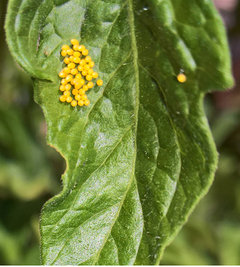
    And I believe these are brand new ladybug eggs from just this afternoon:

    And might these be lacewing eggs?

    I don't know how long either takes to hatch, but given all that, I might hold off on insecticides for now.

    I may have even confused some adult lacewings with winged aphids. Are they about the same size?

  • 9 years ago

    Adult lacewings are quite large compared with aphids. Think of a mosquito, but larger.

  • 9 years ago
    last modified: 9 years ago

    Adult lacewings are quite beautiful (at least, I think so) and, as rgreen says, much larger. Hard to confuse with an aphid. The ones around me, which are likely to be the same as the ones around you, are generally about 3/4" long. Much larger than a mosquito.

    Those are ladybug eggs, yep, and can't be sure about the lacewing eggs, but that would be my guess, and they look like they've hatched already, whatever they are.

    Lacewing nymphs and ladybug nymphs both look like mini-alligators, though the coloration is different.

  • 9 years ago

    gorbelly - what flowers do you plant, besides alyssum and bolting coriander? Not in general (I read the article), but YOU - what do you have planted for the beneficials?

  • 9 years ago
    last modified: 9 years ago

    Oh, boy--prepare for a longish post.

    In the early part of spring, I have rock cress and a sedum that flowers fairly early.

    As we get into late spring, the alyssum starts producing flowers, and the creeping thyme produces flowers that are extremely popular with just about anything that likes pollen and nectar.

    As summer gets on, the alyssum, which is really my workhorse flower for beneficials, starts to sulk in the heat, which is where the yarrow takes over, as does the cilantro and dill (I plant varieties designed to flower and produce seed for spices as well as slower-bolting varieties for my leaf-herb needs). This year, I also planted some anise, as I want to harvest the seed, but it hasn't bloomed quite yet. I succession plant these to try to always have some herb blooming all season. Coreopsis is also popular with hoverflies and tiny wasps, and I notice a ton of them around it, although I originally planted it for pollinators. Any radish I let go to seed for seed-saving purposes is also very popular. Oregano should be blooming any minute now as well (which I will deadhead before it can set seed because it's already foolhardy to have it in the ground in the first place). I have various daisies/daisy-shaped flowers that tend to bloom during high summer, too. And I have a second species of sedum that flowers in summer. The sedums that produce tiny yellow flowers just swarm over with hoverflies constantly when they're in bloom.

    As summer wears on, a lot of the basil goes to flower. As we get closer to fall and temps start to drop a bit, the alyssum comes booming back in full force and will flower profusely until frost (it actually tolerates some light frost and keeps blooming until a hard frost). I also have some asters here and there, which bloom from midsummer all the way to frost. I'm going to get some solidago (goldenrod) for the fall as well, as I hear it's an important late-season source of food for pollinators, too, and my fall offerings are a little slim. But a lot of the beneficial predator activity is naturally winding down on its own by early fall, and that's when I have to get vigilant again scouting for aphids, etc.

    Note that these are just beneficial predator flowers. I also plant for pollinators, as I have an especial love of native bees, especially bumblebees. But that's a whole other topic, LOL.

  • 9 years ago

    Dang, I killed a few lady bug larvae, thought they were eating my cucumber leaves :-(.....but thanks for the pic, now I know what they are.

  • 9 years ago

    What is this guy? A praying mantis?


  • 9 years ago

    I think it's a katydid nymph.

  • 9 years ago

    Ah, ok then. Thanks.

  • 9 years ago

    It looks like the aphids are backing off of my developing fruit. They swarm the flowers and their bases, but seem to be completely clear off the bases of the new fruit or the fruit themselves. I'm certainly not complaining, but I wonder what the reason is, and whether there is any danger to the development of the fruit from their actions elsewhere. Certainly there has been some blossom drop most likely due to the aphids, but hopefully round one of the harvest will actually harvest something, and hopefully the future fruit will be more plentiful courtesy of the ladybugs and their larvae.

  • 9 years ago
    last modified: 9 years ago

    In my experience, aphids don't like fruit. Perhaps the skins are too thick for them. They prefer leaves, especially young, tender leaves and buds and the flower stalks.

  • 9 years ago

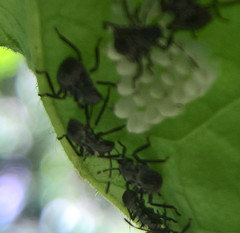
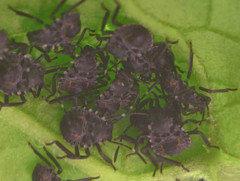
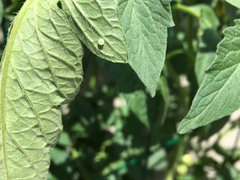
    Found something else on the underside of a leaf. Any idea what these are?

  • 9 years ago

    The picture is blurry, so it's hard to tell. When you look at them IRL, do they look like any of the instars of the Brown Marmorated Stink Bug? http://entnemdept.ufl.edu/creatures/veg/bean/brown_marmorated_stink_bug.htm

  • 9 years ago
    last modified: 9 years ago

    I would personally snip off that leaflet and place it in a closed container while I figure out what it is. If a pest, you can kill them. If it turns out to be a beneficial, you can re-release them onto your plants.

    But in general, when nymphs cluster like that, they're herbivores, therefore pests.

  • 9 years ago

    It's really hard to see them close up without removing the leaflet. I think they do match those stink bug images, and I've seen an adult stinkbug on my plant once before. There's also a ladybug pupa on that leaflet. What kind of container would you suggest?

  • 9 years ago

    Any kind of a container, as long as they can breathe . A jar, a takeout plastic tub... whatever. It's only to get them off the plant while they're still clustered together and easy to deal with just in case they're pests that you later want to kill.

    If there's a ladybug pupa on there you want to save, then knock the nymphs into the container and cut off only the part with any eggs that are still alive.

  • 9 years ago

    Definitely stinkbugs, yuck. Thankfully, the pupa was already abandoned.

  • 9 years ago

    Yeah, they're gross. But they do conveniently like to cluster together while young, so they make it easy to get rid of them by clipping off the leaflet they're on.

    Be vigilant for more. These guys can ruin fruit. I don't get worked up over pests that like to take a nibble of foliage here and there, but I don't tolerate ruined fruit!

  • 9 years ago

    gorbelly - Just wanted to thank you again for your wealth of information in this post, and sharing your flower plantings for beneficials.

    I planted some of your suggestions, let my radishes bolt, etc, and I've seen lots of beneficial bugs. I had never before even seen an infested aphid (didn't even know it could happen) and now I'm seeing them everywhere.

    I think this is a ladybug baby:


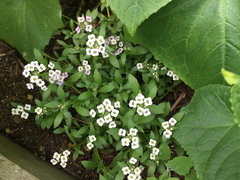
    My alyssum is doing well:

    Of course, I also just found this yesterday too :(

  • 9 years ago
    last modified: 9 years ago

    Isn't it so satisfying to see predators and parasitized aphid mummies? For some reason, I really enjoy seeing evidence that my garden is an ecosystem.

    Hornworms are a whole other thing. Parasitoids will eventually take them down, but often not before they do a lot of damage. If you put up things that birds can perch on and peer through your plants, they'll help you a lot with larger pests like caterpillars.

    The only problem with that is that sometimes you'll find damage and frass and completely fail to find the culprit no matter how hard you look. So you have to wait and see whether the damage worsens. Unfortunately, birds and wasps will not leave a note for you giving you closure when they eat a caterpillar.

    Of course, you could always spray BT. I prefer to hand-pick unless I get a real caterpillar infestation or something like pinworms, which are the worst, IMO.

  • 9 years ago

    So far I just planted some marigolds, since they are already in bloom, so no need to wait for anything to sprout and grow flowers. I got a fair bit of ladybugs, both larvae and adult (the Asian kind, but I'm not complaining as long as they don't want to come into the home for the winter). I see other beneficials occasionally and a few mummies, but nowhere near as much. Things have gotten a bit better with the aphids, but not 100% by any means. I am reluctant to spray lest I lose the building ecosystem. Next year, I'll plant more to attract beneficials before planting the tomatoes. Hopefully that will tip the balance in my favor early on.

  • 9 years ago

    One of my plants is almost smothered with aphids, so that one I will have to spray with some insecticidal soap after the rain ends today.

    I just read that a lot of viruses can be spread by aphids, so now I'm worrying more about them. I don't want to get this far into the season only to get a dreaded virus.

    I do get some calming satisfaction (sadistic as it may be) from looking under leaves and smushing whole families of aphids gently with my thumb. ;-)

  • 9 years ago
    last modified: 9 years ago

    It can take a while for beneficials to strike a balance with pests. Even with all my interplanting, in the spring, the aphids often get a big head start. I just keep knocking them off the plant with plain water (I use a spray bottle I have that can emit a pretty forceful stream because my hose jet is too forceful for tender young tomato foliage) until I see that the populations are being kept down naturally.

    I like to smush them as well.

  • 9 years ago

    And, yes, aphids can transmit CMV, etc. But the transmission of viruses is usually done by the winged aphids that can actually travel. Most of the aphids multiplying on your plant are parthenogenic clones which can't really leave your plant unless they decide to take winged form (they do that in the fall so they can mate and lay eggs before winter, in the spring when they emerge from eggs to look for a host plant, when a food source is running out, etc). There's really no way to stop the winged ones from flying into your garden. As long as I don't have a plant in my garden that is currently infected and therefore can serve as a reservoir, I just choose not to stress about aphids spreading diseases. Because there's not much I can do to stop it.

Sponsored
Wannemacher Interiors
Average rating: 5 out of 5 stars26 Reviews
Customized Award-Winning Interior Design Solutions in Franklin Cnty OH