Software
Houzz Logo Print
rcranf1

Logan lab soil test result

9 years ago

Attached is my soil sample from logan labs. Could someone help me interpet this. I have tall fescue and i am located in nc

Comments (22)

  • 9 years ago

    I'm curious how you posted that image. It didn't come in like other .jpg images.

    I can't help much with chemistry specifics, but I can tell you what I see in a global sense. TEC of 2.5 means you have the purest sand. With a pH of 6.7 I'm saying it is silica or granite sand and not a seashell type sand that would boost the pH a full point or more. It may as well have 0% organic matter.

    I almost never suggest people use compost, because it is very expensive. If you feel inclined to put in the work, compost might help. What I usually suggest is using organic fertilizer. I would strongly encourage you to use that from now on to help bring your organic matter up. Growing grass will do the most good for the soil. Always mulch mow to incorporate the organic material from the clippings.

  • 9 years ago

    I just took a screen shot from the attachment i recieved from logan labs. Is it not readable?. So i gather i need to put down a organic fert in order to get my organic matter in the soil up

  • 9 years ago

    This soil test may very well explain why your grass is drying out, your soil can't hang on to much water.

  • 9 years ago

    What do you mean by hang on to much water and how do i fix that. I have no clue what im reading on this test

  • 9 years ago

    Think sand. If you try to water it, the water just runs right it through because the particle size is so big. On the opposite end of the spectrum is clay - very small particle size and it "soaks up" a lot of water. Organic matter also "soaks up" a lot of water. These 2 particles also hold on to nutrients.

    Ideal soil is a mix of sand, silt and clay with a good amount of organic matter(6%-8%). Yours is on the sandy side, with not that much clay and OM. This results in a low Exchange Capacity, which is a measure of how well your soil can hang on to nutrients. It also means your soil is very well drained and doesn't hold a lot of water for the grass.

    In this situation, lighter more frequent irrigation is appropriate. Also, since the soil can't hang on to nutrients, organic fertilizer which releases nutrients a little at a time will ensure the grass has a steady supply. Regular synthetic fertilizer would mostly leach through.

  • 9 years ago

    Ok so my soil is made up of mostly sand is what i gather. So with my tall fescue you had said i should go to 0.5 inches of water every 3 days. But now with these results should i adjust this for the summer or keep it the same. Also what would you recommend i use for a organic fert that is slow release

  • 9 years ago

    Stick to 0.5" every 3 days for now, should work well. Milorganite is popular among organic folks and readily accessible. Your next app of fertilizer should take place in September.

  • 9 years ago

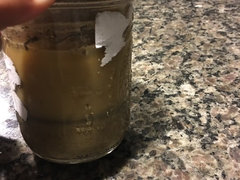
    Ok great thanks. Also is attached is a picture of the jar test. Looks like over 75 percent is sand

  • 9 years ago

    Why did you get an ammonium acetate test?

  • 9 years ago

    I ordered the standard test

  • 9 years ago

    Organic fertilizer is a good idea as it is slow release and the soil life will hang into the nutrients instead of them just leaching away. But I wonder if there is sufficient soil life to process the fertilizer. Another issue is that you need potassium and organic fertilizers generally have little. I'm hoping Ridgerunner will have mercy and give some guidance (he has said he's not going to interpret Logan tests) as this one is beyond my level. I think you could probably use some local professional help with advice on your backyard drainage problems and your soil's inability to retain water and nutrients.

  • 9 years ago
    last modified: 9 years ago

    Mercy?

    Seriously, Becky?

    BTW, this situation is pretty beyond anyone's level.

    @rcranf1

    The only good news is that you have fairly decent iron levels.

    With a CEC of 2.5 (I saw the pics and you certainly have a beach sand soil) you have no soil storage to speak of for nutrients. No buffer, no space for reserves for a little insurance. Even if we could adjust all the nutrients perfectly, you'd be lucky to reach the bare minimum levels for a "not performing poorly" lawn and it would be back out of whack within a year if not a few months. We're talking minimums, not sufficiency levels.

    in ppm:

    Min S = 7, you : 7

    in pounds per acre:

    Min P2O5 = 107, you: 73 (FYI sufficient is 112 to 232)

    Min Ca = 700, you: 719 (by the skin of your teeth)

    Min Mg = 100, you: 84

    Min K = 80, you: 35

    When you add to raise one (Ca, Mg, K, H, etc), you inevitably lower another.

    Although micros are seldom an issue for turf grasses as long as they are present in some amount, your Mn and B are so low that they may be deficient enough to create issues.

    There are so many conundrums here. Sand doesn't hold water, so you're going to need to water daily, watering is going to exacerbate nutrient leaching out of the soil. To increase CEC of the existing soil, you can add OM, but a thick layer of raw OM material on the surface is going to hold moisture and create a breeding ground (just like thatch) for disease and fescue is pretty susceptible to disease. You could till in OM, but that can be tricky. You could bring in a quality top soil, but that can be expensive and quality is a gamble. You could spoon feed the primary nutrients on a continuing basis, but that takes a lot of effort and the only way to perfect it is to take a saturated paste test prior to each application for maybe two years and that's effort and expense.

    I'm sorry, but the simplest I have for your current conditions with fescue would be:

    May 1, June 1 and September 1: apply Milo then 1# of Urea Late November.

    or

    Apply 1# of slow release synthetic June 1, September 1 and 1# Urea late November and 1# of Triple Superphosphate April 1, May 1, June 1 and October 1.

    In either case apply 1# of SOP (potassium sulfate) May 1, June 1, August 1 and September 1.

    Then test again next year the day before the June 1 apps.

    If this were me, I'd walk the neighborhood (looks like newer construction) and ask those people who have a nice lawn what they had done to get it. Added top soil? What type of grass. How they fertilize. How they water? Who they hired or bought from. In other words I'd collect all the information I could get my hands on to help me make a plan I can live with and afford.

  • 9 years ago

    Thanks, Ridgerunner. The only thing I could think of was alternating organic feeding with spoon fed synthetic feeding but I had no idea of what exactly to recommend or whether it would even work.

    Rcranf, keep in mind that Ridgerunner has recommendations here for fescue. If you do Bermuda in the backyard, it would have a different schedule. Bermuda gets most of its fertilizer in the summer. For fescue, you avoid the hot part of summer.

    I wonder if this might be a case where it might sense to give up on grass for now and plant crabgrass in the backyard and keep whatever weeds make their way in. That at least puts roots in the ground. Then in a year or so try Bermuda for both back and front.

    +1 on Ridgerunner's suggestion to talk to neighbors.

  • 9 years ago

    Wow thanks ridgerunner and becky this is alot to take in. I will digest all this information and figure out the best route to go. Thanks for advise and knowledge. I will post an update once i figure out the plan

  • 9 years ago

    Bermuda should do well in that, other folks apply layers and layers of sand to their lawns and it thrives.

  • 9 years ago

    So after spending all day with landscaping contractors and talking with neighbors this is what ive come too for my backyard. Long story short Contractor will come in level everything back out. Bring in top soil. Fix my issues with downspouts by running underground piping. Putting seed amd fert down and they will maintain the yard for 30 days to ensure no problems. I would like to also grow fescue in the backyard but from all my reading here i would assume i should not seed that here in july. Allthough the contractor says it will be fine and that we can seed it. My neighbor 3 houses up seeded his tall fesuce last july and it seems to be doing well nice and dark green. But i dont remember if it was this hot last July. My second choice would be to have him seed bermuda instead. I just wanted to stay consistant with what i have in the front yard

  • 9 years ago

    Don't seed fescue in July, it's as useless as massaging a prosthetic leg.

  • 9 years ago

    So...

    1. Other than the neighbor 3 houses up, do the rest of the ones you spoke to have fescue?

    2. How do their lawns look after a year? Would you be happy with the condition of their lawn(s)?

    3. Did they bring in topsoil or did they grow their lawns on your native sand?

    4. How often do they water and do they have a in-ground sprinkler system?

    5. How often do they fertilize and what with?

    How much topsoil is the contractor suggesting to bring in? Anything less than 4" in depth wont help much.

  • 9 years ago

    Of the 8 i talked too. 3 have fesuce 2 have centeipede and 3 have bermuda. Both fescue and bermuda lawns look good. The centeipede lawns are ok i guess i dont like that grass and dont really know how a lawn like that is supposed to look in a good state. All the bermuda lawns were sod in back and seed in front. Fesue lawns were seed. Bermuda owners said it was layed when the house was put up so they have no clue how it was out in. They just maintain it. 1 fescue lawn bought in too soil the other 2 grew right in sand. Seems like everyone just waters on differnt schedule. No rhyme or reason to it. They just set the timer and forget it. As far as fert goes it was also mixed. I payed more attention to those with fescue as one of them just put down some fert this past weekend. I meant to take pictures. His lawn is ok. Not deep green but not brown either. The other 2 have lush green yards they both last fert in may one plans to fert again in july and the ither said when it gets cool. I will have to ask the contractor about the depth. But he mentioned 5 pallets. Im waiting on all the specifics in the quote and detailed write up he will provide

  • 9 years ago

    1 fescue lawn bought in too soil the other 2 grew right in sand...The other 2 have lush green yards they both last fert in may one plans
    to fert again in july and the ither said when it gets cool.

    If the two lush yards are on sand, I'd copy what they do/did. I'd say your soil is able to support a lawn. Seed on your sand, follow the recommendation for fertilizing this year and I'd copy their watering schedule.

    5 pallets probably indicates he intends to sod, that may be a very viable option if the price is in your wheelhouse. Both seeding and sodding have better success rates (and less watering) if done in the Fall when temps break.


  • 9 years ago

    I would be wary of bringing soil in unless an equal amount was taken away. And even then, would it be graded properly? If the idea is to bring in a inch or so of soil and put it on top of what you what, that will put your hard surfaces (sidewalks, for example) in a valley and won't change your underlying soil problems. Talk to references of any landscaper you consider.

Sponsored
Custom Home Works
Average rating: 4.6 out of 5 stars10 Reviews
Franklin County's Award-Winning Design, Build and Remodeling Expert