Software
Houzz Logo Print
kellywodetzki

Corn meal vs cracked corn... any difference?

9 years ago

I am going to apply corn meal or cracked corn to lawn to treat/prevent fungus (yep I know - some of you are believers and some of you are not)
Question to the believers: any difference between applying the corn meal vs cracked corn? I have access to cracked corn 50lb for $12 plus applying corn meal is a b*tch of a mess
Also, could I apply soybean meal at same time/week after?
Would an application of potash feed any bad/emerging 'bad' fungus (my potassium levels are low - yes soil was tested)
West MA, fescue / Kentucky bluegrass mix, approx 5000 sq ft lawn, a LOT of rain recently

Comments (12)

  • 9 years ago

    There's cracked corn, corn meal, and corn flour. Obviously you don't want the flour. I have found the meal flows perfectly well out of my spreader. I don't know why people say the meal is difficult to apply. It is about the same as soybean or alfalfa in texture. There really is no difference in how cracked vs meal act, but I prefer the meal because I think it breaks down quicker, and the birds don't notice the meal. When I apply the cracked corn, I have a birdfest in the yard. A couple of years ago I counted 65 birds in one small area of my back yard eating the cracked corn. Some on this site say it doesn't matter, that there is so much cracked corn that the birds can't get a significant amount, but I disagree. I see no reason not to use the meal when the great benefit is that the birds hardly notice it.

    I don't know whether the corn does anything for my lawn as far as fungus. I had an outbreak of some kind of fungus last year, but it does add organic matter to the soil in any case.

    I would apply soybean a week or two later, but I don't really know if it matters. I can't comment on the potash, but I don't know why it would matter if you did it at the same time as the corn.

    Pippin thanked danielj_2009
  • 9 years ago

    Can anybody tell me how much soybean meal to put down (20lb per 1000sqft?) and is there any difference between putting down soybean or alfalfa? I'm trying to keep the organic matter up - I've noticed a difference with there being less fungus issues so far (tho with all the rain we have been having ... )

  • 9 years ago

    Corn meal vs cracked corn... any difference?

    Nope, both equally useless for any kind of fungus prevention or treatment.

  • 9 years ago

    I use a medium screen cracked corn from local feed store monthly @ 15lbs 1/k.

    10 to 20 lbs of SBM and alfalfa is fine. I use alfalfa pellets (smaller rabbit size) as meal is a pain to spread. I cycle between SBM and alfalfa pellets at 15 lbs/1k. I also apply cracked corn and either SBM / Alfalfa at the same time.


  • 9 years ago

    I applied cracked corn in April. It has made a difference in promoting a healthy grass growth (general fertilization). So in the sense of having a healthier plant, it probably helps. I have been reading about rhizontonia solani. It overwinters in sclerotia, which are hardshelled and not vulnerable to chemicals or other fungi. When conditions are good for development (warm, humid), bulbils attached to roots start sending out hyphae. They can attack the plant through natural openings, like stomata. The mycelium can spread plant to plant (easy in turfgrass which is so close to each other) and spread the disease. Generally for turfgrass it's the leaves that are attacked and as long as the crown and roots are unaffected, the plant can regrow. However the grass is very stressed and does not have as much photosynthesis from the leaves (since many have been decimated) and so can be done in, especially if it has other stresses, like drought stress. Having a healthy plant ahead of attack may make a big difference in survival. I have some clumps where probably the corn was probably applied more heavily than others and they are noticably thicker and greener with wider blades.

    Try to keep the leaves as dry as possible as long as possible: water in the morning, when watering, so the leaves dry quickly. Mowing at 3 inches or 3.5 is probably better than 4 so that there is less humidity down there. I am reading that brown patch is worse when the highs are in the 80s than in the 90s (maybe because things dry more quickly at higher temperatures) so I am mowing at 3.5 for now and will move to 4 (highest I have) when temperatures are higher. I am also using Serenade as a preventative. I think I have had an attack in one area but in general the grass is hanging in there. Excessive nitrogen exacerbates brown patch. However, light applications (1/4 lb/k) or a slow release, like any organic, would help the grass grow. Be judicious in amounts applied, even for organics, as cool season grass should not be forced to grow in the hot part of summer.

    I did 25 lb/k of the corn in April and calculated that it supplied about 0.4 lb/k of nitrogen. That's not much. The grass is acting like it had more. Maybe it was so grateful for any nitrogen (I had not done the late fall feeding as the grass was still growing all through December), it started celebrating.

    Pippin thanked beckyinrichmond
  • 9 years ago

    @pippin: Be careful not to use alfalfa too frequently. My understanding is that it has a growth hormone in it that isn't good for the lawn in large quantities, particularly in the fall, I think.

    @j4c11: I have to agree to an extent. I do not see any particular benefit for fungus prevention for me. However, others do report success, so it is a bit presumptive to say it doesn't work for anybody anywhere. I'm sure in the transition zone it is probably useless on a lawn, but maybe not in other areas or other particular lawn situations. There's just not enough real data as far as I know.

  • 9 years ago
    last modified: 9 years ago

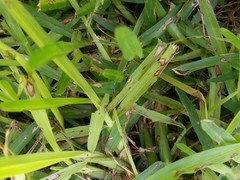
    Presumptive indeed. It has worked very reliably for me every year from 2002 to 2014. Since moving from San Antonio my new lawn has not developed the disease (yet). Then again I only had a few square feet of actual grass for the first 2 years. Here is a before and after example from my former lawn.

    Before

    ...and after corn meal

    These were taken a month or more apart.

    I took the second pic not to document the corn meal effect, but to show the chlorotic yellowed grass in the center of the picture. This was due to heavy rainfall washing away nutrients and/or possibly changing the pH of the soil.

    I don't know why the universities cannot achieve similar results. After all the original idea for using corn meal against fungus came from Texas A&M University. They have been trying to distance themselves from this idea since the 1990s when it first appeared on their website. In the mean time, I'm not alone in getting this same benefit. I get feedback from people reporting that it works. I cannot explain why it works for some and does not work for others. Maybe it only works on St Augustine??? Maybe it only works in Texas??? Maybe it only works on calcitic soils??? The first time I tried it I was not an organic kind of guy. I was very skeptical, but that magical turn-around instantly got me on the organic band wagon.

  • 9 years ago

    Here's testimony of the efficiency of corn meal on fungus: http://forums2.gardenweb.com/discussions/4685895/grey-leaf-spot?n=12

    People report success, but a lot of people say they feel much better after taking sugar pills. It's called the placebo effect. Even if there is improvement, you still don't know if the grass would have improved anyway without the corn meal, or whether it's the nitrogen in the corn helping the grass grow out of it and a handful or urea would accomplish the same thing, or whether any kind of organic material not necessarily corn would do the same thing.

    In order to be able to claim any kind of benefits from corn you'd have to set up:

    - A control plot with nothing applied

    - A plot where some other form of nitrogen is applied

    - A plot where some other form of organic material is applied

    - A plot where corn meal is applied

    - A plot where fungicide is applied to compare efficiency.

    Then make observations regarding the severity of fungus in each plot, and see how the corn plot fares vs the nitrogen/other OM/fungicide/control plots and draw a conclusion. Right now some people report success, some people report failure, it's random enough that it's indistinguishable from nature simply taking its course as if nothing had been applied.


  • 9 years ago

    Update:

    I applied cracked corn (due to price but would have preferred corn meal) and soybean meal/ alfalfa meal a bit over a month ago

    Outcome:

    Significant improvement in fungus issues ... I do not have the issues of previous years and if I had to put a number on it I would say an 80/90% improvement after approx 4 weeks - it has also resolved most of what was there when I applied it

    We have had massive rainfall - unseasonal to get so much over summer... that coupled with humidity has been a recipe for lawn fungus - neighbors lawns are certainly suffering from this

    I am a believer and thrilled with the progress so far!

  • 9 years ago

    @dchall: Well after about 4 years here I've been able to make some observations regarding corn meal. I'm in NJ and have KBG. After using it pretty extensively, I cannot say it has provided any anti fungal protection for my lawn. It is hard to say a lot more than that. Maybe it works for grass that isn't under heat stress? Anyway, I'm reading that KBG sod doesn't usually get fungal problems until the 3rd or 4th year, which is really interesting. In my 3rd year I had a small area hit with fungus (undiagnosed) and this year with all the heat and rain I'm getting hammered in the sunniest portion of lawn. The side and back yard, with a little less sun are mostly fine.

    I'm coming to the conclusion that while having a nice ecosystem of fungi etc would be nice, my particular environment might give me no choice but to use fungicides as a preventive measure. I have made 2 applications of Headway G in a somewhat desperate attempt to limit my losses in the front lawn this summer. Are there any alternatives? Do any of the organic fungicides really work or is the heavy duty stuff the only realistic option?

  • 9 years ago

    I'm wondering if the application of soybean/alfalfa meal at the same time helped? I also put down double quantity of the corn to take in to account the birds etc feeding off the cracked corn... the other thing I did earlier in the season was apply a fertilizer high in potassium since the lawn was deficient in that area and I think it might have helped with the stress of summer

Sponsored
AIS Renovations
Average rating: 4.5 out of 5 stars15 Reviews
Custom Craftsmanship & Construction Solutions in Franklin County, Ohio