Software
Houzz Logo Print
nerdyshopper

Do Dryer Balls Damage Dryers?

8 years ago

I had a set of 4 of those wool dryer balls but I quit using them because I think the banging around of those heavy balls is hard on dryers. They did soften clothes but it is no bargain if they shorten the life of the dryer. Anyone else tried them?

Comments (28)

  • 8 years ago

    I've been using the Nellie's blue dryer balls for probably 10 years with no issues with the dryer at all.

    nerdyshopper thanked akl_vdb
  • 8 years ago

    I don't see how they could cause any damage. It seems like heavy jeans and large zippers would be more of a problem, banging around in there.

    nerdyshopper thanked hisown
  • 8 years ago
    last modified: 8 years ago

    Do you hear the balls banging around in the dryer? Don't they have rubber type too?

    nerdyshopper thanked always1stepbehind
  • 8 years ago

    They were really banging loudly. My old Whirlpool has the sensors built into the lifting rib. That is what took a beating. I don't really know if it causes damage but we can't take that chance.

  • 8 years ago

    Do they damage the clothes?

    nerdyshopper thanked HighColdDesert
  • 8 years ago
    last modified: 8 years ago

    "NerdyShopper: My old Whirlpool has the sensors built into the lifting rib."

    I'm not aware of any Whirlpool-built dryers with sensor bars in the drum baffles. What model is your unit? Must be one I haven't seen.

    nerdyshopper thanked dadoes
  • 8 years ago

    I've been using dryer balls for years, including tennis balls, until my granddog came for a visit. Had Whirlpools for years, too. The balls soften up in the dryer and I can't figure how they'd be able to dent anything that snaps, zippers and buttons wouldn't.

    nerdyshopper thanked Jeannie Cochell
  • 8 years ago

    I use tennis balls or clean white tennis shoes, makes a racket for sure but I've never seen dents or had damage.

    nerdyshopper thanked mamapinky0
  • 8 years ago

    Mine was 1992 vintage. Has a plastic baffle with sensor in it.

  • 8 years ago
    last modified: 8 years ago

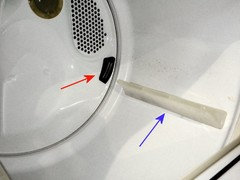
    Are you referring to sensor bars mounted to the rear bulkhead (red arrow), as shown on the 1992 Whirlpool/KitchenAid?

    Or sensor bars in the three (or four) drum baffles (blue arrow)? As noted previously I'm not aware of any Whirlpool dryers that have sensors bars there. Need the model number to confirm it via parts diagrams. There were some Kenmore (Whirlpool-built) models with sensors mounted to the drum in the spaces between the tumble baffles but those date to the 1960s.

    Neither will be damaged by dryer balls.


    nerdyshopper thanked dadoes
  • 8 years ago

    dadoes, you are right. The sensor is just as you show and the bars are just plastic. I guess I just panicked. I will say that after 25 years, the porcelain is rubbing thinner where it rubs on something near the opening. Anyway someone (nobody in our household admits to it took them out and either hid them or tossed them. Right now we are using All free and clear dryer sheets for knits etc. At first we liked the balls but I got worried from all the noise they made.

    This is a great forum for shared information and I am sorry if I misled others here.

  • 8 years ago

    Using dryer balls??? NO..!!!! Why??? Common sense tells me the dryer mechanisms (belts, rollers, idler pulleys, springs, etc...) take enough of a beating as folks tend to over-fill dryers to begin with (jeans, heavy sweats, etc...). As a VERY simple test, place a hand atop your dryer (obviously while it is operating) WITHOUT using Dryer Balls and feel the degree of vibration for a minute or so. Now add Dryer Balls to the dryer (same load of laundry) and repeat the test. I strongly believe this to be objective (not subjective) evidence that your dryer is taking a greater beating. Each time the balls "drop" down from tumbling and hit the drum during continual drum cycling you can clearly feel a more significant impact e.g. your machines internal workings mentioned above will be more stressed and suffer consistent impact (as felt with your hand atop your machine, which in my mind will equate to faster wear, tear and failure. If you've been using balls for 10 years and your machine lasts another 5...then great but...I'd be willing to bet if you NEVER used the Dryer Balls you may well have gotten 20 years out of your machine. Furthermore, I read a "Popular Mechanics" article regarding Dryer Balls....end result...No significant difference regarding the "less drying time, static, and wrinkles. You be the judge. Use common sense and the KISS (Keep It Simple Silly) principle ALWAYS.

  • 7 years ago

    I bought a set of 4 and thought the noise was deafening, tried 3 and it was still loud, however I continued using. Immediately after my dryer began squeeking through the whole cycle. Still using the wool balls I happen to think it might be them. I stopped and the noise stopped and has not continued. So I would agree with rayncryss above that they do cause a hardship on the dryer. The outter workings have to impacted from the continual banging against the drum.


  • PRO
    5 years ago

    There's still some debate whether dryer balls actually do much, the popular mechanics article about this is a definite eye-opener. If you need balls, the woollen kind are probably better - especially if you hate the clanging sound.

    Source: https://www.electrafixbc.ca/articles/balls.html

  • 5 years ago

    I believe the dryer balls cause damage to dryers. Recently, I had to replace the start button / control button on a dryer that is less than 6 months old. I was using wool dryer balls and balls that are made of plastic / rubber material. I am not going to use dryer balls anymore.


  • 5 years ago

    Does anyone know if it’s at all possible for the dryer to “eat” a wool dryer ball? I had six balls in there when I started the day and now I have five. I have looked all over my apartment (thinking one fell out and my pup got it) and I have looked behind and on the side of my washer and dryer. It is no where to be found. I am wondering if it could get small enough to get sucked into the lint trap? I just wanna know what the heck happened to the ball.

  • 5 years ago

    I use 6 of the woolies at a time on every load, with a few drops of lavender on a couple of balls...while I still occasionally get static cling, they have absolutely cut down on the drying time. Ive also not noticed any extra noise they cause, but can imagine how the plastic/rubber ones would be noisy

  • 5 years ago

    I used them (wool) for a while but in the long run I was unimpressed with any effectiveness they might’ve had. I also got tired of them running away when I removed the laundry from the dryer, rolling around on the floor and having to be picked up. I don’t use them anymore as they seemed a nuisance.

  • 5 years ago

    @Donald, what is your interpretation of the process and science by which the wool balls you use have the ability to reduce drying time?

  • 4 years ago

    Yes, they contribute to the heating element going out.

  • 4 years ago

    @Jesse Painter, what's the mechanism by which dryer balls can interact with the machine's heating element?

  • 4 years ago
    last modified: 4 years ago

    That’s highly improbable. Take your dryer apart once and you’ll understand immediately. Actually, anyone trying to argue for or against should take one apart, you’ll gain a great deal of understanding just looking at what the components are made of and where they’re located.

    My point isn’t to be judgemental or snarky, it’s actually quite a do it yourself job in the not so recent models. Like circa 1990s-2000s and cheaper models. All you need is the sticker located on the back and/or on the inside of the dryer door(model and serial numbers) and put them into youtube. Estimate each fix the ”Bob Villas” of appliance repair perform will take you 4-5 times as long for a while before you get used to it.

    anyway, the point is that the drum is mounted to a bracket on a thick metal spindle. The back of the inside of your drum is extremely thick, resilient, stainless steal that is rust and heat resistent. The heating element is located on an oven pan to pie pan thick dish located around the spindle, and the element is literally a wire and works much like a toaster. It is wound in a slinky like design and you attach it to clips at the edge of this plate. This again is located behind and around the spindle which is attached to that super strong aforementioned plate.

    If you have a dryer ball that can somehow contact the element, then its not a dryer ball, its probably ably a bomb or some other type of weapon.

    Now if it through the drum off enough and put pressure on the pully and belt and your model was weak enough to then allow contact between parts, then you will have a problem in time. Stick with the light rubber balls. They won’t last as long but they won’t risk issues.

    Btw, whomever runs the IT/design on this site needs to fix this comment section. The whole point of a blog is commenting, and the lag time and attrociously terrible autocorrect and word suggestion glitches are laughable.

  • 4 years ago
    last modified: 4 years ago

    A wool dryer ball, which stays dry, weighs less than a wet sock and is just as soft. I can't imagine a dryer that is overwhelmed by the weight of a sock.

  • 4 years ago

    @Ryan Johnson,

    I don't think spelling/grammar auto-correct is part of the Houzz site software. I don't get any suggestions in that regard. Auto-correct is typically part of the user's web browser local to his computer. I have auto-correct turned off on my browser, which is why I don't get the correction suggestions.

    Anyway, the dryer design you reference is one type. There are others, such as Whirlpool that has the (electric) heating element in a heater box mounted to the base of the machine under the drum, not at the back of it. Airflow is through a duct that comes up to a grill at the back. They also don't have a center bearing spindle, the drum is supported by rollers beneath it.

  • 2 years ago

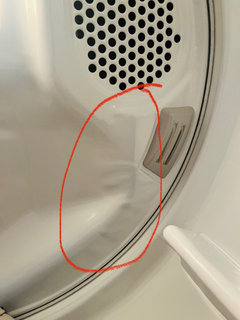
    Anyone ever have this happen inside their dryer? This is a brand new Whirlpool- 4 months old and I didn’t notice this until recently, after I started using wool dryer balls. Or could this bubbling be from something else? We have one year warranty but they charge you if they come out and can’t do anything for it!

  • last year

    The first time I used them (2), they knocked out the light and the dryer does’t stop when you open the door

  • last year

    I ised wool dryer balls they beat and whack the whole time and they knocked out the baffles after a week never again