Software
Houzz Logo Print
carrie_andrewes

Soil jar test

9 years ago

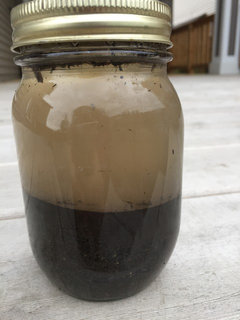
I did a soil jar test using the yellow clay subsoil layer in our brand new yard. I added the soil half way in the jar, filled the rest up with water, shook it like crazy and let the jar settle. I don't see any soil layers except a very small layer at the bottom with some tiny pebbles in it. Does this mean my subsoil is pure clay? We have only a few inches topsoil on top of the clay sub soil level and the soil is very compacted from construction.


Comments (16)

  • 9 years ago

    Thank you kimmq. Here's my problem. In our city all new houses in a new subdivision will have to receive a rough grade certificate and a final grade certificate before landscaping can commence. My yellow clay layer is my rough grade and then my final grade was made up of only a few inches of black soil that is very clayish. I'm going to do a jar soil test on that layer as well. I can tell that my soil has very little life because I have dug in it many times to plant my trees etc. and I didn't see a single bug or worm until I got to the backyard and I've seen quite a few worms back there. Anyway, according to our city, we are no to change the grade in any way. We can't raise the height, disrupt the different grading soils or change the drainage pattern. So that means no tilling to add in organic matter. That leaves spot amending where I plant which I have read is not ideal. What would you suggest I do keeping in mind that I can't cause any drainage issues?

  • 9 years ago

    I have never heard of such restrictive ordinances, but in any case, by tilling in compost, you're not "raising the grade" in the way you would be by, say, adding inches of topsoil. You're just amending the soil to grow gardens. Stick to that explanation if anyone asks. Besides, adding organic matter to soil improves its ability to absorb water (which reduces urban runoff), as well as grow plants, which are also good for purifying runoff and the air as well. Amend away and don't worry about it. Now if you're going to sneak some of that clay subsoil out at night and replace it at the same grade, we don't need to know about it. Just out of curiosity, are raised beds completely prohibited?

  • 9 years ago

    Toxcrusadr, yes it is crazy. This is what they say below. Truth be told I have been sneaking some subsoil out here and there because it's sticky gumbo and I can't see plant roots having a good time trying to grow into it. I think raised beds are fine as long as they are not on top of a drainage swale or pathway. I see people with raised bed vegetable gardens everywhere. :)

    Final grade must be completed within one year of the Rough Grade Approval or within 60 days of the final grading being completed or within 30 months of the building permit being issued for the premises. The rough grade has been left approximately 7 to 20 cm below final grade for topsoil placement. The topsoil should be smoothly spread out, compacted and ready for sod, liners, or rocks.

    If rocks, wood chips or other porous decorative material is planned, the clay base (rough grade) must be raised to final grade before placing the decorative material. Rocks or wood chips do not make up for the 7 to 20 cm of final grade, since surface water can flow through those materials.

    The Lot Grading Inspector issues Final Grade Approval based on the site conditions at the time the inspector was present. It is the homeowner's responsibility to maintain the surface grades in perpetuity. The City may at any time, require maintenance or repairs on the lot grading if alterations or settlements result in surface drainage problems.


  • 9 years ago

    You do not need anything called "topsoil" but the soil you have does need organic mater. That can be added, and tilled in, without changing the grade. The city is setting up a drainage problem by not permitting proper soil preparation, the interface between this subsoil and what ever is placed on top may not allow water to flow freely between the two.

  • 9 years ago
    Thank you kimmq. My yards drainage pattern is all wonky too. Part of my backyard drains to a drainage swale at the bottom of my property and then closer to one of my side yards it slopes back again towards the street. How would I go about tilling the soil but making sure I don't change the drainage pattern because of the stupid multi directions the yard has going on?
  • 9 years ago
    Also if I add amendments before I till won't that raise up my soil quite a bit essentially raising my grade?
  • 9 years ago
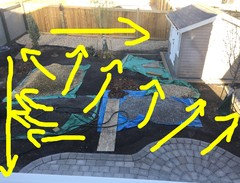
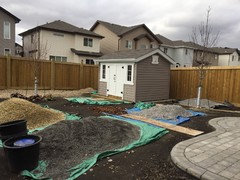
    Please excuse my bad drawing and my messy yard but this is basically what I'm working with. The middle and right side of my yard drains to the swale. The far left side drains to the left swale and between me and my neighbours house and out to the front street. My soil is compacted down from the building of my fence, deck and patio and even from just sitting uncovered for so long. As mentioned above how do I till while maintaining the same final slope and grading with my wonky drainage patterns? I'm a gardener but I feel nervous about this part of landscaping. I'm scared to screw things up.
  • 9 years ago
    Grade on right slopes towards front of house and street.
  • 9 years ago
    The rest of the yard sloping to the swale at bottom of lot.
  • 9 years ago

    I think you may be over-interpreting the building codes. What you copied there is the process intended for builders and contractors as homes are being built.

    "The homeowner is responsible for maintaining grades" just means that you're not supposed to change things so drastically that it causes problems for your neighbors. It is generally accepted practice (and in ordinance in many places) that you don't dump water on your neighbors in such a way that it harms their property. This is taken into account in the design of the lot grades, but you also have to make sure you don't change something that causes problems for someone else. For example, if your downspout pointed toward the street and you turned it 90 degrees so it flows toward your neighbor's foundation, that's a bad idea. Or if you put a new raised bed in a place that blocks runoff and turns it sideways so it causes a swampy area in the neighbor's back yard. That sort of thing.

    The answer to your yard issues, I think, is two fold: 1) watch what happens when it rains (you've kinda done this based on all your arrows), and 2) try to maintain those drainage ways and don't raise up an area that water has to go through to drain off. Trial and observation will get it.

    I am a bit concerned about the arrow at the left that comes back toward the house. But maybe that's a swale along and under the fence that drains toward the front yard and street, which is obviously lower. So no problem there. The main thing is that everything drains away from the house on all sides, at least for a few feet out from the house.


  • 9 years ago
    last modified: 9 years ago

    Thank you toxcrusadr, we, the homeowners are responsible for getting the final grade done with topsoil which is then approved by the city and a certificate was sent to us with the approval. I completely agree with you about not changing the grade to affect my neighbour but I haven't seen a single person in my neighbourhood rototill the soil to make garden beds. Everyone just digs a hole in the ground and plants their tree/shrub/whatever. My last home was in an old neighbourhood and we rototilled the gumbo clay soil and amended it which resulted in very nice soil after a couple of years with loads of worms.

    Regarding your second point, if I amend the soil in my swale to the depth of 8-12 inches, will the excess water still run off in that swale or will the water soak in until the soil is saturated and then cause water pooling?

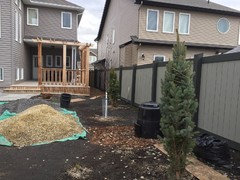
    Yes, you are right about the side swale between me and my neighbour. Our downspouts actually drain into the storm sewer underground. My neighbour to the right in the photo has above ground downspouts so I get all of his roof water from the back of his house to the street. We need to touch up the grading there but the water does drain away. There is a layer of moss as you can see in my photo due to the soil compaction. I have amended one section right by the fence with a pitch fork to a depth of about a foot and I plan to work my way backwards. Instead of rototilling where the flower beds and grass go, could I just use a pitch fork to do the work?

    I did a soil jar test of my "topsoil" layer and it looks to be mostly silt and sandy soil. There is some clay in the top layer of the jar (it can be quite sticky when wet).

    Thank you so much for your help!

  • 9 years ago

    Once adequate amounts of organic matter have been worked into the soil drainage through the soil will occur although that may take a few years to be fully working. As you work the organic matter into the soil you have you may well raise the soil level as air is entrained into that soil mix, but it will settle as that air is dissipated.

    What I see in the jar above is still just one soil type. Some years back for one class of my Master Gardener classes I prepared this test using a soil mix from one of our local nurseries that the owner mixed which contained about 45 percent sand, 25 percent silt, 25 percent clay, and 5 percent organic matter and the separation of each was quite dramatic and easily seen. Some of the images for this mason jar soil test on line do adequately represent what you could see if you had a good soil mix.

  • 9 years ago
    Thank you kimmq. I guess I just have two different soil types (clay and some sort of topsoil) with very little organic matter. I amended a little patch of my backyard today using my pitchfork. I have no problem getting the pitchfork all the way down into the soil and I can mix in the amendments but about 4" down is the clay layer. My amended soil ends up in balls about the size of a large marble and they don't break apart. This makes for clumpy soil.

    I was looking into rototilling organic matter into the soil but I've read that I will end up bringing loads of weeds to the surface and my soil will sink unevenly, especially in the lawn area.

    I feel torn as what is the best thing to do. Rototill, have lots of weeds, have uneven soil eventually. Or leave as is and pile organic matter on top of the existing soil and just spot amend when I plant my plants.

    What would you do?
  • 9 years ago

    If you simply put the organic material on the clay you have it may never incorporate. I have seen that happen with organic material and "topsoil", the two never mix and create an impenetrable interface that does not allow good growth. I would till the organic material in and it can be done so the surface is even.

    I think people that say do no0t till because you might bring "weed" seeds to the surface are wrong although you may well do that. However, "weed" seeds are going to get in there anyway as birds fly over and drop them, the wind carries them in, and other critters pick them up and move them in. Some studies I have seen over the years indicate that is a more common means of new "wed" than tilling.

  • 9 years ago

    Your top soil (and perhaps a lot more than that) was already moved and reworked and replaced anyway, so presumably if there are weed seeds in it, they are already mixed randomly. Don't worry about that.

    As far as the lawn, it's customary to get a lawn roller (rolling drum you can fill with water for weight) and use that to gently compact the soil after grading and amending. This will tell you where the low spots are and you can fill in any that you find.

    A pitchfork may be fine depending on the type of soil, but if it digs up in clumps and clods, you won't be mixing in your compost evenly. This can actually cause more uneven settling than tilling which at least makes it more homogenous.

    As for amending large areas vs. individual holes, this is a matter of debate and evolving science. They recommend nowadays that you avoid amending tree and shrub planting holes especially in heavy clay, so the roots don't get stuck in there. I have clay soil and I make more of a wide dish for a hole so the roots can spread out.

    Back to your original question of the permit and inspection: You could either put down all your soil and get the inspection done and passed and THEN amend any large areas or beds, OR do it first and as long as it drains OK the inspector is probably going to be fine with it. If they think anything is too high, it's going to re-compact. But I'm betting if you don't change the drainage pattern too much it's going to be fine.

    Excess water will not pool where you have amended soil, any more than it would in unamended soil. Pooling has more to do with elevations and drainage than with soil type. Having said that, if you rototill in a low area, it's going to get soft and muddy when it's wet, at least for awhile until it settles in and recompacts back to a firm surface. Don't walk on spots like that when they're soaking wet.