Software
Houzz Logo Print
ml12321

New Aggressive Bees.

9 years ago

We have had very peaceful sleepy little bees on our property for some time - we were aware there was a nest (in the roof eaves) but really took a live and let live attitude toward them, mostly they would be crawling on the grass-clover mix and basically you would have to step on them to get stung.

In the last 3 weeks, a new aggressive larger-sized group of bees has suddenly emerged and been dive bombing us in our yard and making it impossible to have dinner or hang out in the backyard. They are bees, not wasps, based on the abdomen size/shape

They are quite aggressive and yes, an exterminator has been called as they are freaking out my children (and me).

I have not seen a nest related to these new bees.. Any ideas why this would happen so suddenly? I am too chicken to take a close up pic as the last time I tried , one landed in my hair and hung on buzzing for dear life.

Coincidentally or not, all the Celestial sage just came into full bloom...maybe it's making the bees crazy?

Comments (34)

  • 9 years ago

    The identification is important. Bugs wont come once, more are in the area I would suspect.

    m ml thanked trickyputt
  • 9 years ago

    Gry Falcon, I think this is exactly what happened. The exterminator was there today and as my husband was showing him the hive on the roof, the new bees attacked both of them even before they got to the hive (very very different behavior from the last time my husband went up to look at the nest).

    Luckily my husband was only stung twice and the exterminator once (on the face where his suit didn't cover) The bees actually followed the exterminator into his car which is totally consistent with how they have been acting the last last few weeks, last night they were trying to get into the house.

    The exterminator is coming back tomorrow with a hazmat suit to block off the entrance to the hive in the wall, and then to drill a hole into the wall with poison (gas) and I am keeping the kids out of the backyard till it's over.

    Yikes.

  • 9 years ago

    That does not sound good--glad you are getting it taken care of quickly.

    m ml thanked gyr_falcon
  • 9 years ago

    What a scary experience M ML! We have tons of bees, all very friendly, love a lot of our native plants but almost invisible, never bother us at all. Was the exterminator able to ID them?

    m ml thanked 5birdy
  • 9 years ago

    Ug.

    He called and said he can't come back till Monday which means no backyard for the kids or their friends this weekend.

    Will have my husband ask then ( I will be at work - he works from home). One pattern I noticed over the past couple of days, they are absolutely present (maybe 12 or so swooping around our back yard and dive bombing) in by late afternoon and nowhere to be found in the am so I was able to get some watering and cleanup work done early this am...

    Maybe they travel long distances to get pollen and the late afternoon activity is the equivalent of irritable commuters coming home? I have a call into a friend who keeps bees in her East Hampton (NY) house to see what she thinks.

  • 9 years ago

    And yes, I miss the sweet little bees we had before in the hive but we are going to have to block off the access to the nest permanently because I really don't want these sorts of bee back anytime soon.

  • 9 years ago

    Apparently the reason for the delay is that he has to "get special supplies from the warehouse" That doesn't sound good....

  • 9 years ago

    Well, adult beverages do have something in them that can disinfect insect stings.

  • 9 years ago

    Walking around watching the nice bees, I realized that I never see where they live, no evidence of nest or hive. It's like they just appear all over the blooms. Sure hope you can get your yard back!!

    m ml thanked 5birdy
  • 9 years ago

    Have you talked to your county's pest control? They will want to know about and eradicate any Africanized bees.

  • 9 years ago

    Nope. I could call on Monday, but to be clear, we are not waiting for the county to take action as I can't think of why it's their responsibility when it's on our property. We are confirmed that the exterminator will be back Monday am, and I hope to never have to worry about this again.

    If they want to do DNA tests after the fact (which I understand is the only way to figure it how "Americanized" they are ) they are welcome to do so.

    Fun fact, I just learned. Despite the fact that some bees are called native, really no bees are native. The first bees were introduced to this country in the 1600s.

  • 9 years ago

    San Diego county, at least, is pretty aggressive about controlling pests. The bees may be on your property, but they can spread.

    Not only are honey bees non-native, they're also domestic animals. They've been bred to be what they are by humans. Their origin, like house cats, is a little obscure!

    A big chunk broke off a sweet gum during a wind storm in the parking strip in front of my last house. I was upset because I thought that I would have to hire somebody to come and cut it up and remove it, fit the appointment into my work schedule, and hope that it didn't cause a problem obstructing the sidewalk until I could get it done. Then I realized that those trees actually belonged to the city. I called them and they had it cleaned up by the time I got home at the end of that day. That's what I pay taxes for. Eventually they decided that the tree was diseased and came out, removed it, and ground down the stump. We moved before they replaced it. If it were me, I wouldn't hesitate to call the county about the bees.

    m ml thanked JXBrown (Sunset 24, N San Diego County)
  • 9 years ago

    What part of California are you in? I'm wondering if I have to worry. Please keep us updated.

    m ml thanked emmarene9
  • 9 years ago

    in LA County, the far western part of the San Fernando valley, about a 1/2 mile away from the border of the Santa Monica Mountains National Reserve.

  • 9 years ago

    And, Emmarene, I wouldn't worry.

    I think the bee's hyper aggression is related to perhaps their hostile takeover of the hive (per Gyr Falcon's theory) and maybe also to the fact that we have been running a sprinkler near the hive a lot over the past few weeks. (We are finally growing fescue in the 1/2 of the lawn in which we ripped out all the Bermuda grass last winter - after killing several Bermuda re-growths with Roundup this spring).

    From recent online reading, it appears that "hot" bees take offense at all sorts of disturbances nearby and perceive them to be a threat to the hive, so they could just be riled up by the sprinkler.

    And, so fun trying to keep moving the sprinkler this weekend while being dive bombed by angry bees... the new grass would have definitely died ,without frequently watering, given the high temperatures this weekend. Sigh.

  • 9 years ago

    Mission accomplished. When I came home tonight there were still 15-20 bees hovering around the sealed-off entrance to the nest and swooping around our yard... but the exterminator told us they will be gone in 1-2 days. Here's hoping he's right and I never ever have to discuss Americanized bees or, really, any bees again.

  • 9 years ago

    It is a shame to lose a hive, but it certainly was not in a good location. Glad you got it taken care of, without anyone getting seriously hurt. I hope your experience does not permanently sour you on bees, and with time, you can enjoy seeing them in your garden again. Just the friendly ones, of course.

  • 9 years ago

    Of course just the friendly ones : ) .. Thanks gyr_falcon. I am good with bees and appreciate your insight.

  • 9 years ago

    Bee update

    There were more "leftover" Africanized bee than I thought. A basketball sized clump hung around the old opening of the hive - quite agitated (understandably) and trying to get back in.

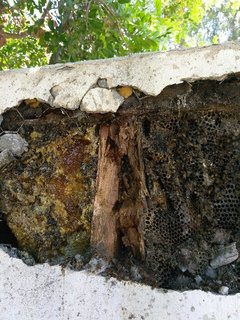
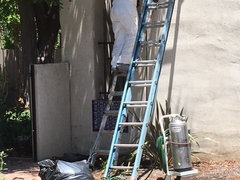
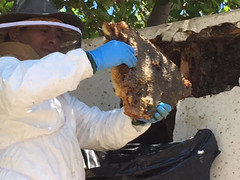
    Over the next couple of days, they continued to chase people and then one stung me on the eyelid when I ventured into the back yard. I am not allergic but my eye swelled shut. So we brought back the exterminators to open up the wall and take out the hive with the now deceased bees. The hive must of been there for years, as they took out full two garbage bags full of hive and honey.


    Kinds of interesting pics attached, you can see the old hive and the new hive side by side.

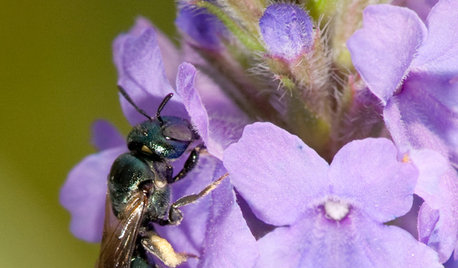
    They closed up and repaired the wall last week and we are back to just having sweet little bees in our backyard.

  • 9 years ago

    Very interesting. I sure hope that is the last of them.

    m ml thanked emmarene9
  • 9 years ago

    m mi, glad to read your update because I was concerned about no previous mention of potential honey in the hive. I had a hive in the walls of my home with their entrance being through the roof a couple of years ago. I called two companies: one that would relocate the bees ($500), and the other would spray to kill them ($500). I wanted to save the bees, but went with killing them because the guy came prepared that day with everything needed to spray the bees, remove the nest/honey and repair the opening. From inside the house, I could hear a few bees bussing, but the guy told me those would die and they did. Had you not been vigilant and noticed bees back, the honey inside your roof/walls would have mold/rotted and a bigger issue would have occurred.

    m ml thanked eloise_ca
  • 9 years ago

    I have seen the damage from wall hives more than a few times. That was what I was afraid of when I wrote in my earlier pot: Honeycombs can be expensive to remove if the bees are able to gain access into the walls, attic etc. It probably is not safe to assume the part you see is the extent of their activity.

    Glad you were able to get it cleaned up!

    m ml thanked gyr_falcon
  • 9 years ago

    I thought nothing could horrify as much as rodents and rattlesnakes but now have another crazy thing to worry about! How on earth did they get in a solid structure like your wall?

    m ml thanked 5birdy
  • 9 years ago

    They probably have genes from Africanized bees. Africanized bees have invaded and been hybridizing and tainting local bee populations with their aggressive genes.

    m ml thanked Parker Turtle
  • 9 years ago
    last modified: 9 years ago

    5birdy, the hive entrance was through the roof.

    There is one positive from this expensive (I don't even want to quote the number) and upsetting episode. My youngest, 8, has always been afraid of bees, no matter how many times we tried to convince her that they were not interested in stinging her. After this episode, she likes the "old" European bees and is happy they are back in our yard sleepily browsing our saliva and crawling on the clover-fescue grass.

    Of course, that is not worth the money spent, losing access to our backyard for 6 weeks, my husband being stung multiple times, and me lying in a darkened room for 1/2 a Saturday with a swollen shut eye and ice packs ... but it's something. : )

  • 9 years ago

    I am just glad that they didn't sting anyone other than me and my husband. I would have felt awful if someone else had gotten hurt.

  • 9 years ago

    How did they get through the roof? Eloise_ca had the same thing. What signs do you look for to see if they go in? I am so terribly sorry M ML for your horrific bee issues! Is your 8 year old able to identify which kind of bee she is looking at? That would help my fear. (except now that I need both distance and reading glasses, when a snake rears its head at me I am unable to fine tune the details on head and eye shape ... "oh wait Mr. Snake, let me get my glasses!")

    m ml thanked 5birdy
  • 9 years ago

    I would have to ask my husband about exactly what to look for, I was kind of being sloppy in describing it. To be more precise it we think it was a crack in the stucco just below the roof line rather than the roof itself _ they were in the only section of the house (the kitchen) that is single story with a flat roof, the rest of the house is two-story with a more sloped tile roofs, either way, both types of roofs should be sound as we replaced them prior to moving in almost two years ago and they did fine in last winter's heavy rain.

    My daughter knows the difference (and you would too) by the bee's behavior no need to get up close. I have never seen bee's "patrol" before. In the afternoons they swooped around our yard at a very fast speed really diving in and out and then bombing anyone who ventured out. If you ran, which I did several times ( I am not proud, I'll admit it) they followed you for an amazingly long distance and they would actually chase you into the house which I have never seen before.

    It's hard to fully describe but I am quite sure that you would figure it out fast... Please don't worry, I have been assured (and I believe ) that they only behave this way if they feel that you are are encroaching on their hive, so this really shouldn't be an issue for you or most people.

  • 9 years ago

    Thank you so much for describing this so I know what to watch out for! I'm sure it will benefit others who surely will face this same phenomenon.

  • 9 years ago

    5birdy, I found the bee nest one evening when I had to go outside. I switched on the light and on coming back into the house notice several bees swarming around the outside light. I had left the door opened since I was coming right back, and there were some bees on the light fixture inside the house (laundry room) -- got rid of those. Next morning, I looked around outside the house and noticed bees flying to a spot under the eves. I recommend not getting to paranoid about this happening to you, but just be aware if you ever spot bees going in and out of a particular place, there could be a hive.

  • 9 years ago

    Thank you too Eloise_ca! Small spots and cracks leading to huge hives.... incredible. Do wasps build inside hives like this too, or are those just outside? I am a bit paranoid today, because I am fighting another swarm of ants inside seemingly coming up from baseboards so spend a lot of time looking around outside.

  • 9 years ago

    5birdy - Wasps nest in or near the ground, so you shouldn't have to worry about them building a nest on your house. I also have an Argentine ant problem. I believe they are under my house and they make their way in through the small cracks between my sliding door and the hardwood floor. Very annoying. Read a great book by Bob Tanem (Tree & Shrub Gardening for Northern California) that had a tip for fighting ants. Start by following the trail and try to find out where they are coming from, so you can place the poison in the best spot. Combine 1 tsp Boric acid, 6 Tablespoons sugar and 2 cups water. Put ingredients in a clear jar, so you know when everything is dissolved. Soak a few cotton balls in the solution and place them inside a small plastic container (poke a few holes in the side) and cover with the lid. Ants will move in and out and bring the poison back to their nest. Eventually (over a few weeks) if everything goes as planned the poison will get shared with the queen and the nest will die as a result. Good luck!

  • 9 years ago

    Thank you so much Kerry! Wonderful tips and advice. I really appreciate it :)