Software
Houzz Logo Print
andreweth

Desert Bluebells not blue?

9 years ago

Hi all,

I've been searching for true blue flowers for quite some time now, and many people online have said that Desert/California Bluebells come up as a deep, inky cobalt or royal blue. Almost every photo I've seen agrees with this claim, so I figured that perhaps it was true and that the online photos weren't all photoshopped blue like they are with so many other flowers. Anyway, I bought some seed and tried them.


Now that the bluebells are finally blooming, I am disappointed to find that they're a light lavender purple. There's nothing blue about them. Mine are about the same hue as this photo, but a bit less deeply colored and lighter: http://www.everwilde.com/store/Phacelia-campanularia-WildFlower-Seed.html (notice how the comment on that page was about how blue they are in person- nothing like the photo!)


What's up with that? The more I check online, the more I read about people's claims of deep, true blue. Is it because the plant has just recently started blooming? Could it be my soil pH? (It's roughly neutral, perhaps slightly alkaline) - Or did I just get REALLY unlucky and get some kind of genetic abnormality? At this point, I think I must be doing something wrong.


It's upsetting! I've tried growing dozens of "true blue" flowers over the last 3 years, but everything either fails to survive, or comes up pink or purple. The only exceptions are spring bloomers like forget-me-nots, lungwort, and Virginia bluebells, and then delphinium as my only summer blue. I'm so desperate for blue, I'm ready to start adding chicory to garden beds!


But anyway, any feedback or advice anyone could give me would be greatly appreciated.

Thanks!

Comments (10)

  • 9 years ago

    I tend to agree that the reason you are getting lavender rather than true blue is the PH of your soil. Try sprinkling a little agricultural lime around your plants to sweeten the soil

  • 9 years ago

    You could try Flax, Linum perenne.

    I'm not sure about the pH theory. The only plant I know which definitely changes colour with pH is Hydrangea macrophylla. Is there evidence for any other species? Blue is a very subjective colour. One person sees blue and another sees purple or mauve.

    Andrew thanked floral_uk z.8/9 SW UK
  • 9 years ago

    try looking at them all... near dusk.. especially on evenings when the sky turns pink ..


    ken

  • 9 years ago

    Thanks for the suggestions! I definitely am going to check out Tweedia and maybe get some Flax.

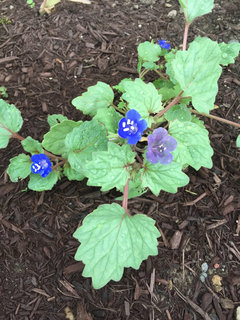
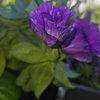
    I'd just like to share with everyone that my bluebells are now blooming a very blotchy, deep, inky blue. It seems the youngest couple of flowers come out light lavender, but they start producing deeper blue flowers once the plant gets going. Here's a photo of an early flower and the newer ones:


    The color is great in person. I will definitely be growing more and recommend them to anyone looking for a nice blue flower!

  • 9 years ago

    Wonder if temperature could be a factor? I know from experience that with some plants -- like African violets -- temps can have a big impact on flower color.

  • 9 years ago

    Glad they turned blue for you! Mine are a combo of blue and purple.

    since you live true blue flowers, one flower I've recently discovered is Baby Blue Eyes. They are short (3-4 inches) and make a great understory for taller plants. I literally threw the seeds on the ground and quite a few bloomed.

    Andrew thanked Faith
  • 9 years ago
    last modified: 9 years ago

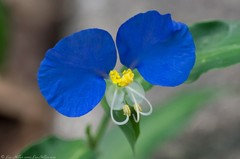
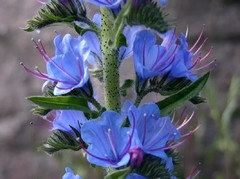
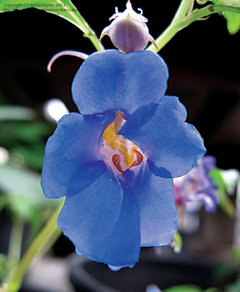
    A few of the nicest blues I've ever grown are Commelina communis,Echium vulgare and Impatiens namchabarwensis. I picked photos with truest color to what I witnessed.Actually the Impatiens photo doesn't do it enough justice.Much,much better in person.

    Andrew thanked Jay 6a n.c. IL.
  • 9 years ago

    Thanks for the suggestions! Baby Blue Eyes are so vibrantly blue, I'm going to have to try them. I really like the Commelina communis, Echium vulgare, and Impatiens namchabarwensis too, although I've heard of Commenlina communis before, and I've read that they can be really invasive. Supposedly even roundup can't kill them once they take over an area! (It's a shame, they're very unique looking flowers.)

    But Echium vulgare and Impatiens namchabarwensis definitely seem worth trying out!

  • 9 years ago

    Be careful where you plant the echium.......in some areas it is considered a noxious weed/invasive species so check with your local invasive species council first. It also has a lot of variation in color, often producing pink or purplish flowers.

    btw, the ONLY plant whose flower color is influenced by soil pH is hydrangea. And only because of the availability of aluminum, which is the mineral that alters flower color on there plants. High acidic soils have greater access to aluminum = blue flowers. Liming in the case of hydrangeas would produce pink or purple flowers, not blue.

    There are lots of intensely blue flowers available - mountain bluet (Centaurea montana), hardy plumbago (Ceratostigma plumbaginoides), various salvias (S. guaranitica 'Black and Blue', nemerosa 'May Night', 'Blue Hill'), Siberian iris, annual larkspur, delphiniums.............

    Andrew thanked gardengal48 (PNW Z8/9)
Sponsored
Peabody Landscape Group
Average rating: 3.5 out of 5 stars8 Reviews
Franklin County's Reliable Landscape Design & Contracting