Software
Houzz Logo Print
raymondranch

Best way to stake a tree?

9 years ago

I live on a small acreage on a hill. Seems that every tree I have planted is subject to alot of wind. I have seen the drive the stake in at a 45 degree angle and then secure it with a rubber tie method, three stakes with ties, and two stakes with ties. Thoughts and pictures are appreciated!

Comments (13)

  • 9 years ago

    How large or a transplant?

    For my small trees I:

    -drive three green metal stakes into the ground equidistant around the tree.

    -tie a section of lady's nylons around the tree loose enough I can slide a few fingers in between it and the trunk.

    -use 10lb to 20lb fishing line to tie the nylon to the stakes.

    The nylon lasts a few years and is GENTLE to the trunk of the tree.

    It also is not tied to the tree not encouraging the trunk to strengthen.

    plus with the 360 degree potential support I don't have to worry about north or west winds vs a south wind or whatever.

    This smoketree / smokebush I planted last year is the largest I have done this with. It is less than 1 inch caliper and grew from maybe 3ft tall to 7 ft in a year. The fishing line is holding.

    One of these big 3inch caliper transplants may require bailing twine or something. I THINK the nylon will be strong enough.

    raymondranch thanked Toronado3800 Zone 6 St Louis
  • 9 years ago
    last modified: 9 years ago

    If trees are small and/or have a good size root ball, they really shouldn't need to be staked. Letting them blow in the wind strengthens the trunk and the roots.

    This can vary according to what type of soil you are dealing with. I've heard of root balls sliding inside the hole (clay soil) when wet but again, if the crown is not that large, it shouldn't put all that much pressure on things.

    I've seen staked trees around the city here that were broken off by strong wind because they couldn't 'flex' so they broke at the point of the tie instead.

    Now if you are talking a tree that has been bare rooted, that's another story. Chances are you'll need to support that one for a year or two, until the roots take hold. Or if the tree has a large bushy canopy to act as a sail.

    I get strong winds regularly here too (25-50 mph), lately, everyday. But for the most part, I have not staked many of the 40 or so trees I've brought in from the woods.

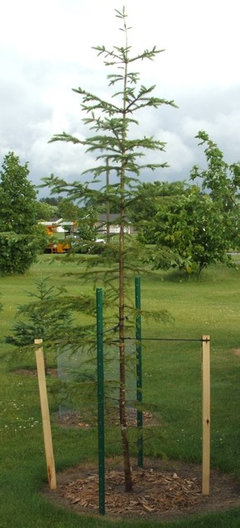
    I did stake this spruce tree. Transplanted from the woods last spring. I darn near had to bare root it because of roots of other trees interfering with the dig. It was windy the day I planted it in the yard and I could tell it wasn't standing on it's own. It's over 10 ft. tall and has lots of wind resistance being an evergreen. Without stakes, it would have been down and out of the ground.

    As Toronado stated, ladies nylon stockings are excellent for tree ties. They are strong, have some stretch to them so the tree can flex and move some. They're cheap and last forever. I had one of my apple trees ties to a stake for over 15 years and finally cut it off as it was beginning to sink into the trunk. They don't abrasive the bark either, actually kind of amazing.

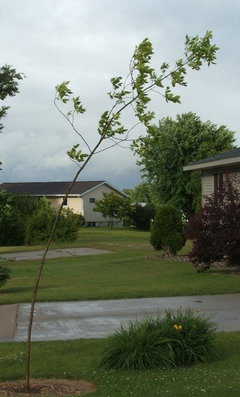
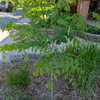
    On the other hand. I didn't stake this Green Ash. I planted it late last fall. There were no leaves on it so no wind resistance. It is 15 ft. tall and maybe an inch and a half dia. above the ground. It had a 24" wide and 12" thick root ball and it had a month or so last fall to make roots and then again this spring.

    The trunk bends quite readily and I've seen the wind bend it over all wet with rain until it was almost touching the ground (not for the weak of heart to see) :-) but every morning, it is standing back up, straight as a stick, upright and happy. This it what will make this tree strong. Now if it bend over and stayed bent over, I would have to stake it. Here it is with a 15 mph wind.

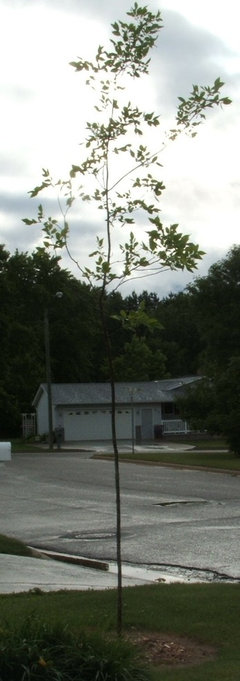
    This next pic is when the wind dies down (Same tree a few minutes later).

    So, stake if needed and all the indications are that the tree will need it. Not just because the trunk bends in the wind. If it stands back up after the storm, leave it be. There's a guide to staking around this forum somewhere but can't find it at this time.

    raymondranch thanked User
  • 9 years ago

    I like to try and push the envelope for trees and keep a close eye on them during windy days to see if I have to adjust my approach ...

    but sometimes you just gotta know when to give in and stake it.

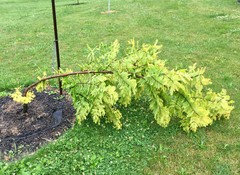
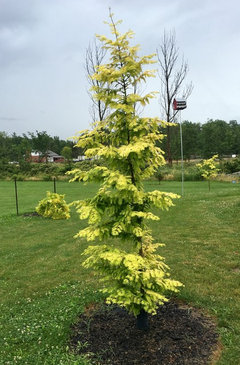
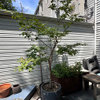
    3 yrs in the ground Metasequoia 'Ogon'. Not sure if I took the stakes off last year or this year, but it put on a bunch of growth this year and was really top heavy and we got blasted with some crazy winds early season that was pushing it the opposite direction to what it is now (hence the single post). Lately winds have been coming from the opposite direction and now the tree has a 6 inch "rubbery" section right where it's bent now. The rest of the tree is quite firm and the roots have not lifted in the slightest .. just an odd soft section in the trunk. Anywho, it's staked up now loosely and hopefully that soft section will firm up this fall.

    Sorry to hijack but I've never had a tree get a soft section like before. The other 2 I planted with it are fine. Hey-ho, interesting anyway.


    raymondranch thanked brothergarm
  • 9 years ago
    last modified: 9 years ago

    The rubbery spot is damaged fibers that will no longer support the weight of the tree. You'll have to triple stake it with little movement for a season, so the damage can heal. Then supply a little room to flex during next season so the tree can adjust. Maybe even do a little top reduction pruning. Hopefully it will heal and be stronger than original. Might be a fluke with that particular tree having thinner than normal trunks in it's genetics.

    Not talking about your tree brother but for the lurkers, When you do stake a tree, make sure that the ties have some elasticity so the tree can sway and move in all directions a certain amount. This causes slight damage to the fibers in the wood which causes the tree to add fibers and becomes stronger over time.

    When a tree is staked too rigidly, the trunk will not strengthen, so the stake is left on. But after the second year in the ground, the tree will become established and start vigorously putting on lush top growth. By then it's a lot harder to get the trunk back up to speed in supporting the tree.

    Never stake a tree more than a season or two. If staked properly you won't have too.

    btw: Beautiful trees you have there brother! :-)

    raymondranch thanked User
  • 9 years ago
    last modified: 9 years ago

    I hear you. If you just knew how bad that next storm was going to be, that would help. :-)

    A tree that I'm not sure of, like this young sugar maple transplant, I made a 'catch all' style of staking. It's doesn't do anything at all unless the tree gets tipped past a certain point, then aids the tree from going too far and possibly failing or uprooting. The lathe last about a season or so then can rot off and break. Duck decoy cord I found on clearance and Yes that's a length of 'knee high' nylon stocking donation in the center. :-)

    Just to add: The diameter isn't important when deciding whether a tree can support itself, it's more how acclimated to the wind it is and if it's had time to root down and stiffen up the trunk.

    I had a 10" dbh green ash growing among mature pine trees in my woods. The loggers came and removed all the pine, leaving this estimated 35-40' Ash standing alone. The tree stood all winter and spring but with the added exposure to sun and good rains, the tree leafed out exceptionally heavy and later that summer, bent over in a wind so the top touched the ground. Kind of upside down 'U' shaped. It just wasn't used to supporting itself. I removed the tree a couple years later for the only thing it was good for, firewood.

    raymondranch thanked User
  • 9 years ago

    So I have read all of this and some other previous discussions I found and I still am wondering what to do about some oaks I have planted. Rather than try to spell it all out I will get some pictures. So appreciate you guys taking the time to share your pictures and your experience!

  • 9 years ago

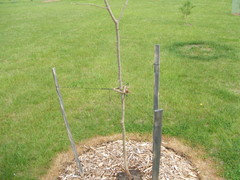
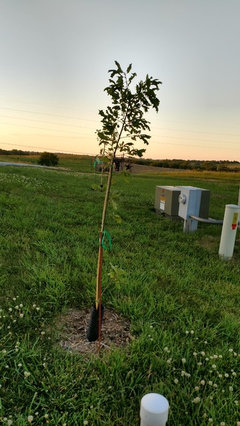
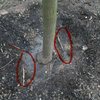
    Ok, the first swamp white oak was planted last fall, is not tied to the stake and is a bit crooked...The second one is a red oak planted last fall and it lost it's leader in a storm this spring. I left the bamboo stake from the nursery next to the trunk and also tied it to the steel posts. It looks pretty straight.

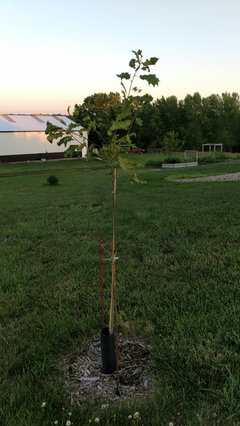
    The third one is another red oak planted last fall. I left the bamboo stake and tied it to the steel posts and it is still leaning.

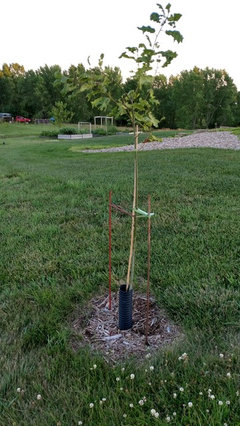
    The fourth one is also red oak, planted last fall, same bamboo stake, tied to posts, and looks really crooked!

    The last pic didn't load but it is a little swamp white oak, planted last week. I put a stake in next to the trunk and it went in a bit crooked and made the tree lean. I took it out and it now looks fairly crooked. I am thinking maybe dig it up and reset it? I will add the picture below this post.

    I am guessing you guys will recommend taking out the bamboo posts next to the trunk on all of them? And staking all the way around each of them? P.S. The red oaks caught some herbicide drift this spring and look a pretty rough.


  • 9 years ago

    Are all those about 5 ft or shorter? I think my method is the best (of course lol).

    Far as the not straight one, I wouldn't worry much. It will figure it out.

    raymondranch thanked Toronado3800 Zone 6 St Louis
  • 9 years ago
    last modified: 9 years ago

    Trees are products of nature, not stamped in a mold. They're all different and have their own distinct character. Your trees are still quite small and haven't had a chance to develop. A minor curve in the trunk, 2 ft. off the ground, is irrelevant at this point.

    You're not doing the trees any favor by leaving the shipping stakes against the trunks. By letting the stake do all the work, you're not letting the tree develop properly. Here's where ken would say "don't love your trees to death" and rightly so. :-)

    If you want to 'train' a slightly leaning trunk, pull the trunk towards a stake that's offset from the trunk, using material that will not wear on the trunk and will allow the tree some movement. But only for the season, possibly part of next. By then the tree should get the idea. :)

    The tree planted 'last week' could be dug & realigned with no consequence but I wouldn't do that to trees that have been in the ground for a while. Too much of a 'setback' with root development and the wrong time of year.

    Oh, eliminate the 'spray drift'. lol

    raymondranch thanked User
  • 9 years ago

    Ok, the shipping stakes are going! The spray drift was courtesy of my husband, bless him. The weeds grow up into the rock of the driveway nearby and look horrible. Thanks for the discussion, I believe I finally get the main idea!

  • 9 years ago

    A little update on the little swamp white oak tree. I did not dig up and replant it, just used one small stake and a stretchy tie and I'll be darned if it didn't straighten itself out already! Woohoo!

  • 9 years ago

    Great to hear! And thanks for the update. :-)