Software
Houzz Logo Print
chickencoupe1

Support for large tomatoes?

9 years ago

A new experience: Growing very large tomatoes.

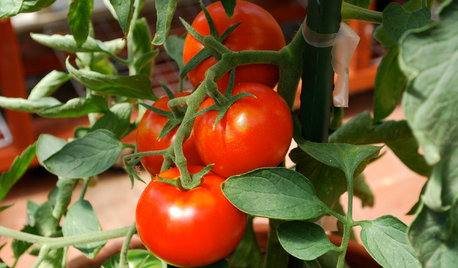
It wasn't intentional, but it's happening. A couple of these tomatoes are dangling from the vines. They appear to be doing just fine and we naturally have high winds, but I'm wondering if they need bottom-up support so they don't break off?

I could place plastic crates underneath them. But this would also provide some rigidity causing it to break off with the winds. I'm assuming the tomato sways right along with the vine.

Splitting hairs in my mind and I'm thinking to just leave them alone?

Thanks for any input.

bon

Comments (16)

  • 9 years ago

    You can always rig a sling support under them to hold them until color break and then pick and let them finish ripening indoors. Any light weight fabric like cheese cloth or old nylon stockings - anything that allows for air and will dry quickly - works well. Just rig a little hammock under it and tie it off to the cage or a pole.

    Dave

    chickencoupe thanked digdirt2
  • 9 years ago

    You'd like to believe that the tomatoes evolved in such a way that large fruit were supported by strong enough stems. If the fruit fell before they were ripe, it would not promote the species. But if these are hybrids, who knows?

  • 9 years ago

    Thanks Dave.

    @daninthedirt Nature rarely provides barrels-full of seasoned compost the prior season followed by an established cover crop of Austrian peas. lol

    It's a cherokee purple and probably moving up to 2lbs We have storms coming this weekend. ha

    You should be catching some this evening, too.

    bon

  • 9 years ago
    last modified: 9 years ago

    you should be more concerned supporting the entire plant. tomatoes typically don't fall off the plant even when pretty ripe.. the bigger the tomato, the bigger the vine that holds it to the plant get. what i found most impressive are cantaloupes. ive had 5+ lb melons hanging off a 1/8 inch vine with no problem. out in nature most melons grow on the ground, not dangling in the air so i did not expect the plant to hold the fruit as good as it did (kind of a pain to be tying individual fruits)... though to be fair, the vines are more fibrous which naturally makes them stronger than tomato vines.

    chickencoupe thanked stevie
  • 9 years ago
    last modified: 9 years ago

    A similar question arose in the vegetables forum yesterday about melons on a trellis, and reminded me of a discussion from a year or 2 ago. I don't think the term 'evolve' is the proper term for cultivated crops, especially tomatoes. One of the foremost reasons for selective breeding is fruit size.

    If we are talking 'evolve'; then we have to recognize that tomatoes evolved to have very small fruit for which the plant had no difficulty supporting.

    Today's domesticated tomato vines may adapt, and the traits for stronger supporting vines and trusses may be selected, but they certainly have not 'evolved'.

    What I usually find is that the truss may bend and hang, and that does seem to slow maturity, but it is rare that it actually breaks off. I'm not saying it doesn't happen, it's just that a couple of the larger fruited varieties I grow often have the same problem. The truss will bend near where it comes of the vine and the fruit will hang precariously, but usually the fruit still receive water and nutrients - although less readily it seems.

    chickencoupe thanked rgreen48
  • 9 years ago

    There are plastic truss supports available. I've used them when entire cluster starts to split from the stem. Surprisingly, newer hybrids that produce 5 or 6 larger tomatoes on a single cluster are more at risk of having this occur. Thinning is always an optional means to minimize issue with those plants. Since I use stringline plant support the truss support is always connected to stringline rather than the plant stem.

    chickencoupe thanked Barrie, (Central PA, zone 6a)
  • 9 years ago
    last modified: 9 years ago

    @daninthedirt Nature rarely provides barrels-full of seasoned compost
    the prior season followed by an established cover crop of Austrian peas.
    lol

    None of which you actually NEED to grow a crop. Yep, it helps, and yep, your productivity will be higher with it, but nope (depending somewhat on your native soil), you don't need that stuff. Kind of amazing how nature managed to produce what it did without barrels-full of seasoned compost every year, no?

    chickencoupe thanked daninthedirt (USDA 9a, HZ9, CentTX, Sunset z30, Cfa)
  • 9 years ago
    last modified: 9 years ago

    The issue is less the nutrients we give them, although that's certainly a factor, and more that tomatoes have been under active breeding/human selection for many hundreds if not thousands of years. It's entirely possible we would have selected for more fruit weight than a plant can easily support. It's, in fact, exactly the kind of thing we'd select for as a species in domesticated fruiting crops. Wild tomatoes have tiny fruit. Obviously, many domesticated tomatoes don't. Wild tomatoes only need to produce enough seed to survive to the next generation. Domesticated tomatoes are bred to please humans and provide enough fruit for our purposes and needs.

    It's like expecting a pug to behave like a wolf "because nature". Sure, some things are basic and difficult to change, but you can't expect them to hunt elk.

    chickencoupe thanked gorbelly
  • 9 years ago

    IIRC, weak trusses can be a nutritional problem, but I can't remember off the top of my head which nutrient it is. But I also know that some varieties will just have this problem due to size of fruit or mass of fruit on trusses. FWIW, in my experience a bent truss is usually no problem at all for tomatoes--the fruit seem to grow and ripen just fine normally when the truss gets bent or even partially broken. The trick is to be dexterous enough to support it to keep it from breaking completely without, well, breaking it completely accidentally or knocking immature fruits off.

    chickencoupe thanked gorbelly
  • 9 years ago

    You can take a long cloth strip (or anything that is somewhat thick, so it doesn't cut under pressure), run it under the middle of the tomato cluster and tie at the base of an upper leaf, and raise the cluster to around it's original position. This usually works best if you do it before the cluster stem has actually bent (if you see 6+ beefsteak tomatoes on a cluster there is a very good chance this will happen). If the bent is bad, this can make the whole cluster dangle in the wind after you raise it back, which might do more harm, so in that case don't raise it, just support it.

    I do this all the time, right now there is an Azoychka with 12 fruits on a cluster and a Berkley Tie Dye also with 12, for the Berkley I actually put two strings since the fruits were kinda spread with big distance between them, while Azoychka makes them closer together, pushing each other for space.

    chickencoupe thanked fungus
  • 9 years ago

    < They appear to be doing just fine and we naturally have high winds, but
    I'm wondering if they need bottom-up support so they don't break off?>

    You can do as Dave suggested early on or I remember reading on here about someone making cages from, I think it was cattle panels? Some heavy gauge wire fencing. Choose something with large enuff openings to get your hands and fruit thru at harvest time.

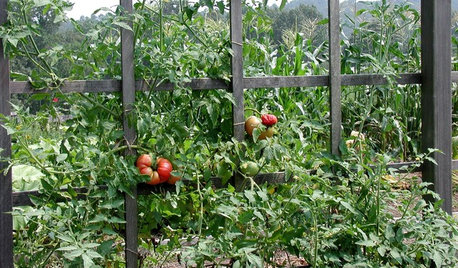
    What I do will work if you are growing in a bed frame or want to build one. I bolt 2 uprights of 2x2 to the frame then connect with a crossbeam which can be 1x lumber. So it looks like an upsidedown U or and upsidedown goal post.

    Then tie a string from the plant up to the crossbeam. Wrapping the stem around the string as it grows. But in your case you could start 3/4 of the way up the plant.

    I was extremely surprised that this would hold mature plants loaded with fruit during the New England type hurricanes we get in late Aug. & Sep. but ti sure did.

    I use jute twine cause it will breakdown in the garden or compost pile but certainly will last the growing season. But you can use whatever you choose - wire, rope, nylon, etc. but those will not breakdown and can make fall cleanup a bit harder.

    HTH

    chickencoupe thanked gumby_ct
  • 9 years ago
    last modified: 9 years ago

    I have see the commercial hydroponic growers in my area use truss support clips, especially on large beefsteak types..

    Something like this:

    http://www.alweco.nl/en/horticultural-supplies/bato-range/truss-supports

    chickencoupe thanked Hrib
  • 9 years ago

    Greenhouse/indoor tomatoes need those supports much more often because the plants don't get exposed to wind. The stress from wind, storms, etc. prompts the plants to grow more sturdy stems and trusses, but without that stimulus, broken vines and trusses are a real problem.

    chickencoupe thanked gorbelly
  • 9 years ago

    i just learned a ton. Didn't know about truss supports and I will acquire some. I'll probably need them in the future. At the most there are two large tomatoes on one truss. It hadn't crossed my mind that a healthy plant under perfect conditions could potentially produce many more large fruit on the same truss!

    Since I began this post a couple of those large tomatoes broke color. I was prompt in removing them, but still didn't know what I was doing. I didn't have my fiskars. I ended up using a steak knife with a serrated edge and sawed the stem to release the tomato. lol Now I know. That being said, one that I pulled broke at the truss revealing that weakness many of you have written about.

    I don't have my actual tomato bed/trellis built and this is a jumbled mess of tomato plants with some of them partially staked near the stems and the vines running all through each other (helping to shade the tomatoes).

    I appreciate the input - especially on the stringed tomatoes in hurricane winds because I hope to use a string system in the permanent tomato bed. Stringing tomatoes just makes sense. I didn't know if it would withstand Oklahoma winds, but I'm thinking in most cases they'll be just fine if they are tied firm and the cords are durable and not able to cut the vines. I don't believe I'll be able to get away with pruning, but the new setup will include potential for shade cloth. I just need to try stuff and see how it goes. I can always throw up some cattle paneling.

  • 9 years ago

    Gardening is just another huge experiment. Keep a Garden Notebook to review before your next planting or over winter.

    I let my tomato plants grow up one side of the crossbeam by winding the string as the plant grows up (no tying is needed except to attach it the first time), then I let the plant grow down the other side. So if its 6ft up then you get another 5.5 ft before you have to worry about it again.

Sponsored
Landscape Management Group
Average rating: 4.9 out of 5 stars33 Reviews
High Quality Landscaping Services in Columbus