Software
Houzz Logo Print
kurchian

I'm giving up on Garden Phlox

9 years ago
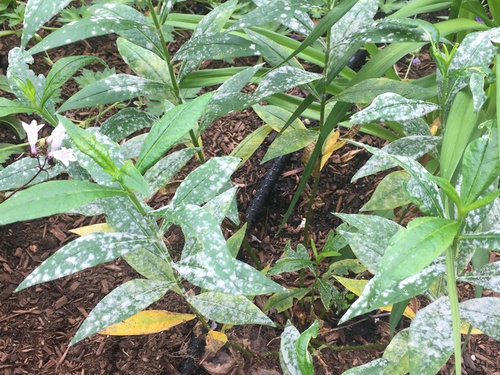
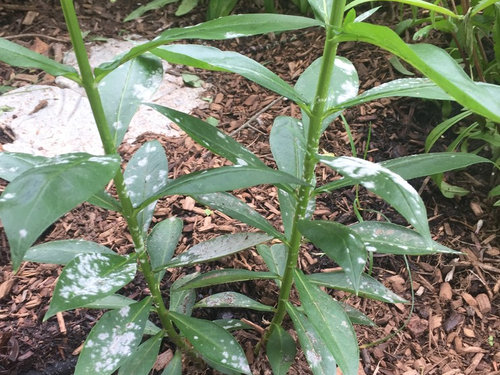
A few years ago I tried growing garden phlox but always had difficulty with mildew so I gave up. This spring I thought I would try again. I bought three David Phlox, which is known for mildew resistance. Well, I think my second try was a failure. Check out the pictures. I'm disappointed because I believe that phlox is a great backbone for a perennial garden but evidently not MY perennial garden.

Comments (29)

  • 9 years ago

    Are you sure it is 'David'? I've never had mildew problems on mine... It does seed around a lot though so I have to keep ripping out clumps or it would take over the garden!

  • 9 years ago

    Yes, I'm certain. I planted 2 David and 1 David Lavender.

  • 9 years ago

    See if you can find one called White Admiral, I've had it for many many years and never a sign of mildew.

    kurchian thanked flowergirl70ks
  • 9 years ago

    It really doesn't look like David to me. It isn't just the mildew, but the leaf form and color.

  • 9 years ago

    I suppose it is possible that it was mis-labeled. I shall try and nurture the three plants into some bloom and that should help us decide. I shall post pictures.

  • 9 years ago
    last modified: 9 years ago

    We've had a lot of garden phlox cultivars in mixed perennial beds for years and see minimal evidence of powdery mildew. I do, however, keep a mildew watch as the phlox grow and cut out affected parts if found. At least in our location, I strongly agree with those who associate powdery mildew in garden phlox with stressed plants which have been weakened by one or more problem(s) related to their growing conditions. And I'd say that although garden phlox do very well in mixed perennial beds, that doesn't mean that they are low maintenance perennials. One final thing: I'd also say garden phlox benefit from garden hygiene; notably from clearing the soil surface of all plant debris prior to the winter freeze.

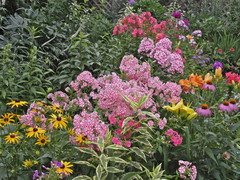
    Last July 31:

    kurchian thanked sunnyborders
  • 9 years ago

    I had 'David' for two years that persistently had powdery mildew. It was the time to toss it out and I bought another one from a different nursery which has been healthy ever since and much more fragrant than the previous one. Now I wonder if the first one was 'David' after all and, if it was, it was probably coming from the weaker batch. I would give it another try from a different nursery. It's gorgeous, constantly blooming, and wonderfully scented.

    kurchian thanked vesfl (zone 5b/6a, Western NY)
  • 9 years ago

    Go to the Chicago botanic Garden website and look at their section on "trials"

    They evaluated many phlox so you'll see you have others besides David for mildew resistance.. from my own experience "Eva Cullum'" and "Dodo Hanbury Forbes" have proven very mildew resistant. It's been unusually rainy here in MA, which might be a factor. I have one phlox with mildew already (hasn't bloomed, no idea which one) but none of the others have it.

    Not that you asked, but I have ended up not liking David very much. It is a hulking plant that only fit in the back of the border in my garden. Granted, it blooms late. However, I think it lacks grace and haven't missed it a bit as a centerpiece of the garden. There are other lovely whites, like Miss Lingard and Minnie Pearl (very early and pristine) that have a more appealing form.

    kurchian thanked Marie Tulin Boston burbs z 6a
  • 9 years ago

    Mine have never mildewed. I agree those don't look like David at all

    kurchian thanked GardenHo_MI_Z5
  • 9 years ago
    last modified: 9 years ago

    I do agree with Camp that it's silly to keep banging ones head over a plant that just won't do well for you, whether the failure is to do with the precise growing conditions and/or whether it's also to do with a particular strategy/style of perennial gardening. As said, most penstemons don't do well for us here and so I've obliged myself to only use those that do last more than a year or two in the perennial beds.

    I do think personal styles/strategies of perennial gardening are worthwhile things to consider with respect to mixed perennial bed success (however that is defined). I'd say I'm an interventionist perennial gardener. With the exception of deep tap-rooted perennials, I try not to leave perennial beds alone. It's more than just dividing individual plants and adding organic matter. It strikes me that a mixed perennial bed has a shelf life of about five years. The first year after planting, it's a bit sparse; the second, it's not bad; the third, it's at its best; the fourth, OK but a bit untidy; and the fifth, a mess. I was advised that professional Victorian gardeners would have taken whole perennial beds apart and replanted them, using the younger parts of the plant, after such an interval of time.

    I'd say, in this day and age, it's not practical to renovate whole perennial beds in such a way. And you don't want too much of the spareness of the first year. Still I do continually try to renovate one or two different parts of a perennial bed each year.

    Re garden phlox: I'm wondering whether adding mulch to the soil surface (as in the pictures at the top) is a stressor for garden phlox. You can read that garden phlox like accompanying plants that keep the phlox base/roots cool (as per clematis).

  • 9 years ago

    I too have some covered, and I mean covered, in mildew. I've ripped a bunch out. My David, however, does not yet have mildew. My understanding is that it is hot dry weather, not rain or humidity, that causes it.

  • 9 years ago
    last modified: 9 years ago

    I love tall phlox, and do have the mildew problem frequently. As I would not like to be without them, I use a homemade spray of one part milk to 9 parts water, and drench the leaves, top & underside, as soon as I see signs. It has worked very well, tho it needs to be re-applied after rain. (In full disclosure of my lazy habits, I do eventually give up if the weather has been in the high 80s or above. I just cannot force myself to go outside in those conditions, esp. when it is humid as well. Yes, the phlox suffer, but at least I do NOT!!)

    Here is what I use to spray the undersides of leaves -- excellent purchase via Amazon, and recommended by me! Solo 419 2-Liter One-Hand Pressure Sprayer (Lawn & Garden)

  • 9 years ago

    adding this link for info about using milk spray to control powdery mildew -- not just for phlox!

    http://www.gardenguides.com/779-using-milk-control-powdery-mildew-garden-pest-tip.html

  • 9 years ago

    Thank you Roxanna - I will try it and report back!

  • 9 years ago

    You're welcome! Hope it helps you. If only I could remember to do this before it starts, rather than as a frantic holy-cow-the-phlox-look-DREADFUL-where's-the-milk??!! le sigh... =)

  • 9 years ago

    A tablespoon of baking soda per gallon of water works as a preventative as well. You can add a 1/2 teaspoon of dish soap to help distribute the spray. Do not spray when it is over 80 degrees.

  • 9 years ago

    uhmmmm... you can just ignore the PM .. and cut them back after they bloom ...


    go a little zen on it all ...


    when i moved to 5 acres.. in farmland [read that more wind/air movement]... on sand.. and quit watering in toto ... you might be surprised to find out.. that a vast majority of PM went away ...


    you also cracked me up.. saying you gave up.. but what the heck.. i will try again ... and now your getting assistance on trying your 3rd iteration ... crikey.. give up ... lol .. either on the plant itself.. or with your obsession on PM ...


    k3n

  • 9 years ago

    Dear ken -- your location with more wind/air movement is one key to avoiding massive mildew infestation. Not all of us are so fortunate. Powdery mildew when advanced is an abomination visually. Yes, the phlox return nicely, even bloom well, but look horrible when the leaves are covered with mildew. Kind of spoils the garden view when rambling about or wanting photos.

    In my experience, PM occurs mainly when the humidity is high with little air movement. I can't control the wind, sadly, and humidity is another abomination, IMO. Watering (not overhead) does not affect the PM, but once it starts, I go for the milk.

    Peren's baking soda application is a good one also, but milk is easier for me.

  • 9 years ago
    last modified: 9 years ago

    Re giving up on "garden phlox": I do think a part of the problem is the term "garden phlox".

    Mentioned recently, Phlox 'Minnie Pearl' and Phlox 'Miss Lingard' are not cultivars of the commonly sold (at least here) garden phlox, which is Phlox paniculata. The former is a Phlox maculata cultivar and the latter a cultivar of Phlox carolina. Both species are reported to be less powdery mildew prone than P. paniculata.

  • 9 years ago

    While I have never tri d it for combatting pm, I know chamomile tea also has antifungal properties and can be used to help combat damping off in seedlings.

  • 9 years ago

    Sometimes you just have to order from on line nurseries. There are still reputable ones. Just be sure to check Dave's garden watchdog before you order or ask here for the ones most used.

  • 9 years ago

    Interesting comment. Marie is inferring that plants from nurseries may not be reputable. I bought these phlox plants and all my perennials from a major Boston-area chain beginning with M. I never suspected that my garden center might be the problem.

    Are there versions of David Phlox that are not mildew resistant?

  • 9 years ago

    Actually, I was neither implying nor inferring that. I was referring to finding phlox maculata and Carolina at nurseries. Once in awhile I notice them at smaller ones, but its the on line nurseries that carry the less usual.

    I think that nursery you are referring to treats its plants pretty well and at least puts its sub par ones on sale at various times during the season.

    kurchian thanked Marie Tulin Boston burbs z 6a
  • 9 years ago
    last modified: 9 years ago

    'David' was originally discovered among wild Phlox paniculata being grown in a bed in a parking lot of a nature conservancy, near Philadelphia, in the 1980s. It was a fragrant form, with large white flowers, chosen "because of it's clean foliage with little trace of powdery mildew".

    There's many more recent P. paniculata cultivars now that, unlike 'David', were actually bred for characteristics including mildew resistance. I'd assume that 'David' or any other mildew resistant cultivar can still get powdery mildew. It's just that if exposed, these plant are more able to fight it off. At the same time, it's clear that poor growing conditions can weaken a phlox, making it susceptible to powdery mildew.

    http://www.wcu.edu/F_M_Mooberry_Citation-2012_Tom_Dodd_Award(2).pdf

  • 9 years ago

    Update on using milk solution for mildew -- I have been pro-active this year. The milk spray has vastly reduced powdery mildew on my phlox, to the degree that there is nearly none. Wheeee! A bit of diligence on my part has had very good results overall, and I am happy. =)

  • 8 years ago

    As the poor guy that originated this thread I thought it appropriate to report back as the season winds down.

    My white David phlox had light mildew all season. I let them grow because I wanted to verify they were, in fact, Davids and I believe they were. They did attempt some scattered blooms, but were no where near what Davids can look like. They are still putting up a valiant, but meager, show.

    My lavender David phlox were a total bust. They mildew on these, supposed mildew resistant varieties, was horrible. I had created some nice large airy spaces for them but they got it early and never got rid of it. At this stage these phlox look dead.

    I had another problem with the garden phlox that I had attempted to reintroduce into my garden that will discourage their use in the future - deer. They seem to like the soft green growth at the tops, as well as the flowers.

    So as much as love a perennial garden with garden phlox as its backbone it won't be phlox next year. I will remove all the phlox and spent some winter time thinking about another set of 36" replacements.

  • 8 years ago

    Asters, although again, certain types are notable mildew magnets...but not, ime, a.cordifolius, a amellus. a.laevis (the lovely Calliope!) or the smaller flowered divaricatus, ericoides, laterifolia. They can get enormous though.

  • 5 years ago
    last modified: 5 years ago

    I used to have problems with powdery mildew on phlox, monarda, and echinacea, and black spot on roses, until I started using Bayer 3-in-1 Rose Granules. Once a month I use 1 capful on each rose bush, and spinkle generously around the roots of my mildew-prone perennials. I haven't had any problems in several years. But you have to get ahead of it an use it from the beginning of the season before any mildew appears. But it is a great product! Not cheap, but given my investment in plants it's a worthwhile expense.