Software
Houzz Logo Print
katgirl38

Cornus Florida Dogwood Tree but which one?

9 years ago
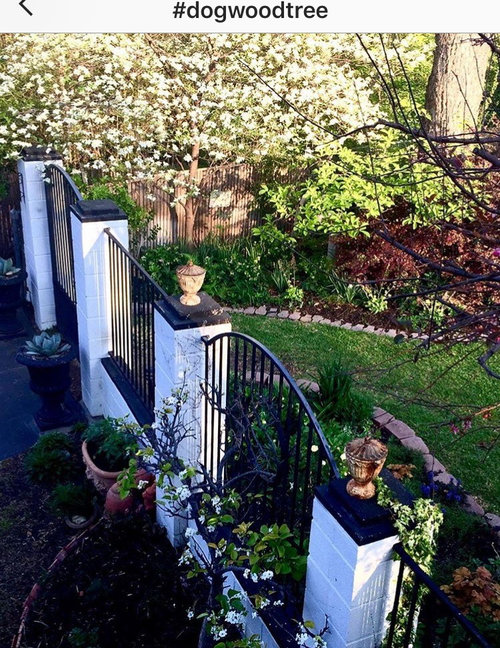
Hi all. I've been deliberating on a back yard tree for what seems like Forever! Im drawn to Redbud, crabapple (but its too messy) and I absolutely Love Dogwoods But not the big flower kind (yes I'm sounding foolish here)

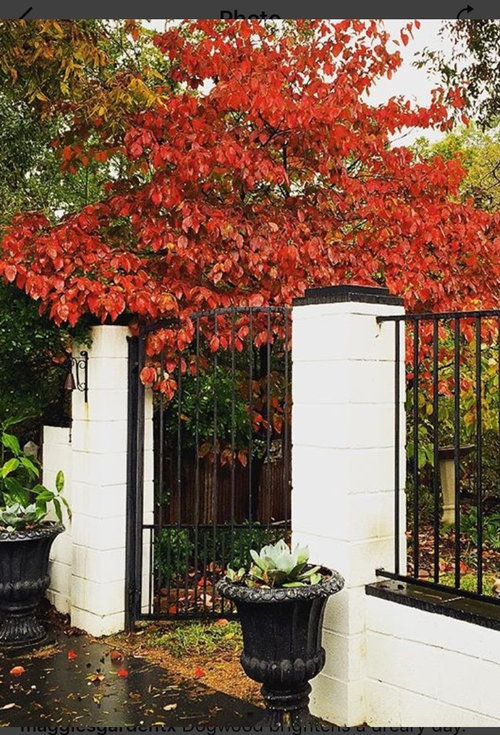
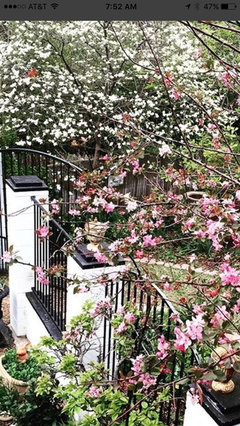
i saw this amazing instagramers post of her garden. I politely asked about her dogwood but she didnt elaborate on Which Cornus Florida Dogwood this is. There are a few. Im sharing a couple of pics of her yard for help with the tree. If you cab help. Please do! I love the reddish color it turns in the fall/winter

Comments (27)

  • 9 years ago

    I'm confused about the tree and its flower color. Are the flowers white? Are the white flowers in the first picture of the dogwood?

    Many dogwoods, Cornus florida, turn a nice garnet color in autumn.

    There are a number of cultivars . See the link below.

    https://en.wikipedia.org/wiki/Cornus_florida

  • 9 years ago

    Virtually ALL Cornus florida cultivars will turn a good reddish-purple color in fall, especially in areas with more distinct seasons (further north) and with adequate sunlight. But there are scads of cultivars with white flowers so you are not exactly limited in the selection. Pick whichever you like and is available in your area.

  • 9 years ago

    Listen to the 2 after me.They know what they're talking about.

  • 9 years ago

    your location nearly always matters ...


    i think OP might not know the difference between a species.. and CULTIVARS .. CULTIvated VARietieS ...


    first you look to the first 2 latin names ... to give you the basic plant you are looking for ...which may or may not grow in your area ...


    and then you look to the fancy name usually in quotes ... and those cultivars usually have minor chosen variations on the theme... as e.g. flower size.. color ... etc ..


    sooo.. i took your common name above.. and found out the latin is Cornus florida... and then i added white flowers ... and came up with the link below ... flip to the WEB side to see the links ...


    btw.. now is not a great time to be planting trees.. in many parts of the country .... as noted.. location matters ...


    good luck


    ken

    https://duckduckgo.com/?q=Cornus+florida+white+flowers&t=ffcm&iax=1&ia=images


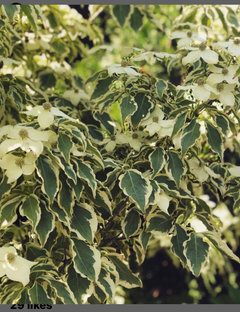
    whoa... this one is way cool ..Cornus florida 'Rainbow' .....wonder if its available in the states ... and.. if only.. i could grow foo foo dogwoods ... lol

    https://www.ornamental-trees.co.uk/cornus-florida-rainbow-tree-pp795


  • 9 years ago

    You would hope somebody has it: I mean, it is one of OUR natives.

  • 9 years ago

    i would suspect .... that the rainbow cultivar is NOT a native species ... eh


    below is a link to my post in the tree forum.. see how location matters ... it doesnt like my winter cold.. and it doesnt like my humidity in summer ... but the native one does work ... i see them around in spring flower ...


    ken

    http://forums2.gardenweb.com/discussions/4734283/cornus-florida-rainbow?n=3

  • 9 years ago

    Well.....if it's a cultivar, then it is NOT the native species :-) Species are not cultivars. As with other native plants (species OR cultivars), provenance matters - locating one that has been bred or grown from closer to your location increases the chances of its being able to tolerate/thrive in your growing conditions.

  • 9 years ago
    Hi Carol! Certainly white. I found another photo

    Its next to the crabapple
  • 9 years ago

    Perhaps you should shop for one in autumn to be certain you like the fall color.

    See if it has a name or if it's the species.

    As much as many to most Oxydendrum arboreum, sourwood trees, are known for their fall color, a garnet red, I've seen some that were duds for any autumn display.


  • 9 years ago

    I looked at Ken's link and it said the Cornus Florida rainbow tree was a cultivar of Cornus florida,which is a native species. Maybe in there selective breeding program they bred some of its cold hardiness and other qualities out of it. When I said " it's one of Our natives I thought everyone grasped that I meant a cultivar of one of our natives. You know like "Tomato Soup is a cultivar of our native Echinacea. The statement was a quip about how ironic it is that our native species can be taken and tweeked into new cultivars in other countries and then be not available back here in its place of original origin. Is this making any sense? I don't know much, but I know the difference between a species and a cultivar.Anyways,the Rainbow is a really cool looking tree. Too bad you can't grow it, but that could be another foo foo tree to water, and with the current drought. Oh, yeah, how's that going, keeping 5 acres watered?


  • 9 years ago

    Perhaps I'm misinformed, but can't a cultivar be a species? For example, Zauschneria garrettii 'Orange Carpet' was grown from seed taken directly from the wild and is therefore just a selection of a species. Many nice cultivars come from wild stock like this.

  • 9 years ago

    I have a red flowered Helenium that's a cultivar. I still consider it a native species. A cultivar of a native species. If the Cornus cultivar "Rainbow had been developed through hybridizing C. Florida with non native Eurasian species, then my statement would have been in error. But as it stands I don't see any error in what I said.Every cultivar is a selection of some species.A cultivar has to always be a species of something. When using the term native, I was referring to a native that was a cultivar. If I were referring to a native in its natural untweeked form, I would call it a true native,or pure native. Cornus florida "Rainbow" is a native Cornus. Only difference is it's a selection of a native.

  • 9 years ago

    I agree with you, macranthos. Many times a selection of a discovered , growing-in-the- wild native plant is named because it may have larger flowers, is more florose, flowers for a longer period of time, isn't susceptible to mildew, is shorter than typical, etc. Those marketing it know a catchy name will lure in more buyers.

    This does not include the manipulated crosses between species , or seeds irradiated or treated with colchicine to cause genetic mutation.

    Plants like ' Annabelle' Hydrangea arborescens which is basically a sterile flower with no positive attributes for pollinators , did it originate in the wild?

    How about the double bloodroot? Sanguinaria canadensis 'Multiplex'? If they are not native, what are they? Certainly not from another country.

    I found an article on line......


    https://www.nwf.org/News-and-Magazines/National-Wildlife/Gardening/Archives/2016/Cultivars.aspx

  • 9 years ago

    "A cultivar has to always be a species of something."

    Not necessarily :-) A cultivar can also be a hybrid, so a crossing of at least two different species (if not something more complex).

    But when considering 'native' plants, it is always the naturally occurring species that is considered the "true" native. Any cultivars are selected forms of that species, sometimes naturally occurring (like the Annabelle hydrangea mentioned above) but often manipulated or via controlled breeding or selection. As the word 'cultivar' itself stands for CULTIvated VARiety, the key is in the term 'cultivated' - a cultivated form is not a natural, native form.

    There was a recent discussion of this very topic on the Native Plants forum. And there appears to be ongoing debate about the validity of 'nativars' (as they are being referred to) or selected cultivars of native species as being the ecological equivalent of the true species. Some are, some aren't :-))

  • 9 years ago

    Ok, I never considered genetic mutation. Thanks Tiffany! If the Cornus florida "Rainbow" cultivar was indeed developed through human induced, genetic mutation,then I would absolutely not consider it native henceforth !!! And my statement would indeed be in error!!! Ha,ha, no biggie. I like Dogwoods, but I certainly don't have any space left to grow one. Always have wanted to taste the whatever things from the edible one. Then there's the ground covering one. That's awesome ! There was a similar discussion about native/cultivar issue on the native plants forum. Except over there we were all more like on the same page.

  • 9 years ago

    Well duh yeah! Maybe the majority of cultivars are hybrids. Like I said , if "Rainbow" had been created using non native stock,then I wouldn't have reffered it as one of our natives.

  • 9 years ago

    Genetic mutations occur naturally as well as being induced by human intervention. Most variegated forms of native plants - like the Cornus 'Rainbow' in question - are naturally occurring mutations. Variegations, sports, chimeras, witches' brooms, crested or fasciated forms are all naturally occurring genetic mutations and account for a large number of the cultivars of many plants we grow.

  • 9 years ago
    last modified: 9 years ago

    If genetic mutations did not occur naturally,then we wouldn't be here talking about it. We would all still be one celled primative organisms. So "Rainbow" is a product of natural occurring mutation ? That makes it even more native than I thought . Honestly gardengal48, I think you are totally awesome and you are my go to person when any kind of cultivar issue comes up. Uhh, I don't really enjoy seeing my quotes hung up hung on a billboard. It makes me feel kind of weird and vulnerable. I especially don't like it when someone is agitated by something I said. That's why I don't comment anymore on the breed your own Zinnias thread.

  • 9 years ago

    "So "Rainbow" is a product of natural occurring mutation ? "

    I don't know that for certain but I would suspect so.........And after some quick research, this is what I found: 'white
    blossoms; bright yellow and green leaves turn brilliant
    scarlet and blue-lavender in the fall. Plant Patent No.
    2743, May 16, 1967. Found by Armond Marzilli, Canton,
    Ohio as a sport from stump sprouts.'

    Here is the original patent information.

    So yes, a naturally occurring genetic mutation.

  • 4 years ago

    Hmmm ..

    Plant Patent No. 2743, May 16, 1967

  • 4 years ago

    It’s beautiful .. the no 2743 rainbow - no longer produced by Schmitt n sons , my parents have one growing in their front yard since 1972 as my brother brought it home from work as a gift to our mother.

  • 4 years ago
    last modified: 4 years ago

    Well ours grows in oregon ,has since 1972 and grown naturally.. no trim ect.. it’s straight from it’s original plant patent producer ”Rainbow” nothing Florida about it.

    I’m not sure how the “Florida” naming got in there, but im rather sure it’s NOT an original of anybody’s nursery except for Don Schmitt and they no longer produce it..!

    as well it’s no Froo Froo tree - rocky , moss covered soil is where it’s been growing healthy as day one ..! Climate zone 9 .. this Florida ? One tho - i bet its froo froo .

    ”Rainbow” ,, their can be only 1 ,, haa and we own it !!

  • 4 years ago
    last modified: 4 years ago

    Florida is part of its binomial name. The epithet describing where the original specimen that Linnaeus named, came from. Benthamidia florida. Got this everyone? BENTHAMIDIA! If you have a one and only great plant, wouldn't you want to share it with others? Or for the sake of science? 🤔


    Benthamidia florida has a much wider range than just Florida. The first sample came from Florida roughly 300 years ago, and back then they didn't know it had a larger range. Several vendors currently offer 'Rainbow'. They must be genuine. I can't possibly imagine why something so magnificent would be allowed to go out of production?


  • 4 years ago

    Hi Jay:


    Benthamidia florida? That's FSUS-ed up...

  • 4 years ago
    last modified: 4 years ago

    Viburnum, why have 2 syllables, when you can have 5? It could be worse, and be called Chamaepericlymenum? Named after English botanist George Bentham.


  • 4 years ago

    Hi all! It’s been a long while since I posted this. After my Cornus Florida died, I traded
    It in for a Cornus Kousa Samaritan. It was cultivated in Ohio and does very well here in Chicago. Here it is late spring

Sponsored
Hope Restoration & General Contracting
Average rating: 4.7 out of 5 stars35 Reviews
Columbus Design-Build, Kitchen & Bath Remodeling, Historic Renovations