Software
Houzz Logo Print
danielinthelionsden

Choosing a different Oak, Shumard Oak?


Last fall I planned out my landscaping and was going to start a Rock Chestnut Oak from seed acorn. We had drought last summer so I was thinking a shade tolerant drought tolerant tree would be a good choice. However, the seed acorns never sprouted and after observing the soil conditions this spring I'm thinking it was a bad species selection. The soil was so wet I was concerned that I was going to lose the sugar maple I planted in the fall. I'm pretty sure it sustained a little flood damage but it looks like it will survive. That said I'm thinking I need a tree with at least moderate flood tolerance. First I was considering Bur Oak due to it's extreme adaptability, moderate flood tolerance, drought tolerance, shade tolerance, etc. But I've always been interested in Shumard Oak so I'm thinking I'll go with that instead. My biggest concern with Shumard Oak is that there are a number of fast growing trees all around the planting site and Shumard Oak has such low shade tolerance. It's also super large and might be a bit big for the spot. But my goal is a long lived tree to fill in as the shorter lived fast growing trees around it die off, so hopefully it will work out.

I'm looking for thoughts on whether Shumard would be an epic failure or if it would be pretty reasonable to put in this spot.


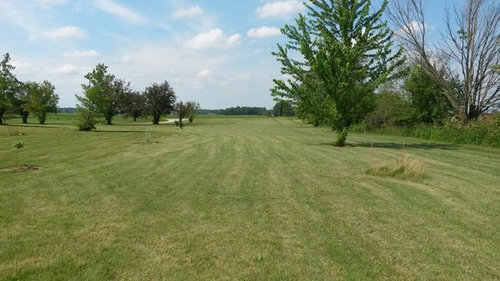
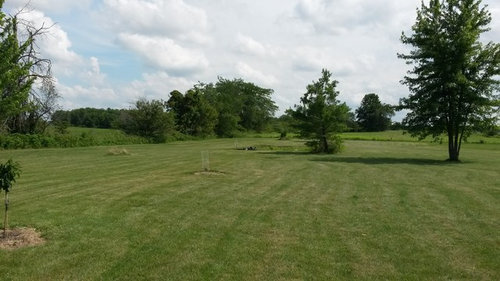
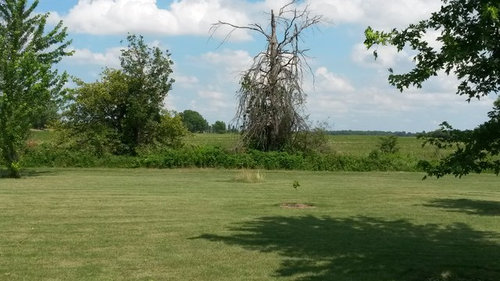
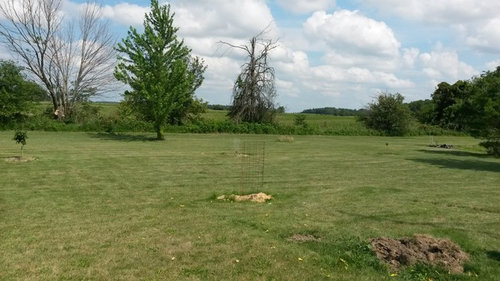
Here are some pictures of the planting spot:


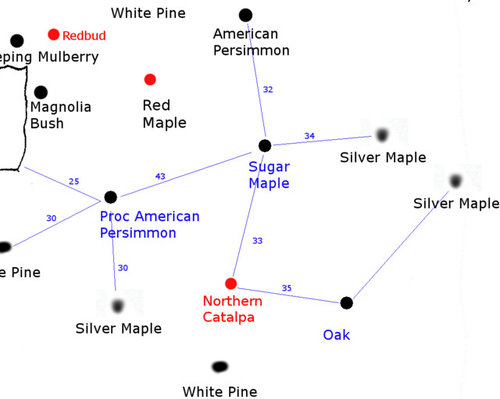
This is the over overhead map with measurements. The spot in question is the one that says "Oak"


As you look at these photo's the spot with the tall grass is the selected location for the Oak, middle right of this photo. It's where the seed acorns where and I've not yet removed the stakes or started mowing the spot again. On the left is the catalpa, then sugar maple, then persimmon. The bigger tree on the right is Silver Maple.


Here the planting site is in the far left. The bigger tree in the far right as a different Silver maple. The smaller tree beside it is white pine.


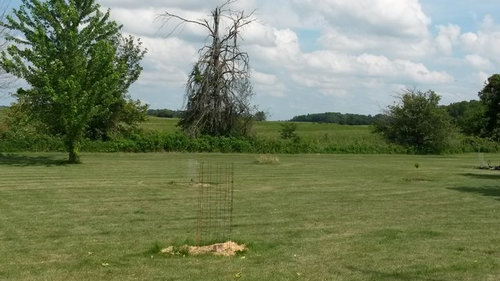
In this photo you can see the nasty dead tree on the neighboring property. To the immediate left of it you can see a Silver Maple growing in the middle of a Downy Hawthorn. The maple is in pretty bad health so I'm considering taking it down and leaving just the Hawthorn. That silver maple will probably cause a shade problem for this planting if it stays...I think


Here's a view with the first cage being the red maple, the next being the sugar maple and the oak spot far off in the distance, (in front of that nasty dead tree), (yes the dead tree really bugs me alot).


Same view just a little zoomed in.


Think shumard will do well here? Moderate flooding in the spring (super wet soil for many days, possible 1/2 inch of standing water after heavy rain), potential for drought in the summer. Currently full sun but that may change as the surrounding trees grow. Clay loom soil, neutral ph. Primary goal: shade tree with long life.

Comments (25)

  • 9 years ago

    Did you also consider Nuttall Oak and Swamp White Oak? There's a table showing shade & flooding tolerance of varied trees, including these 3:

    SP656 Shade and Flood Tolerance of Trees
    e University of Tennessee Agricultural Extension Service.

  • 9 years ago

    Yes and Yes. I actually looked at that same table. A super helpful resource. I also considered bald cypress. Now there's a tree that can handle some flooding. Anyway, I'm having a really hard time finding Nuttall Oak. I have a local nursery that can get me a Shumard or Bur Oak. I thought about Swamp White Oak too. Swamp White oak could be a good fit too, I just wasn't sure about the drought tolerance for that one. The perfect tree would have moderate food, drought, and shade tolerance (sounds like the bur oak to me). I especially like the fall colors from shumard oak. I think that might be one reason I was leaning toward it. Also it seems like the crown is not as dense. I read that Bur Oak can be nearly impossible to grow anything under. End up with bear dirt. How in the swamp white oak on drought tolerance? Maybe I should think it bit more on that.

  • 9 years ago

    Most any oak will have good to outstanding drought tolerance, even ones normally associated w/wet situations. So I wouldn't worry about the drought tolerance of whatever oak you want.

  • 9 years ago

    Agree with beng on the drought tolerance. If you can find it, there's a new variety of swamp white oak called "American Dream" that's supposed to have decent yellow fall color. I've seen it at a couple nurseries in this area.

  • 9 years ago

    Hmm, maybe I should do a little more reading on this swamp white oak before I commit on this planting.

  • 9 years ago

    Swamp White Oak is perfect for this spot. It tolerates wet soils and drought.

    If you go with a cultivar you'll need to know what its grafted to. For example if Quercus robur not sure the wet soil is a good idea.

  • 9 years ago

    Swamp white oak, white oak, baldcypress

  • 9 years ago

    White Oak? I'd put that on the list of trees that are intolerant to spring flooding.

  • 9 years ago

    Nuttall, Shumard, Swamp White, Swamp Chestnut, and good old Pin Oak would all do fine.

  • 9 years ago

    Doing a little more reading on Swamp White Oak. Looks like it is a really good fit for this spot. The size is more appropriate and being both flood and drought tolerant with shade tolerance as well is really good. Great in acidic soil but tolerant of neutral and slightly alkaline soil so it should work in our nearly prefectly neutral soil. I'll have to see if I can find a good source for this one. It seems like it's another one that's not as easy to find. All the local nurseries I've checked with say they have Pin Oak when I ask about Oak trees. There's one a little farther away that said they can help me with Bur Oak and Shumard oak. Maybe they can get this one too. Thanks everyone for your input. Very helpful.

  • 9 years ago

    Actually, on second thought, if your soil isn't at least a bit acidic, I would avoid Pin Oak.

  • 9 years ago

    Pin oak is bad about sending limbs down toward the ground, even from high up the tree. Got a couple in our yard put there before we moved in, and already fairly large. If you aren't willing to sacrifice a sizable footprint in the yard to accommodate that, it can be a fight.

    Richard.

  • 9 years ago
    last modified: 9 years ago

    All you have to do is prune the limbs.

  • 9 years ago
    last modified: 9 years ago

    So glad people have mentioned the swamp white oak, which I call the Overcup Oak and I think we are talking about the same tree....the one whose acorn caps almost cover the whole acorn.

    It can grow when there is standing water on the ground up to 40% of the time, so it loves water and flooded areas. Not sure of its drought tolerance, but I assume that once established, it would be fine.

    I have one in my yard which I plsnted ted in an area to catch a lot of water that flows down a large hill. In sun, it should have beautiful goldeny-orange-brown leaves in the fall.

  • 9 years ago

    I am not a huge fan of pin oak. They are "mall trees" to me. But I did plant two to block the view of my neighbor's house, since they hold on to their leaves for a while in the winter when they are young, and their branching habit is rather dense.

  • 9 years ago

    There are already 3 Pin Oaks on the property and I'm starting to find little seedlings coming up all over the place. So I know that one would grow well here. I could just go with that but the life on that seems to be much shorter than the other Oaks. So I won't get to see it but I think it'd be fun to plan a 300+ year tree. At this point I'm thinking I'll probably go with the Swamp White oak. It seems like a really good fit. Thanks all!

  • 9 years ago

    "All you have to do is rune the limbs." I've read that if you prune off the lower branches of a pin oak, those remaining that are now the lowest will in time grow downward toward the ground, recreating the problem. I am observing that on the 2 we have. I'm curious as to how high up a pin oak trunk one must prune limbs (assuming an open-grown specimen) to reach the point where no branch descends under, oh, way, 5 or 6 feet?

    Richard.

  • 9 years ago

    Just prune it again when it starts to come close to the ground. Depending on the size, it could take 15 minutes, or an hour, but either way it's still worth it.

  • 9 years ago


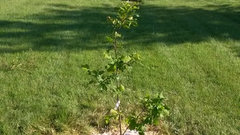
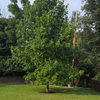
    Here's the end result of this conversation. The nursery that's 40 minutes away had a couple swamp white oak in stock. The other was three times the size. I figured in this case smaller is probably better. In retrospective I think that was probably a good call. This one already had a few circling roots that I had to loosen, I'm assume the bigger one would have had that even worse. I'm not so sure I'll go for the whole "potted medium can be planted anytime thing again either." I wasn't very comfortable with the amount of root work this one required, doesn't seem like a good plan during the growing season.


  • 9 years ago

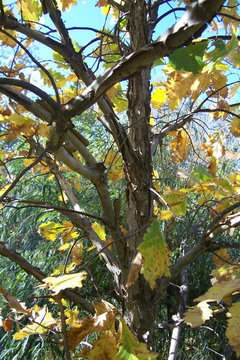
    I think you'll like it. Quick tip I learned about online after seeing something with ours; the bark can peel. I'm not talking like river birch, but it can peel. I thought the top had died in ours because I saw a strip of bark peeling off, but after some online checking and then watching it up back out in the Spring just fine, I've come to understand it's not that unusual with swamp white oak.

  • 9 years ago

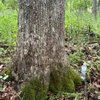
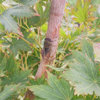
    Swamp white oak bark on an 11-yr old (the one I show above):

  • 9 years ago

    Now you just have to water it! What is that you have it mulched with? Sawdust?

  • 9 years ago

    Looks like wood shavings from a planer or other wood machine. Probably will turn into dirt a lot faster than coarse chips but it's probably a freebie the OP gets from his hobby shop. :)

  • 9 years ago

    It's good to know that peeling bark is normal. I haven't observed that yet on this tree but I won't worry if it does start to do that.

    Regarding watering I've been watering it every day since planting. I couple days here I'll probably slow that down to every third day for a couple iterations and then go to a normal watering cycle of once a week. As of today there aren't any wilted are brown leaves so I guess it wasn't too shocked by all the root work I had to do.

    Regarding the mulch. I use planner shavings as mulch. They are inferior to normal large wood chunk mulch but are free and keep the ground moist. This planting I was running low on shavings and mixed in some shredded paper. I've read on line that paper shreds make a great mulch around trees. I find that it's not so great and tends mat down into a hard paper mache. So I mixed it in with the shavings and that seemed to work decently.