Software
Houzz Logo Print
ne1one

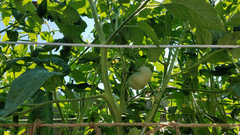
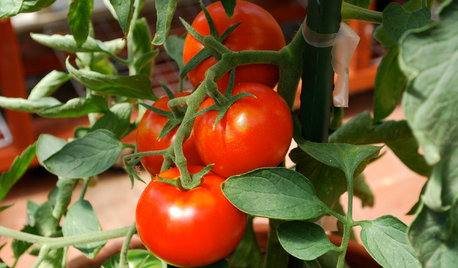
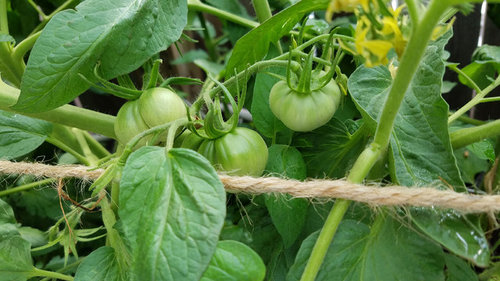
Tomatoes and salad on the same plant.

9 years ago
last modified: 9 years ago
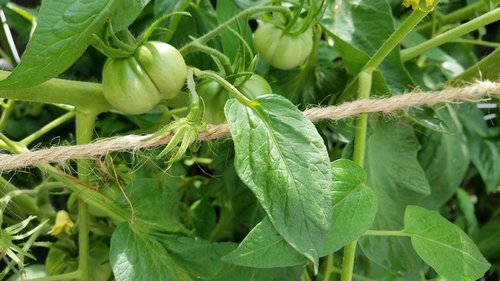
this variety grows the salad (spinach) along side the cluster of tomatoes.

Comments (29)

  • 9 years ago

    Hmmm! I thought that tomato leaves were poisonous - even Potato Leaf varieties!


    Linda

  • 9 years ago

    You are kidding right? Doesn't look like spinach to me. Don't want folks to think they can eat tomato leaves!

    Dave

  • 9 years ago
    last modified: 9 years ago
    yes i am. don't think someone could be that naive.
    i'm just the joker type, and perhaps this forum isn't used to it since it seems people are generally a bit tense ;)

    spinach was the first thing that came to my mind when i saw the odd leaf coming out of the cluster of tomatoes. maybe i was just hungry.. there are many spinach varieties that look similar in shape.

  • 9 years ago

    Next time you'll have to put a "ha ha" after the joke so everyone gets it.

    I knew it was a joke, but I thought maybe you had spinach growing in the same bed and the plants got tangled up. I have a green bean/tomato plant because a seed was dropped in the wrong place and a green bean sprouted up next to a tomato plant and started to twine around the stem.

  • 9 years ago

    Yeah, we'll get pretty tense when readers start eating their tomato leaves. I believe Brandywine has potato-like leaves. If people are encouraged to eat leaves on the basis of their shape, we'd end up with a smaller surviving community.

  • 9 years ago
    last modified: 9 years ago

    it's first time i've seen a leaf come out of there. i've seen plenty of abnormalities, never a almost full size leaf form like that. maybe the kelp spray is causing it go to into a frenzy, since one of the effects of kelp is drastic increased the amount of foliage according to a few of the studies i've read using it on tomatoes.

  • 9 years ago

    There's surprisingly little evidence for tomato toxicity.

    It's one of those things that's become "conventional wisdom" but may be based on faulty information.

  • 9 years ago

    Just to be clear, I'm not suggesting anyone eat a jumbo salad composed only of tomato leaves. The dose makes the poison. That goes for everything. But it's far from a death sentence or even an upset tummy if someone were to taste tomato foliage. I'd be more concerned with the fact that tomato leaves are often sprayed with pesticide and fungicide than about the effects of the leaf itself.

  • 9 years ago
    last modified: 9 years ago

    found some more abnormalities on other plants (different variety as well) so must be the kelp doing it or some other odd anomaly.

    if you look at the tomato, it's like a normal tomato cluster, but at the tomato, it decided to branch off and turn into sucker and continues growing up.. it's flowering and fruiting as well there (off the top edge of photo).

    what came first.. the cluster or the sucker? ;)

    Bigger picture here

    this looks like i grafted a leaf to a premature flower cluster.
    Bigger picture here

  • 9 years ago

    " The dose makes the poison."

    One of the more unknown, misunderstood, unused truths.

    " ...It is credited to Paracelsus
    who expressed the classic toxicology maxim All things are poison and
    nothing is without poison; only the dose makes a thing not a poison."
    This is often condensed to: "The dose makes the poison" or in Latin
    "Sola dosis facit venenum". It means that a substance can produce the
    harmful effect associated with its toxic properties only if it reaches a
    susceptible biological system within the body in a high enough
    concentration (i.e., dose).[2] ..."

  • 9 years ago

    stevie: found some more abnormalities on other plants (different variety as well) so must be the kelp doing it or some other odd anomaly.

    It's fairly common for tomato plants to do this sort of thing. Tomato plants grow at a prodigious rate. In only a few months, they go from seed to 8, 10, 12 foot tall plants. When a living thing grows that quickly, there are many more chances for errors in cell division, stem cell differentiation, etc.

    People often attribute more abnormalities to higher N. This has some logic to it, as more N leads to faster, more vigorous growth. But I also notice that stuff like this just happens.

    Things that affect the plant's hormonal milieu can also produce weird things like this. Many herbicides do this, although on a much more severe scale that is harmful to the plant vs. just an oddity here and there. Some viruses can produce weird growth as well.

  • 9 years ago
    last modified: 9 years ago

    by the way, seems to be only the potato leaf plants having odd growth. the RL plants seem normal.

  • 9 years ago

    I notice more oddities on potato leaf plants as well. Even more so on potato-leaf dwarfs.

  • 8 years ago

    Deer like cows have 3 stomach, we have one.

    ghtshade and related plants

    The Solanaceae is a family of flowering plants, many of which are edible, while others are considered poisonous.

    The family is informally known as the nightshade or potato family.

    The family includes the Datura or Jimson weed, eggplant, mandrake, deadly nightshade or belladonna, capsicum (paprika, chile pepper), potato, tobacco, tomato, and petunia.

    The most important species of this family for the global diet is the potato.

    The Solanaceae are known for possessing a diverse range of alkaloidal glucosides, or simply alkaloids.

    As far as humans are concerned, these alkaloids can be desirable, toxic, or both, though they presumably evolved because they reduced the tendency of animals to eat the plants.

    Note: The above text is excerpted from the Wikipedia article "Deadly nightshade and related plants", which has been released under the GNU Free Documentation License.


    This is not a joke, I worked with the BSA & was shocked at how little parents knew about plant danger.

  • 8 years ago

    n 2016, the 55 U.S. poison control centers provided telephone guidance for nearly 2.159 million human poison exposures.1 That’s about:

    • 6.6 poison exposures/1000 population,
    • 41.3 poison exposures in children younger than 6 years/1000 children,
    • 1 poison exposure reported to U.S. poison control centers every 14.6 seconds.

    Year: 2016 Human Poison Exposures 2,159,032 Animal Poison Exposures 54,019 Confirmed Non-Exposures 6,776 Info Calls - Drug ID 137,880 Info Calls - Other 352,335 Total 2,710,042

  • 8 years ago
    last modified: 8 years ago

    I'm of the opinion that some tomato leaves are more toxic than others. That could explain the conflicting studies I've read about, anyhow.

    But yeah, it's not abnormal for people to use a small amount of tomato leaves as a sauce seasoning.

    It's probably no more dangerous than fried green tomatoes, which, unless they're ripe green-when-ripe tomatoes, still contain tomatine like the leaves, although I'm not sure how the amounts compare.

    I don't personally like the feel of tomato foliage in my mouth and throat, but I understand some people think it's edible.

  • 8 years ago
    last modified: 8 years ago

    https://www.thekitchn.com/are-tomato-leaves-actually-poisonous-222259

    No, they aren't. I wouldn't eat a lot of them, for the same reason I wouldn't eat a lot of green tomatoes. But I've eaten them, and I'm still around. There are a lot of things I wouldn't eat a lot of, actually.

  • 8 years ago

    Shule: I'm of the opinion that some tomato leaves are more toxic than others. That could explain the conflicting studies I've read about, anyhow.

    Which studies? The only documented case of tomato leaf toxicity in the scientific literature was one questionable and completely unverifiable anecdotal story from a long time ago. If there are actual studies, this would be good to know. Last I checked, there weren't any.

  • 8 years ago

    When there is no evidence that something is poisonous (and no evidence that it isn't), but a reason to believe that it might be, one would think to err on the side of caution and not eat it. Of course people thought this about the fruit themselves for centuries and turned out to be wrong, but had I been alive during that period, I wouldn't be the trendsetter who tried to eat them and find out.

  • 8 years ago

    There is reason to believe that tomato plants are NOT poisonous.

  • 8 years ago

    I use tomato leaves occasionally as an herb in my cooking. It causes no stomach upset or any other symptoms.


  • 8 years ago

    Gosh, tomatoes are members of the nightshade family, which includes deadly plants. Better err on the side of caution and not eat them!

    Look up a few posts, and you'll see a link I gave that refers to the unpoisonousness of tomato foliage. Just another garden myth. Such myths abound, and I enjoy squashing them.

  • 8 years ago
    last modified: 8 years ago

    There are also plenty of other plant foods that are not solanaceae which also contain similar levels of solanine to tomato plants. Nobody worries about how "toxic" they are. It seems the tomato hasn't escaped the legacy of the original myths about its toxicity.

  • 8 years ago

    Recently I spent a couple of hours scanning sites with the .edu extension for tomatoes and toxin or poison. I came away with the feeling that ripe tomatoes have less of the alkaloids tomatine and solanine than do green tomatoes and lots of people fry up green tomatoes and eat them without any problems.


    Elsewhere on the internet there are numerous accounts of children (plural) being made ill drinking tea made from tomato leaves. Someone writing for the New York Times said they could find only one [perhaps reliable] reference to one child perhaps getting ill drinking tomato leaf tea.

  • 8 years ago
    last modified: 8 years ago

    gorbelly, I don't know if they were studies in scientific literature or not, but I've read about two different experiments where cows were allowed to feast on large amounts of tomato foliage. In one study, I believe the cows all died. In the other, they were just fine.

    I don't know where I found that information, but in searching again I found something new that might be interesting. This seems to indicate that nitrates in tomato leaves are more of an issue for cows.

    Of course, cows aren't humans, but if it kills cows in some situations, that might be cause for concern.

    What I would recommend is for researchers to determine the variance of tomatine between tomato varieties and species. I believe S. pimpinellifolium is said to have more toxin in its unripe fruit than for domestic tomatoes (the same may be true for leaves). Many tomatoes are hybrids between wild and domestic tomatoes. So, toxin levels could potentially vary a lot by that criteria alone. Any study on tomato foliage should probably say what kind of tomatoes were used.

    There also seems to be some dispute as to whether tomato foliage contains solanine at all, although people can agree that it contains tomatine (which is much less toxic, although still potentially toxic).

  • 8 years ago
    last modified: 8 years ago

    Large amounts of tomato foliage isn't healthy. I think it has been established that a couple POUNDS of tomato leaves will harm you. So if those cows really chowed down, they might have been ill-disposed. If you eat a couple of pounds of chocolate, you'll get theobromine poisoning. If you eat too much of anything, you'll probably run into problems. Ever hear of hyponatremia? That's where you drink too much water and collapse and possibly die.

    Bottom line. Tomato leaves (and green tomatoes) have glycoalkaloids that can kill you if you eat a huge amount. But in the amount we're likely to eat, they won't even come close. Happy eating.

  • 8 years ago
    last modified: 8 years ago

    Just a note: cows are not people. Ruminants will get very sick or die if they eat perilla, for example, which is an increasingly common pasture weed. But East and Southeast Asians eat tons of perilla as part of their cuisine. I probably eat some every day of my life. What is an emergency for a cow or a goat is just good eating for people. Conversely, cows can eat Atropa belladonna, aka deadly nightshade, whereas even relatively small quantities are deadly to people.

    I wouldn't eat a pound of tomato leaves in one sitting, but there are lots of herbs and greens nobody worries about that I wouldn't eat a pound of in one sitting because they can be harmful in excess.

    So lets all remember: humans are not cows or rats or rabbits or whatever. And the dose makes the poison. Always.

  • 8 years ago

    The dose makes the poison. Well said. This applies to legions of people, for whom a humongous LD50 translates into a horrible poison to be avoided at all costs. Nope. Doesn't work that way. There's a lot of that going around.