Software
Houzz Logo Print
kyra_harris_schulz

What disease is this? Please help quick!

9 years ago

Hi there!

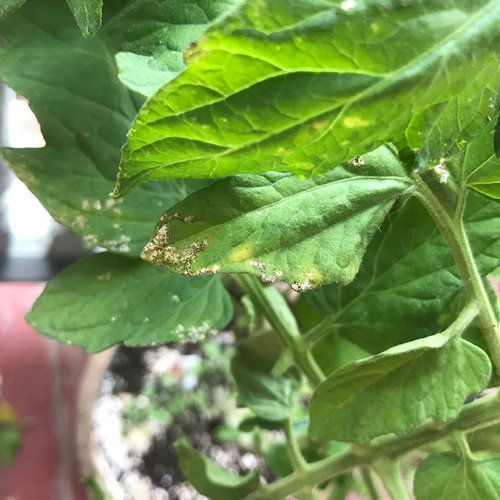
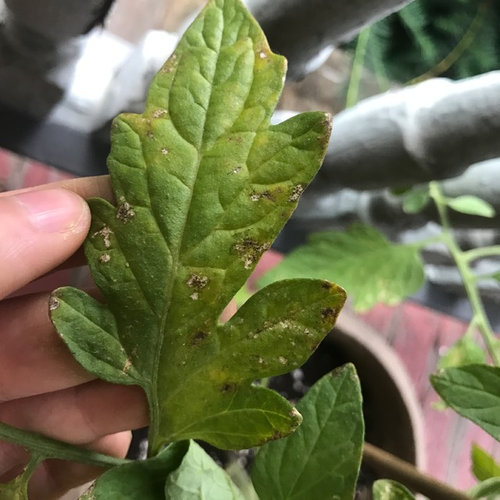
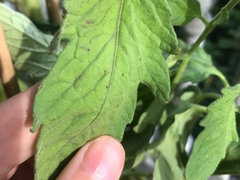
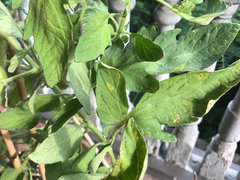
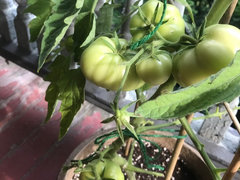
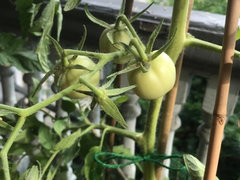
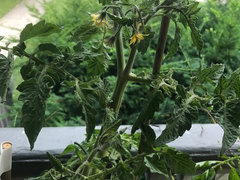
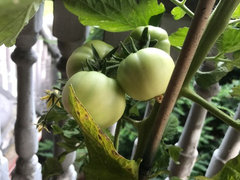
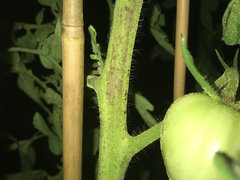
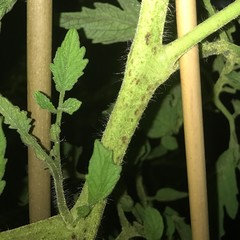
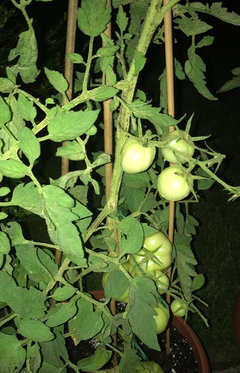
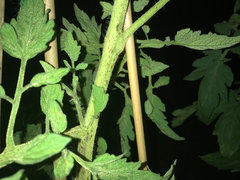
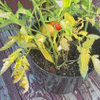
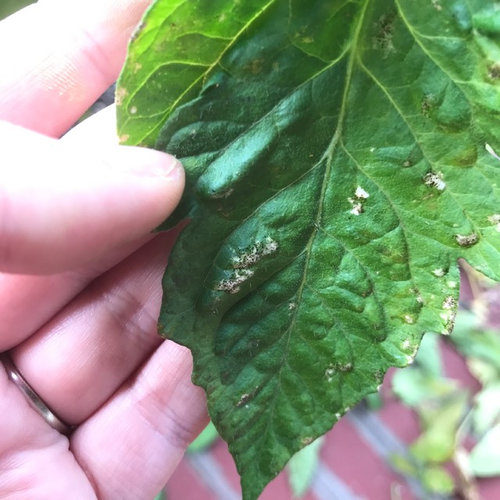
I'm new to growing tomatoes and need some guidance desperately. I purchased an Ultra Girl a while back and grew it in a pot on my deck. It has done beautifully, so I returned back to the local greenhouse where I bought it looking for another. Given how late in the season it is, their big tomato plants (approx 4ft tall) were on sale for $4. I bought two, despite the fact that the bottom foot on both plants looked a bit diseased. I truly thought they just needed a good pruning, however, once I got them home I realized two things: 1) the leaves look like they have a disease I don't recognize (some leaves are yellowed, others have dry, white patches with tiny black specs that look like black heads); 2) the one plant has what look like aphids (however I doubt they are since I thought aphids hated tomatoes). I've attached pictures and am looking for some help to answer these questions:

1) What disease is on the leaves and what do I do about it? I've pruned away most of the diseased leaves but did have to leave some on that were less effected as I was worried about that there wouldn't be enough left for photosynthesis.

2) Can tomatoes get aphids? What can I do about it?

3) I grow in pots, but I'm still worried my diseased plants might infect my original healthy plant. How far should I keep the pots away from each other? I don't have a huge full sun area, so it's not as if I can separate them to the front yard and backyard.


Thank you kindly in advance everyone!

- Kiki


Comments (13)

  • 9 years ago

    Ok, first aphids love tomatoes so that is one definite possibility. Another is just a guess since we can't see the whole plant and don't know the size of the container you are using and much more. But nutrient issues and pests are far, far more common than any diseases so it is too early to jump to the "disease" conclusion.

    On the off chance that it is one of the common tomato diseases then it really makes little difference which since the treatment is basically the same for all - removing damaged foliage and regular spraying with the fungicide of your choice per label directions.

    The damage I see in your photos is most likely insect damage of some kind but you have given us a very limited view of the overall plant health so first you need to examine the entire plant very carefully and ID any pests you see.

    Then please give us some more info and a photo of the whole plant container and all please. What is the container size, plant size relative to the container, feeding what and how much and how often (some of the edge symptoms could just be nitrogen burn), water regimen. what is the container filled with, etc.etc.

    Most of all - don't panic, ok? ;-)

    Dave

    Kyra Harris thanked digdirt2
  • 9 years ago

    I replied to the duplicate thread you have in the tomato pests forum. It looks like thrips damage. See the other thread. http://forums.gardenweb.com/discussions/4740954/please-help-odd-disease-on-leaves?n=1

    Kyra Harris thanked gorbelly
  • 9 years ago

    Thank you SO much for all your quick replies! I'll give you a bit more info as requested:

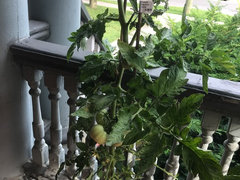
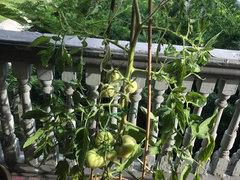
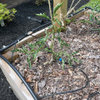
    - the tomatoes are both in small pots as I just got them home from the garden centre. I've attached a picture. They pot size is about 10" I'd say. I planned to transplant them today in Rubbermaid containers with water holes drilled into the bottom. I have no idea how often they were watered or fertilized at the garden center - they seemed pretty moist yesterday.

    - I did inspect the plant and there are a number of things I found: there is one of two fast moving small bugs, they look maybe like thirps.

    - there are small things that look potentially like aphids or eggs - but mainly on the top of the leaves.

    - the leaves this morning are curling on the one plant

    - the upper half of the plant seems uneffected. The blossoms are really nice and the fruit that's growing seems healthy.

    - there are a number of different things on the leaves: there's the silver/white patches with the black dots, there's a black rim on some of the edges of the one plant, there's some yellowing, and there's some curling on the one plant.

    At this point I'm not sure whether to just return them to the garden centre or to try to stick it out. If they are thirps, I'm a bit concerned that they might infect my other plant.

    Any additional help would be SO appreciated! Many, many thanks!


  • 9 years ago
    last modified: 9 years ago

    As I mentioned in your duplicate thread, spinosad is supposed to kill thrips.

    The silver/white patches are the thrip feeding damage. The black specks are their feces. Only thrips leave damage like that.

    You may have aphids as well. If you see bugs like this (hopefully, your infestation is not as heavy as the pic shows) that are either peach colored as shown or light green, you also have aphids. Little white specks are usually the shed skins they leave behind as they grow. Aphids can be knocked off of a plant with a vigorous stream of water. Then you can spray spinosad for the thrips. Aphids can cause leaf curling and yellowing.

    And as Dave points out, your plants also likely have some nutritional issues. Are you fertilizing them? And obviously, as you had already planned, they need to be moved out of those pots. Those look like peat or paper pots, too, and if they are, that could be responsible for a lot of the water/nutrition issues that are evident.

    As for whether to return them or not, that's your call. They're already fruiting, and could potentially give you a decent amount of production if you fix their growing conditions and they haven't contracted a disease from the thrips. Personally, it would depend on their variety for me (fruit worth the effort or just middling-tasting standard red hybrids?) and whether or not I could keep them at a distance from my other tomato plants for a while while I try to fix the pest issues.

  • 9 years ago

    That's such great info! Thanks so much! For $4 a plant I think I'll give it a go and see if I can clear up their issues. I'm shocked by the aphid situation since I make an tomato leaf tea to keep them off my kale. I'll definitely get some Spinosad, transplant them, and fertilize. I generally use Miracle Grow Tomato Plant food once a week for my other plant (1 tbsp in 1 gallon/week). I've heard some people mix a small amount into their daily watering instead. Thanks so much for all the help! Hoping I can get them to turn the corner!

  • 9 years ago
    last modified: 9 years ago

    Kyra Harris: I'm shocked by the aphid situation since I make an tomato leaf tea to keep them off my kale.

    There are very many different species of aphids, and some are fairly host-specific. So, theoretically, using something like tomato compounds that have a strong odor may repel or confuse aphids used to seeking out the odor of brassicas. The compounds may even be mildly toxic to the aphids on your kale, as those particular aphids (I'm assuming cabbage aphids) have evolved to cope with the toxins in brassicas (almost all plants produce natural compounds that can have pesticidal properties) but probably not to the ones in solanaceae like tomatoes, peppers, etc. The aphids on tomatoes, at least where I am, are the potato-tomato aphid, which as I mentioned are usually peach or green and a completely different species than the cabbage aphid.

    Does the tomato leaf tea work well for you? I usually try to keep aphid populations down by knocking them off with water when needed and planting to attract and nurture beneficials. But tomato leaf tea is an interesting idea.

  • 9 years ago
    last modified: 9 years ago

    Oh that's so neat to hear about the different types! Tomato leaf tea was an amazing fix for my kale. I was knocking them off with water twice a day and could not keep my population down. I read about tomato leaf tea online and it really got rid of them. I do two cups of tomato leaves (no stems) in a litre of luke warm water, brew overnight, spray the next day. I spray the entire plant + soil but also put extra time into targeting the pre-existing populations and knocking them off simultaneously. You do need to make a batch each use as it does have a tendency to grow mould and smells to high heck. Now if I could only get the cabbage moths off I'd be set haha

  • 9 years ago
    last modified: 9 years ago

    i am trying the tomato tea after reading it on some garden website. going to use it on my kale since something is chewing up my baby plants pretty bad, i can't figure out what insect is causing it.. sprayed neem oil and it works, but i don't like having to reapply it that often. it's perfectly safe, but i think its slight odor (kind of pleasant) might stick to the kale and effect the taste since it's a little oily.

    my beets seedling are also being gobbled up by something. they eat the first two leaves before it even has a chance to develop true leaves..

    i chopped up about 2 cups of tomato leaves and stems and steeping in 2 cups of water, hoping it will work.

    for tomatoes, i always use just neem oil extract. works great for everything as an all-purpose fungicide/insecticide.. And since i don't eat the tomato leaves, i don't mind using it weekly for things like blight. it's great for insects, but generally most insects stay away from the tomato scent it seems, except the dumb aphid and some tomato caterpillars.

    btw, garlic/onion is another one to try as well.. works good for rodents too ;)

  • 9 years ago

    Fingers crossed it works! Did wonders for me!

    Does anyone have info on where to buy Spinosad (or under what brand name) in Canada?

    Also, are there any commercial neem oil sprays or do you have to make your own?

    Many thanks!

  • 9 years ago

    I think a brand name available in Canada is Entrust. But I have no idea where. I would guess you could find it online.

    RE: neem--get cold-pressed neem oil. Be careful--here in the US, we have a lot of products that look like they're neem oil, but they actually contain neem extract and not the real oil.

    You mix it up with a little dish soap in warm water. You do have to shake the tank/bottle frequently as you spray. Instructions are usually something like 1 tsp/quart of oil, with a little squirt... maybe 1/2 tsp? of dish soap.

  • 9 years ago

    Thanks so much!

  • 9 years ago

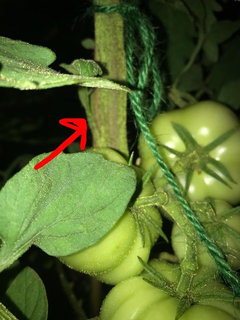
    I'm going to post a new thread to discuss further, but I was out of town for two days and came back to find one of my plans has brown spots on its stalk. I have no idea what this is or what to do about it! Any thoughts? I'm in Canada so I need a spray that is sold here to treat.

Sponsored
Peabody Landscape Group
Average rating: 3.5 out of 5 stars8 Reviews
Columbus' Reliable Landscape Design & Contracting