

Help - Too much fertilizer or not enough?
Hello, first time post. I've been struggling with my tomatoes lately. I think I may need to put epsom salt on them but I'm also concerned I've over fertilized. I'm in zone 8b.
I'm attaching a few pictures. One you can see the whole plant(s). 2 close up pics of leaves on the tomato. Also including a close up of the basil and bell pepper plant as they are in the same container.
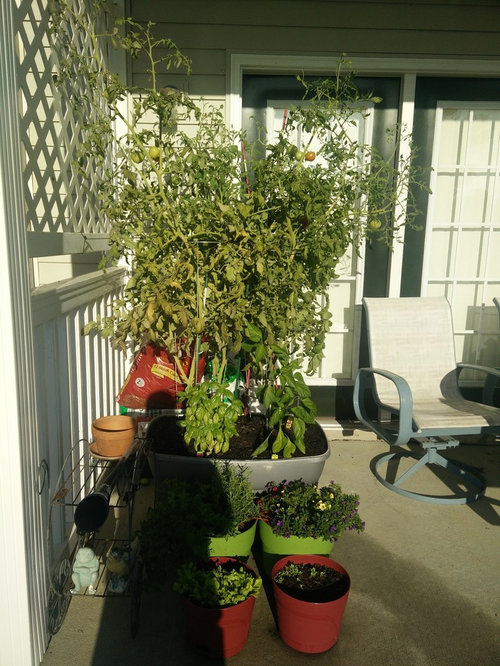
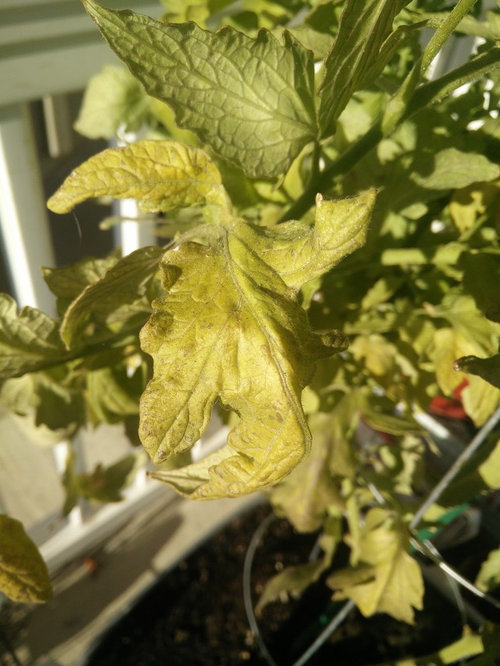
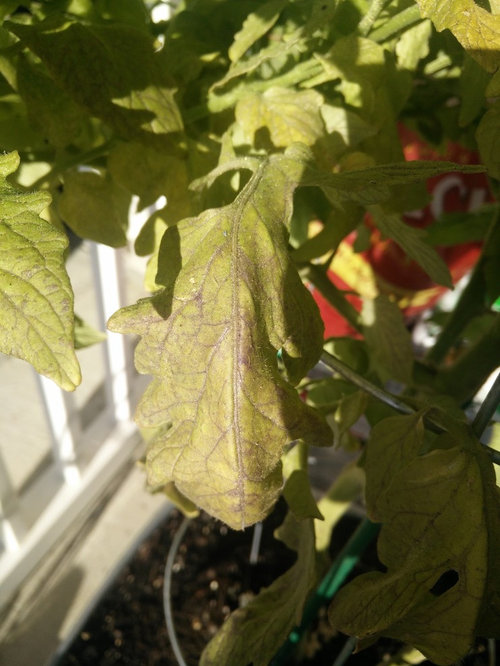
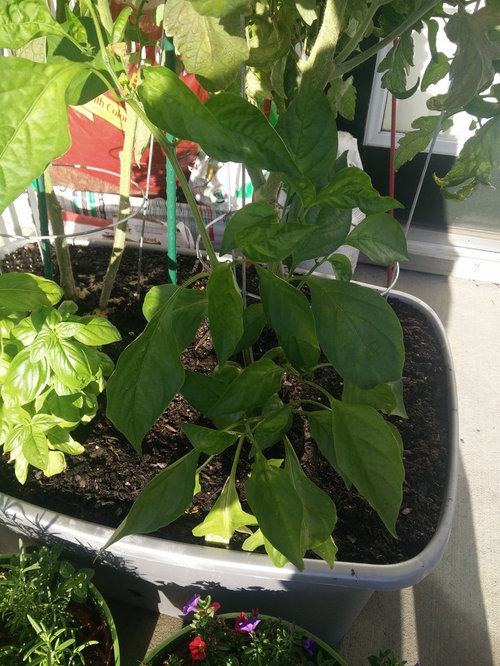
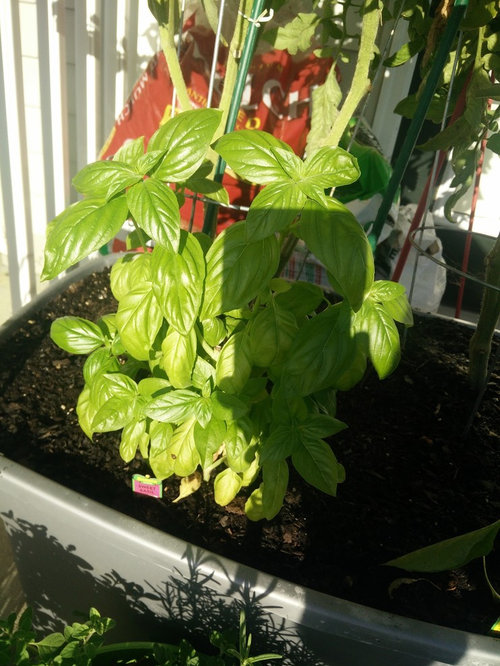
Thanks for any help!
Comments (30)
 9 years ago
How much fertilizer are you using?
How much are you watering?
Stick your finger a couple inches down in your growing medium and report back on how wet or dry it is.

J J
Original Author9 years agoIt's a self watering design container. I did water the top yesterday because it seemed a bit dry. This morning I checked and it was damp.
Related Professionals
Bowling Green Landscape Architects & Landscape Designers · Sugar Land Landscape Architects & Landscape Designers · Champaign Landscape Architects & Landscape Designers · Barnstable Landscape Architects & Landscape Designers · Mankato Landscape Architects & Landscape Designers · Modesto Landscape Architects & Landscape Designers · Clarksdale Landscape Contractors · Martinsburg Landscape Contractors · Sierra Vista Landscape Contractors · London Landscape Contractors · Florence General Contractors · Tupelo General Contractors · Amherst General Contractors · Saginaw General Contractors · Sierra Vista General Contractors- 9 years agolast modified: 9 years ago
How much are you fertilizing and how? The strip method? What kind of fertilizer?
J J
Original Author9 years agoI'm using JOBES organic tomato plant food. I have been sprinkling some on about once a week or two. Like half a handful. I figured since there are 2 big tomato plants, a pepper plant, and a basil plant in there it needs a lot of food.
J J
Original Author9 years agoI'm not sure about the strip method? I just evenly sprinkle on top all around the container and water it a bit.
 9 years ago
Definite across-the-board nutritional deficiency and why can be explained easily. First because you are using an organic dry fert in a container which never works at all well because there is no active soil bacteria to pre-digest it so the plants can use it. So as often discussed here, using dry organics in containers is basically a waste of money.
Second because you are not applying it where the plant's roots could get to it in a self-watering container - water is in the bottom while the fertilizer is on top. Either water from the top or add the fertilizer to the water well.
Third because even if you were using a non-organic dry you aren't applying enough.
The "strip method" when used properly works like side dressing an inground plant - water must flow through it dissolve it to work - and it must be supplemented regularly. Self-watering containers assume those supplements will be added to the water. For that reason liquid nutrient supplements work far better.
And lastly, your container is over-planted and contains plants with very different nutritional and water needs so that creates additional issues.
The best solution is to remove the pepper and basil and give them their own separate containers. That way they won't be robbing from the tomato plants and vice versa and you can water and feed them as only they need.
Then buy a good water-soluble fertilizer (either organic or not) and apply it per the label directions for the size of your container. Most inexperienced container growers find that Miracle Grow not only contains everything the plant needs but is easy to use. It is mixed at 1/2 strength and applied from the top every 7-10 days.
If you only want to use organics then the fish/kelp blended liquids will supply most of the needs of the plant but it is mixed at full strength (per the label) and applied either from the top or poured into the water well weekly.
Your plant does not need epsom salts as magnesium deficiency is not its problem and that is all epsom salts is good for.
Hope this helps you. If interested there are numerous discussions about all this over on the Container Gardening forum as well as this forum that the search will pull up for you to browse through.
Dave
 9 years ago
Granular organic fertilizers are not a very good choice for a containerized plant. They require the attention of large populations of soil organisms to break them down into plant usable forms - which happens over an extended period of time, sometimes months - and the vast majority of container soil mixes simply do not have anywhere near sufficient populations of these organisms for this type of fertilizer to be effective or efficient.
So for a proper application nutrients the plants can access easily and in an appropriately timely manner, try using a water soluble or liquid synthetic fertilizer, like the Dyna Gro or Miracle Gro products. Even fish emulsion is a better choice.
- 9 years agolast modified: 9 years ago
> Granular organic fertilizers are not a very good choice for a containerized plant.
if you use a potting mix with mostly peat, i would agree. the soil in my potting mixes have some peat, but also a lot of compost and some soil/hummus from broken down leaves, etc. i prefer this type of potting soil for this reason.. there are worms and lots of soil dwelling critters in my potting soil, but my pots are huge (most over 20 inches). no idea how the worms got there, but they are there. so if you can see signs of life (insects) imagine what can't be seen in which case organic dry mixes should have no problem breaking down..
- 9 years ago
And for the best success with any container planting, you want to avoid using any garden soil or readily decomposable material like compost or chopped leaves. The reasons for this are many and varied but the key concept underlying the issue is that container gardening is NOT the same as gardening in the ground and you cannot treat the two methods in the same manner. What works well in the ground will not work well in a container setting. That is why they sell a specialized container soil mix to begin with!!
The other big factor with using dry organics is that they take time to get broken down by the microorganisms..........sometimes quite a lot of time (weeks to months) is required.........provided the microbes are present in the populations required to begin with. There may or may not be enough time during the relatively short veggie growing season for these to become properly converted to plant usable nutrients. As clearly demonstrated by the photos above.......the plants are starved for nutrients.
- 9 years agolast modified: 9 years ago
General rule of thumb - use liquid fertilizers for containers. Our area "Tomato Guy", Dave Freed, grows in self-watering containers and uses liquid fertilizer or granular fertilizers that are designed to be dissolved in water.
- 9 years agolast modified: 9 years ago
to be fair, using a self watering container makes it a no brainier to use liquid fertilizer.
the real big issue here is not the dry nutrients. despite all the nutrients not being available, it still has some water soluble nutrients, most likely found on the label. even something like dry chicken poop (3-2-3 NPK) 1% of it is water soluble nitrogen, 2% non-soluble. almost all of the phosphorus and potash is available.the issue is if the dry fertilizer sprinkled on top isn't being thoroughly watered all the time from the top, then there is no way for that small water soluble portion to make it down to the roots.
- 9 years ago
"even something like dry chicken poop (3-2-3 NPK) 1% is water soluble, 2% is not."
And what pray tell is the other 97%?? If only 1% is water soluble, at that NPK, the plants are still being starved for nutrients. Unfortunately, organics have very little place in container gardening.........it is just a fact of gardening life :-))
- 9 years ago
You can give them now a shot of liquid fertilizer. And then start top watering to activate that fertilizer you already added. Also I think for self watering, most people use something to cover the container, should keep more moisture close to the surface.
- 9 years agolast modified: 9 years ago
"Unfortunately, organics have very little place in container gardening.........it is just a fact of gardening life"
I don't agree with that. Maybe with some additives like epsom salts and stuff, but otherwise one can have good results with mostly organics.
- 9 years agolast modified: 9 years ago
>And what pray tell is the other 97%?? If only 1% is water soluble, at
that NPK, the plants are still being starved for nutrients.
Unfortunately, organics have very little place in container
gardening.........it is just a fact of gardening life :-))highly unlikely that even at 1% nitrogen the plants will "starve"
i barely fertilize and my tomato plants are over 7 feet tall.i use even lower NPK fertilizers (2-4-1 Espoma fish emulsion) on tomatoes in containers and they still grow like crazy. organic and synthetics fertilizers are completely different. and to say organics have little place in container gardening is just BS. in recent years organic/container gardening have exploded because there are less problems with organic fertilizers than synthetics for new gardeners with less gardening knowledge.
- 9 years ago
You can disagree all you like but the science simply prevents the most efficient use of organic fertilizers in a container setting.
"And then start top watering to activate that fertilizer you already added."
Water does not activate dry organic fertilizer. If you believe that then you do not understand how organic fertilizers differ from the standard synthetics. You can water all you want but unless the fert can be mineralized by soil organisms - which has absolutely nothing to do with watering - then there is no benefit to using dry organics.
J J
Original Author9 years agoThanks for all the comments, I will look into getting some form of organic liquid fertilizer. I wonder if i were to put the stuff I have in a container of water for a few days if it would dissolve and be useful? I don't want to waste it.
When I apply the granular JOBES, I watered it in from the top.
As for the plants themselves, do you think they will bounce back or is it a lost cause?- 9 years agolast modified: 9 years ago
"I wonder if i were to put the stuff I have in a container of water for a few days if it would dissolve and be useful?"
Okay... there's another potentially controversial topic...
In theory, yes... if you create the conditions for microbes and enzymes to flourish, you can get some of that product to be in an available form. However, it's a fine line. At a certain point, you are also developing waterborne flora and fauna that will use the available nutrients in their growth cycle. Algae is a good example. So, if you have no plans to use such fertilizers in soil anytime soon, you could try it, but do some research first and learn how to create proper conditions. You will not get a perfectly efficient breakdown, as some of the nutrients will gas off, but it can be done to a degree.
You could add it to a compost pile, keep the conditions right and the pile covered and get a decent return, but if you have room for that, you probably have room for soil gardening. A tumbler might work if you add a little at a time.
- 9 years ago
"As for the plants themselves, do you think they will bounce back or is it a lost cause?"
Can only speculate and that is based on just the photo but IMO the plant is well past a good recovery. That is not to say they can't improve somewhat and even manage some limited production. But no, it won't ever be nearly what it could have been in either health or production. It simply has too much damage already, too many strikes against it.
Depending on where you live and the length of your growing season I'd give serious consideration to just replacing them.
"When I apply the granular JOBES, I watered it in from the top."
Yes but it was such a small amount (sprinkling 1/2 handfull) as to make little to no difference. And honestly, when compared to other similar organic products, the make-up of that particular fertilizer is not held in very high regard by most. You' do better to use it on your lawn or a flower bed if you don't want to waste it.
____________
"if you use a potting mix with mostly peat, i would agree. the soil in my potting mixes have some peat, but also a lot of compost and some soil/hummus from broken down leaves, etc. i prefer this type of potting soil for this reason.. there are worms and lots of soil dwelling critters in my potting soil, but my pots are huge (most over 20 inches)"
stevie - Glad that works for you but that approach voids several well researched recommendations for container gardening and can create a whole other set of problems. I'm sorry stevie but 20" pots are not considered "huge" by most and the soil food web that works on dry organic fertilizers can't be seen as they are microbes. All you are getting is worm and bug poop. gardengal is right that the components of dry organic fertilizers are not water soluble and simply cannot feed containerized plants. Jobe's as well as most other drys contain bone meal, feather meal, sulfate of potash, dried kelp, rock phosphate, and soy meal. Try dissolving any of them in water
As a life long organic gardener my biggest pet peeve is their false advertising that defies all the research and mis-leads so many new gardeners. Great for in ground gardens but that is where they belong, not in a container. Just as repeatedly stated above and in numerous discussions of this issue, containers require pre-digested or emulsified organic supplements.
Dave
J J
Original Author9 years agoThanks, good info. Can I plant one of the suckers from towards the top of the plant, those seem to be green and look pretty healthy? Or would it already be starting as a deprived plant that won't do well. I don't think they still have plants at the store, so I don't have a lot of options. We don't get a frost here for another ~3months at the earliest.
I'm new at the container thing, and I just assumed the "organic" fertilizer would break down in the soil.
I'll do some researching about the fertilizer solubility etc.
Thanks!
- 9 years ago
rgreen48, it was the granular organics in particular I was referring to :-) Until recently there were very few predigested or plant ready liquid (or even water soluble) organics available....fish or seaweed emulsions were about it. There are certainly more on the market now but all are extremely low dosage, most require some dilution with water, which makes the nutrient delivery even weaker, and even fewer offer a full range of micronutrients.
I am 100% organic with all my inground gardening but containers pose an entirely different situation and one that is not easily addressed - or addressed to the full potential of the plants - by organic means. For those, I rely on a fully nutrient loaded water soluble synthetic....Dyna Gro's Liquid GROW.
- 9 years agolast modified: 9 years ago
Yes, there are microorganisms everywhere, but in order to colonize they need proper conditions.
Here's an interesting aside that people rarely discuss. Plants can 'digest' nutrients themselves. It's true. Some plants are so good at it, they can colonize on nothing but rock. Plant roots give off CO2 through respiration. The CO2 mixes with water in the growing medium and carbonic acid is formed. The carbonic acid 'digests' minerals and renders them into forms available to plants.
The actions of microorganisms create humic and fulvic acids which too 'digest' minerals.
I've even read where plants themselves have been shown to produce, and give off humic acids through their roots (however, soil activity is not easy to examine. There is a lot going on in soil and the interactions of the biome, and scientists are still learning.)
Microorganisms are, well, micro. And, although they are everywhere, in order to create a herd large enough to make any appreciative difference, just like any other life form, the proper conditions must be met... culturing bacteria for instance. Bacteria are everywhere, but they do not colonize and flourish until the proper conditions are created.
In soil, plant roots can be massive and cover a very large area. In containers... not so much.
When I/we say that slow release, dry, granular organic fertilizers do not work in containers, we are simplistically saying that... yes, some of the fertilizer will reach a state of bio-availability. However, what we are trying to get across is that the processes of digestion in a container do not reach the 'critical mass' (for lack of a better term) necessary to support a vigorous flowering, fruiting, and vegetative plant in a confined space. Sure, you will get growth. Yes, you can get fruit, but if you are going to go through the trouble, it only makes sense to take steps to maximize the process. The cost is the same. The maintenance requires diluting a substance and watering as usual... so why wouldn't you want to take one small extra step?
 9 years ago
Dave said, "Miracle Grow not only contains everything the plant needs but is easy to use. It is mixed at 1/2 strength and applied from the top every 7-10 days.
If you only want to use organics then the fish/kelp blended liquids will supply most of the needs of the plant but it is mixed at full strength (per the label) and applied either from the top or poured into the water well weekly."
Dave - why the difference here? Can the Miracle Grow not also be applied in the water well? And why half strength? Gardengal seems to imply that organics are puny and weak to begin with so why weaken her preferred stronger synthetic before using? Especially if it is only ever being applied to the top.
- 9 years ago
You might also like Texas Tomato Food (TTF). While they don't qualify as organic, I understand that's mostly a technicality on the minerals. Ingredients include bat guanos, sea kelp, worm castings and other great stuff. It's made by a small business and they'll answer all your questions and help you with any problems you're having. There's a long thread on Tomatoville with lots of info if you'd like to read up.
- 9 years agolast modified: 9 years ago
jenwrens: Can the Miracle Grow not also be applied in the water well?
I don't grow in SIPs, so I'll wait for Dave's answer, as he has a lot of experience there and I would always defer to him on that front. But off the top of my head, I can think of several good logistical reasons why you'd water in MG from the top.
And why half strength? Gardengal seems to imply that organics are puny and weak to begin with so why weaken her preferred stronger synthetic before using? Especially if it is only ever being applied to the top.
It's not "only being applied to the top". It's being watered in, so it's being applied throughout the medium. It's just being watered in from the top, where exact timing and exact dosage are easier to manage.
Nobody is saying organics are "puny and weak". They're saying they're less concentrated and the nutrients are delivered more slowly. That's fine and even sometimes desirable in an in-ground environment. In addition, in an in-ground environment, the types of nutrients, which are chosen to feed the soil organisms as much as if not more than the plants, work well in that environment. A container, as people keep pointing out, is a very different environment and needs a different approach to fertilizer.
MG and similar products deliver concentrated, rapidly available nutrients. But in a SIP container environment, you want to be careful about excessive buildup of these ingredients, as, unlike containers with freely draining bottoms, you're not washing out some of those nutrients every time you water. So using lower dilutions gives you a safety buffer there. You can always add more fertilizer if it's needed, but taking it away from a SIP container is very difficult.
There are a lot of myths about synthetic fertilizers being inferior or destroying soil or producing plants that are weaker. None of that is true. There are appropriate tools for specific jobs, and you have to use those tools correctly. It's as simple as that, but it takes some time and effort and experience to know how to use them properly and evaluate the context of use wisely.
- 9 years ago
MusicMinded: You might also like Texas Tomato Food (TTF). While they don't qualify as organic, I understand that's mostly a technicality on the minerals. Ingredients include bat guanos, sea kelp, worm castings and other great stuff. It's made by a small business and they'll answer all your questions and help you with any problems you're having. There's a long thread on Tomatoville with lots of info if you'd like to read up.
I'm skeptical that the organic thing is "a technicality". TTF is first and foremost a product intended for hydroponic use. and my understanding is that many staple hydro ingredients are not organic because something that soluble and readily available to be used successfully in a hydroponic environment is very difficult to make organically.
That said, it can be use in containers and in-ground. And in fact, I use it myself in various ways in my containers and for my in-ground plants (not just tomatoes but all my fruiting veg), and I consider it an excellent product. It's given me great results, and it's very good for containers.
It's a bit pricey, but given that I have a small garden, it's easier for me to pay the premium for the convenience of a pre-mixed liquid concentrate that I can purchase in small quantities fresh every year. - 9 years agolast modified: 9 years ago
"Dave - why the difference here? Can the Miracle Grow not also be applied in the water well? And why half strength? Gardengal seems to imply that organics are puny and weak to begin with so why weaken her preferred stronger synthetic before using? Especially if it is only ever being applied to the top."
The difference is in the dosage and the frequency of application in containers.
MG is exceptionally high dose fertilizer when compared to most anything else on the market. It contains almost 4x the amount of nitrogen and 3x as much phos as most other fertilizers. Even at 1/2 strength it is still 2x stronger than most and more than tomato plants need. Many recommend 1/4 strength mix. But sure it can be added to the water well too.
Liquid emulsions of organics mixed per label directions are not puny and weak but actually much closer to normal plant needs so there is no real need for diluting it. But in containers you may need to add it more frequently than you would add MG (even in its diluted form).
As for both top and into the water well providing - roots aren't all just in the water well but throughout the soil so you feed the whole container. That is why I won't use the plastic covers on EB - it makes it very difficult to properly feed the plants.
Dave










rgreen48