Software
Houzz Logo Print
dh335

What shall I do with my fiddle leaf fig tree?

9 years ago

It is huge. I'm told it's not supposed to fan out so wide and that it should be pruned. Where to start?? (I apologize for the messy house) I will add better pic later today.

Comments (33)

  • 9 years ago

    I would scale it back like that.

  • 9 years ago
    Wow!! You are brilliant! Thanks!!
  • PRO
    9 years ago
    Be careful to not cut back more than 1/3 of plant. Might shock it too much.
  • 9 years ago
    Noted- thank you, Flo!
  • 9 years ago
    The tree is nice but the drummer has it goin' on!
  • 9 years ago
    Haha! They're identical twins. They love that set :)
  • PRO
    9 years ago

    So adorable! Get those ear plugs in! Your ears! haha!

  • 9 years ago
    Yep! They believe loud is better!
  • PRO
    9 years ago

    Just to be serious for a moment, I was kinda kidding, but indeed, ear damage at a young age can be a life long problem, so they probably could use ear protection. Might want to ask your pediatrician.

  • 9 years ago

    it's fanning that way reaching for the light. The plant is letting you know it needs more light. it will continue to do so if left in that spot. I would move it, more lighting, maybe trim the top 1/3 and tray and stake it to grow upward. Mine is a bit larger than yours and grows straight up. It gets nice, bright light for the majority of the day.

  • 9 years ago
    Thanks so much for the advice. My husband and I are professional musicians and the boys have been taught to respect the instruments so while they really want to BANG they understand how to properly play with good pulse and rhythm. With that said, they're still little kids and there's always the chance they'll play too loud. Thanks again!
  • PRO
    9 years ago

    Sounds like they get their talent from you guys! Wonderful.

  • 7 years ago
    last modified: 7 years ago

    All plants are phototropic. The cells that grow on the side away from the light grow longer, which bends them toward the light. That's not what makes them 'fan out', though. They're over-extended because they haven't been pruned before they could get that way. I regularly remove up to 100% of the foliage of trees in the mulberry family, of which includes call species of the genus Ficus.

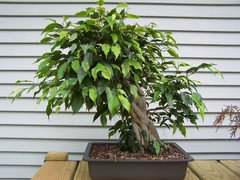
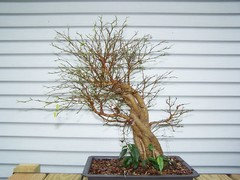
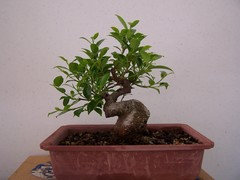
    Illustration - Ficus benjamina:


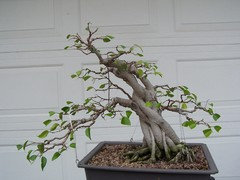
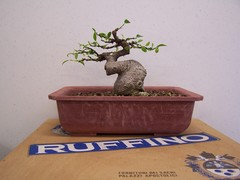
    Another sequence - Ficus retusa in June:


    Same year in early Aug:


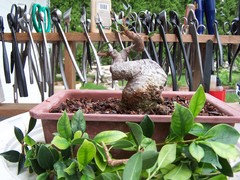
    After refining:


    Now, both trees can grow until next June and the same process will add further refinement.

    Most growers look at any growth a tree puts on as sacred, sacrilege If you remove any of it. The truth is, either you and your pruning tools decide what your trees look like, or your trees will do it for you ...... and they ain't as smart as you. They'll grow ugly just to spite you because you keep them indoors.

    Your tree needs a hard pruning to be brought back within bounds. The best time to do that (if you live in the N Hemisphere) is in June. After that, it needs to be pinched religiously from June to Sep, then allowed to grow wild (unpruned) until the subsequent June when you remove all winter growth and pinch again until Sep. This keeps your trees compact and full. I realize it's an old post, so I won't go any further unless you or others want more information.

    Al

  • 7 years ago
    Thank you for the education! Now I can plan for June :) Yes, always scared to take too much. You make complete sense to me. Thank you!
  • 7 years ago

    Must have been one of my good days ..... wish you well. Thanks for the kind words.

    Al


  • 7 years ago

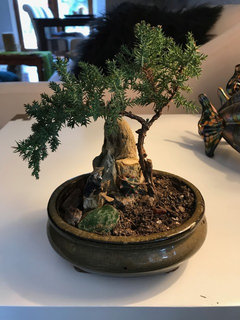
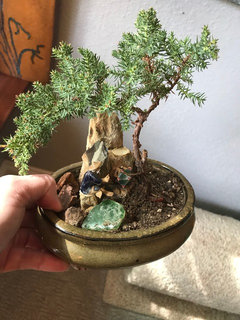
    tapla,,,may I butt in w/a quick question? I've had this for a few years. I don't think it grows. I water it every 2 days or so. I have added a bit of soil, but am wondering if I should transplant this to a bigger bowl, or replace the soil? it seems very compact. I have aerated the soil a bit.


  • 7 years ago
    last modified: 7 years ago

    Juniperus procumbens 'Nana'. Commonly, dwarf Japanese garden juniper. I'm not sure where you live, which impacts when they should be repotted, which should include root pruning and and a change of soil. This plant usually does very poorly indoors because warm/dry air sends the respiration rate through the roof, while reduced photo loads make keeping up with energy needs via photosynthesis all but impossible. That arrangement sets the plant up to use more energy that it makes, which is guaranteed to end in disappointment if not reversed.. This plant won't give much warning when its in decline. By the time the foliage starts to look drab and lose color, it will long have been beyond saving. I have at least 50 junipers covering about a dozen different species. All are just finishing their winter snooze in my unheated garage and losing their bronze color in anticipation of the spring equinox when they'll show some grow like they're starting to get serious about it.

    Water when they are almost dry, flush the soil when you water, fertilize about every 3rd or 4th time you water. I use Foliage-Pro 9-3-6 on everything I grow, and I grow a LOT of different plants. Tying your fertilizing intervals to the number of times you've watered makes more sense than watching the calendar. Drop a marble or other marker in the pot when you water, when you're about to add the 4th marble - it's time to fertilize, gather the marbles, and start the cycle over - never any need to keep track of when who was fertilized. That's the tip for the day. ;-)

    Al

  • 7 years ago
    Al, you are a master.
  • 7 years ago

    Al - Thanks for all of your insights they are very helpful. Might I ask what you do with your junipers during the winter months - do they all go into the garage or do you follow an age rule for leaving them in the elements? Also, if the garage is unheated it probably works as a shield for the junipers from the brutal cold, but does it have windows or do you support with lights? Do you harden them to the garage prior to bringing them in? Lastly, is humidity in winter a concern?

  • 7 years ago

    Might I ask what you do with your junipers during the winter months - do they all go into the garage or do you follow an age rule for leaving them in the elements? Also, if the garage is unheated it probably works as a shield for the junipers from the brutal cold, but does it have windows or do you support with lights? Do you harden them to the garage prior to bringing them in? Lastly, is humidity in winter a concern? All my temperate trees, deciduous and evergreens, are left on the grow benches until they have experienced as much chilling as possible before the forecast warns that temperatures will be <25*F. Before that occurs, all but a few very hardy trees are brought indoors where they rest on large tables or on the unheated garage floor. There are 3 windows in the garage. A supplementary light source provides no benefit to the dormant deciduous trees, and the growth rate of evergreens is so depressed by chill below 40*F, you'd be tempted to say they're not growing. I have friends that over-winter their temperate trees in dark pits covered by treated lumber lids. I haven't noticed anything to be concerned about with relation to humidity when over-wintering trees in the garage, but humidity is a serious driver of a plant's rate of respiration when they are over-wintered inside of buildings heated to generally comfortable temps for humans. The increase in respiration caused by warm temps and low RH during winter, combined with a significant reduction in plants' photosynthesizing ability (food making) more often than not turns out to be unsustainable due to the plant using far more energy than it can create via photosynthesis.

    Al

  • 7 years ago

    Hey guys, Al, sorry if I'm asking a terribly newbie question here, but I am interested in shortening down my weeping fig foliage to eliminate the bare branches. My understanding is you can prune it down considerably, but I have no idea what it means to "pinch" them after. Do i cut the branches straight down to the desired length and let the leaves take over from there? Is it too late in the year now to start??

    Any help or links to a useful thread that already covered this would be most appreciated.

    Thanks in advance!

    Eric

  • 7 years ago

    Eric, this post is 2 years old. you'll get more answers if you start your own post in the Garden dilemma.

  • 7 years ago
    last modified: 7 years ago

    Hi, Eric. Speaking in general terms, pinching IS pruning, but the term 'pinching' is a specialized type of pruning that usually carries with it the idea that only the apical meristem (area at the tip of branches/stems where elongation/extension growth occurs) and perhaps a leaf or two immediately proximal to (toward the trunk from) the apex are involved. For the most part, pruning is used as a way to remove branches that don't fit with a branching plant's basic structure, and pinching is how to achieve fine ramification (more branches and leaves), which is another way of saying density and fullness of the foliage mass.

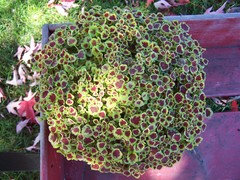
    Pinching can force a plant with a trailing growth habit to form a tight little ball. This is a coleus with a trailing habit that has a very little pinching done:


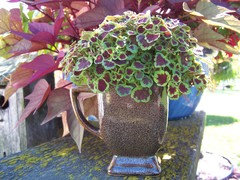
    These coleus with trailing habits have been regularly pinched:


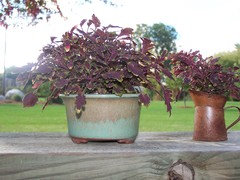
    These are a duck-foot variety that have been pinched.


    Pinching and pruning works because it changes a plant's hormonal balance. A growth regulator/hormone called auxin is synthesized in all living tissues, but primarily in the apical meristem I mentioned above, which is the growing tip of the branch. One of auxin's many duties is suppression of lateral growth (side shoots from branches). Remove the branch/stem apex and you nearly eliminate the polar (downward only) flow of auxin to the roots. The absence of auxin causes another growth regulator/hormone primarily produced in the roots (cytokinin) to become dominant. One of cytokinin's duties is to stimulate lateral shoots. Auxin and cytokinin maintain an antagonistic relationship such that diminishment of one causes the other to become assertive. All of pruning/pinching is based on the underpinnings in this paragraph.

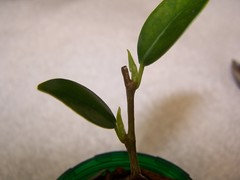
    This is a ficus cutting I started:


    You can see it has brand new branches growing in the axils (crotches) of each mature leaf. The only reason they are growing is because I chose to make an internodal cutting, which is a cutting with the apical meristem removed - see the stub at the top? That's where it was pinched. If I had left the apical meristem on the cutting, the flow of auxin would have suppressed activation of the buds becoming branches, and instead, the cutting would be growing longer with no branching.

    I started a link about pruning on the houseplant forum not too long ago, if you're interested.

    Al

  • 7 years ago
    last modified: 7 years ago

    Makes sense. I'll look into it more!

    So even if I have a fully mature branch/leaf, and I cut it anywhere along the branch, new leaves will grow at the nodes underneath? Regardless of if they're 6 months old or 2 years old? Again sorry for such a novice question. I will do my share of googling as well not to waste time of the good folks in here but I just want to know how to eliminate the leafless branch parts of my weeping fig.

    Thanks Al & co!!!

    By the way the link above doesnt work @tapla but I'll look it up in the forums!

  • 7 years ago

    Try this:

    https://www.gardenweb.com/discussions/5185228/pruning-basics-q-and-a-format#n=70


    Branches are numbered by order. The trunk/stem is a first order branch, a branch growing from the trunk is a second order branch, and a third order grows from the second order branch, etc. Auxin is the suppressor of lateral (side) branching. Generally, if you cut a branch in half, you get branching in the leaf axils (see last image in my post above yours) of only the leaves on that branch. The reason: you removed the (primary) source of auxin for that branch only. ALL the other branches, unless you pinch or prune them, are still intact, with an apical meristem to produce auxin that suppresses lateral growth.

    I just want to know how to eliminate the leafless branch parts of my weeping fig. Let's say you have a long branch or trunk with foliage concentrated near the branch/trunk end(s). If you prune a branch back so there is 1 healthy leaf left on it, then cut that leaf in half & wait, you'll get back-budding proximal to (toward the trunk from) the half leaf. Once those leaves start to mature, you can pinch/prune back to the most proximal (closest to the trunk) leaf, and the same back-budding will occur proximal to the leaf you left at the second pruning.

    Keep in mind that how enthusiastic the response is depends on how healthy the tree is and WHEN you do the work. The best time to prune hard is about 2 weeks before the summer solstice, for a number of reasons, the most important of which are A) The plant will be as healthy as it can be, within the confines of other culturally limiting factors (low light, poor soil, lack of fertility, over-watering, ....) B) it will be approaching the peak of it's ability to turn the sun's energy to food (the summer solstice on the northern hemisphere is June 21) C) You should always prune the lanky winter's growth from your trees every June, then regularly pinch until Sep or Oct, depending on geography, followed by letting the tree grow unimpeded by pruning for the winter.

    If your tree suffers from root congestion, it's habit is to lose interior leaves (those close to the trunk) and resist back-budding. While pinching and pruning will work whether the tree is root-bound or not, you won't get much of a bang unless there is room for roots to run in the pot. Proper nutrition is also important. Plants need an ample amount of N to facilitate enthusiastic back-budding.

    Al

  • 5 years ago

    First post, old thread, bad joke. "What should I do with my fiddle leaf fig?"


    Mine looks so bad I think I should burn it for heat.

  • 5 years ago

    .... all the latex in 'em will make you wonder if you're not burning old tires.

    Al

  • 5 years ago

    Maybe I could MAKE tires out of it!

  • 5 years ago
    last modified: 5 years ago

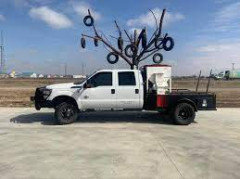
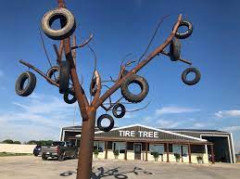
    I know it wouldn't help you now, but, if you plant a rubber band in the back yard, in a few years you can forget any concerns about tires. You'll have a whole tree full, so you'll even be able to share with friends and family. My buddy from Texas has one. Most have been picked from this tree; the remainder will be left to grow larger for use on tractors and heavy equipment.


    He planted this particular tree about 20 years ago after I gave him the idea. As soon as it started producing rubber bands, he was all excited. I told him to REMOVE the rubber bands for the first few years so the tree would put the energy it takes to grow rubber bands into increasing its overall mass, which would cause it to bear mature fruit sooner.

    Well, first thing he did was plant a bunch more rubber bands so he would have a tire tree orchard. Next thing he did was to build a tire store right behind that original old tree. I know you probably think I'm joshing you, but I have irrefutable proof. Scroll down.

    *

    *

    *

    *

    *

    *

    *

    *

    *

    *

    *

    *

    *

    *

    *

    *

    *

    *

    *

    *


    See? Told ya!

    Al

  • 5 years ago

    :-) Why, how wonderful! I planed a spaghetti strand one year and now have an entire spaghetti tree.


    Here's an image of one being cultivated in Switzerland: https://www.ripleys.com/wp-content/uploads/2013/11/spagtree.jpg

  • 5 years ago

    You guys are awesome!!

  • 5 years ago

    Don't encourage me - now I'll tell you about the time the whole station had fish ears and frog legs.

    While stationed at the Point Barrow, Alaska US Navy Weather Station, I suddenly found myself caught up in a once in a lifetime experience. It was summer and warm, but Joe, one of my station mates read and reread the weather instruments, finally and reluctantly concluding that a kowillowa was almost upon us. Now, a kowillowa is as rare as an honest politician. It's a sort of storm, short in duration, but violent - its defining characteristic being an extremely sudden plunge in temperatures. Usually occurring in arctic summers, these freak storms have been known to produce a plummet in temperatures from 78 degrees Fahrenheit to -65 degrees in the span of a second or two. When I asked Joe how long we had before it hit, he consulted the Doppler and announced, "An hour and 14 minutes".

    Just then, an idea was born! I gathered all my warmest clothing, all the tin cans I could find, & 200 yards of parachute cord. I strung the cans together on both sides of a nearby creek, donned every piece of warm clothing I was able to carry, hunkered down, hid myself & settled in to wait. Fortunately, Joe had predicted the arrival of the kowillowa to the very second. Just as it was about to strike, I pulled the cords with all my might, rattling the cans and setting up a terrible racket along both sides of the waterway. It scared the frogs half to death, so they jumped for the safety of the water. At the same time, all the fish in the creek lifted their ears clear of the water to hear what the commotion was about. THAT, is when the kowillowa struck, and it froze the water instantly, trapping the frogs half way in, and the fish with their ears sticking out. Fortunately the temperature moderated somewhat as I returned to the storage hangar to fetch our rear bagger mower. I set the blade on low and ran it up and down the ice, collecting the fish ears and frog legs in the bag. We had a fine feast of a rare local delicacy that day, with enough left over for another meal for our 7 man detail. The local Athabaskan tribe was particularly impressed and asked where they could get their own Navy Weather Station and a lawn mower.

    That was in 1974, and I keep in touch with some of my retired buddies. To their knowledge, and mine, since that day, the weather station has yet to record another kowillowa.

    Al Fassezke (grammar and spelling errors copyrighted)

Sponsored
Wannemacher Interiors
Average rating: 5 out of 5 stars26 Reviews
Customized Award-Winning Interior Design Solutions in Franklin Cnty OH