Software
Houzz Logo Print
canaanjs09

Tips needed: Fishhooks Senecio Undersized foliage

9 years ago
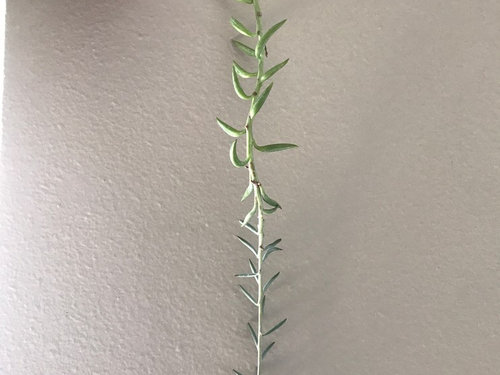
Hi there. I have
a number of Fishhooks Senecio plants and I've noticed that the foliage that
grows after I bring them home from the nursery is much smaller and thinner than
the plump foliage that is already on the plant when I purchase them. They
are getting plenty of light. I actually have them in two locations: 1) a
south facing window with lots of sun and 2) under high quality grow lights.
I get the same type of growth in both locations. I have attached a
picture showing what I'm referring to. You can see where the small
foliage begins. The vines looks healthy, they grow pretty quickly and the
original foliage stays plump, but the new hooks are small and thin and they do
not "fill out" over time. I'm being careful not to overwater
(or underwater). Maybe they get fertilized in the greenhouse? I'd
definitely consider it, but most sources I've read say that it's not really
necessary with these plants. Any tips would be greatly appreciated.
Thanks!

Comments (13)

  • 9 years ago

    Senecio are succulent plants but they don't grow in arid areas. They are not cacti and many varieties actually need quite a bit of water. Yours looks like it's underwatered

  • 9 years ago

    Thanks for the comment! That's what I would've thought as well. However, I previously had an issue where a seemingly healthy vine would suddenly wither at its base right where it comes out of the dirt. After doing some research online, I came to the conclusion that the most likely cause was overwatering. So I reduced the amount of watering which has since solved that problem. Upon researching this current issue of undersized new growth, I've found a couple sources that say the most common causes of spindly growth are 1) lack of light (which is not the case with mine) or 2) overwatering. It seems counterintuitive, but perhaps if there's too much water at the roots, the plant doesn't grow large, plump foliage to store water in? I was thinking I should perhaps try reducing my watering even further.

    Also, below is an excerpt from the Wikipedia page for Senecio Radicans which indicates that they are native to arid areas. But given the fact that you live right near their native habitat, perhaps I should take your advice instead ¯\_(ツ)_/¯

    Senecio radicans is native to the Cape Province region of South Africa.[3][4] In fact, in the desert areas of South Africa where aridity increases, including the Karroid central region, the dominant vegetation consists of xerophytic dwarf shrubs and succulents, including many members of the Genus Senecio. In these areas of very low moisture, the grasslands typical of other areas of Africa give way to areas in which grass is subdominant to these drought-tolerant plants... As a native to the Cape Province area of South Africa,[3]Senecio radicans is a succulent that can grow in warm, tropical areas and also fares well in arid regions. Its succulent tissues help to conserve moisture, rendering it well-adapted for the dry, hot conditions characteristic of many parts of its native South Africa.

  • 9 years ago
    last modified: 9 years ago

    When they wither at the base, that would be a fungal root rot and it isn't necessarily due to overwatering per se, but because the soil doesn't drain quickly enough. They like water, but they don't want to sit in it. It's always a tricky balance if you are growing these plants in a higher humidity environment.

    Perhaps I should have phrased arid environment differently, what I mean by that is that they aren't your typical karoo semi-desert plants like mesembs. Yes, it is arid where they grow but not as dry as areas where many other popular succulents grow. They are found in central areas of the country, not the extremely arid Northern and Western parts of the Cape. The map Wikipedia links to is out of date, These days, people refer to the Northern, Western or Eastern Cape Provinces and it is only the Northern Cape that is semi-desert. The Western Cape has a Mediterranean climate and Eastern Cape is arid on its Western edge and sub-tropical at the North-Eastern edge.

    Like many drought-tolerant plants, they prefer to grow in semi-shade so perhaps less direct sunlight, better drainage and more water will do the trick. Take a look at this link https://kumbulanursery.co.za/plants/senecio-radicans

    canaanjs09 thanked niksouthafrica
  • 9 years ago

    Thank you both for the information! So nice to hear from helpful folks who know their stuff. So as for soil, I'm using a pre-mixed organic cactus mix by E.B. Stone. It says it's 30-40% pumice, aged fir (softwood) bark, aged redwood (softwood) and sand. I actually assumed it had peat in it and I'm relieved that, at least according to the bag, it doesn't. If either of you, or anyone else out there, have any thoughts on that mix, I'd definitely be interested to hear them.

    As for the vines that withered at the base, it's as though they just dried up at the base of the vine where they come out of the soil. When I pull the vine, the roots actually look normal and healthy. It's not like root rot I've seen in the past where things are slimy. Perhaps it's just a type of root rot I'm not familiar with?

    So here's a twist in my dilemma... The vines that are in the south facing window are actually growing in upside-down containers. You water them through holes in the top which fills a terracotta reservoir which sits on top of the dirt. The water then wicks through the terracotta reservoir into the soil. So it doesn't work like a traditional container where you soak the soil and let the water drain out the bottom. The reservoir just slowly wets the soil from the bottom (which might support niksouthafrica's theory that the withered vines are the result of staying wet too long). Maybe this type of system just won't work for the Senecio, but I'm really hoping I can make it work since I've put a lot of work into it. At this point I'm putting a small amount of water in each container and watering every two weeks. Interestingly, as for the foliage, I'm getting the same undersized growth in the upside down pots as I am on the vines in traditional pots that are under grow lights. The ones in the traditional pots are still in the soil they came from the nursery in.

    Both locations do get a lot of direct light (sun in one, artificial in the other), so I'll try reducing that.

    Nik, thanks so much for the clarification on their native habitat. It's always good to know where your plants actually thrive. I hope hope hope I can visit South Africa some day soon. And thank you for the link. Very helpful.

    If anyone has any further insight given the new info I've provided, obviously I'd love to hear it. Thanks!!!


  • 9 years ago

    What type of sand is in the EB Stone mix? Is it beach/playground sand or is it larger grains? Fine sands like beach/playground tend to compact and cause lots of problems, but a larger grain should be ok.

    Maybe tropicals would be better in your upside down container system?

    canaanjs09 thanked Liz (Virginia z6b)
  • 9 years ago
    last modified: 9 years ago

    Something that happens with senecios like radicans and string of pearls is that when they get too long, they do just break off at the roots. This isn't usually a problem because a happy, turgid plant can easily root again readily from anywhere on the stem and I think that is the case for you if there is no sign of rot. If there is a single set of roots in a hanging pot, the weight of the stem breaks it off

    I would limit the sun exposure to no more than 2 hours of direct sun a day and see if that helps.

    From what you are describing, I don't think your wicking system is particularly at fault, since the others in traditional pots are doing the same. Perhaps the mixture is also too coarse for them to really thrive. If you look at the link I supplied, she says that "I no longer mulch this Senecio as it is then unable to root into the soil as it travels". This means 2 things:

    1. Planted in hanging pots, it has a single root supply and water has a hard time travelling all the way to the end of a long stem. Normally, a stem would have roots at shorter intervals and that is one cause of a dessicated look. Hanging pots look good but they aren't ideal for these plants
    2. The root system struggles to establish itself if your medium is too coarse. I have seen this happen with Haworthias, they can shrivel and lose their roots and will re-grow roots only if planted onto a much finer substrate. So water is sufficient, but the root system struggles to get established and supply the plant. I am a bit of an anomaly in this group in that I plant my succulents in soil, but that is fine for me because the climate here is perfect for succulents. I'm not sure of the size of the pumice particles and wood chips in your mix but perhaps if you crushed it up and sieved out all the particles over +/- 1mm in size, it might be happier.
    canaanjs09 thanked niksouthafrica
  • 9 years ago
    last modified: 9 years ago

    The withering of the vines remains a mystery. It's happened to a very long
    vine around 4 feet, but mostly to shorter vines around 12 to 20 inches.
    I've attached a couple images of affected vines. The first one is
    in the early stages of withering and the second one is fully withered. As
    you can see, the roots look normal (although some of the finer ones may have
    broken off when I pulled them). The vine withers for a few inches
    starting at the soil, the rest of the vine looks healthy and it never breaks off
    (but obviously would die eventually).

    The soil is pretty fine. There really isn't much in the way of chunks in it.
    Perhaps there is an issue with the sand as Liz suggested above. The
    soil in the pots from the nursery, however, is quite chunky and water does seem
    to kinda go right through it. I water those ones every Sunday and I
    checked them with a moisture meter yesterday and they were already dry.
    So I'm wondering if it is a water issue and I'm fearing the worst: that
    the wicking system doesn't work well for the senecio; that a good amount of
    water will cause them to wither at the base and less water will cause theme to
    grow the undersized, not very "succulent" foliage.

    I do expect that the foliage will get smaller the further down the vine when there's
    just one set of roots, but this does seem to be a sudden reduction in size from
    the point I bring them home. There's still the possibility that it's
    light. I've reduced that so we'll see what happens.

    Nik, I'm so grateful for all your input. It's very kind of you to share your
    knowledge. Let me know if you (or of course, anyone else) has any more
    thoughts.

  • 9 years ago

    I saw via email that you replied, caananjs but I can't see your comments. Perhaps if you log in again, they will show up?

  • 9 years ago

    I can finally see what you posted now. One question: what happens to that little root tuber when the stem breaks off? If it dies, then you may be looking at some kind of disease process but if it sprouts again, this withering may just be from the weight of the stem and lack of other roots. String of pearls is prone to this kind of die-off, too.

    Some senecio can be very tricky with watering and light: too much of both and they grow so profusely that they eventually die. I've had this happen with string of pearls and S. Articulatus (pencil cactus).

    The sudden change in growth after the nursery does suggest that light is a problem and these do grow under bushes in their native environment. I would try reducing the light, watering the ones in the coarser medium just a little more frequently. Leave the watering in the wicking pots as is and just give less light. Perhaps also take a string out of the hanging pot and allow it to grow flat. That will test whether the breakage issue is as I have suggested.

    Another thought, how close are your stem to the pot rims? How does this withering happen in relation to the pot rim? It could be that a loss of turgidity for any reason also cuts off nutrient/water supplies to the roots and that is causing die-offs


  • 9 years ago

    I believe that I left one vine in the pot for a good while after the stem withered and when I finally pulled it, the tuber had withered as well. For most of them though, I've cut off the healthy part of the stem and thrown the root away. The vines did grow in length pretty quickly once I put them in place, some more than others. The vines are all planted at least about an inch from the edge of the pot and the ones that have withered have come from all parts of the pot within that inch or so.

    I will do everything you recommended :) The light is tricky because the vines in the upside down planters are in a south facing window. I have a black-out blind behind them so I'll have to figure out a schedule for opening and closing the blind. I live in Seattle, Washington and we have very sunny summers and then things start to get pretty grey, so the change of season will provide it's own test. I believe I planted these in April so they've really only been up for the sunny season.

    Thank you again for sticking with me on this :)

  • 9 years ago
    last modified: 9 years ago

    You're welcome: these sorts of issues are annoying and it helps to have other around to troubleshoot them with. I just had an problem with a staghorn fern that wasn't thriving and then it finally occurred to me that the nursery that mounted it had tied it on to the wood too tight and water wasn't reaching the lower roots. Loosened up the mount and it's looking better already.

    I do think that the pot rim is somehow interrupting the supply of nutrients. It will be interesting to see what happens after summer. With South-facing windows, try placing your pot high up so that once the sun is higher, it no longer gets the sun's rays, or, further in from the window.

    Keep us posted.

  • 9 years ago

    Will do! I'll probably be back here with more questions at some point as well. Thanks Nik!