

a fall crop exeperiment
Where I am, the tomato season has been over for a month. Wildly productive spring, but when the fruit is gone, the plants decline. I once tried to plant a fall crop around this time, and it was a bad experience. Trying to keep small plants alive in totally fierce heat is a lot of work. They never grew well, and I don't think I ever got any fruit. What's more, falls are shorter than springs around here. That is, I set plants out in February and harvest in May-July. That's 5-6 months. If I set plants out in August, with a first frost in November, that's one month too short, especially bad since everything will be going slower at the end.
So ... this year I hit the cherries hard with strong nitrogen fertilizer in July. Over the weeks, I've been pulling off the old, declining foliage. That is rapidly being replaced by new, lush foliage (and even a few flowers, which of course won't set fruit). So what I'm hopefully looking at, by October, is a thoroughly mature, large, and healthy plant that is all ready to bear lots of fruit.
The key to this is the high N fertilizer. Those plants are getting seriously OD'ed with N, and the foliage is thriving. At some point I have to back off on the N, but maybe I'll wait a month or two.
Anyone down way south have experience with this strategy?
Comments (67)
 9 years agolast modified: 9 years ago
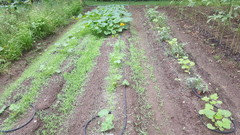
Dan take a non contact thermometer out to the plants on a hot day a measure the increase of plant surface temperature against the ambient air temp that day. The difference would be interesting to know. I do not know if the "too hot" number used for tomatoes is really describing the weather conditions necessary for a plant to reach the 125 I see on lawns around here when the temps are in the mid and high 90s. It may be a shade cloth is the correct answer, but maybe only a 50% shade, as infra red (not uv) is an important energy wave both for the plant function and the plant temperature. Of the heat we deal with, roughly 3% comes from UV, 44% from visible and 53% from IR. There are very clear mylar products that can absorb the IR in the 780-2500 nano meter range while passing 75% of the light. I was just thinking shade cloth for my fall tomato replant, but my experiment is running 2 heat resistant varieties and a desease resistant variety. I loaded the deep holes with organic tomato food so they are just beginning to find it. I expected a kick when the roots got down there and the heat resistant plants are definitely bigger than the others. BTW I pull the new grass away from the curcubits roots but let it grow elsewhere until I can pull it for my compost green layer. Confessions of a compost junkie.
daninthedirt (USDA 9a, HZ9, CentTX, Sunset z30, Cfa)
Original Author9 years agolast modified: 9 years agoThe heat we deal with on foliage mostly doesn't come from light hitting the foliage. It comes from hot air hitting the foliage. That's why I can take a thermometer in the shade when it's 100F outside and, presto, it's 100F even in the shade! If there were no atmosphere, it would be a LOT cooler in the shade. Sure, surfaces, especially dark ones, like asphalt, will be hotter if they are sunlit. But they'll never be cooler than the air temperature. The too-hot number for tomato pollination is about 90F, especially if it doesn't get below 75F at night. Shade cloth and light filters won't ever get me below those numbers.
Actually, WET surfaces will be cooler than the air temperature. They'll approach the dew point, if air motion is substantial. But I don't keep my foliage wet.
Related Professionals
Dover Landscape Architects & Landscape Designers · Indianapolis Landscape Architects & Landscape Designers · Hilton Head Island Landscape Architects & Landscape Designers · Moline Landscape Architects & Landscape Designers · Kalamazoo Landscape Architects & Landscape Designers · Laconia Landscape Architects & Landscape Designers · Reno Landscape Architects & Landscape Designers · Boise Landscape Architects & Landscape Designers · Springfield Landscape Contractors · Clarksdale Landscape Contractors · Albuquerque Landscape Contractors · Peoria General Contractors · Traverse City General Contractors · Newport General Contractors · Cornwall General Contractors- 9 years agolast modified: 9 years ago
But the foliage is wet inside, and can perspire though I imagine it is conserving water in the heat. The actual measurement would be curious. And being a living organism, does Tomato not experience wind chill effects?
Whoa. I just envisioned you waving palm fronds over your tomatoes. Thanks!
- 9 years ago
Wind chill is experienced by humans (and warmblooded animals) because they have a sustained body temperature. When there is no wind, your body heat prevents you from fully feeling the actual cold temperature outside. When there is wind, the cold air actively hitting your skin making you feel more of the cold temperature because more of it penetrates your body heat bubble.
Tomatoes don't have this mechanism at all, but even if they did, 100 degree temperatures are above the (human) body temperature anyway, so any wind will make you feel hotter, not colder through this process. What they do have is transpiration, which does get helped by the wind and can cool the plant to below air temperature assuming humidity is not at 100%. The same happens when you sweat even at 100 degree temperatures.
- 9 years ago
So even if you had a fan, the tomato must be convinced to co-operate? I read they are going to open stomata in blue light. I am having a vision of my neighbors asking about the party when they see the shade cloth, fans and blue lights.
daninthedirt (USDA 9a, HZ9, CentTX, Sunset z30, Cfa)
Original Author9 years agolast modified: 9 years agoWow. Sounds like GW folks need some zero-basic course in thermal engineering.
No, wind chill is experienced by humans because of body moisture and perspiration. You experience wind chill a lot more if you're soaking wet. Like if you just get out of the swimming pool. Dew point, again. Body heat bubble? Duh?
Yeah, foliage is wet --- inside the leaf. Not outside. Perspiration? Sure, foliage loses moisture that way, but if it were soaking wet and at dew point temp, the plant would dry out very rapidly. Yes, foliage is a TINY bit colder than air temperature because of perspired moisture. But a very tiny bit, because it's just perspiring a TINY bit of moisture.
A fan doesn't keep you cool unless you sweat. A fan by itself just blows hot air at you. If you blow hot air at a 2x4, or a bottle of coke, it will not get any cooler.
I think this discussion has grossly diverged from the original question, and it doesn't sound like I'm going to get much wisdom from it. Thanks anyway. I'll let y'all know how it works.
 9 years ago
My only question is: isn't it the drought stress, not the heat, that kills the plants? Tomatoes cope quite well with hot temperatures when it comes to vegetative growth (obviously, the fruiting aspect has issues in very hot weather), provided they have enough water. I would think that the real issue keeping young plants alive in searing heat is that it's hard to keep their root zones consistently moist, and because their root zones are small, they really need consistent moisture.
For an indeterminate cherry, I would agree with fungus and try cutting the plants back PLUS give them a boost of higher N for a short time. I disagree with his reasoning, though. I think that an older plant with long stalks with lots of areas that have been pruned for disease reasons/senescent foliage/drought and pest damaged foliage has long swaths of plant that are just a lot of pointless upkeep (from the plant's perspective). Cutting it back significantly would relieve the burden of keeping that stuff alive and let the plant focus on robust, healthy new growth. And it would still give you a head start over new plants or cuttings.
But I'm just kind of going with my gut here with what I would do in your shoes. Since I don't have experience growing in Texas heat conditions, I can't speak from direct experience.
- 9 years ago
I've never taken thermal engineering, but I *am* an amateur meteorologist. If you don't believe me see https://en.wikipedia.org/wiki/Wind_chill . The thing I was trying to get across is that despite weather reports provide a "wind chill factor" below the actual temperature, the wind by itself cannot cool anything below the ambient temperature. And yes, it works on you and not on a tomato plant because you have a body heat bubble protecting you from the cold and a tomato plant does not.
What you are talking about is evaporational cooling. Wind helps accelerate evaporation and therefore, makes you feel even colder when you're wet. This is not wind chill. This does work on plants thanks to transpiration (not perspiration) similar to how it works on humans (though through real perspiration). Neither will make you or your tomatoes feel much better when it's 100 degrees outside.
- 9 years agolast modified: 9 years ago
Ok but here is the problem in that stomata open to receive CO2 and Evaporate water which creates a vacuum in their vascular but passive system this drawing upward the water in the plant and simultaneously cooling it, which is Dans NEED to promote summer or mid season growth. The Morning light has the blue light to which the plants respond. Which frequency I have no clue, but unless stomata are open and able to transpire, then no evaporation, no nutrient movement, no high ambient temperature growth. The plant must evaporate to cool itself and grow and set pollen at the higher levels of temperature on the North American Continent. But what mechanical or man made means one can consider is the thesis of the question? Especially given that the cost should be reasonable and the conditions the plant requires have 4 or 5 impact points. Personally, I say that if we can figure this out, then Dan should implement said prescription while wearing a single indian feather headband. This because they grew corn and squash and tomato all together and it would be impressive to advance thought from the practice of sheer survival, and they too had our conditions, but not the resources nor the internet.
- 9 years ago
I think Dan knows that his plants aren't going to set fruit until conditions get cool enough for them to do so. The point of a fall season is to have plants ready to flower and fruit when that happens. The challenge, from what I understand, is to keep young plants alive in the heat.
I wonder whether the heat is really the problem, or whether it's the moisture problems the heat causes. If the latter, can this be remedied by changes to watering?
At any rate, those musings are just tangential, since Dan is trying A Thing in which he tries to keep his spring planted plants surviving long enough that they'll bear fruit when things cool down in order to bypass the whole problem of young plants dealing with the heat/moisture issues from the heat.
I hope you report back, Dan. It might be interesting if you had a few plants you could experiment on. One you would just feed high N. The other you would cut back, no high N. A third you would cut back and feed high N. A fourth you would do nothing. Of course, to be relatively scientific about it, they'd have to be the same variety planted out at the same time and subject to the same conditions. But even if you didn't do it strictly scientifically, it might produce some usable results.  9 years ago
I imagine that this is an issue that us PA growers don't fully appreciate but my first impression is to extend the fruiting season as long as feasible by:
1. Choosing varieties that have a reputation for heat tolerance, Heirloom varieties are typically poor choices
2. Use shade cloth or fans to relieve stress on plants- I use both for high tunnel grown plants and they both are effective when my inside temperature exceeds 100*F. Most plants can easily cope with higher temps if just for a few hours
3. Keeping plants well watered and at optimum nutrition. The latter might best be determined by a plant tissue test combined with a soil test.
Giving high nitrogen fertilizer to plants undergoing heat stress just doesn't make sense, either when dealing with nature plants in high heat or when hardening off young plants not accustomed to heat.
daninthedirt (USDA 9a, HZ9, CentTX, Sunset z30, Cfa)
Original Author9 years agolast modified: 9 years ago"I wonder whether the heat is really the problem, or whether it's the
moisture problems the heat causes. If the latter, can this be remedied
by changes to watering?"Fair point. But year after year, after my cherries ripen in April-June, the foliage starts to decay. Leaves get yellow and brown. Makes no difference how much water you apply. At least in my climate, I think the leaves are saying, eh, we're done. But by hitting the plant hard with N fertilizer, you get beautiful NEW foliage, even as the old foliage is decaying. A month or two ago I had plants full of yellowing and browning foliage. I now have a plant that is green and lush (having picked off the decaying stuff). It's different foliage, and it's even hotter now than it was in June when the old foliage was starting to decay.
Re "heat tolerance", I have NEVER seen a tomato plant that can pollinate itself in high temperatures. Some SURVIVE high temperatures better, but that's another issue entirely. My plants are surviving just fine, thank you.
Re "relieving stress on plants", my plants right now are bright green (with newly grown foliage), totally unstressed, and sitting happily in 100+ temps. That misses the point entirely. The new foliage is due to the nigh nitrogen fertilizer. So far, that high N fertilizer makes great sense to me. The old foliage is not decaying because it's "stressed". It's decaying because it's DONE. It did it's job.
This conversation peculiarly digressed into a discussion of how to make tomato plants cooler. Ain't gonna happen without air conditioning.
daninthedirt (USDA 9a, HZ9, CentTX, Sunset z30, Cfa)
Original Author9 years agolast modified: 9 years agoBoris, I owe you an apology for the "duh" I gave you. I think you're on the right track. I was a little exasperated at people trying to tell me how to cool my tomatoes, which is largely nonsense. But your point about wind chill is close. I wouldn't call it a warm "bubble", but rather that convection, which is a powerful energy exchange mechanism, happens a lot more efficiently with more air contact. Wind makes more air contact. In the same way that cold wind makes you feel colder, warm wind can make you feel warmer! But wind chill includes an evaporative part, wherein blowing wind on a moist surface always makes it cooler. Whereby a hot wind can make you feel cooler IF you're wet.
Gosh, if I keep spraying water on my tomatoes, I'll bet I could cool them off! Though they'd be dead with fungal infections. Not going there.
- 9 years ago
daninthedirt: Re "relieving stress on plants", my plants right now are bright green (with newly grown foliage), totally unstressed, and sitting happily in 100+ temps. That misses the point entirely. The new foliage is due to the nigh nitrogen fertilizer. So far, that high N fertilizer makes great sense to me. The old foliage is not decaying because it's "stressed". It's decaying because it's DONE. It did it's job.
I was mostly thinking that the plant would be more efficient with its energy/resources if it was cut back in addition to being fertilized heavily to stimulate healthy new grown. It would also be more manageable for the gardener. But whatever works for you. I would just personally want to also experiment with cutting the plant back and feeding them. daninthedirt (USDA 9a, HZ9, CentTX, Sunset z30, Cfa)
Original Author9 years agoThe usual thinking is that if you want to get fruit, you should cut back on nitrogen. Well, I'm not concerned about getting fruit, because for a few months, I simply won't be able to get fruit. Just too hot. Yes, I actually do have quite a few flowers coming out of the new foliage, and they're all going to just dry up and fall off. Indeed, in a month or so, I'll back off on the high N fertilizer to encourage blooms that will actually have the potential to make fruit.
I don't think that efficiency with regard to energy/resources is an issue here. As I said, my new foliage is thriving. Yeah, one could cut the whole plant way back, but how does that result in a large mature plant once temps have come down enough to allow pollination? On a shrimpy plant, there are fewer sites to generate new foliage. I am removing a lot of the first-generation foliage which, as I said, was fading. That does take some work.
- 9 years ago
<I don't think that efficiency with regard to energy/resources is an issue here. As I said, my new foliage is thriving. >
Foliage and fruit have different needs. But for cherries, you're probably right--it won't make much of a difference. - 9 years ago
Ok tomato berries then. I am learning something else right now and will have to get back to that later. So Dan, would not leaving the older leaves as at least a partial, less effective but still contributing photosynthesis source not serve the effort after the temp breaks toward fall? I ask because we have a steep 60 day decline from August 1 to the end of September where evening temps get low enough by October to crush production via cold related issues. I would ask if those old ugly leaves might not contribute in a significant but partial way when the time does come?
- 9 years ago
The problem with old, ugly leaves is that they're weakened and offer an easy foothold for pathogens.
daninthedirt (USDA 9a, HZ9, CentTX, Sunset z30, Cfa)
Original Author9 years agolast modified: 9 years agoFoliage and fruit do have different needs. But I don't have fruit, and I'm not going to get any for a long time. When I do, their needs will be provided for.
Leaving the older leaves on, as they turn yellow and brown, won't do any good. There isn't much chlorophyll in them, so there isn't much photosynthesis going on with them. The new foliage, which has pretty much replaced ALL the old foliage by now, is going to do a fine job for the plants when it gets cool enough to produce fruit. That being said, yes, as I said way in the beginning, our fall growing season is shorter than our spring growing season. So the eventual issue is whether cold, but not freezing, weather will interfere with production. Same issue if I set out new plants.
My zero order question was whether the resurrected plants will bear fruit at all. I'm encouraged by the fact that the new foliage is at least producing flowers.
- 9 years agolast modified: 9 years ago
Is it even possible that micro control of salts (thinking fertilizers) or something else either externally or internally in some way can effect change in transpirational pressures (is this what they call osmotic pressure?) and thus increase nutrient uptake mass allowing for a higher or different order in time cycle of production?
daninthedirt (USDA 9a, HZ9, CentTX, Sunset z30, Cfa)
Original Author9 years agolast modified: 9 years agoUh, not sure what you're saying. Is it possible that fertilizers could accelerate the production process? Well, that's exactly what I'm doing with nitrogen and foliage. I suspect that, to the extent nitrogen doesn't actively discourage fruiting, it would accelerate that process as well once started. Nitrates make amino acids, which make proteins, which is a lot of what tomato seeds are. Tomato seeds are about 20-30% protein. Ought to make Muscle Milk out of tomato seeds.
- 9 years agolast modified: 9 years ago
I was doing a poor job of trying to describe a question about what might accelerate the evaporation from the stomata which as I understand leads to a vacuum pressure in the plant tube network thus raising more water and the associated dissolved nutrient upwards into the plant. A fan perhaps?
daninthedirt (USDA 9a, HZ9, CentTX, Sunset z30, Cfa)
Original Author9 years agolast modified: 9 years agoHere's the deal. In my locale, 50% date of first frost is Dec 6. Average last date with mean high temp below 90F is Sep 15. That's about 2.7 months of tomato pollination and growing for the fall.
I want to have a big, lush plant, with flowers out and ready on Sep 15. That's a month from now. So as of now, I'm going to withhold nitrogen fertilizer from my plants.
You want to accelerate evaporation? That would suggest that in a dry climate tomatoes would grow faster, because evaporation rates are higher and the plant would suck up nutrients faster. I don't think that's the case. Tomatoes would be pretty pokey in the deep south if that were true.
- 9 years ago
I think you are on the road for nice cherries. I do the same thing in Chicago because the growing season isn't long. I start with a high N for a few weeks and then I do a blossom booster to get the plant flowering. After the fruit sets I go back to the tomato or all purpose fertilizer. I had good success setting tomatoes this year. I have many more than expected from the few plants I put in a raised bed. Good luck!!
daninthedirt (USDA 9a, HZ9, CentTX, Sunset z30, Cfa)
Original Author9 years agolast modified: 9 years agoYes, Patti, when I plant out my tomatoes in March, I give them a strong hit of nitrogen. I stop doing that a month later. I don't do any "blossom booster" , as they seem to take care of themselves in that regard, but a strong early push to develop foliage is important. I have to suppose that one reason why my spring foliage rapidly declines after fruiting is because the plants are no longer getting a lot of nitrogen.
I just never tried this strategy for the fall season, on existing plants. There is a strong temptation to just rip them out in July when fruiting is done and foliage is declining, but that may not be the best route. Here we are in mid-August, and I have thriving 7-foot cherry tomato plants. Never seen that before. Some years I tried to keep the plants going without adding high N fertilizer. More water!!! But that simply didn't work.
daninthedirt (USDA 9a, HZ9, CentTX, Sunset z30, Cfa)
Original Author8 years agolast modified: 8 years agoWell, not so good, unfortunately. A lot of the new growth is dying. It seems that the stems are drying up (yep, as in getting brown and crispy), and the lush new growth on the end of those stems is collapsing as a result. I've gotten a couple of late season tomatoes, but not a lot. It would seem that when one tries to resurrect springtime plants for the fall, after brutal summer heat, the stems may be injured beyond repair. It isn't for lack of water. I watered carefully. A little too early to rip everything out, but what I'm seeing is a good reason to start new plants for a fall crop because many stems of the old ones are "used up".
I have to say that although new plants would have to be babied in order to survive July and August, you probably need less water to do that than to try to preserve large older plants.
But it's been a useful experiment. Fall tomato crops around here aren't easy, however you try to do them.
daninthedirt (USDA 9a, HZ9, CentTX, Sunset z30, Cfa)
Original Author8 years agoNo, I did not. Given that there are green young sprouts coming out near the base, that might have been a good idea. Actually, cutting back a large plant might be a better strategy than planting new plants, since the large plant already has a very well developed root system, and nursing them through the violently hot summer might be easier than with small new plants.
- 8 years agolast modified: 8 years ago
I took a little different tack and due to the heat and humidity hit them (spring plants) hard with antifungal (daconil) and insecticide (bifenthrin). As the heat eased, leaf count was actually pretty good but whitefly and other leaf suckers emerged on the peppers and I started Neem oil into the cooling temps but just went out with malathion this evening for the first time this year because I have a good 2 week window before the fall squash and zukes start coming and the fall cucumbers are also just flowering. I would not say the tomatoes set on the old plants are anything like highly productive, but they are of good quality, in appearance and flavor. About 2 weeks ago I went with heavy N and K based on a self test, but cannot say at this point that I did anything but promote white fly.
- 8 years ago
It might be to late but it sound's like you don't have much to lose by trying my strategy. Bury stem in soil leaving end above ground and keep it moist. Hopefully,the stem develop's enough roots to support itself before it completely dry's out. I'm surprised you didn't join the discussion in Tx Gardening when I talked about this recently. I have brought plants through hot weather and got fall tomatoes and made cuttings that produced but both have been hit and miss. Layering stems in July-August has been more successful. The question now is can plants be kept in large pots exposed to sunlight where they are in air conditioning until bloom set then planted outdoors? I'm wondering if plant would abort fruit if moved into 90F+ outdoors. If this worked,the plant could be grown to maturity outdoors,moved indoors to set blooms then back outside.
daninthedirt (USDA 9a, HZ9, CentTX, Sunset z30, Cfa)
Original Author8 years agolast modified: 8 years agoBending the stem over and burying it is a good idea, though I'm not sure it offers any advantages over just planting new plants. What you end up with is just small plants that need to grow, mature, flower, and fruit, before frost. It may be that doing it this way requires less water to keep the new plants alive, though.
I had some fungal issues in the spring, but none that were evident in the summer and fall.
- 8 years ago
You might again think I'm off-topic but I just read an article in "Vegetable Growers News" about tomato trials at Texas A&M for 2017 dealing with fertilization and grafting. It may be worth reading. But it was the variety choices that they made which leads back to my #1 point earlier.
The trial used 2 varieties: TAMU Hot, a heat tolerant summer variety, and Tycoon, a 2014 Texas Superstar variety. While I have not grown either variety the premised point of your experimentation is to get greater production. Start by selecting heat tolerant varieties, then test whether different fertilizer applications make a difference. In the article Joe Masabni recommended 150 lb. N, 80lb. K, and 100 lb. P per acre per season, adding fertilizer every 10 days based on fertilizer used and plant's production stage.
I just tend to doubt that Texas A&M would support your methods, however well intended you may be.
daninthedirt (USDA 9a, HZ9, CentTX, Sunset z30, Cfa)
Original Author8 years agolast modified: 8 years agoHeat tolerant tomato varieties, in my experience, NEVER tolerate the kind of summer temps we endure for fertilization. You might get another week or two of fertilization on either end of the summer, but when it gets really hot you're pretty much done with fruiting.
Not clear that heat tolerance has much to do with the premise of fall tomatoes. Maybe you're saying that such tomatoes, even if they don't fruit in the heat, can better survive the heat? Never heard that. I don't want to bother with grafting, which is what a lot of the TAMU Hot fuss was about.
- 8 years agolast modified: 8 years ago
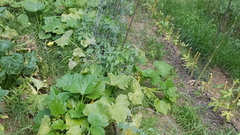
Amelia hybrids were my new plantind disease resistant gamble because I set twice as many as the other heat experiment types. Determinate and slow, no fruit and it is getting into September. Heatmaster was not any faster height wise but it is fuller in its canopy. All are setting flowers but it seems too late. Solar fire too is flowering and is next to the tallest which is Parks Whopper Improved. PWI did not blink at the 100ish temps and came up nicely and is about 60 inches now. It also has 1.5 inch fruit as does the Heatmaster at 1/2 the PWI height size. They were all set very deep, organic tomato fert with eggs and all the trimmings set in a deep hole in a row tilled in with 10-10-10. They even got a sprinkle of crushed vitamins in the deep holes because it would not hurt as they got down that deep. Overall though, I would say taking care of the spring plants for a revival bounce has produced way more than a fall planting will, but that crop is not in to be certain.
- 8 years ago
Dan,try it if you please or consider it hopeless and don't if you prefer. It's probably too late anyhow but there might be some who want to mull it over between now and next summer. The fact remains, I have healthy looking plants that are blooming while the mother plants from which they came are in decline despite receiving the same water. I don't fertilize.
daninthedirt (USDA 9a, HZ9, CentTX, Sunset z30, Cfa)
Original Author8 years agotrickyputt, looks like you were successful in doing a fall revival of spring plants. Specific suggestions about doing it?
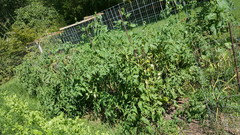
- 8 years agoThese were the spring tomato plants that did the best. Indeterminates that we specifically did not pick clean of diseased leaf. I suspect that the little extra photosynthesis and the little extra shade of those leaves made a difference going into the fall. One whole row that was denuded gave up and 4 are left in another denuded row but simply are not really useful though they have fruit. I hit them with High N and K as the temps broke also, as our soil is high in P. the main thing I did was aggresive fungicide and insecticide. Its still a mess out there but the plants have enough energy to put into fruit. And this was not just the tomatoes, all the squash and cucumber and peppers were attacked heavily. I lost at least one bell to insects. I get the distinct impression that the insects and biolife all have a fall growth cycle that starts as does the garden at this late time of year, which makes sense if you consider that they to are planning to emerge next spring after the winter. So why not have one last growth spurt that wanes into the cold fall? Perhaps I did nothing more than tamp it all down to some degree at the beginning, without actually being actively aware that the effect would be to release the fall plant energy toward growth. So I chose winners, sort of, though they could be prettier.
- 8 years agolast modified: 8 years ago
I have reflected on the questions and realized I missed describing something I did in the deep heat of summer that may not be normal. Not that I worry about normall, but I put out Sulfur. I actually lost a few squash leaves because of the sulphur heat reaction, My mid season ph test came back strongly alkaline so I was working acid, which in turn not only promotes tomato, but is key in the medicine any doc would give you if you travel to a tropical country, as it tamps the bacterial action in your guts down to the point that your worst tropical experience is hurricane force gas.Bacterial wilt and other family members would suffer rejection from the application of the element. I think I benefited from that suppression effect, and the tomatoes I picked were very tasty.
daninthedirt (USDA 9a, HZ9, CentTX, Sunset z30, Cfa)
Original Author8 years agoMy soil pH is only mildly alkaline, so application of sulfur wouldn't help much. The soil pH ought to be pretty constant, so if the tomatoes were doing fine in the spring, alkalinity shouldn't have prevented them from dong fine in the fall.
- 8 years agolast modified: 8 years ago
A key difference in my testing occurred when I disrespected the instruction call for distilled water. I tested the water and found it acidic which throws the baseline off of course. It turns out that youtube videos show tap water is treated to be ph neutral so it does not eat the pipes- that filtered and distilled tend to the acidic because carbonic acid from air absorption, and well water can be alkaline, which one supposes is a local soil strata issue. Anyway; So I tested my tap, found it neutral and used it as a more true base for the chemistry, which then produced actual garden results. I had followed instructions prior and been misled by the results. Its a subtle thing, but I became aware of the concept of an "acid mantle" covering our skin in a soap thread, and have been pursueing a closer control of the acidic condition of the garden not as a nutrient issue but rather as a boicide.
Would you assume a lower ph soil would be less likely to harbor particles that splash up to infect leaves? Would an Sulphur ( or other ) soil top layer suprise if it were biocidal relative to topical tomato pathogens? This is where I am at right now.
- 8 years ago
I ran some low energy fall experiments this year. After last year’s losses(eight surviving plants converted to confetti, out of 25 or so new starts) in October due to a hurricane, I just wasn’t up for more of nature’s wrath.
I put two potted cherries, big box store sourced Cherokee Carbons, in the front shaded hedge area and just left the 45 or so mature plants in the main nearly full sun garden plot on their own. I watered the hedge, but the garden patch got nothing. We did get a lot of rain.
I fertilized the hedge pots a couple times with non-organic time release. Hedge pots received dappled sun throughout day.
Both hedge plants died one week in Aug. We had a heat wave that wiped them out. Cooked my potted mint, which did come back. Just for comparison, All my potted peppers sitting right beside the toms and mint lived. In October, one hedge pot regrew a new tomato plant from root stock that survived. It flowered and has tomatoes on it.
The patch garden has some live plants and tomatoes. All visible fruit are cherries. All live plants with tomatoes receive partial shade (as fall came around, some previously full sun spots became shady late in the PM). I know the Dr Wyches Yellow was still alive in November. Chocolate Sprinkles and either chocolate Cherry or Sweet Million was also flowering and fruiting. Chocolate Sprinkles, being in shade late in the day, had the most foliage, blossoms and fruit. I believe Brandy Boy lived too, or regrew, and was in partial shade late in day.
While I am not a plant, on 100+ days, I will seek out the benefit of shade. I agree the air temps are constant throughout. The sunlight, a form of radiating energy, seems to penetrate and transmit some of that energy into the plants(and into my skin too). By shading, I believe you can limit the transfer of energy.
The Dr. Wyches ‘Yellow was an exception, being in full sun throughout. It was a particularly incredible performer this year. All of the Sungold died. They also had no shade. If any plant can survive adverse conditions, I would think those could.
- 8 years ago
Back in 2011, As a near newbie, I accidentally produced a fall harvest of Big Beef and Sungold. The BIg Beefs were undersized, and I remembering stripping all the tomatoes off the plants in mid December due to impending frost. The tomatoes were green, but most turned red after I brought them in the house.
Here is how I did it(occurs to me now in hindsight that shade played a part and I managed to incorporate it by accident):
A Sungold was placed so that it was shaded late in the PM by a fence. The fence was just west of the Sungold. The Sungold grew massive(it loved that late PM shade). East of the Sungold was a Big Beef, placed so it had at least a 6’ X 6’ feet of growing area(maybe more, I did not crowd back then like I do now). It produced spectacularly during normal season, and then during late summer/fall grew massively tall foliage, while shaded by the Sungold. That Big Beef loved the late PM shade thrown by the Sungold.
To the east of that first massive Big Beef was another Massive Big Beef, benefiting from the shade thrown by its peer late in the PM.
Since that time in 2011, I have changed the plant locations so they don’t shade each other. This is probably a mistake for plants you want to keep going through fall.
All I had to do was water and fertilize. I am not a pruner, but I will remove lower leaves, or heavily diseased stems.
I have photographic proof of the December harvest. I posted those photos last year trying to come up with a working strategy for Fall 2016. A lot of forum contributors were concerned there would not be enough time to ripen the fruit. There really wasn’t enough time, but I did manage to get some toms to ripen in the house.
 8 years ago
I've done it many times (when the weather cooperated with a mild October)
into "tricking" an early determinate to successfully produce a second harvest by cutting it down to within a foot after getting its maximum harvest.You folks in the South should be able to do the same even with mid season bush tomatoes, since you get a month or more extra warm weather than we do here in Maryland.
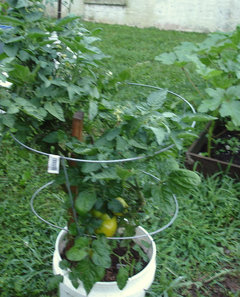
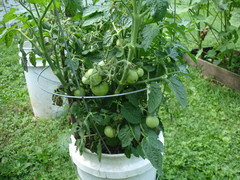
Here is Lime Green Salad from this season.
------------------------------------------------------------------------------------------------
7-24-2017 update:
Still very healthy with lots of blossoms. Yesterday picked 5 tomatoes
(largest was at 6+oz), today 5 more (one was the biggest so far at 7.11
oz).Average is about 3.5 oz. So far, over 45 fruits harvested, I expect a
few more --- not bad for a total of about 10 lbs from a 2.5 feet tall
plant.It has become very juicy and the flavor is even better now. I'll rate its taste at 9.
--------------------------------------------------------------------------------------7-25-2017 -- picked a couple of ripe ones and a handful of green
tomatoes. Then, decided I won't wait a few weeks for the dozens of
blooms to fruit and then have the plant die, but cut it down to about
one foot.I've done it before (when the weather cooperated with a mild October)
into "tricking" a determinate to successfully produce a second harvest.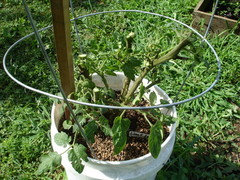
---------------------------------------------------------------------------------------------
After cutting Lime Green Salad dwarf tomato plant down to nearly bare
bones five days ago (see above pic) --- here are today's pics
(7-30-2017). Not only is it bursting with new healthy foliage, but it
has set some blossoms already!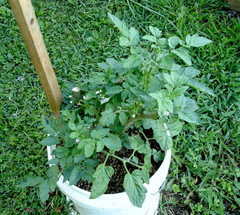
----------------------------------------------------------------------------------------8-13-2017 update:
19 days after cutting down this little WONDER --- it is super healthy and
ready to give a 2nd crop! Two feet tall and growing, lots of blossoms
and a couple of fruits already set --- AMAZING tomato dwarf plant !!!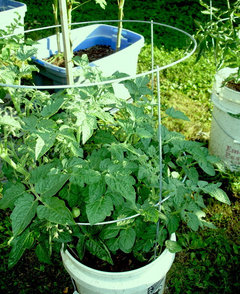
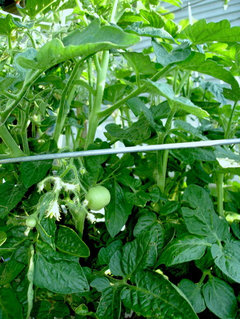
------------------------------------------------------------------------------------------
8-22-2017 update:
Counted over 20 fruits set so far, from pea size to egg size --
setting a lot more fruit now, than before. Probably because it's
mid-Summer, and thus setting faster than in the cooler Spring. Many
dozens of blossoms that look ready to set lots more.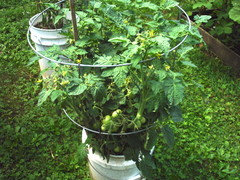
-------------------------------------------------------------------------------------------
You can see the entire thread here:
Tony
daninthedirt (USDA 9a, HZ9, CentTX, Sunset z30, Cfa)
Original Author8 years agoInteresting. Thank you. But my new strategy is to pull the tomatoes in July (by which time they are totally non-productive because of the heat), and replace with squash. I think I've determined that, by July, squash vine borers are done around here, and I have four or five months after that for production.
- 8 years ago
Since we love home grown tomatoes 365, here is what we do in the Winter.
Tony
2018 Winter Tomatoes -- what, when and where are you planting?
- 8 years ago
Thanks Tony. My plants in pots in part shade died. My theory on why that happened is the pot is not as good a heat sink as the covered ground. Cutting back might work for in-ground here AS LONG AS there is a way to throw shade in the late PM. Cut-back plants don’t throw as much shade.
i like your plan Dan. Tacky pollen might be a challenge if you get high humidity along with high heat. If you can grow big plants, you will be ready when the conditions turn more favorable.
if I go to the big box store in July, they are selling Okra starts around here. Okra may be able to keep producing throughout the worst summer months. Must be a very special plant. Not everybody likes Okra though.
- 8 years ago
Janice -- okra loves heat! We don't care for it when cooked, since it gets slimy. But, we love it pickled -- just as crispy and tasty as dill pickles!
Here is a post from Aug 18th:
"Pickled so far: 3 gal cukes, 2 gal small green tomatoes, 3 quarts okra. The okra is just starting to produce (have 15 plants) --- so, expect to pickle about 40 more quarts of okra. At end of season for tomatoes, expect to pickle about 3 more gallons of small green tomatoes."
Tony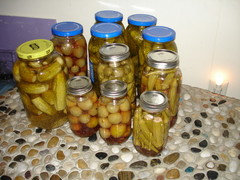

gorbelly