Software
Houzz Logo Print
devin_edmondswestlandmizone6

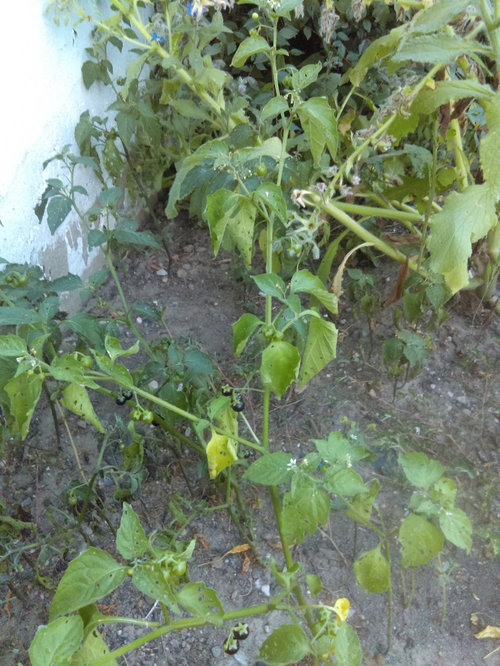
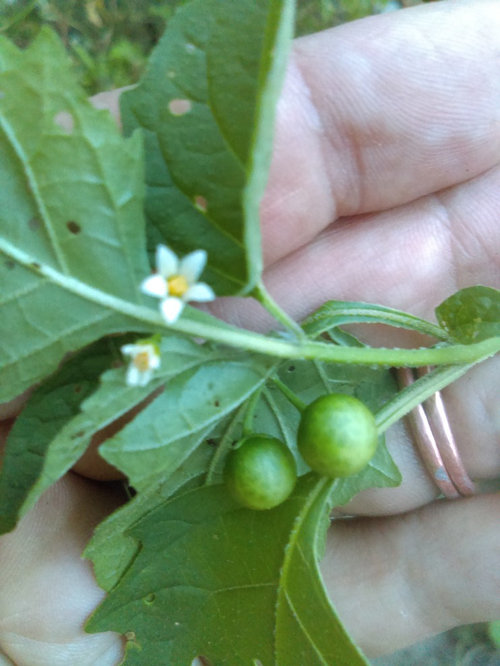
Black colored berries

black when ripe what are they

Comments (19)

  • 9 years ago

    Solanum species, probably Solanum nigrum, black nightshade.

  • 9 years ago

    Yes I agree.

  • 9 years ago

    Yes,I was thinking the exact same thing. I've eaten Datura seeds a few times, in moderation, for shamanistic reasons, so preaching doom about Solanum weeds is ridiculous to me. And then there are the millions using tobacco, knowing it's killing them,but still doing it anyway. That's a Solanum.

  • 9 years ago

    Tobacco is not a Solanum species. It is in the Solanaceae (Nightshade) family, and the Nicotiana genus. The commercial crops are usually N. tabacum; but, there are ten more non-native, plus five native Nicotiana species growing in the US wilds. The resources for this info are from Wikipedia and BONAP.

  • 9 years ago

    I can't understand why information about the plant's toxicity causes such heated response?

  • 9 years ago

    Not heated, just trying to correct misconceptions caused by overzealous wording.

    I think that it can be interesting to note a plant's possible toxicity but I'd not abuse the word deadly without a clear explanation.

    Our gardens would be very bleak and bare without any plants with known toxic pieces and parts.

  • 9 years ago
    last modified: 9 years ago

    Sorry, what I meant was it was in that family. I was going with the flow and didn't feel like getting technical. Yes I have probably developed a habit of calling any species in Solanaceae a Solanum. Just like I call every species of plant in Lamiaceae a mint, and every species in Asteraceae a composite. That works for me. Now, seems like most plants contain good and bad compounds. Just like people, there's good and bad in everyone. I just think it's ridiculous that every time a poster wants an i.d.,and it's a plant with some known toxicity, people will start telling the o.p. all sorts of horror stories. The odds are that when they get our i.d., they will googlel it right away and catch that bit of info in a more informative, less emotional fashion. I hear stuff on here like don't even touch Poke Weed or Solanum, or Snake Root. I fondle these plants all the time and I am not adraid of them. I'm not a complete idiot either. Like I would never go out and eat Snake Root or Water Hemlock foliage. Snake Root's leaves may be toxic, but its flowers give energy to migrating Monarchs. I don't think there are any plants on the planet, where if you tasted only one berry, you would instantly drop dead! From a plant's point of view, it's better to give a predator a belly ache than to murder them instantly. If those kind of lethal plants were around, they wouldn't be for long, because the potential threat to our lives would make us eradicate them. As far as touching plants, yes I might tell people horror stories when it comes to touching plants like Toxicodendren radicans or Heracleum mantegazzianum.

  • 9 years ago
    last modified: 9 years ago

    Precisely, rhizo. It's the choice of the word 'deadly' I take issue with. And not heatedly, but in an attempt at accuracy. There's no argument that it is toxic to varying degrees. 'Deadly' just seems far too strong a word. It makes it sound as if the plant has to be handled in a hazmat suit. How would one describe something which really was deadly ie almost always fatal?

  • 9 years ago
    last modified: 9 years ago

    Actually, with Poke Weed the hasmat requirement has been changed,and a quarantine tent is now called for. And if you get any closer than 10 feet to a Castor Bean the entire surface of your skin will break out in festering pustules, and you will die a horrible death ! But, seriously, sometimes it's funny, when you are trying to extoll the virtues of a native plant , and how it attracts pollinators, and there is somebody else saying it will kill you, your entire family,and all your pets. And I think it's many times just an excuse to make a comment. Well I love hearing all your comments and know we all can do better than that. ! This forum could be potentially lethal if you were to get so involved with it that you refuse to take food and water. LOL ! I have also swallowed Castor Beans, turns out that stomach acid cannot penetrate their seedcoats. Someone else said that same thing on here recently. Maybe they've popped a few Castor Beans before also.

  • 9 years ago
    last modified: 9 years ago

    Can't help to join in... as for the castor bean, you might not know this. One or two drops of the liquid dripped from the young petioles has been used as a treatment for conjunctivitis in my village, a long time ago when I was a child, (off course not anymore) but no one ever died of it. I grew them in the past, on a herb garden, for the exact reason. I wish this gives an additional trivia, (I also do not encourage anyone to do this... this is totally trivial, but it is not a lie. as no confirmation whatsoever of scientific topical-anty-inflamatory, nor topical toxicity or safety on conjuctival sac aplication). So yes, sometime toxic plants are even more fascinating to grow or to discuss.

  • 9 years ago

    Found this online:

    '...To purify ricin, there are “special, technically difficult processes that might not be readily available,” notes the CDC. Bottom line: High-quality ricin is hard to make, and it’s difficult to produce a powder form that is easy to inhale. That doesn’t stop people from trying. In 2008, Roger von Bergendorff was found comatose in his Las Vegas hotel room after he had accidentally inhaled ricin he had produced. After he woke up from his coma, he was sentenced to three years in prison....'

  • 9 years ago
    last modified: 9 years ago

    Reverting to the main cause of all this commotion:

    rhizo_1 (North AL) zone 7 "I think that it can be interesting to note a plant's possible toxicity but I'd not abuse the word deadly without a clear explanation."

    Here it is (a clear explanation):

    Quote: "Solanine levels in S. nigrum can be toxic. Children have died from poisoning after eating unripe berries. However, the plant is rarely fatal." wikipedia.org/wiki/Solanum_nigrum#Toxicity

    Conclusion: Even if the plant is rarely fatal, it still has potential to be fatal. The berries can look attractive to small children. I happened not to share the opinion that there is anything wrong with forewarning, to the contrary.

  • 9 years ago
    last modified: 9 years ago

    Why would anyone want to make high quality ricin ? Only reason would be to kill people or animals. The method for purifying ricin has crossed my mind before. Kind of afraid to look it up. Have no reason to,I don't plan on killing anyone. I did see that someone on the vegetables forum posted a recipe for home made castor oil. There are a couple plants in the garden that I try to avoid touching. Urtica dioicus, and Opuntia humifosa. All these dire warnings about Solanum nigrum are giving me the desire to taste two or three berries next time I run into one! Walked over scorpions, barefoot on Catalina Island, and I am not afraid! They were very tiny scorpions truth be told.

  • 9 years ago

    High quality ricin is not really very hard to make, but it is dangerous to make, as many have died trying to purify it. You need to wear some type of breathing apparatus to prevent accidental inhalation. The process involves using acetone and takes a couple of days to get to the finished product, but I don't think it is worth attempting. Anyone making purified ricin is usually up to no good.

  • 9 years ago

    wndberry, I once posted, elsewhere, that pokeweed is toxic. Man! You would have thought I kicked someone's grandmother. Granted, when properly prepared, it was used in poke sallet, but that was probably more common when food was scarce and definitely by people who knew the procedure. Many, many plant toxins have been, and still are being used in medicine. The trick is knowing how to prepare a toxin to make it reasonably safe and in what dosage to use it. I would bet that in the 1800's and before, it might have been difficult to know if someone died of the disease or the cure.

  • 9 years ago

    I agree. Almost all medicines that we need today can be made from plants found in our surroundings, and some of those plants are very toxic as found in nature, or even after being prepared, but the trick is knowing which plants to use for what ailment, and how to utilize them to their fullest.

  • 9 years ago

    Well said kentuck_ !