Software
Houzz Logo Print
hzdeleted_21934719

Japanese Barberry

9 years ago
last modified: 9 years ago

I finally ripped one remaining one out. Geez, sometimes these shrubs look nice, kinda fond of the red hued ones, but the thorns are awful. When I got into my current home there was a long hedge of them that I removed. I realize that they were planted to avoid the appetites of deer, but so many other things to plant. I know they are supposed to be invasive but have never seen this in my yard but if I do I won't hesitate to rip them out.

Comments (20)

  • 9 years ago
    last modified: 9 years ago

    We had a long hedge of them when I was a kid. I have memories of stepping on thorns after they'd been trimmed, fishing balls and toys out of the thorny branches, and how homely they were in the fall and early winter since the pin oaks dropped leaves forever, and the leaves immediately got caught in the hedge along with any papers or trash that was blowing around. Ugh! I think isolated small ones can be attractive with their bright-oloreed foliage if planted in areas that don't have invasive problems.

  • 9 years ago

    I had only one for 5(?) years..bought a red one on clearance because I've seen them look pretty..it was beautiful when leafing out in the spring but as the season went along the color would fade (my fault no sun) and the leaves would be eaten by something(?) so I ripped mine out too..I never had invasive issues either..I also read they are tick magnets..still think they're pretty sometimes..

  • 9 years ago

    I rarely rip out trees and shrubs (half the time I feel guilty of murder when I do). I do have a pin oak but the trees planted next to my barberry where Northern and Southern Magnolias. No leaf debris issues , I just HATE their thorns, and I'm a cactus lover!

  • 9 years ago

    Mine also reverted to all green as the Magnolias smothered it in deep shade, but nothing ever dined on it, and we herds of deer..., no ticks.

  • 9 years ago

    I also HATE the thorns..this is one of those plants that I HAD to try but now that I have I'm over it and moving on to a 1000 others lol..

  • 9 years ago

    I find 'em when hiking in the woods around here. The "forests" of Northern Virginia aren't very old since the area was turned to desert during the Civil War. Folks on small farms scratched to get by for a couple generations then the government bought 'em out during the Great Depression, creating Marine Corps Base Quantico and Prince William National Forest Park. So there's no old growth forest and any plant with invasive tendencies shows up.

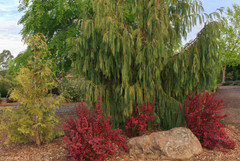
    Red barberries are planted at pretty much every gas station, fast food place and strip mall, generally accompanied by golden euonymus or gold mops and a few Knock-out roses so I kinda cringe when I see them. They typify cheap landscaping.

  • 9 years ago

    Now Euonymus I do like, though I agree they can be over planted. I USED TO be able to grow them, but deer really, REALLY like them. I believe the barberry I did have was sterile; vaguely recall reading about varieties that are not an invasive risk. Roses? That's another one deer love and I've long since abandoned.

  • 9 years ago

    I saw a variegated euonymus that had been trained as a small tree with an open form -- it was maybe eight feet tall. I LOVED that look.

  • 9 years ago

    I love Berberis. I have orange, yellow, purple, chartreuse, red and green leaved varieties. Some are small, some narrow pillars, some spreading, some large. I use them mostly as color accents but I have some drifts of them. They are all sterile. De gustibus...

  • 9 years ago
    last modified: 9 years ago

    "They are all sterile"

    One researcher says "Most of the popular forms (cultivars) produce more fruit than you would like them to. Generally, the yellow and dwarf purple forms produce the least; standard-size green and purple forms are prolific."

    Dwarf forms like Crimson Pygmy can apparently produce at least a few viable seed, and can sometimes revert and produce even more seed.

    I believe the sale of barberries is prohibited in a few NE states. I have observed barberry invading mature wooded areas here in SE Michigan.

    Good article on the development of new sterile varieties:

    http://www.timesunion.com/allnews/article/Banned-invasive-plant-returning-as-infertile-11267781.php#photo-13192541

  • 9 years ago

    Sara, please don't assume that the "sterile" cultivars you've planted with confidence are guaranteed to remain that way. So far, the research that I've scanned indicate that none of the popular Japanese barberry cultivars have remained fruitless over a few years.

    Historically and horticulturally speaking, introductions of sterile or fruitless forms of popular ornamental plants have not proved stable once they escape cultivation. Barberry is following that path.

    So Sara, it really is a bit more than a matter of taste. We should be responsible when bringing these plants into our personal space.....read up on the plants, understand its behavior in the long term. Don't be beguiled by a pretty face.

  • 9 years ago

    Sara's varieties may not be sterile but I doubt she has seen anything much in the way of flowering or fruit production on her shrubs. Colored forms of Japanese barberry are very popular here and are widely planted. And to date they have demonstrated no invasive characteristics. For whatever reason, one hardly ever sees them in bloom here. Plants that are often significantly invasive on the eastern half of the country seldom share the same propensity on the west coast - barberry, burning bush, nandina, etc. - typically due to a lack of any fruit production. The plants either bloom so sparsely as to not be a concern or do so late enough in the season that the fruit does not form or ripen properly.

    But we do have our share of other problematic plants - butterfly bush being one :-)

  • 9 years ago

    Berberis thunbergii and selections thereof are plants used by newbies, beginners before they learn about the hundreds of superior shubs. They become a horrible invasive problem for us especially on the forest floor in neutral soils. Just in case someone here thinks they don't set seed check out your favorite seed catalogue

    The atropurpurea seedlings are routinely sold in cheap, mailorder catalogues.

  • 9 years ago

    Here's the treatment for Japanese Barberry:

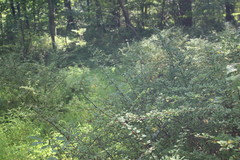
    This shady glen in our local state park used to be a charming spot loaded with ferns, jack-in-the-pulpit, ginger etc. It is now a barberry thicket.

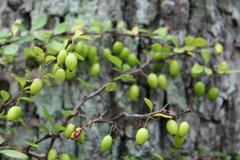
    Here's what the seed looks like today, very plentiful
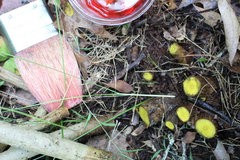
    The prickly bush is bent over with the boot, cut close to the ground and given a generous dose of 41% glyphosate.
    What is reassuring to me is that many are coming around to Dr Tallamy's ideas. My Hometown Habitat thread discusses this.

  • 9 years ago

    'Admiration' is covered with fruit, most of the others never set any fruit at all. Despite the fruit on 'Admiration', I have never seen a single seedling. Not a one. I rather wish that I had, as it is my favorite B. cultivar, but the seeds do not appear to be viable. I've had Berberis cultivars for 20 years or so, and never seen a seedling from any of them. Invasiveness can be a local phenomenon.

  • 9 years ago

    This Scientific American article is one of many linking the invasion of Japanese Barberry with the increased incidence of Lyme Disease. The prevalence of ticks infected with the Lyme Disease spirochete (Borrelia burdorferi) is greater in areas with Japanese Barberry than areas without.

    One of the ongoing limitations of forums such as this one is that there is nothing "local" about it. Posters have a tendency to never look beyond the end of their nose. In this thread for instance the OP is from NJ, I am from MD, the enthusiastic advocates for a weed like Japanese Barberry are from the West Coast. A few years ago we had the same issue with cultural practices advocated from an obscure extension office in Washington state, an assumption was made that they applied to the whole country which of course is absurd. It is the main reason why I never respond to a thread where the OP is from PNW or West Coast, I know nothing about that part of the country.

    Gas stations and convenience stores will always use cheap, mass-produced garbage like J.B. I am encouraging posters here to increase their palette of shrub selections and move beyond J.B., a noxious, introduced weed.

  • 9 years ago

    Sam you are absolutely right - no local component. So here is the disclaimer: I live on the West coast, in a Mediterranean climate. I can grow Ampelopsis, Fallopia, Berberis, etc, with no danger of them becoming invasive. We have no summer rain, and these plants cannot live in an non-irrigated environment. These plants are not even problematic in my garden, since the vast majority of my irrigation is drip, so virtually no seeds germinate.

    Why do I love Berberis? (And why you should love it too if you are a Western gardener.) Here's why:

    Berberis t. 'Orange Rocket'

    Berberis t. 'Admiration' in summer

    Berberis t. 'Admiration' in winter

    Other cultivars have deep purple, lime green, chartreuse and gold foliage. Some are narrow pillar forms, other squat bun-like shapes and still more rounded shrubs.

    I get that the species is a noxious pest and in many parts of the country should not be planted. Here, oddly, the biggest culprits on the garden-escapee list are Cystisus scoparius (Scotch broom) and Crocosmia. The broom, particularly, is a nightmare. My guess is that nobody in MD worries about broom invading your woodlands! My mother used to grow it in Virginia with impunity.


  • 9 years ago

    While the invasive potential of any plant is highly influenced - even governed - by location, there is no similar region-only appropriateness necessarily associated with any cultural practices. That is comparing apples to oranges!

    And why the Washington state extension service should be considered any more "obscure" than one located in NJ or MD is a bit mystifying!

  • 9 years ago

    I am in NE PA, zone 6B. Working with 5+ acres 20 to 40 year old landscape. I have 5 Japanese Barberry left, have been removing them over time. Love the color and texture, hate the thorns. My knuckles double in size after being stuck. Through this forum I learned of the invasiveness. Mine do not have fruit. Should i remove the remainder due to invasiveness?