Software
Houzz Logo Print
patti_sano

asian pear questions

9 years ago

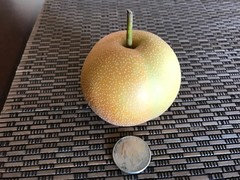
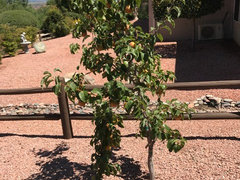
My asian pears (I have a 20th century tree) are not "lifting" and coming off the tree, so I used the clippers to cut one off. It was very sweet, but very firm. I cut about 26 off, leaving the rest on the tree. Should I leave them on or clip them off? This is my first harvest. The pears are kind of small, maybe between a golf ball and a tennis ball. I did thin them once. I thought that was enough, but I think now that it could be done at least twice.

Comments (20)

  • 9 years ago

    Where do you live? When ripe 20 th century pears turn light yellow and come off easily when lifted.

    It seems you picjpked them too soon. They are small because you did not thin or not thin enough. Not thinning will result in fruit being small, less flavorful and possible the tree going biennial.

  • 9 years ago

    I live in northern Arizona, about 17 miles from Sedona. We had a very wet summer here. My pears are still very brown, but are yellow under the skin, if that makes sense. I noticed that they started "glowing" yellow in the sunset about August 1st on the tree. What do you mean that the tree might be going biennial? So I might not get any fruit next year?

    I left some fruit on the tree, but I don't want them to get "mushy". But I'll leave them and see if they eventually "lift" off.


    I l


  • 9 years ago

    You should post some pics of your 20 Century pears. When you said your pears are very brown, it means they are russeted. 20 th Century pears usually are not russeted. I wonder if your pears are true to label. Where did you buy the tree from?

    Yes, fruit trees like Asian pears and apples can become biennial when the trees have to spend so much energy carrying a lot of fruit. They will take a break from fruiting the next year and the biennial cycle continues if you don't help the trees by thinning out fruit.

    By thinning fruit, you need to thin fruitlets when they are very small like a pea size. Thinning them when they are a golf ball size does not help a tree. Much energy is already spent sizing up those fruit by then. When you thin, you should thin up to 80% of fruitlets off. Many people are too emotional to thin that much. For a variety that is prone to biennial like 20 th Century, you would either get a minimal amount of fruit or no fruit at all the following year.

    Like I said, post pics of your fruit will help us determine if what you have is a 20 th Century variety or not.

  • 9 years ago

    I got my tree from a local nursery. It was supposed to be a 20th Century pear tree. When I thinned it, I left only one fruit every 6-8 inches. I'm not very emotional about leaving fruit on the tree. My parents were farmers. I understand the concept of thinning, but I never read that 20th Century pears could become biennial if they had too many fruit the year before. I'll post pictures of the fruit later. I wondered about the fruit being brown, I wondered when that would happen. Yellow skin is one of the reasons I wanted the 20th Century pear. At least it tastes good.

  • 9 years ago

    Asian pears are notorious for setting too many fruit. On average, they are in clusters of 5-10 fruit. I thin them to one pear per cluster and if there are several clusters close to one another, I thin off those clusters as well. You can never thin enough of Asian pears.

    For A pear fruit, I divide them into two groups, russeted and non-russeted. Example of russeted are Korean Giant, Shinko, Hosui, etc. Non-russeted are 20th Century, Shinseiki, etc. Non-russeted have thin skin; some are yellow, some are pale green. You can eat them without peeling the skin off. Some people eat russeted pears, skin and all. I sometimes peel them.

    Any place including reputable nurseries can sometimes, make mistakes re. selling incorrect varieties. As long as you like the fruit, mislabeled would not be a big issue.

  • 9 years ago

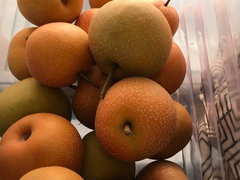
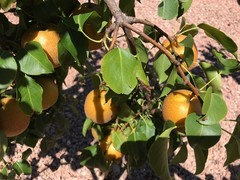
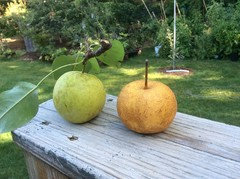
    I took some pictures of my pears. Now to post them... Is this a 20th Century pear?

  • 9 years ago

    I usually have peeled the asian pears I've bought at the store, but since these are kind of small, I didn't want to peel them. So far, the skin has been very edible

  • 9 years ago

    Possible since you live in an area with is hot and dry. Russeting could occur. You could google this variety and compare the pics.

  • 9 years ago

    I did google some images of the 20th Century pear. Most of the images showed a light yellow skin which I was expecting, but a couple had fruit like mine, described as orangish, so I guess it's possible. If I'm lucky enough to get a lot of fruit next year, I'll clip more off in the thinning process. I gave some of these away, and just got a text saying they were delicious, so I guess they're ripe. Thank you for your input.

  • 9 years ago

    Update: My pears broke off easily this am so I picked all of them. A few were closer together than I remembered. I'll do a better job of thinning next year. Thank you to everyone for your help.

  • 9 years ago

    Hi Patti, that is not a 20th Century pear. 20th Century should be more of a yellow color and not golden russeted. Those are likely Shinko or Housi, but could also be Chojuro. The size of them resembles the size that i have for Shinko (i live in zone 5 so i still have another 2-4 weeks before mine are fully ripe).

    The best way i can tell if they are ripe is to look at the bottom and see if any green is still showing through. If there is still green showing through, then they are not ripe yet.

  • 9 years ago

    Where do you live? One day in June, before the monsoon season started and cooled things down a little, it got up to 114 degrees here. Couldn't the high temp have caused the fruit to get browner?

  • 9 years ago

    I have sent pictures and the temp they went through to UC Davis. If they say that a temp of 114 (was it ever that high in Omaha?) wouldn't change the color of the skin, then I'll believe them. Maybe the tree was mislabeled at the nursery, but very few asian pears are said to do well in our climate, and 20th Century is one of them. I know that 20th Century is supposed to have yellow skin. As I said earlier in this thread, that is what I was expecting, so I was surprised to get this fruit, and was wondering when it would change to yellow, but it didn't. Regardless, the fruit is very sweet and delicious, and I'm happy about that. I don't have room to plant a lot of trees like you. You're very lucky.

    I've read that Shinko doesn't store well. We'll see how this one stores. That is one of the reasons I chose 20th Century. It has been reported to be refrigerated for up to 6 months.

  • 9 years ago

    The overall late best Asian pear period is Korean Giant. A must have.

    Tony


  • 9 years ago

    So I heard from UC Davis, and they said it was a very difficult question. They recommended asking at the nursery that I bought the tree from. I did today, and I didn't know that they had a horticulturist there, and he said that it was a 20th Century pear, that the heat we have makes them darker than they would be in other climates. Now I know, and it makes me very happy. I don't have room for a lot of trees.

  • 8 years ago

    Patt

    Here is a friend 20th Century on the left and Hosui on the right. My 20th Century Asian pear photo above are also Greenish Yellow when ripen.

    Tony

  • 8 years ago

    Tony, I've seen lots of pictures of the 20th Century pear on the internet. I know they are typically yellow. But I live in Arizona, and it got to 114 Fahrenheit earlier this year. Does it get that hot in Nebraska?

  • 8 years ago

    We do get to 100 degrees once in while but not 114. Mostly in the upper 80's or low 90's with some humidity.

    Tony

  • 8 years ago