Software
Houzz Logo Print
donnie_fitz

Hard, curled tomato leaves, help!

9 years ago
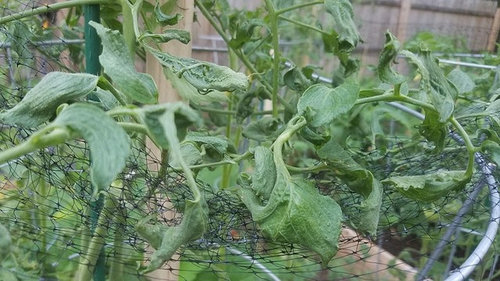
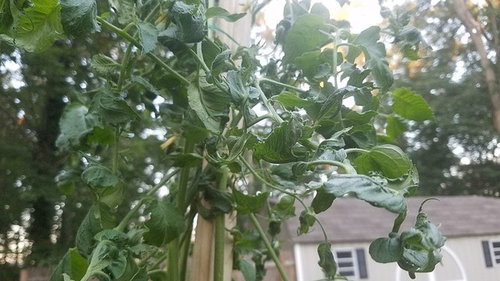
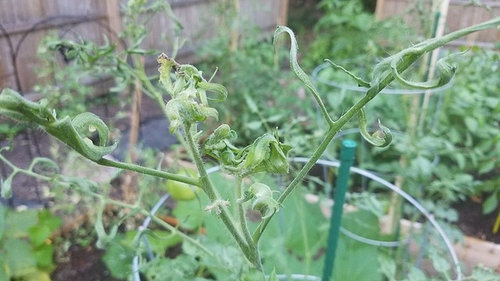
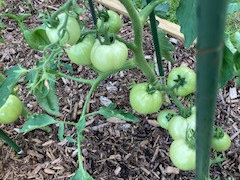
My 4 tomato plants are all suffering from this same issue. I am in CT, zone 6a. I just built raised beds and added peat moss, manure, compost, and raised bed soil to fill them. I don't really use fertilizer. Every other plant is doing amazing.


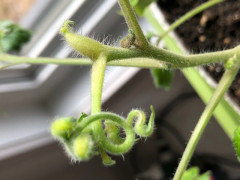
The leaves on the upper half of my tomato plants are rolled up and balled up. Not typical leaf curling from what I've seen online,


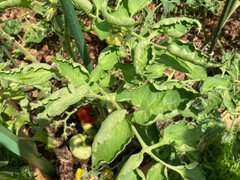
I've attached 3 pics.


Comments (17)

  • 9 years ago

    Agree, herbicide damage is the most likely culprit.

    If your plants have just started showing these symptoms and you haven't added any mulch, compost, or lawn clippings recently, then I would suspect drift from spray herbicide. If you've had any lawn or landscaping work done recently or your neighbors have (fumes and spray don't respect human boundaries), then that is probably your source. It could even be drift from spraying of nearby park, agricultural fields, etc., as when sprayed in mass quantities, herbicide can drift for miles on a windy day.

    If there's no possible source of herbicide at all, it could be something like cucumber mosaic virus, which is spread by aphids, usually via their winged forms, as non-winged aphids don't travel far enough to really spread diseases.

    But herbicide contamination/drift is a more common problem than CMV.

  • 9 years ago

    It's kinda odd. There is a cucumber plant, two squash plants, pea plants, and one eggplant plant in that same raised bed, all planted at the same time. These four tomato plants are the only ones with this issue.


    It's so sad, I've have no tomatoes. There are only like 7 growing on all four of the plants total. Only one is red, and just about ready to be picked and it's already just about September.

  • 9 years ago

    Herbicide drift can affect plants in weird ways. Sometimes, one plant gets hit, and the one next to it is spared. Depending on air currents, it can skip over some plants.

    Viruses can also be pretty selective and spotty in the plants they target.


  • 8 years ago

    If you have only 4 tomato plants, and they are all affected, understand that tomatoes are extremely sensitive to herbicide from any source.

    If you have some tomato plants without problems, are they in the same bed? And was manure mixed into the soil in that part of the bed/garden? If so, please explain.

  • 5 years ago

    Hi there, I just came across your post.

    I had this very same symptom with my tomato plant this year as well.

    I didn't really come across the idea that it might be 'herbicidal' until just now.


    Here are my stats as well:

    • This year, 2020, I put in 3 new raised beds.
    • All new screened loam/compost mix from a local garden supplier.

    Note: I did NOT add any additional cow manure or the like. I do not know where their
    sources are though. (This is interesting)

    • In one of the beds, I grew 3 diff varieties of tomatoes and only one of them showed this symptom. It initially grew very nicely up until about 3' tall 'ish.
    • I had no other problems with this variety and the plant had all the other signs of looking ok. These 2 plants were 'indeterminate' and both grew to at least 8' tall this year. (except for the extreme curling, twisting, and leathery look of the leaves.)
    • I was able to have a decent harvest from those plants (I think there were only 2 plants of that type) Unfortunately, we did eat all the fruit from those plants, since I could not find any supporting info on this until now. The fruit was all normal looking and tasting.
    • This bed was a 4'x8' bed and did have 2 other varieties of tomato in it as well, along with a string of melon in between them. The melon started out great and produced just a couple fruit before it was hit with a vine borer. So it was gone.
    • In my other 2 beds, which are within 2' to 12' away from this tomato bed, we were growing several other veges and didn't notice any other problems to make serious note of.
    • In the closest bed, we had cucumbers, celery, Broccoli and cauliflower and some herbs.
    • We did grow 5 pails of potatoes using the same soil and didn't notice anything worth noting along these lines.

    This is the only issue this year to make me stand up and take notice of it. Everything else, I could come up with a reason.

    I am interested in knowing what else you found out regarding this.

    At this point, I am thinking possibly of 'AminoPyralid' concerns here. Since a lot of the info I've seen on this so far supports the same kind of leaf symptoms.

    And, I do remember there being bumps along the main trunk of this as well. I thought that was interesting.


    I'm really hoping this is not the case though, since the end result might mean getting rid of the effected soil maybe.?

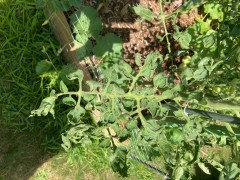
    I will try to attach photos of mine as well.


    Hope to hear from you,


  • 5 years ago

    That looks like herbicide damage to me. Were the affected plants right next to one another? If so, then I would suspect drift from a neighbor spraying herbicide or hiring a landscaping company that sprays herbicide. Especially since other tomato plants in the same soil/mulch were not affected and the affected plants grew fine up to a certain point. Sudden distortion of foliage when the plant was growing fine for a while is likely herbicide injury. If you think about how random air currents can be outdoors, it's very possible for one part of a bed or even just one plant in a bed to be affected by drift while others are spared. I have seen this in my own garden, with one plant affected but the one next to it is fine.


    A virus is also possible, but those usually affect fruit form and flavor.


    If you want to make sure it's not something in the soil, take some samples from the areas where the affected plants were and do a bioassay. That means sow some tomato and/or pea seeds (preferably both, as peas germinate and grow quickly and are pretty sensitive to most herbicides, but tomatoes will give you 100% certainty that the soil is free of herbicide that will affect tomatoes), with a control group in store-bought potting mix that you know to be herbicide free and a test group in your soil samples from your garden. If your soil has herbicide in it, the seedlings in the test group will show stunted and distorted growth compared to the control group. If you do this over the winter, you'll know before it's time for spring planting whether the soil in your beds is OK.

  • 5 years ago

    Also, if there's a way you can let your neighbors know that spraying herbicide anytime other than very early spring is extremely inconsiderate, that would be ideal. Landscaping companies know this, but they'd rather keep their clients who demand weed-free lawns.


    In my experience, no matter how nice you are about it, people are VERY defensive about their lawn care and don't like to be told by weird neighbors who grow vegetables that what keeps their lawns weed-free is damaging their neighbors' plants. The best I could get was to make friends with my neighbor's lawn guys and ask them to give me a heads up before they spray herbicide so I could cover my plants with tarps and try to minimize damage that way.

  • 5 years ago

    Hi there, and thanks for the feedback,

    All good info. I'll try to see how I can dig through the frost layer to get some samples and see what I can do.

    Good point about the neighbor landscapers also. I can only think of one neighbor off hand that seems to use a contractor a couple times a year.

    None of my other direct neighbors use any contractors. Not sure if they may be spraying anything themselves though.

    Thanks for the feedback.

    Good Gardening to you.

  • 5 years ago

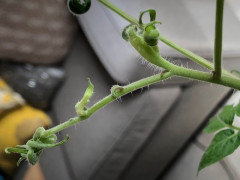
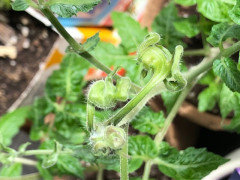
    My tomato seedlings are all developing this weird twisting with thickened areas on the top. They have never been outside so I don't see how herbicide exposure could be affecting them. All looked fine in their flats and then I transplanted when they had a couple sets of true leaves into peat pots with purchased potting soil. I have never seen this before and looks like they are all going to die although some plants are pretty large already. Does anyone have any idea what might be going on? Thanks for any help!


  • 5 years ago
    last modified: 5 years ago

    Were the peat pots or the potting mix sitting exposed in a garage or shed where herbicide is also stored? Or possibly at the shop?


    Also, are you using anything to spray or water the plants that could ever have contained herbicide?

  • 5 years ago

    I purchased the potting soil right before I used it and it was not near any herbicide while I had it. Some of the peat pots belonged to my mother in law and have been around for quite a while so can't be absolutely sure on that. My watering can and spray bottle have never been used for anything like that. Does it appear to you to be chemical damage? At first I wondered if my seeds were somehow blighted but it's both my romas and cherry tomato plants. My peppers and cabbage are unaffected as far as I can tell. It's really weird and I've never had this happen to my tomatoes before.

  • 5 years ago

    A friend of mine has suggested cucumber mosaic virus. Is anyone here familiar with that?

  • 5 years ago

    A lot of viruses can resemble herbicide injury, but CMV is spread primarily by aphids, and you say your plants haven't been outdoors at all, so that's unlikely.


    Tobacco Mosaic Virus can be spread by people, and a common way that happens is when smokers handle tomato plants, but it doesn't really look like what I see in your photos.


    I think you need to do an experiment. Take your potting soil and put it into a container you know is clean and germinate some pea and tomato seeds you know are virus-free (i.e., from a packet you used in previous years) in it to see how they grow. If they grow distorted, then the potting soil is the source of contamination. Contaminated commercial potting soil is extremely rare, but it's not impossible.


    You should also take a peat pot from your batch with the distorted plants and put soil in there from a different package and do the same and see what happens.

  • 5 years ago

    Virus could be seedborne, but it would be very strange for it to wait to show up until just after repotting. Also, unless all of the affected plants are the same variety from the same seed source, that seems very unlikely.


    My guess is some kind of contamination happened during or around the repotting process. Most likely the pots or growing medium, but it could also be someone who had been using herbicide being around the plants. Maybe the trays they're sitting in? An open window while a neighbor was spraying?


    Question: are the unaffected pepper plants in the same place and in the same peat pots and potting soil?

  • 5 years ago

    Another possibility is ethylene damage from a heater, though what I'm seeing in the photos would be pretty extreme or indicative of really bad ventilation. Are they in a closed room with a heater?

  • 5 years ago

    Thanks Gorbelly, I really appreciate your help to try and figure out what's going on. I also read about the aphids and CMV and there are definitely no aphids around. We live on a farm so there are no neighbours that could be spraying chemicals. They are in my sunroom which is part of the main house so no heater. We don't smoke so that's not it. My peppers and cabbages are in the same peat pots and soil and are not showing unusual growth so far. I will try planting some seeds in the same soil and pots to experiment. People are telling me to just abandon them and start new which I have but I really want to figure out what caused this. Thanks!

Sponsored
More Discussions