Software
Houzz Logo Print
heruga

'Dwarf' conifers not really dwarf

9 years ago
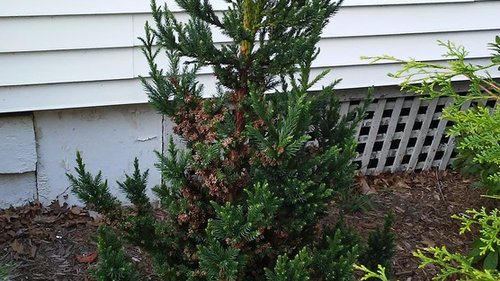
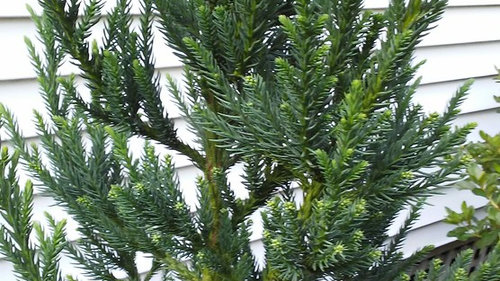
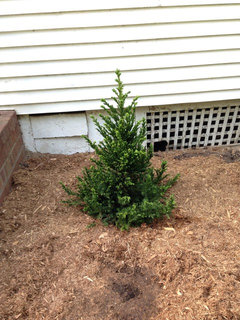
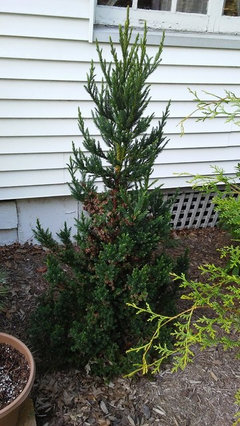
Last year in spring I planted cryptomeria japonica black dragon and chamaecyparis obtusa thoweil thinking they are dwarfs. Well what'd you know the cryptomeria already grew 2+ feet this year and my hinoki grew 3 feet since last year. What's going on?? I thought they were dwarfs? If this same amount of growth rate keeps continuing every year they will be giants, not dwarfs. Can anyone tell me why a supposedly dwarf tree is growing so fast. You can probably tell from the pics where the new growth started from

Comments (45)

  • 9 years ago

    I think a reversion is definitely happening with the obtusa, and it's probably happening with the Cryptomeria. I must say that it's odd that it would be happening twice, and both involving leaders, although if you let reversions go long enough, they will quickly become the dominant plant. Unfortunately, I think both of your specimens are probably, effectively, no longer dwarf cultivars.

    As a point of reference, my black dragon has grown a foot in three years, and my Thoweil six inches in two years.


  • 9 years ago

    I just went out and looked at my two BDs - one has barely budged over six years (it could probably use more water) and the other maybe a foot in 3-4 years. I fear that Dean is correct unless you got the same beans that Jack did.

  • 9 years ago
    last modified: 9 years ago

    What is reversion?? And who is Jack? So are you saying I will be getting two 90 feet trees that are planted only 3 feet apart and not even 10 feet away from the foundation?

  • 9 years ago

    Reversion is when a cultivar starts to exhibit the same sort of growth the species does. It can happen in various ways.....variegated foliage reverting to unvariegated or the dense, congested, slow growth of a dwarf being overtaken by looser, faster, larger growth of the species plant.

    Will these necessarily grow to 90' tall trees any time soon? Very doubtful but they may not continue to grow very slowly, they may no longer feature the characteristics that defined that cultivar (the Hinoki is already displaying that trait) and they will likely get larger than their listed mature size would suggest.

    Jack as in the guy who traded his mom's cow for some "magic" beans.

  • 9 years ago

    One of my dwarf alberta spruces has reverted. As I understand it, dwarf varieties often originate as a witches broom. A reversion is when the dwarf specimen from that broom reverts back to the original (much larger usually) species.

  • 9 years ago
    last modified: 9 years ago

    Oh my lord. I have such bad luck don't I. Its rare enough that this happens and 2 trees happen at the same time!? Well what should I do next?

    Oh you mean Jack and the beanstalk? I thought it was someone from this forum lol

    So I am guessing anyone who buys a dwarf species because of space issues is always at a risk

  • 9 years ago

    Yes sorry I was a bit flip about Jack! What has happened to you is rare; I have hundreds of conifer cultivars and can only think of one that has reverted - and it's an odd one: a Larix decidua 'Pendula' that decided that it didn't want to be pendulous anymore. So you can mostly figure that dwarfs will stay dwarf. Or dwarf-ish. Or not...

  • 9 years ago

    Sigh. Well theres a reason why I planted them so close to each other and close to the foundation. What should I do next? Its been in the ground for a little over a year. Too late and too big to transplant them now is it? And I don't even have space anywhere in my yard for 2 gigantic soon to become 60 footers....

  • 9 years ago

    The usual answer is to cut the reversion off. I think doing so in your case is going to seriously mess with the aesthetics of your plants. Since both cultivars are common and easy to cheaply obtain, I'd just replace both of them.

  • 9 years ago
    last modified: 9 years ago

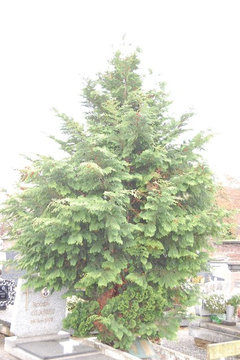
    One other, turning to Chamaecyparis obtusa species.

  • 9 years ago

    bark changes every year .. either in color.. or texture. or whatever ...


    second pic.. the green is obviously this years growth ...


    below is last years ... and if you go further down ... you will find a 3rd version ...


    somewhere way down.. im wondering if you will find.. evidence of the failed graft.. indicating this is the understock plant .. which is usually not dwarf stock ...


    as to the other.. i am stymied ... you can also compare this and last years growth .. and ID where the change took place in time ...


    did you fert these.. at planting ...


    once you ID the dwarf growth pattern .. from the nondwarf ... you are just down to pruning and training ... to keep the plant in any size or shape you want ... you are going to have to learn such sooner or later ... so even if these dont end up being exactly what you want.. you will learn experience from them ...


    and knowledge is power ,... so dont get all depressed about it all ...


    ken


  • 9 years ago
    last modified: 9 years ago

    The answer is that 'Black Dragon' is only dwarf relative to the giant parental species. And, as mentioned your Hinoki has a reversion to the typical species popping out of it. Your Tsugi cultivar looks perfectly normal for that kind and should not be pruned back anywhere on the top. You could, however try slowing it by slicing around part of the root system every year with a spade. Annual pruning of roots during re-potting is used to help dwarf the tops of bonsai and you could use the method I have described to dwarf the Cryptomeria - and other conifers in your garden also.

  • 9 years ago

    Growth rates are also dependent on climate and soil conditions.

    Generally speaking with the mild winters, soil conditions and great rainfall averages during the growing season, things in the NE tend to grow faster/bigger.

  • 9 years ago

    That nana gracilis certainly isn't a nana anymore lol. don't think either of these are grafted, I think they were propagated from cuttings. For the cryptomeria I'll see how it grows next year and if it doesn't stop growing fast I'll try root pruning. For the hinoki I think I will cut the whole top of it and try to propagate it from that cutting. It will turn out to be a species hinoki instead of the cultivar thoweil right? I think I'll quit growing cultivars of conifers and keep growing species trees if I have to risk reversion..

  • 9 years ago

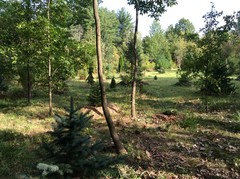
    Well I just happened to get caught on a red light right next to a dwarf Alberta spruce that is reverting. Took a pic from my car. Looks very weird..

  • 9 years ago

    While reversions on cultivars can happen, they are not common and certainly no reason to stop growing 'dwarf' cultivars! Like Sara, I have grown countless dwarf conifer selections over the years and have yet to have one revert.

    I personally don't grow DAS - don't care for the plant or its problems - but if well established in the landscape and give a few years to develop to some size, this cultivar seems to be more prone to species reversion than most others.

  • 9 years ago

    Well I'm more into species trees anyway than manmade cultivars so I still be happy growing them. I think by now you guys all figure that from all the conifer questions I ask regarding pure species conifers and I rarely ask about cultivared conifers.

    But back to my previous question, can I still propagate species hinoki from that cutting? Will there be a possibility that the cutting can return back to the cultivar 'thoweil' or be a hybrid between thoweil and the species?

  • 9 years ago

    Cultivars are not necessarily "manmade" :-) With conifers, the vast majority are from naturally occurring sports or witches' brooms. And if you want anything to grow in the small, compact or dwarf category, then you are pretty much relegated to a dwarf cultivar as virtually all species plants will grow big.

  • 9 years ago

    Yes, you can propagate the reversion. It's a bit tough to say that your reversion "is" the straight species unless you take a good look at its DNA. But it's certainly heading that way. I have no idea if there is some tendency towards genetic instability in the reversion. Someone else around here may know.

  • 9 years ago

    Then I might as well stick with big trees. I've already had super bad luck having 2 supposedly dwarf trees being reverted at the same time and being stopped on a red light and there had to be a reversioned alberta spruce right next to me. I feel they're saying 'oh look Kens here lets reversion in front of him!'.

    Ok I guess I'll just cut the top off instead of making cuttings from it. But I cannot find the species chamaecyparis obtusa anywhere! Everything in the market is cultivared

  • 9 years ago

    It looks as if you are having normal growth on the Black Dragon. I would move it this Fall where it has more room to grow without restricting it.

    Your Hinoki has definitely reverted. Simple and easy to cut it off. Why would you not grow dwarfs when the fix is so easy, especially taken care of early?


  • 9 years ago

    There is often a very good reason why one only finds cultivars of certain species and not the species themselves. Usually it is because the cultivars are superior to the species in some aspect in terms of garden worthiness. There is nothing a species obtusa offers that would make me want to select that over one of its gazillion cultivars!! A big hulking thing that will look ratty in age and not nearly as appealing as one of the dwarfs!

    I have to agree with Mike that a fix on a reversion is super easy to accomplish, should you even need to.

  • 9 years ago

    Well for me personally, I am not so crazy about the whirled foliage on the hinokis. I like it better looking like a plain cuppressaceae, like the foliage of that of an thujas. Well even if I cut off the reversioned part, won't it grow back again as the same reversion again?

  • 9 years ago
    last modified: 9 years ago

    Probably not. I've seen a reversion happen twice on the same plant, but in different places. That happened on a Dwarf Alberta Spruce which are prone to reversions.

  • 9 years ago

    Sometimes, the réversion are only biased, between the cultivar and the species, and a new cultivar are possible.

  • 9 years ago
    last modified: 9 years ago

    When seeds of Hinoki are planted most of them produce plants that look like your reversion. Growing your own from seed is a way you can get conifer species instead of cultivars.

  • 9 years ago

    Well I don't know how old these hinokis were when I got it so I may possibly have to wait a long time until it becomes mature and start producing cones. Or I may just visit a botanical garden that has some mature hinokis and take there cones

  • 9 years ago

    Hey guys so I decided to move this reversioned hinoki to a spacier area and grow it as a large specimen. My goal is to propagate species chamaecyparis obtusa from cuttings. Will the reversion really take over the 'thoweil' if I leave it be? Or will the 'thoweil' stay in the bottom and the species grow on top? Wondering because some people here say they will take over yet I see a photo from clement of a 'nana' cultivar still left on the bottom.

  • 9 years ago

    Can you spot the reverting Dwarf Alberta Spruce?

  • 9 years ago

    No I can't. Or maybe it's because I am looking through my phone. What is it really like in the pic?

  • 9 years ago

    You could use this to help identify suitable kinds.

    http://coenosium.com/small_conifers.htm

  • 9 years ago

    The reverting dwarf alberta spruce is lowest tree between the two main tree trunks. Look at the top of it.

  • 9 years ago
    last modified: 9 years ago

    I see it now. But once it gets very big, will the whole tree become the species picea glauca? What I mean is will the cultivar 'conica' dissapear eventually because it got completely overtaken by the species picea glauca?

    Embothrium, nice detailed list but right now I'm more interested in species trees.

  • 9 years ago
    last modified: 9 years ago

    I *think* the picture you posted above answers your question. Looks like it will stay "2 trees in one", unless I cut out the dwarf part on the bottom. I could be wrong of course.

  • 9 years ago
    last modified: 9 years ago

    The descriptions in the book is the part that I thought could be of use. Since you started out complaining about unexpected lack of dwarfness.

    Planting species only isn't going to be a panacea, comparatively few wild conifers are naturally small growing and compact. If you don't have acreage you are not going to be able to house very many conifers of typical stature over the long term. If you are instead going to carefully choose wild conifers for smallness you might as well be choosing from among the much larger pool of garden conifers offering miniature, dwarf or small growth. These exist in part in the first place because of the desire among gardeners for plants that don't grow 60+ ft. tall.

  • 9 years ago

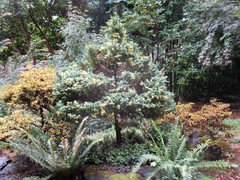
    Pete, Here's a picture of a variegated cypress that is a reversion I let go....for now. The original plant is now a groundcover below the reversion. The ferns are going to be moved in a few weeks. They're out of scale.


  • 9 years ago

    In most cases a reverted dwarf will always appear to be two different plants - the original cultivar and the species reversion. It is only if the form of the dwarf and its size allows the species to overwhelm or overshade the original dwarf cultivar to the point where it completely dies off that you lose all signs of the original plant.

  • 9 years ago
    last modified: 9 years ago

    Here's a picture of a variegated cypress that is a reversion I let go - for now

    I've seen other examples of that same - or a similar - variegated Sawara* producing a tree habit. I don't know what the correct naming of the cultivar is. And I spent some time looking into it, some years ago. At that time at least it was another one of those garden plant identification subjects where printed photos and descriptions don't match the material at hand. Trying again now with the web being so much in the picture might produce a different outcome.

    Anyway since it is basically the same foliage on a differently shaped plant I don't know that I would call it a reversion. And I certainly like the cultivar as a small conical tree better than the tuffet it comes from the nursery as.

    *Sawara cultivars are often quite polymorphic and unstable

  • 9 years ago

    I'll just cut off cultivar form to create a slightly exposed trunk. I like the look of that anyway. Embothrium so there are dwarf species trees you are saying? How do propagators make that kind of plant...?


  • 9 years ago

    I found an old pic of my black dragon cryptomeria I took when I first planted it last year spring. Current growth looks nothing like that of a dwarfs. Is this a reversion or not? The new growth doesn't look like the species cryptomeria foliage and retains the foliage of black dragons so I'm wondering.

  • 9 years ago

    I'm seeing about 50% slower growth than the species, and I grow both. 50% sure doesn't make it a dwarf. Who said it was?

  • 9 years ago

    The ACS classes 'Black Dragon' as an intermediate.

  • 9 years ago

    Oh I did not know that. I always thought they were classified as dwarf. And I have been told that this tree will probably only be 25 ft in height by the end of my life

  • 9 years ago

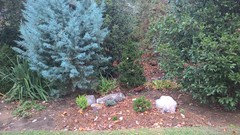
    To the left: Cupressus arizonica var glabra 'Blue Ice.' Not a dwarf. In the middle next to it, Cryptomeria japonica 'Black Dragon.' I bought and planted both plants at the same time, and the Blue Ice was probably two feet taller at that time (4 years ago). So exposed to virtually identical environments, the Blue Ice is now 20 feet tall and the Black Dragon is 5 feet. I'm not sure how old the Black Dragon was when I planted it, but I'm guessing it's approaching 7 or 8 years old now. I'd call it a dwarfish, here in Georgia at least.