Software
Houzz Logo Print
steffen_harris

1925 House Sloping Floors

9 years ago
I know this is a topic that's been discussed previously, but I can't seem to find anything along the lines of what I'm asking.


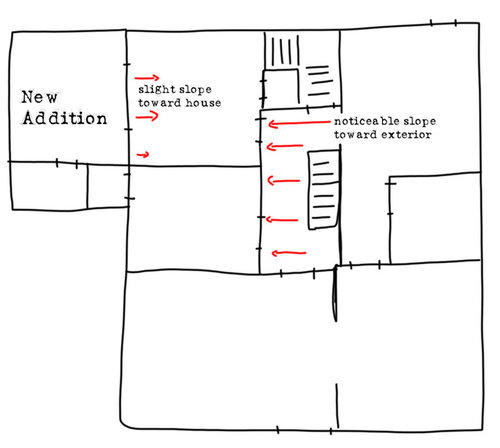
We are looking at a 1925 Bungalow. The floor slopes toward the left side of the house in the hallway on the main floor. Upstairs, there is VERY little slope, if anything at all. Is this, from experience, anything to be concerned about? We will definitely have an inspection done, but I'm curious to know from others.


I have uploaded a sketch to show what I mean, it only slopes in part of the house. I guess it's more like a sagging floor. In the hallway, it's really noticeable. There is a new addition to the house, I didn't know if the settling of an addition could cause sloping or not? From the new addition going into the house, there is a slight slope down toward the house. Please see picture for reference.


Any thoughts?


Comments (13)

  • PRO
    9 years ago

    We had rather significant slope in our 1920's craftsman house. We had a contractor look at it. He suggested installing jacks permanently to support the sagging floor joists. He poured some concrete pads for the jacks to rest on and installed some new beams to lift all the joist simultaneously. He lifted the joists a fair amount initially and them came back on a weekly basis to raise the joists and inch or so each time. It has worked out well. Every house of a goodly age will have some joist/floor sagging. I would suggest if you are planning on selling the house that such a floor problem be taken care of. Potential home buyers such as yourself a greatly put off by sloping and sagging floors.

  • PRO
    9 years ago

    Make your offer contingent on the inspection. We bought a house built in 1820. Lots of ups and downs…house was solid as a rock.

  • 9 years ago

    Thank you for the comments. We are definitely going to see what an inspector says and possibly put an offer down contingent on that inspection. Granted, every house is different so it could be an issue, but from my research and from all your comments, it seems to be just an age thing, and a somewhat easy "fix."

    JudyG Designs, wow!! 1820?! That's so old. Very cool!!

  • PRO
    9 years ago
    last modified: 9 years ago

    Yes, it was cool. It was a half Cape (on Cape Cod) and we had 7 great years there…the house actually was featured in a New England Home magazine; then on to a new build…7 years there, then on to a mid-century ranch. We have lived in 9 houses in 48 years…and never left the state! We don’t flip, We just love searching, fixing up and moving on. I think this is our last one….the DOWNSIZE!

    You are in the driver’s seat once you make the offer, contingent on inspection. The fix might make you walk; or the fix can be negotiated into the price; lots of options.

    As my wonderful real estate attorney says “deed-check; check-deed”. That is when the deal is done.

    Hope it works out for the best. My motto? Too many houses and not enough time...

  • 8 years ago

    Steffan, don't use "just any inspector". Make you to use one who is very very familiar with old homes.

  • 8 years ago

    It may likely be worth getting a structural engineer in to take a look.

  • 8 years ago

    Yes, inspectors are not usually qualified in this area. Hire a structural engineer for an hour. That is what we did and he told us exactly what needed to be done.

  • 8 years ago

    Agree with PP: spend the $ for an hour of a structural engineer's time. I live in a 1920s home, and one side of the 2nd floor slopes down (away from middle of house). Zero diagonal cracks at windows or doors (a huge red flag for settling that is problematic), or elsewhere in that room or rooms above or below. Twice I've had it investigated and both times the SA said it was normal and do nothing until/unless I see cracks radiating from corners of windows or doors. HTH! Oh - and a friend near by did have to jack up part of her foundation due to a slope. But the cost wasn't that bad: other potential buyers ran from it, and we're in a HCOL area with all old homes so this isn't that bad to fix, and the cost was less than the apparent price reduction (for having this problem).

  • 8 years ago

    Granted, every house is different so it could be an issue, but from my research and from all your comments, it seems to be just an age thing, and a somewhat easy "fix."

    Trust me, no one or no house gets to that age without a little sagging.

  • 8 years ago

    My motto? Too many houses and not enough time...

    Drives me nuts when I see all these gorgeous old homes that would just need a little TLC and realize I'm no longer of the age to help them. Sigh.

  • 8 years ago

    Steffen Harris, what did you end up doing? Eager to know if you bought the house.

    Fwiw, my 1922 bungalow has a distinct slope in the rooms at the SW corner of the house, but they clearly settled into place long ago. The baseboards have been cut to accommodate the slope, and not recently. And when we had a most unusual earthquake a couple of months after I moved in, nothing shifted at all. Not even the tiniest crack in the plaster. I'm going with "sloped but stable in place" till I see evidence of something else, or until I'm doing work in that corner of the house anyway.

  • PRO
    8 years ago

    We discovered that our 1948 house also has floors that slope - toward the rear of the house. This was discovered when a 2nd floor pipe burst and all the water ran toward the back of the house. One would never have known this unless one walked around with a level! The house had just settled over the years.

Sponsored
J.Holderby - Renovations
Average rating: 5 out of 5 stars4 Reviews
Franklin County's Leading General Contractors - 2X Best of Houzz!