

200 Year Old Home; Curb Appeal?
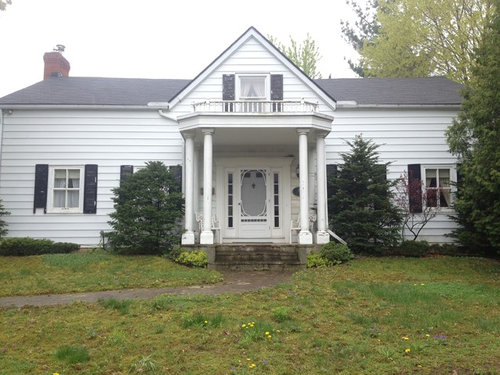
My plans for front windows are to make them longer (allowing more light inside as it is dark). The new windows will have more traditional grills, 6 on 9 I think its called. I haven't decided casement or double hung. I was also thinking of making the shutters a pale muted blue to give it a softer appearance.
Any ideas? Landscaping? I think the two trees next to the door have to go since they block the window light.
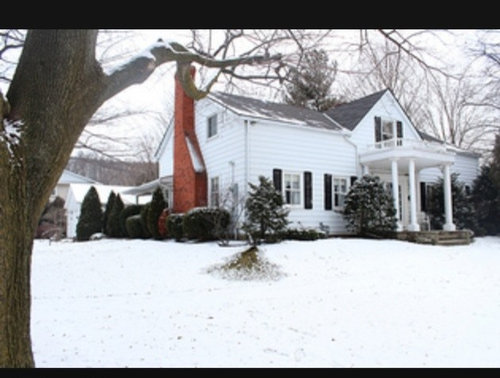
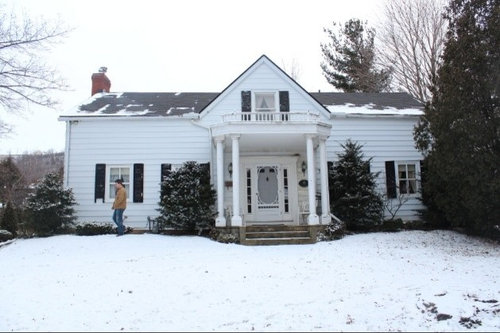
Here are some photos, keep in mind it has been neglected so this is were we are starting .. :)
Comments (180)
 13 years agoOK, I haven't been here in a while but noticed some talk about tube and knob wiring. If it's not broke don't fix it. Not all knob and tube needs to be removed and it's not true that you may not get homeowner's insurance. When you get rid of all the wiring you are also opening all the walls and ruining (if it wasn't damaged to begin with) that wonderful fire retardant plaster.
Unless there is evidence that the wiring is a hazard, don't mess with it. It's easier to add wiring, such as for three-pronged appliances, than it is to rip out and replace.- 13 years agoAgree colonialgp on the knob and tube but it at LEAST needs to be disconnected!! Dead wires in the walls are not a problem. IF it is live, there may be insurance issues so getting rid of it could mean DISCONNECT not rip out.
Related Professionals
Atlanta Interior Designers & Decorators · Nashville Interior Designers & Decorators · Elgin Interior Designers & Decorators · Rochester Interior Designers & Decorators · Wausau Interior Designers & Decorators · Colorado Springs Interior Designers & Decorators · Pullman Interior Designers & Decorators · Bennington Architects & Building Designers · San Jose Architects & Building Designers · Liberal Architects & Building Designers · San Angelo Architects & Building Designers · Bronx Architects & Building Designers · Jacksonville Kitchen & Bathroom Designers · Hudson Kitchen & Bathroom Designers · Murrieta Kitchen & Bathroom Designers- 13 years ago@bubblyjock As I too had noted, however, seeing that did give me a "kinda" "lions-and-tigers-and bears" reaction to what she may be facing in that small town dealing with anything "Corman"
- 13 years agolast modified: 13 years agoMmm - wonder if there's a bit of a history to the OP's house, hence the ominous-sounding "Remember the Corman House" headline! But, it does look like a pretty active historical society, and once the OP's been to a few local hatches, matches and dispatches, a slack handful of church suppers and country fairs, and borrowed sugar from one neighbour while rescuing another neighbour's dog, I'm sure she'll have a variety of great stories about her lovely house!
Meanwhile, OP, as many have noted, it'll do the house a power of good (and make it MUCH lighter indoors) if you get a pro to cut down the trees that are close to the building, sooner than later, asap preferably. - 13 years ago@bubblyjock There is a "bit" included in the Designation document Theresa posted - family trees appear to be online and other references to Cormans.
- 13 years agolast modified: 13 years agoUgh - now I feel like a stalker, lol. Much more fun pondering this house than dealing with our own 200yo domestic bliss!
Theresa - I'm guessing you're already discussing your ideas with the local Planning Department. You need building permits for most structural modifications to houses here in Ontario, of course, plus the Heritage Group will want to know what's going on, hopefully giving their seal of approval in a timely manner.
IME these groups aren't always particularly cooperative, but your house has already had major cosmetic changes on the exterior, such as the bay window, that clearly don't fit with the house's vernacular, so maybe you can use these considerations as leverage to make your own tactful updates, such as little dormers at the back, which are certainly in keeping and sound eminently practical.
Can you get an extension on an end date for completing the renos? Two months is VERY tight indeed, particularly if you don't get started until later in the summer, which will bump into autumn, when all good contractors disappear for two weeks of jolly deer-hunting... - 13 years agolast modified: 13 years agoMy goodness..so much to think about! I am restoring a1890's Victorian. WIth contractors, even it has taken over a year and double the estimated cost. It was in similar neglect. Lead paint exterior and some interior floors, asbestos in the basement, had to be removed before workers could work there. All wiring and plumbing, all fixtues and lights. Every detail! Basement windows with new casing tto keep the basement dry. Still have 3 whole porches to remove and rebuild due to age, collapse. It will be worth it when I am through..just be prepared...it will be lovely!!! Have fun with it! My radon will just have to wait. Even the kitchen had asbestos in floor.
 PRO13 years agoby creating a curbed front entrance it will change the whole look of the house...
 PRO13 years agolast modified: 13 years agoTheresaJoy,
I applaud your gumption and obvious love of this place and the importance of preserving it's historic nature. It has been transferred to a loving caretaker. Taking on this project yourself takes guts, and can be incredibly gratifying when completed. You are to be commended for that. But I have to voice a professional concern here.
Without extensive personal experience in this sort of work, to do it without a general contractor managing subcontractors or without an Architect overseeing them and all the legal and code requirements is not just a potential for a lousy design or historic scarring but for serious health and safety hazard.
The knob & tube wiring is a case in point. You are getting mixed signals on this here (some say remove, others say it's safe). Both are wrong and right in certain instances, but no-one here advising you knows your specific conditions. Yet it is a serious life safety issue that can go horribly wrong based on a single piece of information not taken into account. For instance, no-one here advising you knows if you plan to blow in insulation or not, and if you so choose, you have no-one advising you the ramifications to other trades like the knob & tube. One way it's a safe house. The other ways it's a bonfire.
And that's just looking at one issue. I see a number of other areas of potential for serious health & safety issues if you don't do them right or coordinate them with other aspects of the renovation (lead paint, asbestos, mold, thermal vapor/moisture, structural integrity, etc.).
These are not insurmountable issues either on their own or together. And, take heart!, you are not the first to renovate an architectural artifact of a home. And I'm certainly not looking to discourage you from renovating this house with the respect, care and the obvious devotion you have to it. But if you are already overwhelmed by where, how and if you are allowed to locate a window, certainly you can see you're going to need to hire a professional to help you organize and manage the whole project.
Hiring professional subcontractors is a great move on your part, but orchestrating them all and overseeing all that they do to assure it all stitches together well requires a general professional (GC or Architect.) I strongly urge you to get a professional *general* practitioner involved to oversee all your work to assure *overall* code, health & safety compliance at a minimum (a General Contractor.) If they can help you with the historic & design issues on top of that (an Architect), all the better. 13 years agoCompletely agree with ReSquare. While many feel they are saving money by not having a GC, in a home like this that may not be the case at all. In addition to the points made, a GC can make certain bid specifications are correct and the same between subcontractors pricing the work, as well as having the clout to demand performance within a very tight timeline. A GC with experience in historic renovation in this geographic area would be a huge help.
- 13 years agoThe porch on your home certainly isn't 200 years old. It looks newer and too big for the scale of the original part of the home. I would seriously consider getting rid of it and working with an architect to design a entrance/porch that keeps with the original age and style of the house.
 13 years agoIf you happen to have an extra $500,000-$1,000,000 you can do ALL these things. Or you could just repair what you already have, update your electrical and find out if the hysterical society will leave you in peace regarding the French doors you would like on the non frontage SIDE of YOUR house. Oh, I do have a hoop skirt frame you could borrow to wear around the house ;)
- 13 years agolast modified: 13 years agoTheresa - looking at that old photo of your house; is there any chance the side door shown was replaced by the chimney? Just thinking that it wasn't unusual for Victorians to add a broad gable over the front door to make the house appear more grand, and unless the house is stone it can be quite hard to tell, especially when it has added vinyl siding, as in your case.
It just occurred to me that it's slightly odd to have had a lovely big family get-together captured by a photographer at the BACK of the house, not the front. Or do you still have a centred back door with a gabled porch over it?  13 years agoI agree Bubbly, and Victorians didn't always have the best taste either. Let's be honest. some of it was awful :)
Maybe the picture was taken in the back because work was being done in the front? :)
@ReSquare. I didn't mention the house fire of friends of ours because I didn't want to scare anyone. But knob and tube did cause it. The wiring was thought to be "safe" but was sparked by something else. So it is best to have it removed regardless. My house has some still that I want taken out. It's a primary concern as well as asbestos which we had taken out of the fireplace. There isn't much point in restoring a home that will go up in flames.Theresa Joy
Original Author13 years agoSo after a long week of much research, reading and countless conversations with the Heritage Council. I confirmed that I do indeed need permits to repair or replace any of the original windows on the home.
@bubblyjock .. You called it ... The picture I had of the original home was flipped. The chimney was actually built over the door in the photo ... I've attached a new photo with the correct comparison. I had an opportunity to speak to the owner today (descendent of the original owner) and it was amazing, all the things that I learned from her!
I also had a Heritage conservationist specializing in window restoration look at the home. He happens to be on the heritage board and is one of the people who would review my permit .....
He said the windows are from about 1850. After all my reading and research I realize the value of the windows and have chosen to repair instead of replace the majority of them.
He also said because so much work had already been done to the home the council would more than likely approve my two French doors on the backside of the home (one would be removing an original window) ... He thinks they would approve the bay window to replace the original window on the corner of the home. He had suggested I replace the current bay window and make the two of them 'Victorian-style'. I've been searching for Victorian-style bay windows ... Anyone have photos of a Victorian style bay window?
I'm curious and have not looked into it yet, what would the difference be between vinyl bay windows and wood reproductions be (do I really want to know?)
He also said the windows aren't that bad and it's something we could do by ourselves. Iv received great links for restoring old windows on this thread .. But the more the merrier. (I've also read a lot about how to take all the proper precautions dealing with lead paint and have gotten pointers from the window specialist)
I think front dormers are out of the question as it would change the front appearance of the home too much. I'm going to forgo back dormers for now. I'm going to see if I can simply make the current windows in the backside bedrooms larger.
This weekend marked the 200th anniversary of the Historic Battle of Stoney Creek here. The original owner of my home was a hero in the battle. Spending the weekend at the festival, watching the reenactment and speaking to all the history buffs about that era and the battle really stirred emotions. I had to hold back tears quit a few times. That paired with meeting the owner and hearing all the history of the family made me so proud and excited!! (but I still want my French doors!!!! Hehe)
Regarding knob and tube, the electrician we hired has been to the house and looked at the wiring. He has worked in a lot of old homes and dealt with knob and tube quite often.
asbestos .... I know what I'll be researching about this week.
@vixenhouse .... YIKES .... Just YIKES! So sorry to hear you had to go through all of that, but I can tell you really love your house because you still seem so positive, thats wonderful! Thank you for sharing your experience with me. I think when times get tough it's comforting to know that others have gone through the same thing. It is not everybody who would buy a 200 year old home, Im pretty certain we need to be a little more resilient then the average home owner .. Surly that comes from a love for our home. My gosh I haven't even moved in yet and I'm in love! For better and for worse haha
This has already been a heck of a learning experience and I'm sure this is just the beginning. Iv learned to be patient and flexible as the idea of asking someone else permission to make changes in my house at first seemed unbelievable, but my love for it has trumped my pride so I will abide by the rules. I actually am excited now to have windows that are over 150 years old !! Not everyone can say they have that :)
Oh yes and I discovered Boxwood this week. I love it!! I'm going to remove basically the majority of the shrubs around the house including the two trees next to the door and have a nice neat row of boxwood of course I want to put flowers in front of that and I would still love the idea of roses or hydrangeas.
And a GC .. I will look into ..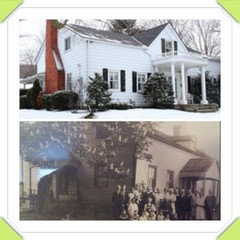

Theresa Joy
Original Author13 years agoRegarding my question about the difference between vinyl and reproduction wood bay windows I meant ... difference in price $$ ..- 13 years agoTJ - rebuilding your own wood windows will cost about 1.5 - 2 x vinyl, but they will have better thermal properties and you will have complete control over your grille / muntin patterns which you will not have with vinyl. In fact, I'm not sure you can buy period You can have simulated divided lights and easy clean swing out built in. Cost of energy savings in the home will pay for the better windows in about 10 years.
The details he may be referring to regarding the victorian box window style might more properly be called edwardian for your house - you will want to consult a historic architect but the gist may simply be that the exterior detailing is period appropriate and integrated. Bays in this mode often were 2 wide in the center bay, and some of the edwardian period were made with 90 degree corners, where they typically carried down to the floor on the exterior / interior rather than only at the window opening.  13 years agoGood for you to get to meet a member of the original family owners!!! I love this site! Thanks for sharing your old-house journey!
- 13 years agoI'm so glad you're having a wonderful experience and loving your house. But I'm also super, super glad that your French doors are 99% go, go, go!!! The house is going to turn out beautifully and I love the boxwood, classic look. As is the hydrangea. I'll keep checking back on this thread as you go along, can't wait to see your progress. :)
- 13 years agoTheresa you can use the search in Photos on Houzz to see 100s of Victorian bay windows
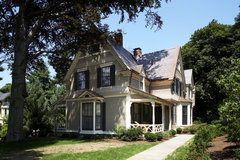 Historic Victorian Exterior · More Info
The row houses of San Francisco are replete with them
https://www.houzz.com/photos/21-house-victorian-exterior-san-francisco-phvw-vp~60645
@libradesigneye dealt with the costs & merits of wood versus vinyl and spoke of "control" over the visual appearance of the wood - vinyl will always look like vinyl and as you spend 10000s on your home this is a couple of thousand more that you will see daily (1400+ per simple window)
With respect to asbestos - if you have square tiles on the kitchen floor (think 1950s) they contain asbestos but note: 'When left intact and undisturbed, asbestos containing materials do not pose a health risk to people working or living in buildings. Asbestos containing material is not generally considered to be harmful unless it is releasing dust or fibers into the air where they can be inhaled or ingested"
Pre 1980 it had many construction uses:
http://www.hiddenkiller.ca/where-is-it-found.asp
I love hydrangeas but although I am buying them marked for my zone they still die: look for ones which are hardier. I'm in Zone 5b you're in 6B - 13 years agoI had 9-inch tile in my kitchen. That's a good sign of asbestos, so I was planning on laying linoleum over it. Marmoleum is great stuff. However, I was pulling up some shoe molding, and up came a tile ... and another ... and another. I found that all the tiles came off the floor intact. At some point, the mastic had failed and was no longer holding down the tile. Problem solved.
Now, the mastic used with this tile may also contain asbestos, so I put on my respirator, got a spray bottle full of water, readied my hepa vacuum and went to town wet-scraping with a cabinet scraper. Wasn't difficult to get right down to the wood. (It took a couple of days, though.) Now I have a beautiful maple floor.
Would I recommend this to anyone? No. If your mastic is intact and holding the tiles, don't try it. Find some flooring solution to put over it. I've heard of people using a Speedheater to loosen the mastic to pull up the tile, but I wouldn't try that. (Okay, I did try it on one tile in my pantry, where the mastic is holding firm. I go the tile up intact, but I could see that all the mastic was going to be hard to get off the hardwood and would have to be sanded off, creating dust.)
Finally, in another part of the house we had a small room with the same tile. I did not instruct my floor contractors to touch it, but to my surprise they did. (They're Polish, and our communication wasn't great.) They redid the oak floor beneath. I was pleased, but ... NOT best practices. - 13 years ago@cazenov1a you lead a charmed existence - the issue of laying over old tile is that the glue does cease to hold and lines and lumps appear on the new flooring
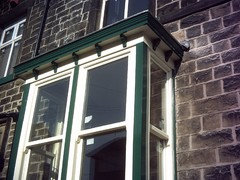
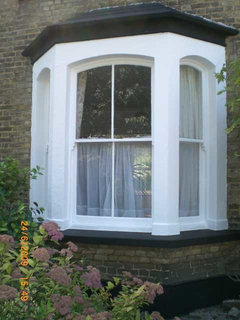
 13 years agoHere are some pics of Victorian style bay windows. For your house, I would keep it simple, but perhaps some restrained details, like a bit of beading in the corner and a thicker than normal cornice. 1850 is right when Italianate architecture and bay windows were popular, and a simplified version could work. The French doors could have a panel on the bottom to match the detailing, like the original French doors that looked like windows.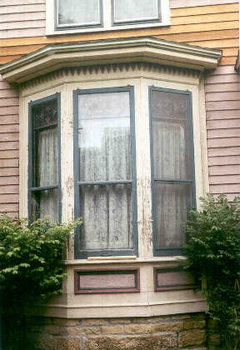
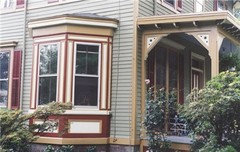
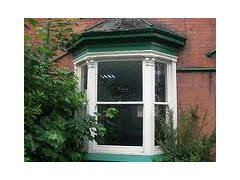
- 13 years agoOf course I would keep the paint subdued, although a bit of color on the sash might be nice. Blue isn't a historic color BTW because it tended to fade. Olive, grey, tan, brown, and green were common. Gray could look nice with blue shutters, and I think it would be fine to only paint the bottom wood windows.
I also think fiberglass could be an alternative to wood for the new windows, if you can find a profile that is similar to the old windows, and the board approves. They are a lot heftier looking than vinyl, and fiberglass has a similar expansion/contraction ratio as glass, so the seals should last better than vinyl, and fiberglass can be painted.
Also, old bay windows were constructed of separate windows for each face, rather than as a single unit as in modern windows. The cost is higher, but it would allow for max customization to make the size and detailing look right with the rest of the house. Transoms on the top could be an option, with 2-over-2 below, for a more late Victorian look.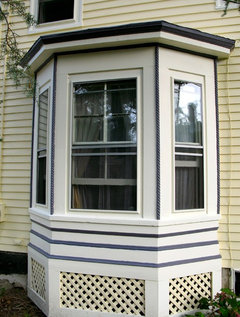
- 13 years agolast modified: 13 years agoTheresa - another couple of hints for you, if there are any outbuildings left on the property. Often home-owners would recycle bits of lumber from one bit of the house, say a collapsing porch, or window trim, to patch up another. Those "scraps" are VERY useful when it comes to restoring your house, so don't chuck out anything you find. Another fun place to look if you have an excavator in to do groundwork is the soil where the outhouse(s) sat - coins and rings might fall from people's pockets, and NO-ONE wanted to go diving in after them. Less icky to have a quick hole or two dug by a friendly excavator driver. You sometimes often find all manner of antique junk lurking under floorboards, or tucked between the basement beams and the floor above.
Lovely that you've found a heritage contractor that seems to be on your side, however, it never hurts to get comparable quotes from other contractors as you work your way through your renovations, just to keep the $$$ in perspective. "Heritage" doesn't always equate to competent or reliable, and does often mean higher rates, whereas many general contractors are also very good indeed with old buildings, and love a little change from boring old 2x4 construction.  13 years agoLove your old home! After reading the entire post, I feel certain you will do it justice. Can't wait to see the progression!
 PRO13 years agoI LOVE the look of your new home, as far as the windows go, I think that double hung windows would look the best, however you could look at getting casements with some grids which might also look really nice.
- 13 years ago@Theresa! Way to go! I am going to keep following this thread because there are great suggestions, and after a year now, I am not moved in yet either. But they are all right, do it the best you can now while it is empty.I am scared of expensive re-do's. Let me know how the boxwood turns out. My yard in Vermont is SAD, and I am looking at cold weather shrubs, and Roses, Maybe?
- 13 years ago@cazenova1a..asbestos. I have a wood floor painted with chipped lead paint. Ugly and expensive to strip. What do you think if I mopped, vacuumed and mopped again, then sanded a bit to rough it up with a mop-sized buffer, mopped and vacummed again, then sealed it with floor sealer? Wearing a mask, of course, and gloves.anything would look better..if I repainted it, it would have to be sanded smooth,thanks!
- 13 years ago@vixenhouse - why don't you start this as your own discussion; I'd loved to see the thread from it
Pictures would definitely help - 13 years ago@vixenhouse: No way I'm gonna go out on a limb on that one. I'm not afraid of asbestos, but I am afraid of lead, especially on a friction surface. And I'm not a pro -- just a DIYer who's done a few things. Is pulling up the boards and reflooring an option?
- 13 years agothanks..that is what my family said too. thought I might just do it and not tell them. Maybe just a good mopping and a nice rug.
- 13 years agoI think stripping may be your best option. Sanding lead paint is a definite no-no and last resort, especially with an electric sander. Misting the surface and a bit of light hand sanding can be OK with precautions.
I spent a whole summer stripping a stairwell a little at a time with many layer of failing paint. They painted latex over old oil enamel and it was peeling and terrible, and the original finish was grained to look like oak.. I did finally do some light sanding on my stairwell to prep for new paint, but I isolated the entire thing with plastic well taped in place all the way up to the ceiling, wore old clothes and a ventilator and kept my son out of the house the whole day. I let the dust settle a bit after sanding, while getting some fresh air outside, vacuumed what I could while wearing the mask, washed all the surfaces down and dumped everything including all my clothes, into a contractor's bag when I was finished, and took a long shower, then a bath, to soak everything out. This was for an empty apartment, so the dust didn't get in furniture, etc.. Even with precautions, I had a metallic taste in my mouth.
http://hardwoodfloorsmag.com/articles/article.aspx?articleid=479&zoneid=6
http://www.heightslibrary.org/materials/hrrc/08-Hazards-Lead/LEAD_CONTROL_INSIDE.pdf
If you plan on repainting, you just need a stable surface, not a completely stripped one. You could chip off the bad areas and fill in the depressions or leave as is, give the whole works a good scrub with a degreaser, like TSP or Spic and Span, and paint a distressed finish. Coat the whole floor with a heavy coat of primer and then several coats of other colors with a light sanding to only the primer (tint it a different color than the original floor) and then coat the whole thing with poly. Can look pretty neat actually.
http://www.ehow.com/how_5636688_paint-distressed-wood-floors.html
If you look in the advertisements in Old House Journal, there is a new stripper that actually neutralizes the lead that might work for you, and I think a lot of the soy and orange strippers can be allowed to settle and be reused. They are expensive, so it depends on how much you want to strip. Infared strippers work well on flat surfaces, but are rather pricey, about $500. Heat gun could work, but will take a while for a whole floor. You might want to get some samples of different products to try them out before going whole hog.
Steam can be used if you construct a box out of foil covered board insulation to confine a flat area, although it tends to raise the grain. But steam is cheap, doesn't create a lot of toxic goo, and the moisture keeps the dust down. This is a nice video of how to strip a door with steam--you see it goes pretty fast once the paint is loosened. A similar technique could be used for a floor.
Other paint removal videos are available too. A paint scraper, like the type normally used for siding, attached to a shop vac could work too. - 13 years agoWow! Thanks, victorianbungalowranch.. You did a lot of research on this. I appreciate all the info. And will look at these options.
- 13 years agoI own two old houses and it is sort of a hobby to figure out what to do with them and share with others.
- PRO13 years agoAnyone looking to remove lead paint in the US should be aware that the EPA regulates professionals on the issue and any contractor removing lead paint or working on a home that was built before 1978 where paint is expected to be disturbed (includes, ESP. sanding it) needs to be EPA certified for lead removal or abatement.
If you DIY lead removal as a homeowner, I'd strongly encourage you to review the EPA guidelines for safe removal at http://www2.epa.gov/lead - 13 years agolast modified: 13 years agoYes, Thanks. I had to have a team in to hand scrape and collect all the debris..on a three story house and carriage house. It was very expensive! Theresa Joy may face this same dilemma..I would imagine Canadian restrictions are similar.
Theresa Joy
Original Author13 years ago@prt13 I finally had a chance to see the link you sent me .. 'Remembering The Corman House" couldn't open it on my iphone, drove me nuts :) ... that is so neat! I wonder if the drawing there is of the original home?? I love the window above the front door .. something to think about for the future ...- 13 years agolast modified: 13 years agoTheresa in that same newsletter there is an email address archives@stoneycreekhistorical & a page for membership application $18 per family $10 single. Personally I would send them an email expressing your desire to respect this historic home and asking if you could meet with someone to look at all documentation and pictures they may have. I'd have the $18 in hand when I went.
Perhaps you could scan the floorplan from your real-estate documents - I've ever so curious :-) - 12 years agoJust bumping out of curiosity, and wondering how - or if (!) - your renovations proceeded, Theresa Joy?
 11 years agolast modified: 11 years agoI just read through this entire post! Loving all the old house knowledge! As the owner of a 100 yo home myself, I have also done a ton of research.
I have done restoration on several sets of sash. One of the best pieces of advice I got was to use Sarco Type-M rather than Dap-33. Tried the Dap & after 2 weeks it still had not set.
I was contacted by a woman who does nothing but historical sash restoration for a living. She mailed me some of the sarco & it's great stuff!
After removing all paint & shellac from my frames, I like to give them a coat of a linseed/turpentine mix. (50/50) Rehydrates the wood & the turp assists in dry time & helping the oil to soak in.
I lay a bead of the Sarco in the rabbet & carefully lay the window inside. Next, I take my palm sander & with a thick rag underneath, I run the sander into all the corners of the glass. This sets the glass into the bed of putty.
Trick to assist with the diamond points: I take a sharp, pointy steak knife & slide it into the wood, push the point into that, the carefully take a pair of 90 deg angled needle nose pliers & push on the diamond point...seating it into the wood until it's no longer visible from the underside of the frame.
Yes, this can be tricky, but I have never broken a single pane doing this. When the wood has been treated with the linseed oil, it's softer (until it fully soaks in) & makes seating those points very easy.
I then follow up by adding the putty to the rabbet over the glass.
Here are before & after pics of my first sash. I was a TOTAL novice & it came out great!!
That is the same view of the same window. Pay no mind to the green & yellow paint. Playing with color possibilities & they both lost! haha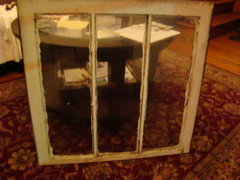
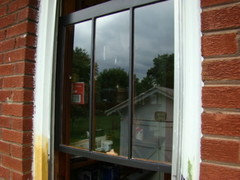
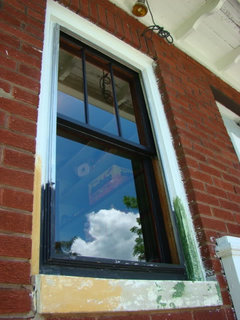
- 11 years agoWow. Beautiful job. I want to paint the windows of our other place black, the delicate mullions/ muntins. We haven't been out to our east coast house in three years, which keeps me from sleeping. Here in Ontario, our little stone house keeps us busy with it's needs. I've "oldified" the replacement windows here, but the house out east has truly old windows, (which seem to have been a target for shooting.) The glass in the old frames is really wavy, and there are some bullseye panes. We're hoping to get out there soon, to add some roofing and stave off winter's harsh touch. Some days I feel way too old for any of this.
- 11 years agoThanks for the props! :0) It has been a long process. My windows had this (pic) weatherstripping all the way around, rather than just at the top & bottom.
It was really difficult working around those channeled strips, so I went to Killians site & got the springbronze 1 1/4"
http://www.kilianhardware.com/114x100sprin.html
I can easily cut the nail heads off the existing channeled stuff & put in the other. It's impossible to remove the sash without buggering up the channeled stuff!
@malhotte...where on the East coast is your place? My friend, the resto expert is in Hawley, Mass.
Here's where she works: http://www.heartwoodrestoration.com/
Hit the "contact" tab & drop an email to Jade if you want. She would rather teach homeowners how to restore for practically nothing, than to think they might replace with vinyl!
I learned everything I needed to know from her. Her momma named her right, because Jade is a GEM!! :0)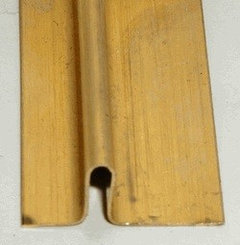
- 11 years ago
From your description, you definitely need new windows! Since so much needs to be done, have you considered double windows where you now have single windows? The windows you now have are a good distance from the floor, and perhaps it is the extra width, not length, that would bring in more light. Would it be possible to have double windows on the sides of the house and also shutters so that the look would be uniform? I would caution you about dormers as they can be susceptible to leaks. Would a large bump-out dormer across the back work for you?
I would suggest window boxes that are on some sort of panel so that they are mounted well below the bottom of the shutters. The idea is that the shutters could be opened/closed without touching/brushing the plants in the window boxes. I can understand your feeling about aluminum siding, but it can serve you well for years. Perhaps in time you can have real wood or cement board siding that simulates wood grain and paint it white. Instead of a red door, you might choose a color you use as an accent in the interior of the house. For instance, if you have medium blue, then use medium blue for the door and then a very light blue for the porch ceiling. You are so fortunate to have such a beautiful home.
- 11 years ago
Regarding the evergreen trees that block the windows, I hope you will be able to relocate them. Such trees look nice along the side or back border of a property and can be incorporated into a park-like setting with a park bench, bird bath, and flower bed nearby. Your house is so charming, and it has many possibilities, even with all the historic requirements and restrictions.











colonialgp