Software
Houzz Logo Print
regularusersept17

Advice for pond newbie?

9 years ago

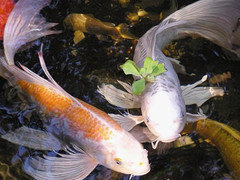
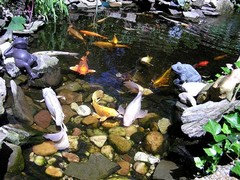
Pond will be about 670 gallons (six feet square times about 2.5 feet deep); I wish I could make it bigger but size is constrained. It will be in a semi-tropical area like Louisiana. What plants should I put in it? Should I add a water pump? We wish to add goldfish in it, which I think will survive even water that's not circulating (not sure) but I believe circulating water will cut down on algae. What kind of pump for outdoors? I believe DC motor pumps and a 12V DC circuit is the safest, agree? Any algae eaters to recommend? I think the pond, being constructed, will be all concrete, so should we add soil and what aquatic plants? Naturally water lilies are nice but I'm thinking maybe a plant that does not block views so much from the top. I like frogs, turtles and the like and I assume they will naturally gravitate to this water, as well as an occasional snake I'm sure. Hopefully not an alligator though ;-)

Comments (32)

  • 9 years ago
    last modified: 9 years ago

    Since thats about exactly size of my pond, I can be pretty precise - I use a Biosteps filtration box + 1000 gph Aquascape solids handling pump has been working pretty good for me (I use fine mesh filter pads at times in the Biosteps to filter out debris). If you get a lot of leaves/tree debris you may want to use a skimmer with pump in addition or instead of the solids handling pump on the bottom of pond. (I just net out the leaves daily - not that big a chore.)

    Water quality - test it till you know your nitrification cycle is established. You dont want pea soup algae but if you have fish, string or carpet algae is your friend. The fish eat at it and it uses the excess nitrate caused by fish poop. Any excess can easily be pulled out and added to compost.

    As a newbie I would either decide between fish or plants (the fish tend to eat plant roots and rip them up) .... OR design pond in such a way that there is an upper chamber where plants go and then space below for the fish. Yeah I know some people combine both - theres no one best way of ponding, so youll have to ask them how it works.

    No more than 1 goldfish per 70 or 80 gals - they get large and are eating & pooping machines. You could probably do OK with 1 per 50, but what's the point of that. - just more poop to contend with and 7-9 fish is a large enough herd. You dont want them to merely survive, you want them to thrive and be happy and grow large. Overcrowding invariably results in diseased or dying fish, and there's no joy in that.

    DONT put dirt in the pond (yuck!!) and be sure concrete has aged enough before youput fish in, or better yet install a epdm liner or do the spray-on thing.

  • 9 years ago

    Goldfish are hardy. They will survive well without circulation; I know because I have two ponds; one without and one with circulation. I am in zone 7 so I really can't help much with your zone. I can point out that you actually DO want some surface coverage, both to shade the pond from excessive sun and to hide fish from at least some predators. I agree with Current Resident about the value of string algae. However, my goldfish don't seem to eat plant roots. I have certainly read many comments here about Koi eating roots and causing severe damage but not heard any complaints about goldfish. Perhaps C.R. has extra tasty plants.

    The sound of falling water is a very nice feature and it would be better to have the circulation; just not necessary. I have never heard of anyone having safety issues with line voltage pumps. I assume 12 or 24 Volt pumps are more expensive. I would suggest a 120 volt mag drive pump. They draw significantly less current than a regular pump. They Are a little more expensive, but should save money in a year or two considering these pumps are usually left running.

  • 9 years ago

    It has been our experience that you need about 70 percent of the surface shaded with either plants, trees (not recommended because of leaf fall) or a site built shade of some sort of combination to prevent extreme algae bloom in spring and summer (pea soup green).

    120 volt mag drive pump is the way to go. They are pretty tough and reliable and they will last for several years. Just keep the pre filter fairly clean and the worst you will have to do is replace a $10 - $12 impeller every couple of years. We have 3 of them that have run 24/7/365 for many years.

  • 9 years ago

    ccecilm just said mag drive pumps 'will last for several years' that suggests a Short Life, but then says that their own pumps lasted 'many' years. I think you should expect a good pump to last the longer period. My Laguna mag drive pump has run continuously for 9+ years. I have no reason to believe it is especially good. I do know that within a year or two, that little vine like plants and other crud will get tangled in the impeller and the flow will stop. I have never had the impeller break and the jammed impeller does not seem to do any damage to the pump. Mine is reasonably easy to clean.

  • 9 years ago

    Pondmaster pumps (and I spoze some of the others) have impellers and parts that are easily available at reasonable cost - easy to unscrew and replace these. I finally gave away my original 300 gph pump recently after nearly 17 years just because it had gotten too noisy. Sounded like a blender.

  • 9 years ago

    We decided to get a friend who builds aquariums to design it. I think they'll put in a AC water pump for a small waterfall and koi rather than goldfish, as well as outdoor lights underwater, which I'm not too keen on, more things that can go wrong. I wonder how a plant can survive if no dirt at the bottom of the pond, but I guess there are aquatic plants that don't need dirt. I will check again this thread in about a week. Thanks to all the comments so far.

  • 9 years ago

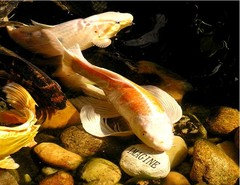
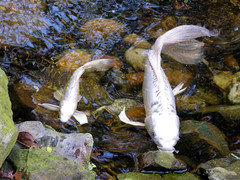
    A koi pond is a different category of effort and maintenance than a goldfish pond or water garden. Before your friend sets you up with koi as a newbie, be sure you're ready to keep them healthy.

    Koi are carp, and are more delicate and demanding than goldfish. A popular rule of thumb is one koi per 100 gallons, at least 4 feet deep, with both biological and mechanical filtration. Peruse the newbie threads over at Koiphen for an expert's perspective: http://www.koiphen.com/forums/forumdisplay.php?273-Beginners-Guide-To-Ponding-and-Forum-Useage

    If you decide to go with koi, I recommend starting with goldfish for the first year anyway, to get the hang of maintaining the pond with a lower biological load. There are gorgeous and showy goldfish that are very satisfying. Good luck!

    User September17 thanked oscarmatic
  • 9 years ago

    Sorry Oscar, just saw your post - are you sure you are not missing a zero (1000 vs 100 gals)? 100 seems low - have my goldfish at about 70 gals ea and thats about right. Im sure there are exceptions to the rules, dealers for example typically have very crowded conditions but they use (or should use) specialized set ups to ensure water quality/oxygenation.

    User September17 thanked Debbie Downer
  • 9 years ago

    Re. dirt on bottom of pond and plants: yes, many plants need soil to at least anchor them. However, there is no reason to heave a pile of dirt in there, you put the plants in pots or big pans that contain the 'dirt'; perhaps potting mix but covered with fine gravel or perhaps cat litter to prevent it from floating away. Most plants probably only need to be just under water and wouldn't grow from the bottom anyway although water lilies are an exception and deep is good, but you still put them in a pot or pan.

    User September17 thanked chas045
  • 9 years ago

    Sunday kid in petshop told me people try and buy koi for bowls.

    User September17 thanked nyboy
  • 9 years ago
    last modified: 9 years ago

    I appreciate the replies. Decided to get goldfish not koi, following the rules above, and a mag impeller sump/underwater pump (need 220V for overseas, hard to find in the USA) that will pump about 1000 GPH (I understand you should pump about 1/2 to 1 times your pond volume per hour). Some questions:

    1) If I run the sump pump underwater, I guess I should put a small mesh filter in the inlet (or a mesh bag to enclosed the pump, as sold at HomeDepot), keep it covered with water at all times, and clean the pump as in [1] below every 3 to six months (do you do that?). My question is more for curiosity: how exactly does pond water get oxygen if you run one of these sump pumps? Naturally water will flow at the top of the pond faster, and that fact alone, will by itself draw in more oxygen, but it seems inefficient to run such pumps underwater just to increase circulation? Unless there are benefits besides oxygen to 'flowing water'? Note: if you were making a waterfall out of such a sump pump, which at the moment I am not planning to do, I could easily see how you are increasing oxygen, but just flowing water with no waterfall, not so much. I have seen for sale "air pump" pumps, above ground, for pumping air underwater, but they are expensive and require a waterproof housing built for them. {Update: I guess since we're talking about goldfish, which don't need flowing water or aeration, then flowing water is just for what exactly? Overall pond health? To keep the algae levels lower than in stagnant water?)

    2) mesh screen at the top of the pond to keep the neighborhood cat from hunting the goldfish? Good idea or no? And the occasional heron? I guess you need a transparent mesh and a small door / opening , and how do you fasten the mesh to the pond, using stones I suppose? I think it will look ugly but my wife wants it as she fears predators.

    3) I like frogs, and can I expect some to show up? This area is rice country so lots of water around, I don't think I need to buy frog eggs ;-) "Build it and they will come"?

    4) I will use potted underwater plants as suggested. Any favorites for "Louisiana/Florida" climate?

    5) Goldfish are nice to what other fish (and vice versa)? Should I put "algae eater" fish in the pond? If there's flowing water (see 1) above) then there'll be not so much algae? Then again, there are such things as "algae blooms" in any body of water, even chlorinated pools, so a followup question is how do people deal with excessive algae? Chemicals?

    Thanks, this is quite an active forum I was not expecting so many replies.

    [1] https://www.youtube.com/watch?v=5Mbusn2QUWc  (HOW TO CLEAN A FOUNTAIN PUMP IMPELLER)

  • 9 years ago

    To the algae excess question: I had a major problem with single-celled algae (the stuff that turns all the water green and opaque), and what's working for me is putting in competitors. I introduced water lettuce, water lily, water hyacinth, parrot's feather, anacharis, duckweed, azolla, and string algae to my accidental pond, and the nutrient levels dropped like a rock. It's not being shaded to death (yet), very little of the pond surface is covered; instead the single-celled algae is fighting with the other plants to get enough to eat, and it's losing. String algae in particular is growing fast, but I've got 3 hungry plecostomus and a bunch of snails in there, and they're all growing, and getting hungrier.

    I don't yet know if the plecos will survive the winter; some sources say yes, others no. But for late summer and early fall at least, they seem to ve doing quite well. And while they do battle, the surface plants are slowly spreading, multiplying, so even if the plecos do die off, there won't be nearly so much sunlight access to pour energy into algae growth in thrle future.

    User September17 thanked Jon Biddenback
  • 9 years ago

    I expect that circulation would annoy the heck out of mosquitoes and increase uptake of nutrients in all pond levels or areas for good or ill but not sure it would do much else. I assume that most oxygenation is from a waterfall or fountain. I hadn't realized that you weren't planning one.

    As I have said numerous times, I have a long stream that I believe does most of my filtering from the massive root structures in that stream. I suspect that even a few feet of semi-stream before a waterfall would create some good filtering. Algae collects in those areas and may be removed by hand. The algae collects other crud and the combined crud is removed together; a win win situation.

    User September17 thanked chas045
  • 9 years ago

    My first pond approximated the size that you are planning. It was planted with Pickerel, water lettuce, Parrots Feather, Papyrus, and Water Hyacinths. No soil on the bottom. I used a ceramic potting mix that I can no longer find. I used a submersible Oase pump and a Bio FilterFalls for bio/mechanical filtration.

    User September17 thanked jrb451
  • 9 years ago

    I like predators for mosquito control. I got water tigers, dragonfly nymphs, and backswimmers (none of which I introduced) in my pool-pond, as well as fathead minnows which I did put in on purpose. No mosquito larvae, and not for lack of trying on the mosquitoes' part. I never feed anything in there, all nutrient input is from things falling in on their own, and plants turning sunlight to sugar via photosynthesis. Keeps the predators on the prowl, and the omnivores watching for opportunities.

    User September17 thanked Jon Biddenback
  • 9 years ago

    I think I might do a very small waterfall just for a bit more oxygenation, and the mosquito control (mosquitoes really bother me, since I'm type O blood which I've heard gets irrigated more by mosquito bites). I might try snails for algae control (we never have winter in this part of the world) and there's a complementary fish to goldfish (I forget the name, I'll try and remember to post here again more details in the future).

    Left unanswered is whether people clean their impeller pumps. I suspect it's like oil changes and new cars. I know of people who drive their new car hard, forget to change the oil, and after three or four years just trade in their car for a new one. Same with cleaning one's house when they rent (some people never clean, and just move to a new place). So I guess you can just buy a new pump every three years or so when they wear out from lack of maintenance. They're not that expensive I was pleased to find.

    Thanks to all the replies.

  • 9 years ago

    I am confident that MY mag drive pump will not be damaged by continuing to run while the impeller is jammed up. I assume that it probably applies to all mag drive pumps. I don't know if it applies to regular pumps. With my pump, I clean it out when I finally notice that the pump has stoped pumping water!

  • 9 years ago
    last modified: 9 years ago

    The OASE submersible pumps I've used have all had some type of cowling that filters out larger items that may clog the impellers. Even so, I've had to remove it from time to time and spray the impellers to remove stuff. Also, you could get a pre-filter to fit over your pump's intake to make this task less frequent, if needed at all. Larger pumps are able to pass larger particulates through the pump without the need of a pre filter.

  • 9 years ago

    You made a wise choice no going with koi, because your pond is

    too small. We have koi that are between 17 and 20 years old.

    The last couple of koi we bought was 17 years ago...we currently

    have 16 koi. However, we did see a koi in a pet store that was gorgeous

    several years ago, so we bought it.,, It hid all summer in the corner

    from the other monster koi...so we called her "baby in the corner" :)

    We have a gravity fed system with a bottom drain and an additional

    bio pond located 18 feet from the main pond.

    We use several small pumps, mostly from Harbor Freight purchased

    for 12:00 each. We have larger pumps, but hardly ever use them, we prefer

    a small cascade of small waterfalls around the pond.

    Swimming area is important, we added an additional pond attached to

    the main pond many years ago, the koi thrive on their long daily swims

    all day long.

    Koi are super friendly...we love our little water puppies.

    Caution to the OP...goldfish breed like crazy...don't buy too many.

    A few goldfish will provide you with plenty of fry.

    I highly recommend hyacinth, it helps keeps the pond clear with its

    long flowing roots... we have to raise our hyacinth in the bio pond

    and rotate them back and forth as the large koi devour them.


  • 9 years ago

    Be aware that it is illegal to keep Water Hyacinth in many areas as it is a highly invasive noxious weed. Authorities have spent many millions of dollars trying to eradicate it. They probably wouldn't hesitate recouping some of that money off you if you're found keeping it in a relevant area.

  • 9 years ago

    Yes, I am aware that hyacinth is illegal in some states, thankfully,

    not here. Another wonderful plant that will help keep a pond clear

    is anacharis, again, it's a plant that koi love to eat. But, if you have

    small koi or goldfish Anacharis will work well in your pond. Here,

    we rely on plenty of aeration provided by several small pumps

    that make small waterfalls into the pond, and proper filtration as well.

    Another important factor is exchanging fresh water, we add fresh

    water every day by just running the hose into the water for ten to

    fifteen minutes a day. (Fortunately, we don't have to use de-clor in our

    pond. ) We also have an automatic shut off valve for our hose. We estimate

    by doing this we are exchanging about 30 - 35 percent of the water in our

    pond each week.

    these are our koi that are now 19 years old...they are the mom's

    to many of our other koi.

    The orange koi is the Pop to many of our koi.

    He was our first koi, his name is Sunny and in September he was

    20 years old. He's extremely friendly.


    This is a 4' X 5' shallow beach area we made for feeding our fish,

    as soon as they hear the back door open they flock to the beach.


    our beauty, she's nineteen, and been kissed often.

    This is silver, she's also 19 and next to her is one of her babies.


  • 9 years ago

    Beautiful! Two of my Koi will turn 20 next year.

  • 9 years ago

    JR's, do you hand feed? Our koi go nuts for earth worms. We have a worm

    farm to keep up a good supply of worms. They truly are water pups! :)

  • 9 years ago
    last modified: 9 years ago

    Yes. They'll take food from my hand but they don't like others standing around. I feed Cheerios in the early spring when the waters just beginning to warm.

  • 9 years ago

    I use to feed some Cheerios as they loved them, then I remember

    reading that Cheerios was not good for them? I don't remember why?

    When we raised up fry in fish tanks we fed them chopped clams

    and chopped shrimp.

    Funny you mentioned that they don't like strangers...when others

    stand by the beach or by the little dock they don't come running

    unless they see a family member. It's hilarious that they know us

    by sight. Our koi are top swimmers...they are always visable in the water;

    but if they see a stranger they immediately swim away! I'm surprised that

    they don't bark like a real pup as their running away and looking back. LOL...

    They sure are fun!

  • 9 years ago

    I have a video of this feeding...I'll dig it up.


  • 9 years ago

    I recall reading that Cheerios were good to feed in cooler temps when the bacteria weren't as active in your bio filters and they were easier on digestion (or something along these lines). I only feed the plain ones and only for a few weeks when the fish are beginning to get active after their winter "sleep". I tried posting a video but it wouldn't let me upload the file; only from You Tube.

  • 9 years ago

    Here is the video, hope I remember how to post it.

    Sorry to Sept 17 to hyjack your thread. It's a while since I've

    been able to participate in a pond forum.

    Are you sure you have no room for a koi pond?


  • 9 years ago

    Oh, ok, (we posted at the same time) that makes sense.

    ...another thing that is not good to do is to aggressively clean the pond in early

    spring when the fish are just coming out from their long winters nap

    and they are at their most venerable to disease.

    The pond over the winter was also

    a host to many parasites. We like to build up the koi for a couple of weeks

    before cleaning out all the leaves etc. that gather in the bottom of the

    pond.

    Jrb...can you post from YouTube?


  • 9 years ago
    last modified: 9 years ago

    ... serious top swimmers...guarded by the head of security.

  • 9 years ago

    Nice pond, something to aspire to. I'm pretty sure this first pond is too small for koi, but maybe in the future with a bigger pond. This pond will be in a tropical country outside the USA. We have goldfish already in it, and potted plants. I bought a timer so the waterfall can automatically turn and and off a few hours a day.