Software
Houzz Logo Print
landaumickael

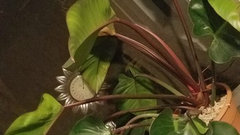
Philodendron red imperial

9 years ago
last modified: 9 years ago
Hello everyone,

Before i started a new thread i did look for a previous one.
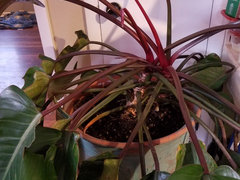
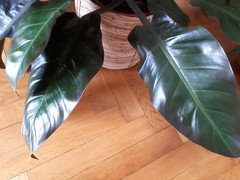
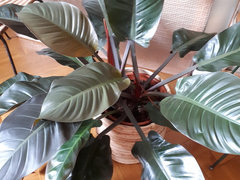
I just picked (around 2 weeks ago) my first philodendron and it happens to be a red imperial.
I never heard philodendron had "anthurium " like flowers (i lost two i guess due to repotting and not knowing it was flowering).

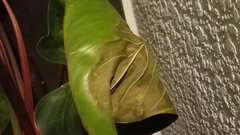
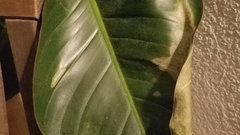
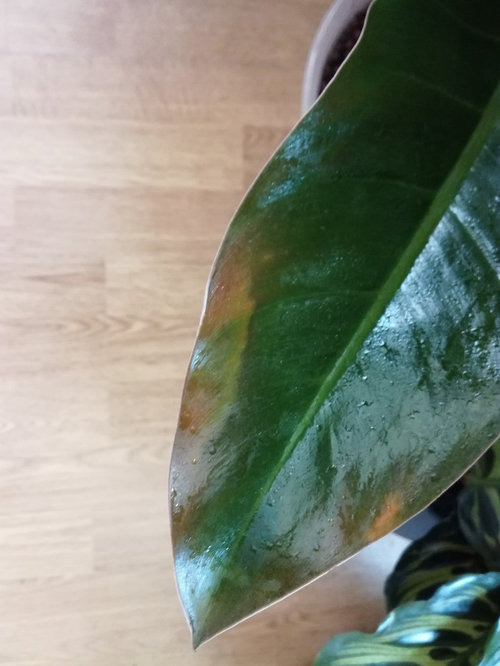
I enjoy the plant and it seems rather ok, until this morning inspection where i spotted something.

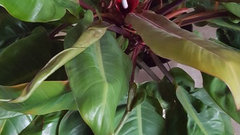
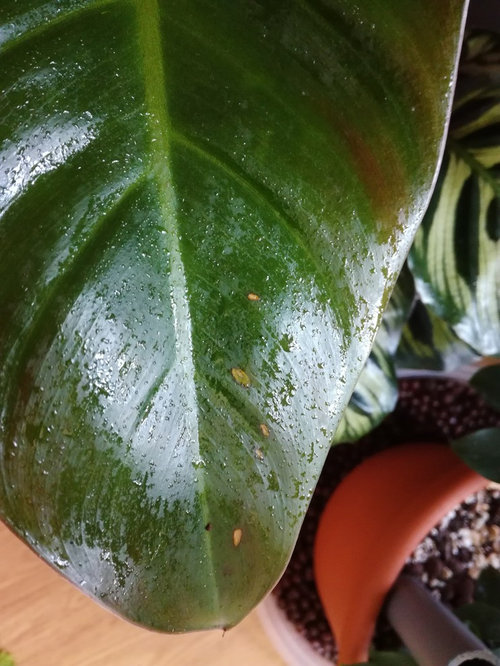
A.Reddish/brownish color on the leave
B.Little spots.

I am wondering if it's due to direct sunlight that touched the leaves or to something else. ( I feel like the soil is still moist but i have no sensor or gauge)

I just mist the plant with and homemade boiled garlic, neem oil, black soap and rainwater also.

I am looking forward to your advice and remarks.

Best to all for this new gardening day. :)

Comments (25)

  • 9 years ago

    Hello everyone, I think it's a little sunburn :). Just for future reference and help on this kind of matters

  • 9 years ago

    Kamiland, it does look like sunburn but could be a few other things. I wouldn't worry about it unless it happens again on another leaf and you know it can't be sunburn. If the area gets bigger just cut the leaf off and see if it develops on other leaves.

    The 'anthurium-like flowers' are typical of all aroids in shape, some are small and plain, others are large, but the anthurium hybrids have the most color with their reds, pinks and oranges. Aroids include philodendrons, dieffenbachias, anthuriums, epipremnums (Pothos types), aglaonemas (Chinese Evergreens), and many others.

    The official name of your philo is Imperial Red, there's also an Imperial Green that doesn't have the dark color or reddish blush of your plant. Your Imperial Red is a very desirable philodendron and is hard to find these days, it was very common in stores 30 to 40 years ago. I'm curious as to where you found it and what state you're in... I have a very large collection of philos but doesn't include Imperial Red at the moment.

    The dark leaves and sunken lateral veins of this philo are beautiful, not many have this coloration. It is a semi-self heading type which means its habit is in-between a true vining type and a self-header which are upright tree-types. It will have a lot of leaves packed on a short stem that will normally curl around and back on itself over time. Once it has a stem of some length and perhaps sprawling more than you'd like, you can cut and pot the tip with 5 or 6 inches of stem. The old base will produce two or three new plants from buds along the stem, and so will be a fuller and more beautiful pot. Tip cuttings will usually have aerial roots attached, so rooting and growing on its own shouldn't be a problem.

    Congrats on the beautiful find.

    Russ

    kamiland land thanked Russ1023 (central Fla)
  • 9 years ago
    last modified: 9 years ago
    I believe I just bought this plant at Lowe's I will send a pic to you Russ, so you can make sure, if you like. It is a little scraggly as it was on the clearance rack. I like it, but thought it was a ti plant or chinese evergeen, possibly (no tag) I knew I had never seen it before. I would be happy to let you have this philo as it's something much more valuable to you than to me. It was abused but not dying. I am sure it can be revived easily, or I would not have brought it home. It is in a 6 inch pot. Only has around 8 leaves, but new growth is plentiful. Glad to send it your way, before it gets too cold here for mail.

    kamiland land thanked Laurie (8A)
  • 9 years ago


    Thank you all for sharing information on this beautiful plant. I have been searching for you the entire weekend! I also purchased one about two years ago from a Lowe's in southeast Texas. It was slow going at first as it would lose so many leaves at the bottom but was constantly adding colorful red leaves at the top. This weekend, I was completely caught off guard when I spotted a reddish flower amidst many new leaves. I had no idea that it would flower like this one day - added bonus! The flower closed on Sunday but is getting larger. Enjoy your Red Imperials!

    kamiland land thanked KLa Bell
  • 9 years ago

    Gorgeous, KLA!

    I do not know how people tell these apart. I have one that looks identical and it's supposed to be 'Black Cardinal.'

  • 9 years ago

    I also believe that it is some kind of sunburn. Just keep watch if it worsens. :) I never found this Philodendron here in Germany until a few weeks ago. It is supposed to be available at Ikea, but no store had this plant. I found mine in my local garden center by surprise, I got it for a bargain, because two leaves were torn. A beautoful plant, isn't it? Good luck and have fun with it. :)

  • 9 years ago

    Hello Russ1023,

    Thank you for your detailed and very informative post.

    I could sense a lot of very passionate yet true informations later confirmed by your mention of philodendron collection. If I knew this beforehand I would have asked you which Philo to get as you really described the features that encouraged my purchase.

    This is my first Philo, and I don't really like the vine type to be frank, so this Red Imperial with its short and compact foliage really works for me.

    I found it in a garden center in France, the equivalent of Green Acres in the states I Reckon, it's a big retailer for garden, classic garden center nothing special, it was pure luck.

    The day before I almost purchased a philo Atom, but i was reading a book and according to this book Philodendrons seem to increase the humidity of the air around them. (I needed that badly).

    So far it seems to be only a sun burn, in few days I will be ordering a moisture sensor on Amazon to get the watering on check also because the leaves turn this way if there is too much water in the soil.


    Good day everyone :).

    This is the end of my gardening day here in this timezone.


  • 9 years ago

    TY, Russ! And how fun that you remember seeing my plant before. I will start another discussion for that. I will leave the comparisons to you since I do not feel qualified. :+)

  • 9 years ago
    last modified: 9 years ago
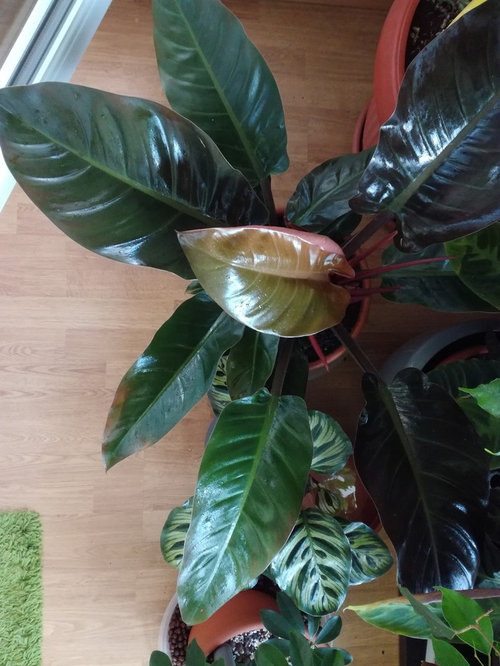
    Hello everyone, I decided to update you with another picture. The spot are appeared elsewhere. I am willing to repot it as I reckon there is not enough drainage In the soil mix. Could it be something else? What would be the pH of the soil mix for reference since I know calathea like slightly acidic soil and fear (with vermiculite)?

    Image 1

    1

    2

    https://imgur.com/DbvveIv


  • 9 years ago

    It looks to me like there is no way to message each other on this forum anymore. Russ, I will post a pic if you are interested. Just let me know. :)

  • 9 years ago
    last modified: 9 years ago

    Hi Laurie,

    I'm interested, you probably need to turn on your messaging but I'm not sure how you do that. You can email me at bluesea14808@yahoo.com, which would be easier. I appreciate you sharing, I look forward to seeing your pic.

    Thanks very much,

    Russ

  • 9 years ago

    Tiffany, you're as qualified as the rest of us!

    Russ

  • 9 years ago

    Hi, I think the spot on the leaves are erwinia virus. I cut them, and repotted in 511 mix. Or is that a lost cause?

  • 9 years ago

    GORGEOUS! Love my Philodendrons! That's a Beauty.

  • 9 years ago

    kamiland, I wouldn't worry too much about the spots. I have hundreds of philodendrons and some have these spots, don't seem to cause any problem other than a minor disfigurement. Repotting might be a good thing, you could see some increase in growth if it was root-bound although this time of year plants normally start slowing down.

    Debra, I love philodendrons too, all kinds, although the large tree-types called meconostigmas being slow and very large aren't as interesting as viners and semi-self headers.

    Russ

  • 8 years ago


    I just got this plant and was told it was an Imperial Red philodendron. I'm just wondering if I need to stake it or let it do whatever it's doing.


  • 8 years ago
    last modified: 8 years ago

    Sheree, your philo looks like Imperial Red, but it is wilting severely based on all the very droopy leaves. When was last time you watered it?

    If you watered recently, let me know and I'll go into possible reasons for the wilting and what you can do about it.

    How long is the stem, from soil line to tip of the stem? You can put it on a short stake, or if the stem is longer than 6 inches you could cut the tip off in the spring and force new growth, making the plant bushier. Root the top in fresh potting mix, fairly easy to do.

    Russ

  • 8 years ago

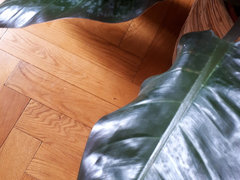
    Hi! My philo gets these faint greyish spots on a couple of older leaves... I wipe them away and they reapear a few days later... fungus or perspiration?

  • 8 years ago

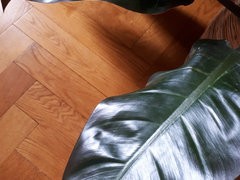
    These are the leaves all cleaned off, more so than the second picture... nothing is apparent. I just need to clean them off with a dry towel

  • 8 years ago

    IDK, Albert, but just had to say your plant is stunning! LOVE!

  • 7 years ago

    Hello! Not sure if this convo is still going but I have the same question about sunburn! My guy got knocked over by a storm so I put him out front to wash off the leaves/pot and literally the next day he had the brown, wilty leaves. It breaks my heart! Is there a way to reverse it??? Other than that he is gorgeous!! And my favorite!!!


  • 7 years ago

    Russ did you delete your comment- I don't see one.

  • 7 years ago

    An excessive photo load (light) excites molecules in the leaf's photosynthetic machinery. As the molecules return to a normal state, an oxidase is produced. An oxidase you'll recognize is H2O2 (hydrogen peroxide). The oxidase oxidizes (literally bleaches) and destroys the green pigment chlorophyll, which initially causes silver to tan discoloration of leaves that progresses to brown or black as the leakage from destroyed cells dries. Leaf temperature plats a part in how serious the sunburn is, and generally the more affected areas are inside of leaf margins; this, because the thicker center of the leaf cannot cool as quickly as thinner leaf margins.

    Al