Software
Houzz Logo Print
cf_carter

Emerald Cedars Browning after 1 month: How to Fix?

8 years ago
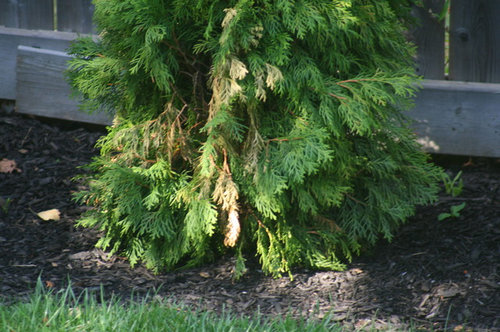
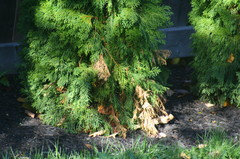
I just planted 14 emerald cedars along our back fence. Our soil is clay, and I didn't dig the holes as large as I probably should have, maybe 50% wider and deeper than the pot they came in. I didn't use any new soil either. After planting I covered the ground in about 4-5 inches of mulch, and watered them every 3 days or so. Not so often now though. Anyway, some of them are getting brown branches on them, and I notice the line of shrubs my neighbour has behind our fence have all turned brown/copper in the past year, so maybe he made the same mistakes, or maybe it's a disease, or just poor clay soil. I was wondering if I should dig them out and make the holes bigger and
add triple mix, or just try fertilizing them with something, or water
them more or less, or what. I hate the idea of digging them up since
its so blasted hot out there and I hate sweating, but I know an ounce of
prevention is worth a pound of cure! So if anyone has advice I
appreciate it, and I'll follow it.


Comments (16)

  • 8 years ago
    last modified: 8 years ago

    One in photo looks kind of flaccid, as though not fully hydrated - check soil moisture inside original soil balls. And definitely do not replace or modify the soil in the holes - you want the same soil texture throughout the planting area, including the planting holes.

    For research based information click on Establishment of Container Grown Plants in the right hand column:

    https://rootmaker.com/knowledge-center

    CF Carter thanked Embothrium
  • 8 years ago

    Hi, thanks for the info! I'm going to go check the moisture now. I read the link you provided too. It says moderate but frequent watering, but I'm not sure how much water to use or how often. I was going out every 3 days or so and watering for about 30 seconds with a spray house on each shrub. Should I be watering less and every day? Or just monitoring the root ball dryness and playing it by ear?

  • 8 years ago

    Poke around and inspect the soil for moisture content visually. 30 second spray won't be adequate.

    CF Carter thanked Embothrium
  • 8 years ago

    And you want to water the soil at the base of the shrub, not the plant, slowly but deeply. Really the only way to know whether they have had enough water is to check out the soil around the root ball and inside the root ball to see if both are moist a few inches down but not soggy. Stick your finger down into the soil.

  • 8 years ago

    Trees and shrubs should be planted no deeper than the top of their natural root ball. Holes should be dug wider but not deeper.

  • 8 years ago

    If the browning is as pictured above, limited to single branches and spotty over the plant, it's likely damage due to handling.


    What you describe from your neighbor is likely from lack of water.


    From what you describe, you did nothing wrong with the planting. Just keep an eye on how much water you need. There is no substitute for poking you fingers into the ground and finding out.

  • 8 years ago

    hide the month ago in the title.. pure evil .. lol ...


    again ... conifers USUALLY dont brown that fast .. in fall .. in my MI anyway ...


    and if it was a full failure of water .. it wouldnt show as one small area on an otherwise green plant ... i cant tell if its flaccid as embo suggests ...


    ken

    CF Carter thanked ken_adrian Adrian MI cold Z5
  • 8 years ago

    CF Carter, consider how many times those plants were loaded, unloaded, spaced an shoved around before they reached you. I think that accounts for the brown on the one plant that you showed us.

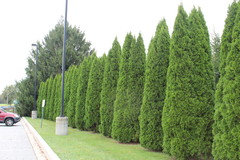
    'Emerald' arborvitae must be considered a resounding success story and I cannot fault them. This pic shows a row planted at a Maryland library. I promise you the contractor rolled them off the truck and plopped them in the ground, no aftercare whatsoever. What aftercare does the OP need? Let's start by what continent are you on? Maybe you can narrow it down just a little bit?

    Whatever snow we have in the midAtlantic has had no effect whatsoever on this selection. AFAIK the greatest threat to them is bagworms. (OP observe the amount of space they require)

    CF Carter thanked sam_md
  • 8 years ago

    Hi everyone, sorry for the slow reply, I assumed I'd get email notifications of new posts on this thread, so I was surprised when I logged back in to give an update and found these. It's nice to know (sam_md) how little these plants need in terms of planting etc to thrive... but at the same time mine are definitely getting worse by the week. But one posted here said it was probably handling since it's restricted to some of the branches near the bottom versus an overall browning. There are some branches that are completely brown now. I checked the moisture both with a finger and a moisture meter. The moisture meter the first time I checked after the original replies last week, it was sort of in the middle near the dryish side. Now the moisture is off the charts since its been raining... It just jumps over to 'wet' on the tester and the needle looks like it'd spin right around if it could.

    So I guess my only question at this point is, should I cut off the dead branches? And should I wrap these up before it starts snowing? It's pretty cold here already. PS: i'm in Southwestern Ontario (Hamilton area), and the tag on the shrubs say Emerald Green Cedar, Thuja Occidentalis 'Smaragd'.


  • 8 years ago

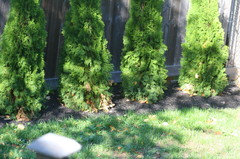
    Hi CF Carter, have you ever noticed what happens to conifers when one side is shaded by a building or a fence? The shaded side becomes thin and unthrifty looking, your plants are too close to the fence.

    And should I wrap these up before it starts snowing? I've never heard of that, is that something you do in Ontario? Why?

    CF Carter thanked sam_md
  • 8 years ago

    It's a bit of an illusion, I took the picture from my upstairs window with a telephoto which compresses things a little. They're actually a few feet from the fence, I can walk along behind them. But there are 13 of them planted so I couldn't move them now if I wanted to. As for wrapping them, some people seem to do it as I see burlap around shrubs in some people's yards, whether it's necessary or not I don't know. I'm guessing from your reply it probably isn't so I won't bother then.. So it sounds then that there is nothing more for me to do, I'll just make sure the ground stays moist and hope for the best.

  • 8 years ago
    last modified: 8 years ago

    Mechanical injury is probably pretty much never the cause of the browning of 'Smaragd' (and not 'Emerald'*) plantings this is asked about repeatedly. Plantings that may start browning out many years after planting - as is often the case in my area of dry summers, where drought injury may sometimes be involved. Or mite damage. Otherwise this selection is unusually prone to root rot for the species. As the reason for the browning may not be apparent - or the same - in every instance those living in the U.S. at least are probably best advised to avail themselves of the services of their nearest U.S.D.A. Cooperative Extension branch office. Good representative samples of affected parts will be needed. As well as an ability to get there during their open hours.

    *Emerald is a translation into English of the Danish word smaragd and not the actual cultivar name

  • 3 years ago

    Oh my goodness you need to water them for 4 minutes each shrub, daily for the first 3 months or so. Or use a soaker for an hour daily. Also use bone meal

  • 3 years ago

    One cannot possibly make blanket statements about watering frequency and duration with any kind of certainty!! Soil conditions and local weather will always be the determining factor. And bone meal does pretty much nothing to assist new plantings.

    btw, this is a 7 year old thread.........

  • 3 years ago

    Hi! Thanks for the comments, I'm the original poster. I did move from that house years ago though..