Software
Houzz Logo Print
kayleighwareham

Wintering questions

9 years ago

I have a few plants that are supposed to be dormant in the winter, I was wondering if they’ll still go dormant if it doesn’t get all that cold?

I also have a grow light to supplement the lack of natural light in the winter but how close is too close to the light and how far is too far? I don’t expect super detailed answers obviously, just a best guess/ generalizations.

Thanks so much!

Comments (30)

  • 9 years ago
    last modified: 9 years ago

    I keep them quite close, just few inches away but make sure they are acclimatized to stronger light. Maybe as close as 3-4"? It also depends on plants, haws, for example, will do good with less light.

    Many succulents are opportunistic, and if given warmth, they will grow. Best is - if possible - to keep them cool and dryer. I would not fertilize them either (but I don't even in summer anyway. My succulents could get some splashing with leftover water (I use collected rainwater - and there is, usually not too much leftover :) with fertilizer in it after watering my veggies. But it usually rains enough for succulents to get moisture they need, and I need to water them very seldom).

    CasualSweater thanked rina_Ontario,Canada 5a
  • 9 years ago

    Couple questions:

    1. What are the plants?
    2. Where are you located?
    3. What lights are you using and how close?

    Photos will help. Broad questions are tough since many succulents can be incredibly different!

    CasualSweater thanked ewwmayo
  • 9 years ago

    1. Mostly a few different mammillarias

    2. Newfoundland, Canada

    3. [Pack of 2] Kyson 3W LED Plant Light,36PCS 3528SMD,20Red/16Blue ,E27 Base Grow Light Lamp for Indoor Plants Vegs Hydroponic System Grow Bloom Flowering AC85-265V https://www.amazon.ca/dp/B01D4PS5IG/ref=cm_sw_r_cp_api_p1C-zbW7YFT7B At least for now

    I don’t really know how close the lights will be yet, I’ve been playing around with the set up too much...

    Since posting this I think I’ve found a place to keep them cold and dark once December comes

  • 9 years ago

    Have to ask, why are you asking about lights if you are planning to overwinter them in a dark cool place? That works well for some plants, btw, but not all succulents..

    CasualSweater thanked breton2
  • 9 years ago

    I didn’t think I had a place to over winter them in cold and dark conditions but I’ve since come up with a few ideas

  • 9 years ago

    At just 3 watts each, the output will be quite low. You will need to put them very close to your cacti.

    CasualSweater thanked ewwmayo
  • 9 years ago

    They actually didn’t even work so I messaged the seller on amazon and am looking at others to get instead

  • 9 years ago
    last modified: 9 years ago

    You could try T5HO or similar. LED probably in range of 30W+.

    CasualSweater thanked ewwmayo
  • 9 years ago

    I’ll keep that in mind when I’m looking! Thanks!

  • 9 years ago

    Sorry to hijack this post, but are there species that specifically need to go dormant in the winter for proper health? I have a broad mix of succulents and cacti that I've recently put under a grow light 16+ hours a day. Good to know a haworthia might not appreciate that.

    CasualSweater thanked Mare TN z7a
  • 9 years ago

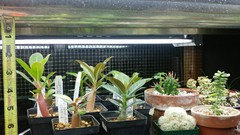
    These are under 54 watt T5HO seem to be doing alright at this height, I do mist often as this setup is in den where wood stove is

    CasualSweater thanked tanpexoctics Willis
  • 9 years ago

    mar9en, I was actually wondering the same things haha

  • 9 years ago

    The plants I've moved under grow lights are not getting any natural light. The lights I have set up so far are this 50W 4000lm 6500K LED floodlight about 8-10 inches away and two of these 23W 6500K CFL light bulbs about 6-8 inches away.

    I'm actually going to set up two of these hanging lights with two of these 4-bulb extenders with the CFLs to hopefully cover a wider area that can encompass all of my succulents and cacti.

    I can post a photo late tonight or tomorrow showing what plants I've got under them and how it looks. The watering has been a challenge -- a bunch of them are also recently repotted and wrinkly, and I'm not sure how long they take to recover. Some are extremely wrinkled and don't seem to respond to water, though I've been trying to refrain to once a week or less. Sometimes I mist the soil around the wrinkliest ones more often out of concern. Will post pics later!

    CasualSweater thanked Mare TN z7a
  • 9 years ago

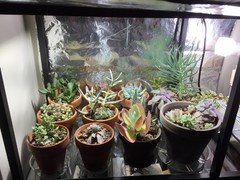
    Better late than never - here's my temporary winter setup:

    This is on one side of an IKEA glass shelf bookcase.

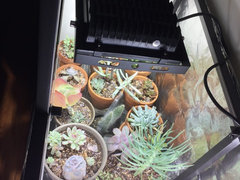
    Here it is from above, showing the LED floodlight (black box) shining down from the glass shelf above. I have two of the CFL bulbs propped up on some books to the side. I plan on clearing off the other end of this shelf and strapping the fixture with all 4 CFLs above it (same height it is now), and put either more plants or my growing cuttings under it.

    The CFLs get a lot warmer than I anticipated (the LED produces no heat on the lit side). I have the shelf semi-enclosed with aluminum-covered cardboard on two sides to reflect more light. I'm hoping with the additional bulbs it doesn't turn into a hot box.

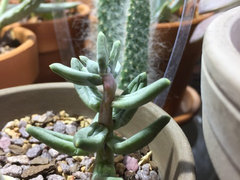
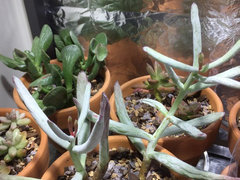
    The watering has been tricky... I have some super-wrinkly plants. :( This P. compactum has been like this for what seems like months (well before it was under this grow light):

    It seems to be doing literally nothing, with no response to watering. This was not a cutting, it had roots. The only change I've seen was the stem pinking up under the grow light.

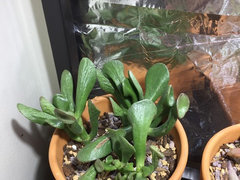
    This Cotyledon had been overwatered at the store, and I was worried it was rotting, so I washed the roots, let dry and replanted without watering for a week or two. It has since gotten very wrinkly, but it's growing:

    It's so leggy that I wonder if it would be better off turning it into cuttings, but I'm not sure how well this plant propagates.

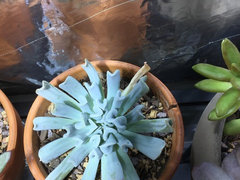
    My Crassula "Ogre Ears" is also shriveled since transplanting, though it too is growing under the light:

    My poor Topsy Turvy, repotted at the same time as the P. compactum months ago, still continues to lose all its biggest leaves. :( It's now a third the size it was. I don't know when or how to help it stabilize.

    I do wonder if I have plants with differing needs combined in the same pot... not these as much, but two other larger pots not pictured. For instance, once pot has a Crassula ovata, Haworthia attenuata, Kalanchoe marnieriana, Kalanchoe tomentosa, Pachysedum "Ganzhou," and an Echeveria...

    Any advice on watering these under the lights would be appreciated!


  • 9 years ago

    Mar9en - Looks like you are using gritty? For the shriveled plants, soak them in a tub or container of water up to the soil line for 5-10 minutes. That will encourage the roots to colonize the entire pot.

  • 9 years ago
    last modified: 9 years ago

    Some of mine did HORRIBLE in the gritty mix....I could never keep up with the watering and even the plants that liked being dry got to dry...Under lights and and in the hot sun on my window sill even in winter especially....You may have to water them a couple times a day before the lights go out if using those and extra heat from them of in a warm room..

  • 9 years ago
    last modified: 9 years ago

    Mike - I have the thermostat set pretty low in my home during the winter to try and optimize growth. Watering gets much better under lights after the plants are well established in gritty. Nowadays my watering cycle is around 7 days for winter.

  • 9 years ago
    last modified: 9 years ago

    Ewwmayo. good job and I love the kind of plants you have...I hate winter though..Ha

    This in particular is a perfect shot!

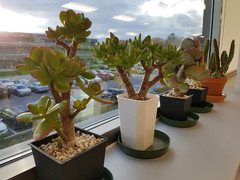
  • 9 years ago

    Thanks! It's nice to finally have a big window at the office. =)

    Yesterday we got a bit of snow. At least I managed to drain the hoses but they are still out on the roof. So cold out today!

  • 9 years ago
    last modified: 9 years ago

    No professional nursery will ever put their cacti in a cold and dark place over winter - they treat them correctly and give them maximum daylight in a greenhouse, heated if necessary. In habitat, desert cacti get full daylight in the winter months - growth slows to zero in the colder and darker days but they are not dormant. Their stomata are open and they continue to photosynthesise, hardening and ripening last year´s growth in preparation for the next season. I even get the odd flower in January, usually a Loph.

    Sure, cacti can survive amazing abuse - they first became popular in Europe in the 17th century because they COULD survive a voyage of several weeks bare rooted in a ship´s hold. But surviving is not the same as thriving.

  • 8 years ago

    Hmm, thanks everyone for the advice about gritty mix. I thought it was actually more water retentive than some of the dryer mixes used for succulents, based on a chart of personal research on water retentiveness of different succulent mixes someone did in this forum. And with people saying they wouldn't water their succulents for 2-3 weeks in the winter, I thought I was doing them good! None of these plants are established in this mix at this point.

    So watering them more often is what will encourage root growth/extension? I thought it would be the opposite...

    If that's the case, I'll soak all my pots with wrinkly plants in water for 5-10 minutes tonight. What about plants that are not wrinkly, just losing their bottom leaves one by one?

  • 8 years ago

    During the winter, it is often safer NOT to water than to do so if one lives in a chilly climate and has the plants on a cool windowsill or in chilly room/basement. Mine go for weeks at a time with no water over the winter. HOWEVER, mine receive no supplemental lighting and the winter sun here is weak and very rarely seen. Allowing my plants to actively grow under such conditions would lead to etiolation, Withholding water -- except for occasional sips -- and keeping them cooler avoids this problem.

  • 8 years ago

    Mar9en - Soaking pots help water get in and right under the plant. Top watering sometimes cannot get enough water deep into the high center area of the root ball, near the base of the plant. This also gets the entire gritty mix thoroughly wet, which encourages roots to colonize the entire pot better.

    Don't water the plants that don't need water? Hard to say what's going on with the ones of yours just losing bottom leaves slowly. Could be a normal growth action or something else.

    The goal of watering is to let the plant roots dry but not have it too dry that the very fine roots (which do the most work in absorbing water) desiccate and die off. If that happens, then the plant will need to grow them back again and it's a lost opportunity for growth.

    I agree with Paul - if you do not have supplemental winter lighting and cool temperatures, then it is safer to water less except for occasional sips. The small amounts of water will ensure the roots don't completely die off, which is a real setback in the spring when you get enough light to start growing properly again.

  • 8 years ago

    Mar9en

    I hope you now realize that gritty mix retains much less water, mostly kept internally and being released slowly to the roots of plants. That is not what happens with soil - it stays wet thoroughly longer, envelops roots and plant ends up with "wet feet". ewwmayo posted very good charts showing water retention of different media (are those charts that you are referring to?).

    If you just repotted plants, they need to get established in new mix and should be watered. And they should not be cold. As already pointed out by several posters, keeping plants dryer during winter works if they are kept cooler. But if they are in warmer environment, they will continue growing (many succulents are opportunistic growers). They need light regardless - meaning that they should not be kept in dark spot - Peter Dennis explained that in his post. If kept warm, they need lots of light since they keep growing.

    Did you check if mix you are using needs watering? Best way is to use bamboo skewer or chopstick - they are 'skinny' and will reach deep into pot. That is where problem often happens - soil stays wet for too long deep inside of container. I would recommend to insert it at least 3/4 deep. Checking just few centimeters on top could be misleading.

  • 8 years ago
    last modified: 8 years ago

    With the plants being in gritty mix and watering them until water runs out the bottom, I thought they were getting thoroughly watered. But I thought they overall liked a dry, airy environment, and no one was watering theirs more than once a week, so I thought this was what they liked. But I guess they need more frequent watering while they're getting established? I'm just learning, but it's become very confusing -- people tend to pot in superdry mixes, water infrequently compared to most plants, warn against any water at all when succulents have been cut or repotted, basically stop watering altogether in the winter... etc. I thought I was overdoing it watering them once a week in gritty mix, since lots of people seem to have even less water-retentive soil and water even less frequently! (rina - yes, those are the charts I'm talking about)

    The environment my plants are in now is warm, no natural light but strong grow lights, and Al's gritty mix. All have been transplanted into gritty mix from their peat-based nursery soil in the past few weeks/months. They get watered more or less once a week by pouring water all over the surface of the mix until water is freely draining out. It seems to drain quite a bit.

    I'll try soaking them all. Thanks for the guidance!

  • 8 years ago

    Pouring water though gritty mix doesn't really ensure all the media is wet, since water flows straight though and capilliary action is much less than in organic media. Watering in gritty takes a bit of getting used to, and plants new to gritty may need some extra water during their transition period. I tend to water from the top mostly but give a good soaking every third watering or so.

  • 8 years ago
    last modified: 8 years ago

    If you are using the 'gritty' mix, I would encourage you to get a sprayer, you know the one gallon kind they use to spray pesticides or so on, use that and fill up with fresh water and spray your mixes so that they get evenly moist and drain through..Never just pour water into that gritty mix or as said above, you will get super dry patches and wet patches within your mix while the roots suffer..Using a mix that gets evenly moist and dries out in a reasonable amount of time, within days not weeks has always been the best for my plants...

    Here you go..I would be lost without this..

    https://www.homedepot.com/p/HDX-1-Gal-Sprayer-1501HDX/207202420?cm_mmc=Shopping%7cBT3%7cG%7c0%7cG-PLA-BT3-HDX-D28I-InsideGarden%7c&gclid=EAIaIQobChMIvNfqhce-1wIVlYuzCh1u6ATmEAQYAyABEgJrf_D_BwE&gclsrc=aw.ds&dclid=CML0hIrHvtcCFdUDNwodeh4MZQ

  • 8 years ago

    Thank you! Would a watering can with a sprinkling nozzle not spread the water well enough? I'm watering these indoors, so I'm not sure about using a forced spray... I do like the periodic soaking idea!

    I haven't seen much improvement in my wrinkly plants after soaking, but I may not have soaked them long enough. I'm going to do it again in a few days for longer this time.

    I've seen a mix of 50% perlite, 50% generic cactus/succulent soil suggested as a good, easy medium. Would this be better than gritty mix?

  • 8 years ago

    No one can really answer that mix ratio Q for you. Every person's conditions can be a bit different so some experimentation will be in order to for you to find the mix that best works for you.

    Btw, wrinkly succs often don't just plump right back up. Often takes several days or even a bit longer to do so.