Software
Houzz Logo Print
evdesert

Best Rye grass fertilizer?

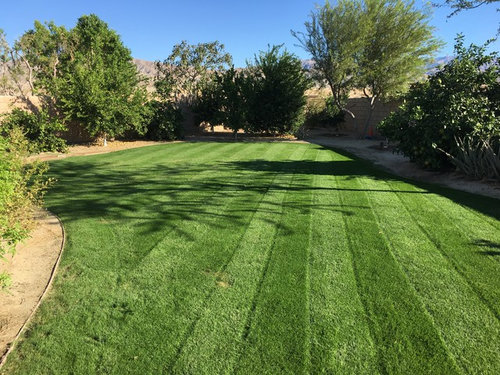
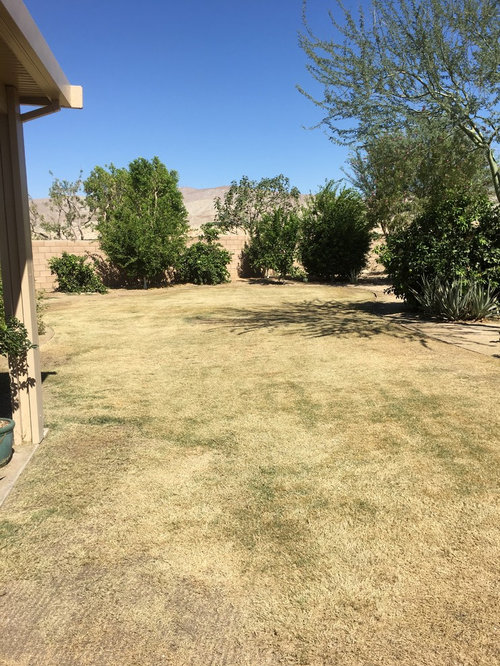
I recently overseeded my summer Bermuda lawn with perennial rye as I do every year. I normally fertilize with Nitra King fertilizer monthly, however, this year has been unseasonably warm so I decided to use 15-15-15 at the suggestion of my local turf management store. Do you think I can use triple 15 all winter and get that dark green look or will I need to use Nitra King for more nitrogen? Here is a before and after pic of my lawn right after it’s first mow.

Before


After


Before


After


Evan


Comments (3)

  • 9 years ago

    Are you in Indio or are you in the mountains above Indio? I'm surprised to see bermuda going into hard dormancy this early in Indio.

    Admittedly the rye looks great. Still, overseeding with rye is hard on the bermuda. In the spring there is a period when the rye is sill growing well, but the bermuda is trying to awaken. I have seen yards where the owners nurtured the rye far too long and the summer grass did not recover at all that year. If I had not seen it I would not have believed it.

    If you really want to know how to tune up your fertilizer, you need a soil test. Look in this forum for topics on soil testing to get an idea about what information you can learn. For example there are soils so rich in calcium or potassium that they will never need more again. I am familiar with the native soil in the Indio area. Unless you had soil hauled in from 100 miles away, your soil is not rich in anything with the possible exception of boron and calcium. I'd get the test and let them help you decide which fertilizer.

    In the mean time, it never hurts to use an organic fertilizer. I like alfalfa pellets (rabbit chow) at 15 pounds per 1,000 square feet. If you have never used an organic fertilizer before, then your soil will greatly appreciate it. I use organic fertilizer exclusively, but once a year is enough to keep your soil fairly happy.

    Out of curiosity, what are your summer and winter watering schedules? How often and for how long do you water?

  • 9 years ago

    Hello dchall, thanks for the reply. I am in Indio, I helped force my Bermuda into dormancy a little by cutting the water mid September. Temps have been in the mid to upper 50’s at night here, I thought that was cool enough to make the Bermuda go dormant.

    If I didn’t have to overseed I wouldn’t, my hoa requires it so I do it, then I can have green grass allllll year, lol. Sorry I’m a little bitter about it because technically we’re still in a drought in our state but because the state lifted restrictions on watering the hoa is back to making everyone have green grass all the time. I’ve been thinking about getting a soils test to see where my nutrient levels (or lack thereof) are at. Maybe this will help me decide to finally do it.

    Thanks for the organic fert suggestion, I will definitely look into that as well.

    I water twice a day for 5 minutes in the summer and once a day for 5 minutes for the rye right now and then I’ll cut that back to 5 minutes once every other day when the weather really cools down.

    I am starting to regret putting down the triple 15, I’m starting to see little burn spots. Glad I didn’t use nitra king that would’ve really fried the grass with these temps we’re having.

    Evan

  • 9 years ago

    Stupid HOA. Thank you for being upset about watering all year long.

    I forgot to give you suggestions for organic fertilizer. Since about 2002 we have been talking about grain based organic fertilizers. If you read the ingredients on many, if not most, organic fertilizers, they used ground up grains as the main ingredient. Grains include soybean meal, wheat flour, corn meal, corn gluten meal, alfalfa meal, and cottonseed meal. Many will add potassium sulfate (I don't know why). Many will also add animal byproducts like feather meal, blood meal, fish meal, and poultry litter. After reading the ingredients I decided to try using just the ingredients themselves. You can get them at your local feed store. These grains will never burn your lawn, so that's a good thing. My favorite, due to universal availability, is alfalfa pellets (rabbit chow). Scatter them by hand and lightly water them. They will swell up from the water and burst. Then just drag a hose or something over them so they fall down through the grass and onto the soil. If you can find corn meal that works and is less expensive than soybean meal. I found soybean meal for $40 for a 40-pound bag in Temecula, but that's a little outrageous to use as fertilizer. Alfalfa pellets should be under $15 for 50 pounds. The app rate is 15 pounds per 1,000. I use a 2-pound coffee can and try to scatter that over roughly 100 square feet (10 feet x 10 feet). That's more like 20 pounds per 1,000, but there's no way to overdose with a grain type organic.

    Now, about watering: Many years ago on this forum I got into a heated discussion about watering with a lawn care provider in Phoenix. My watering philosophy was exactly like yours going into the fight. Water frequently and lightly. I came out convinced that I was bass-awkwards and the lawn pro was correct. Deep and infrequent is the way to go. Your water restrictions may not allow this, but I'm here to say this is the truth. Here's the gist of what he was preaching. I have tuned this up after years of discussions with other lawn gurus and professionals.

    Watering: Deep and infrequent is the mantra for watering. This is for all turf grass all over the place. Deep means 1 inch all at one time. Put some cat food or tuna cans around the yard, and time how long it takes your sprinkler(s) to fill all the cans. Memorize that time. That will be the time you water from now on. My hose, sprinkler and water pressure takes 8 full hours to fill the cans. Your time will likely be less. I like gentle watering. As for watering frequency, that depends on the daytime air temperature. With temps in the 90s, deep water once per week. With temps in the 80s, deep water once every 2 weeks. With temps in the 70s, deep water once every 3 weeks. With temps below 70, deep water once a month. Note that you have to keep up with quickly changing temps in the spring and fall. This deep and infrequent schedule works in Phoenix and in Vermont, so it should work for you. The reason for deep and infrequent is to grow deeper, more drought resistant roots and to allow the soil to dry completely at the surface for several days before watering again. If it rains, reset your calendar to account for the rainfall.

    I have a friend in Phoenix where the weather is about like yours. He has a St Augustine lawn in a yard shaded by sissoo trees. He follows the deep and infrequent plan very closely. When the temps get above 100, he starts watering twice a week on Tuesday and Friday. St Augustine is supposed to be a water hog, but if you want green grass, even bermuda, it needs water every week in the summer. Anyway his lawn looks great all year. For my lawn in the Texas Hill Country, I have only watered maybe 10 times this year so far. We don't get a lot of rain events, but they can come hard when they do. We had 11 inches in one weekend in May and 4 inches one week in September. So it was mostly in July-Mid September that I watered once a week (we can only water on Tuesdays).

    Please read some of the discussions about soil testing in this forum. There is another lawn forum which insists you get your soil test from Logan Labs in Ohio. Gotta admit they are good. The $25 test is all you need. However, the mystic test readers on this forum have other ideas about test labs. In any case, there are no labs in California that have passed the rigors of the internet lawn forums.

Sponsored
Whisler Home Improvement
Average rating: 5 out of 5 stars9 Reviews
Franklin County's Committed Home Improvement Professionals