Software
Houzz Logo Print
travisb88

Gesneriad Society Seeds

Hello,

I was thinking about joining the gesneriad society and ordering some different seeds. Does anyone have any experience with them or growing from seeds?

Thanks!

Comments (38)

  • 8 years ago

    I am the member of G-society since 2005. Love it, I made good friends, it is a bunch of interesting people to associate with.

    The first thing you get - a pack with mixed seeds - they will give you seeds to try and a list of them to try to identify later.

    Yes I started seeds from their seed fund. Sometimes successfully, sometimes not. It is a nature of these minuscule seeds that even when stored in a fridge - with time they lose viability.

    The way how you start them - is sprinkle them on a surface of the premoistened soil, keep them covered with a dome, put them under good light and wait. Fresh seeds hatch immediately, older seeds - take time. Sometimes it takes 6 months, sometimes more if you are stubborn enough to wait. But after a year - it is it.

    Irina


  • 8 years ago

    I have very limited experience with their seeds (and I've been meaning to order some more). I had germination of about half of the species I bought, which is probably about what one might expect. The amount of seeds I received per packet was much less than I've gotten from the Begonia seed fund. I think the range was about 10-30 seeds. If they are viable that's enough for a few plants, of course.

    The big plus is that they have an amazing selection, and prices are good, so even 50% of each species showing at least some germination gives one a lot of nice plants at a reasonable price. The ones I had germination of were Streptocarpus dunnii (but just a couple), Drymonia chiribogana, Columnea purpureovittata and Sinningia helleri. Chances are the seeds of those are still good, as I ordered in May...

    The number of species/hybrids offered from the Gesneriad seed fund exceeds that of the Begonia seed fund by many fold. It's clear the fund is well run and someone is very good at soliciting seed donations.

  • 8 years ago
    last modified: 8 years ago

    Our club planted gesneriad seeds at our last meeting. I ordered species seed while another member ordered hybrid seed from the GS. We then mixed each packet with a small amount of sand in a salt or spice shaker, made up a number of propagating kits, ( I used Wendy's side salad containers), printed pictures of our varieties and then allowed the members to select the ones they wanted and sprinkle over the medium in their kits. It was great fun! We are hoping for many reports of young seedlings at our next meeting!

    Terri

  • 8 years ago

    For project seeds - i think the easiest will be Deinostigma tamiana fresh seeds - they sprout with vengeance. And a very easy plant to grow...

    We had a similar program years ago - and we tried one of the micro Sinningias - pusilla or muscicola..

    Good luck sprouting - can be now - or in 6 months.

  • 8 years ago

    I second the tamiana seeds. I tend to love this little plant.

  • 8 years ago

    Nice--I have a Vietnamese friend who is setting up a terrarium. I'll have to alert her to this plant--she likes plants from Vietnam. I just got Sinningia pusilla seeds from an Ebay source. I was a bit disappointed when it appeared many/most of the seeds were crushed. However, after 13 days I'm already seeing germination--3 so far.

  • 8 years ago

    Sinningia pusilla is quite prolific. You get one or two going - you will have a colony soon.

  • 8 years ago

    Thanks for the feedback! I'll probably give it a shot, I've been wanting to add some unique diversity to my plant collection. I think this will be a fun way.

  • 8 years ago

    Seed them up! Plus no live plants delivery in winter anyway.

  • 8 years ago

    I officially signed up for my membership. It said it may take a few days to get approved esp with the holiday. Do you have any recommendations on soil type or environment to sprout them? I read that African violets need light to sprout. Is that true with other gesneriads?

    Happy Thanksgiving!

  • 8 years ago

    Every single one needs to be on a surface of the soil, exposed to light and in a covered container. I think they are going to send you a pack of mixed seeds with instructions.

    Soil - any good av soil, Promix BX, Fafard with perlite etc.

  • 8 years ago

    Well, I got my packet of TINY seeds planted this week. I'm excited to see how they do! I really want to order more seeds now, but I'm a little overwhelmed with their selection!

  • 8 years ago

    I think it's useful in a situation like this for people to mention which recent seed purchases were viable seeds. That might give some indications of a what's worth trying. It would be sad to spend hours and hours figuring out which seeds might be most interesting, only to find out that many are not viable. I already mentioned what germinated for me.

  • 8 years ago

    I agree that would be very helpful!

  • 8 years ago

    I have a batch of seedlings just transplanted from an August sowing of about a dozen different Gesneriad Society varieties. Total germinated: about 25 plants, overall indicating low viability of seeds (I get fresher seeds to germinate with a vengeance, including Sinningia speciosa seed that's been stored in a fridge for well over a year). Still, the Seed Fund is one of the only ways to get seed of less common gesneriads and is worth supporting.

    Note: avoid avoid avoid most eBay gesneriad seed offerings, especially those from Chinese, Russian and former Soviet republics sellers. The droolworthy color photo collages almost certainly reflect varieties that do not exist, or which you will never get from one of those seed collections.* I got burned just once by a Chinese seller (fortunately for a miniscule amount of money) for seeds that never germinated.


    *my favorite example is an eBay alleged Anthurium seed offer where the seller did a sloppy Photoshop of a spectrum of fantasy lurid colors - where "fantasy" means "I cooked up a fake to lure you in".

  • 8 years ago

    Unfortunately, there are a couple very real problems with compiling a list of "what worked for me" as useful guide to ordering seeds from any such society.

    1. Just because person A had no germination with seeds X, doesn't mean person B will have the same result .... after all, conditions can very from person to person.

    2. There is always the possibility that person A received old seed but by the time person B comes along, the society may have received a fresh batch of that particular seed.

  • 8 years ago

    Of course, things can change. This becomes more likely as more time passes. However some information, especially regarding a recent attempt, is better than none.

    I think it's wise to only publicize what worked, and not what failed, for the reason you give as #1 (and also #2)..

  • 8 years ago

    The Seed Fund ladies - every so often try a small amount of older seeds for germination, so they do not send totally dead seeds.

    You need to sow the seeds as soon as you got it. After they are taken out of the fridge - they prime themselves up to grow... and if not sown immediately - they die. That's what Chinese Botanists told us.

    Make sure they are on a surface of the soil and rewet them every so often with a sprayer. Keep them covered and under a good light.

    My Swedish friend told me that their letters are x-rayed if they come from other countries -and it will kill the seeds. I do not know if it is specifically European treatment - but it can be an issue,

    Gesneriad seeds are only viable for a short time after harvesting unless kept in a fridge. I do not expect the cheap seeds from who knows where to be kept in a fridge. So - it is a crap shoot. and if you are looking at the florist gloxinia seeds in the pretty packages with tons of blossoms on the front - 6 months already passed. They are pretty much dead.

  • 8 years ago

    That's all really great information esp for a newbie like me. Thank you very much!

  • 8 years ago

    Well it's been about a month and wanted to post an update. So far I haven't had any germination. They've been in a warm moist environment under a bright light. Maybe I waited too long before planting? It was about a week from the time I got them and sowed them.

    Travis

  • 8 years ago

    These are the Gesneriad mix, the free packet that comes when one joins the Gesneriad Society? If you've never sown dust-like seeds before, I think it often takes a couple tries before most people get it to work well. It's worth practicing with some dust-like seeds of any plant, not just Gesneriads. But of course it may as well be something interesting. When I give people seeds (often Begonia seeds), I try to give them a bunch of something which is known to be highly viable, so that they can get the technique down.

    The seeds I have right now that I would give people to practice on are Calceolaria mexicana and Trachelium caeruleum 'Hamer Pandora'. Calceolaria mexicana might be interesting in your climate; it reseeds strongly every year for my aunt in St Paul, MN. The seeds are actually from her plants at the moment. There was some preliminary genetic evidence that Calceolarias are closely related to Gesneriads. I don't know if that has held up--my suspicion is no. Perhaps someone knows that story.

    If you are looking for some seeds to practice on, I'd be happy to send those two for postage ($3) as well as any of the following Begonias: B. palmata, B. fusca, B. rubriflora, B. dregei, B. gehrtii, B. boliviensis. I have tested all of those within the last month for viability except B. boliviensis, which is actually the one I have the most of.

    But back to the Gesneriad seeds. I think it is important to sow one or more seeds which are known to be highly viable. Otherwise it can be completely unclear as to whether the seeds or the technique is the problem. This is another reason why it makes sense to be open about which seeds from the seed fund have germinated well. I did not get good germination from the seed mix, and that was in May--I think 2 or 3 seeds grew. I did get good germination from several other seeds which I ordered--I mentioned those before.


  • 8 years ago

    Yeah those were the mix that came with my membership items. The process I used was: I made my soilless mix damp and I put the seeds in a folded piece of paper. I let the seeds fall in the crease and gently tapped on the bottom of the paper to let the seeds fall on the mix. I gave it a couple mists of water and put under a light. I'm not sure if that's the correct way or not? I haven't given up on them yet.

    Thank you for the seed offer! I may take you up on that. I've never thought of planting begonias from seeds before. I do enjoy planting seeds this time of year. It seems to make the winter go by a little faster.

    Travis

  • 8 years ago
    last modified: 8 years ago

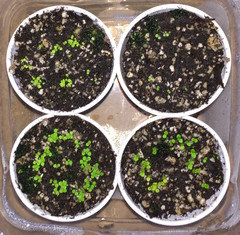
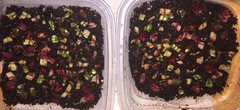
    That certainly sounds like the right way to do it. It could be the seeds that were the problem, although you might expect to see some germination over the next few weeks. The Gesneriad Society sells some amazing seeds; if their sample mix has a problem they need to fix it. As I said, I only got a couple to germinate in May, and the other person I know who planted them this summer only got two seedlings. Begonia seeds and Gesneriads are very similar in terms of size, and the way one germinates them. So growing one is good practice for the other. Here are some I started on December 9th. Clockwise, from upper left: Begonia rubriflora, B. gehrtii, B. dregei, B. fusca.

  • 8 years ago
    last modified: 8 years ago

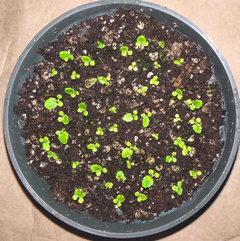
    Notice that there are patches of algae in the pots above. That could doom those seedlings if it grows out of control. So I'll probably keep the humidity slightly lower. Another option is to transplant early, even now. I transplant at all stages, with no problems. If one treats small seedlings with care, it can be done.

    I transplanted Sinningia pusilla seedlings recently at the stage where they just had young cotyledons, without any problems.

  • 8 years ago

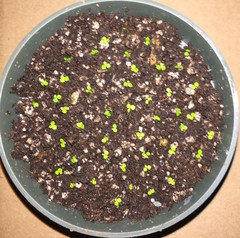
    These could just as easily be Gesneriad seedlings, so I'll follow up. I transplanted the Begonia fusca seedlings (lower left above) to a 4 inch pot, to make 2 points (besides concern about algae). The seedlings (Gesneriads or Begonias) can be transplanted at this stage, and I can follow up in a couple weeks. Also, 48 seedlings in a 3 oz cup is far too many, even though the seeds were distributed reasonably well. They will appreciate a larger pot.


  • 8 years ago

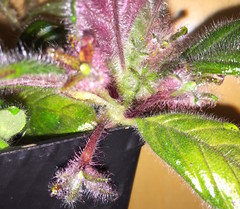
    Travis, if you want Gesneriad seeds, I should have fresh Lysionotus seeds soon (?) and Columnea brenneri seeds in 2-3 months. Below is one of 5 blooming stems of my plants of the Columnea. There appear to be a number of berries forming, with many buds still developing. Each berry has on the order of 200 seeds, I think. So this brings up the other side of the equation, which Irina mentioned earlier--I should consider donating some of these seeds to the Gesneriad Society. My original seeds of this cannot be traced back to the Gesneriad Seed Fund, but to someone's shipment from South America. That's even better, as genetic diversity is a good thing.


  • 8 years ago

    That would be great! When you have some ready let me know. I'd like to give it another try.

  • 8 years ago

    Sorry I must have missed your other posts. I am noticing quite a big of algae forming too. What temps are you keeping them at? Also, are you using anything special for the growing substrate?

    They do have a lot of varieties and I'd like to give it another try, but want to make sure I know what I'm doing first. Do you grow a lot of begonia from seed too?

  • 8 years ago

    The posts were sort of all at once. My temperature right now is a pretty constant 66 F. In the summer it's usually low to mid 70s. I use a mix of peat and perlite, roughly 50:50, for starting seeds, microwaved and of course cooled. When I transplant them, I use a mix that incorporates potting soil as well. So It's maybe 3:3:2 peat:perlite: potting soil, again very rough, nothing measured. The potting soil is a local store brand. I tend to propagate Begonias from leaves more than anything else, but I do propagate a fair amount from seed. There are a few that are best that way, such as Begonia dregei, which is also one of the easier ones from seed in my experience.

  • 8 years ago

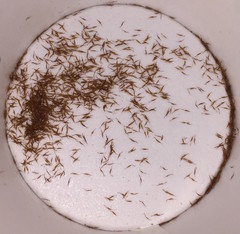
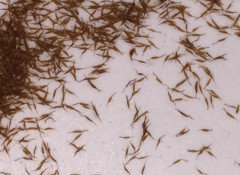
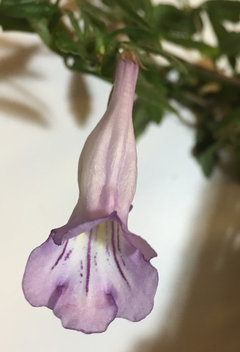
    Here are the Lysionotus pauciflorus seeds, just harvested. Sorry for the duplicate post of this. For scale, they are in a 3 oz paper cup. So this is one where it's a question of what to do with the seeds. I don't need any more Lysionotus plants, let alone hundreds (~1000 is a quick guess). Is it worth sending them to he Gesneriad Society, or should I distribute them "locally."? I guess if they were something less common or in greater numbers I would be more inclined to make a seed donation. I do realize that's faulty logic, as I don't know what they already have. And if the Gesneriad Society turns them into packets of 25 seeds, that's still maybe 40 packs. But first, I should check for viability. They look good...


    And the flower:

  • 8 years ago
    last modified: 8 years ago

    From the Gesneriad Society site:

    You can help by harvesting ripe seeds from your gesneriad plants. Many requests are for seed of common plants, so even a small amount of fresh seed from an old favorite is welcome and appreciated. Each type of seed should be individually wrapped in tissue paper or other thin paper, but not in plastic. Fold the ends and top of the paper over two times and don’t use tape. Place each in a separate envelope with the name of the seed and the date when it was collected. Pre-cleaning the seed is appreciated, but not necessary.

    All seed donations should be sent to:

    Karyn Cichocki
    79 Beaver Run Road
    Lafayette, NJ 07848 USA

    So a reasonable approach might be to keep a couple hundred and send the rest. If I do that, Travis, I should have plenty and hopefully they will be highly viable--and free. Even if this isn't the plant of greatest interest (but Lyisonotus is fun because of its growth habit, especially in a mesh pot)., it's a reasonable one to practice on.

    Here's an image I found online showing the growth habit:

    http://www.gesneriads.info/wp-content/uploads/2015/11/039.jpg

  • 8 years ago

    I'm sure they would appreciate that! Let me know what you decide to do. I would be interested in a few if you have some extra. I did have an unfortunate event and bumped my container I had seeds in. It dumped over. It had a lid, but now all the seeds are mixed in. I'm guessing it's really hopeless now...

  • 8 years ago

    I think most of all they would appreciate people getting in the habit of sending in seeds, no matter what they are. Lysionotus is beautiful, but it's also fairly common. But if one is in the habit, they are already set up to send in the less common ones.

    I have plenty of seeds--I'm about to post on those and other things. I could send a couple things of more dubious viability. One is a tiny number of seeds of Drymonia folsomii. I don't know if this is too big to grow inside--probably. But plants can likely be traded. I have seeds that I got from a friend's trip to Costa Rica in June, which did germinate back then. I have more recent seeds of Sinningia defoliata, which I received in September. I already have plenty of seedlings from those.

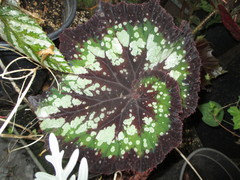
    Your experience with your seedling pot reminds me of what I did to these Begonia 'Tornado' plantlets/leaf pieces. I managed to kick both of these and scramble them:

    I didn't want to sort through everything, so I sent half to a woman in PA. This is 'Tornado':


  • 8 years ago

    I'm sure you're right. The more they can get people participating the better it will be for all the members.

    That's a great looking begonia, I'm sure she's glad you sent it to her!

    Travis

  • 8 years ago

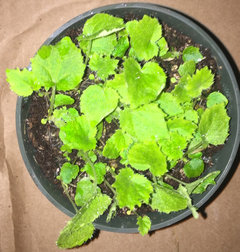
    Just to follow up on my point above that tiny seedlings can transplanted (in this case Begonia fusca seedling, but Begonia seeds are typically even smaller than Gesneriad seedlings). My point was that seedlings don't need to have two true leaves, or two pairs of true leaves, as is often claimed. They can be successfully transplanted at any stage. If the seedlings are crowded, or are in danger due to fungus or algae, it's advantageous to transplant them early.

    The transplanted B. fusca seedlings (see Jan. 5 above for the photo immediately after translating).

    January 13th (8 days post transplanting):


    February 3rd, 4 weeks after transplanting:

    I just gave the seedlings individual pots (I counted 50), so assuming my original count was roughly correct (I counted 48 initially) then I didn't lose any.


  • 8 years ago

    Between Streps and Begonias.... you can as well relocate to the front steps...

  • 8 years ago

    One of the big advantages about my climate is that almost everything can go outside, if things get too crowded. There are only a couple plants it's too cold for, such as Begonia bogneri, and Sinningia pusilla and its hybrids. Begonia brevirimosa is one of the few I take in for the winter--actually it's about the only one. It's ready to go out at this point. We have had an unusually mild winter, and now it's more like April or so, about 70/50.

Sponsored
Franklin County's Heavy Timber Specialists | Best of Houzz 2020!