Software
Houzz Logo Print
janplants12

What's wrong? Please help!

8 years ago
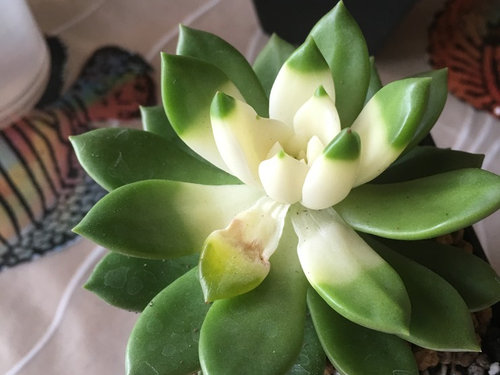
I do not know the ID of this succulent but I'm guessing she's an echeveria? I bought about 1 week ago and since yesterday, I noticed that some of the leaves near the rosette are not doing so well and I don't understand why. It started with 1 leaf yesterday and a 2nd leaf today. The bottom leaves are fine. Has anyone encountered this before and know why?

Comments (13)

  • 8 years ago

    Pardon me, but can I ask about the mix it's in? Or the top dressing, or is there other soil beneath that stuff on top. That looks pretty fast draining to me.

    Are you referring to the shriveling leaf or the whitening center? Which confuses me, that center rosette, almost looks bleached.


    janplants12 thanked Karen S. (7b, NYC)
  • 8 years ago
    last modified: 8 years ago

    I think the dried out leaves. At first when I read this last nite I thought she was asking about the white leaves too, but maybe there's some really white variegated Echeveria I'm not aware of. Which is a total possibility.

    When I read it today I realized it's the wrinkled leaves she's talking about.

    I've bought plants from reputable greenhouses where you would think that the mix is fast draining, but it doesn't. Even looks fast draining, but If I leave the succulents in their mix the roots don't grow as well, and the plant starts looking bad. This has happened a few times. It's strange idk why. A month or so after switching the mix the plant does better. That's why I like to suggest changing the mix. Plus you can inspect The whole plant.

    janplants12 thanked Kara 9b SF Bay Area CA
  • 8 years ago

    hi everyone thanks for the replies! Yes i think this is a variegated echeveria that is white in the centre! It is my first time coming across this beauty too :)

    The younger top leaves have been shrivelling, sorry for not being clear!!

    When I first got her last week, she was sitting in wet soil, so i repotted her immediately. I am using a mix of 40% akadama (which is the top dressing), 30% perlite, 10% pumice, 10% volcanic sand and 10% peat moss. The mix is fast draining and dries out well - I live in Singapore and it's sunny and warm all year round!

    I gave her a little sip of water after 7 days of repotting, and the leaves started to shrivel (as seen in the picture). So I changed the mix again for fear of overwatering but more leaves began to shrivel. I didn't notice any signs of rot or pests, and I find it strange that only the top leaves around the centre of the rosette are affected. It's tough to tell what's wrong at times.

    Just like what you said Kara, perhaps i just have to wait and see!

  • 8 years ago

    Hmm, this variegation looks like chemical treated, not real variegation. From what I've read, the chemical solution is applied to the center of the rosette, and the new growth became white, that's why the variegation looks false, just a circle of variegation in the center of the plant. There are now unscrupulous vendors selling these types of variegated succulents in Asian countries, especially in China, at the moment. My guess is the chemical solution may also have damaged the plant.

    If you can read Chinese, google 多肉出锦药水.

    janplants12 thanked Frank
  • 8 years ago

    Thank you for the information Frank. I did not know that 多肉出锦药水 exists. I am sure this echeveria came from China because I asked the staff at the nursery, so it was probably treated like you said. I just read about it on google, it's terrible! I will be cautious about this from now on.

  • 8 years ago

    Thx Frank for informing us of that, 'cause it absolutely looks artificial (not nature made) to me. I was thinking it looked painted, but couldn't figure out how it was white to start. So bizarre.

    Thx Jan, for explaining abt the mix, but just so you know sand & peat are not good for succulents. I know you're in the tropics, but they may clog up the roots & impede drainage.

    What's the stuff on the very top (is the photo the old mix or the new)?

  • 8 years ago
    last modified: 8 years ago

    You know what Jan you may want to get rid of the sand and peat moss. People do have success with sand so I don't want to talk bad about it, but whenever I have dealt with it it can drain, but stays damp. Peat moss retains water too. There have people who have been on this forum from Singapore and have had major issues with humidity. Pretty much instantly as soon as they get the plant problems occur. I'm not trying to scare you, but just letting you know:).

    I just looked at Singapore's weather forecast. That's exactly what I remembered lots of warmth, humidity, and rain. So just using pumice, perlite, and akadama might be better. Unfortunately this type of thing is trial and error. You're going to have to find what works best, and sometimes that means murdering a few plants;).

    Also try to get terra cotta pots they breathe;), and finding a spot with excellent airflow.

    Watering once a week may be too much because of the humidity. You need to test the mix every time before you water. Use a wooden skewer and dip it all the down the container. If that skewer comes up damp anywhere wait to water.

    Goodluck:).

    Edit: typing the same time as Karen;).

    The person I was thinking about wasn't from Singapore now that I think about it. I believe he was from Vietnam, but I remember the poor guy just was constantly chasing his tail trying to deal with the humidity.

  • 8 years ago

    Frank are Echeverias your fav;)? You seem to know a lot about them.

  • 8 years ago

    Thank you for the tips about the soil mix! I have been quite apprehensive about peat too. I do not use peat for some of my plants which i know do not like too water as i noticed that it is quite water retaining. I've only started this hobby a few months ago and I'm still experimenting on what would work best. So far i've murdered an echeveria and a crassula because I did not repot it after bringing them home and they were just sitting in a pot of peat. I've been learning since then!

    I check the soil with a wooden skewer and the soil usually dries out after 5-7 days depending on how warm it has been. The larger pots will take a longer time to dry out. I keep my succulents outdoors under a sheltered roof so it gets bright light and breeze. Sometimes I bring them indoors when it's raining heavily.

    I have been trying to find terra cotta pots as well! I know they would prefer terra cotta. It's just pretty hard to find ones that are suitable for succulents. I've been on the hunt!

    Karen, the stuff on the top is the new mix. It is akadama, which is clay-like bits of soil that is from Japan. I read that many cacti and succulent growers in Asia use akadama as their main component in potting mix and top dressing as it is fast draining and encourages healthy roots.

  • 8 years ago

    Karen,

    From what I've read and understood, it is using the same principle as growing white asparagus, by preventing the plants from producing chlorophyll (naturally by keeping them out of sunlight), except here they used chemical to destroy the chlorophyll pigments. I hope this practice does not spread worldwide, fingers crossed.


    Kara,

    Yes, you can say Echeverias are my favorite, but due more to circumstances than any other reasons. I would love to grow all types of cacti and succulents, but I only have a small east-facing balcony, so I have restricted myself to just grow Echeverias, and a few other smaller-growing succulents. I'm still learning, but sometimes trying to ID plants help to improve my knowledge, or to test myself, LOL.

  • 8 years ago

    Interesting but strange stuff.

    Jan, I should have qualified about sand, coarse sand is OK, it's fine sand that's problematic. Don't know which you have, but hope your volcanic sand is coarse. Then again, you using small amounts like 10% each hopefully minimizes the risks they bring. I think the Akadama looks great & a mix of largely that sounds good. I'm familiar w/ the clay bits, I use clay balls called Leca stones in several Hydro growing set ups I have.

    It sounds like you're doing everything right, I guess as suggested, you may just have to wait & see. Fingers crossed for ya.

    Yes, it's that perfect circle look to the variegation that's looks artificial and the chemical treatment does sound disturbing.

    Hi Frank, I'm familiar w/the white asparagus which I think they do by covering it. I've heard they sometimes do it to Endive too.

  • 8 years ago

    Thank you, Karen. Yes I am using coarse volcanic sand, it's slightly larger than the perlite i am using. I hope i am doing everything right too, I have been doing a lot of research on succulents and cacti. They are so interesting and I really love them :)