Software
Houzz Logo Print
nhbabs

Plants of winter interest, please

8 years ago
last modified: 8 years ago
Since full-on winter has arrived (snow covering the ground, most likely for the duration), at least in my part of New England, I'd love to have folks take a look outside, either in your own yard or in others' to see what there is of interest. Evergreens, fruit, berries, deciduous plants with ornamental branch structure or color, garden art or structures . . . whatever catches your fancy, either deliberately planted or a serendipitous accident. Words and photos (don't have to be current) are welcome, and if you know plant names, I would love to have them. I would even be happy with links to photos from elsewhere as long as there's a source or credit (I hate that Pinterest doesn't require sources.)

In my own garden I have focused mainly on evergreen foliage and branch color and shape, though this year I hung weather-resistant ornaments on some of my metal trellises as well and I often add a few lights.

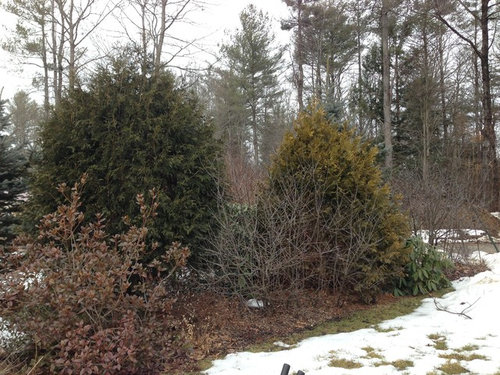
The bed below has two types of arborvitae, Thuja Sunkist (R) and Techny (L) with a couple of Rhododendron Independence Day behind them. Rhodie Olga Mezit (front) has prettier leaves than this brown-toned photo would make it appear, and peaking in from the far right is Fat Albert blue spruce/Picea pungens. I did plan this bed (unlike many of mine) and it has 2-4 of each of these evergreens as well as a couple of Hydrangea paniculata that contribute their tan blossoms to the overall look in winter.

My planters are filled annually with a combinations of evergreen and colored branches over Thanksgiving weekend, this year a combo of white pine, balsam fir, hemlock, red maple stump sprouts (not quite as bright as red-twigged dogwoods, but close) and a couple of little gray birches that needed to be removed before they grew up into the power lines. I haven't taken a photo of them yet.

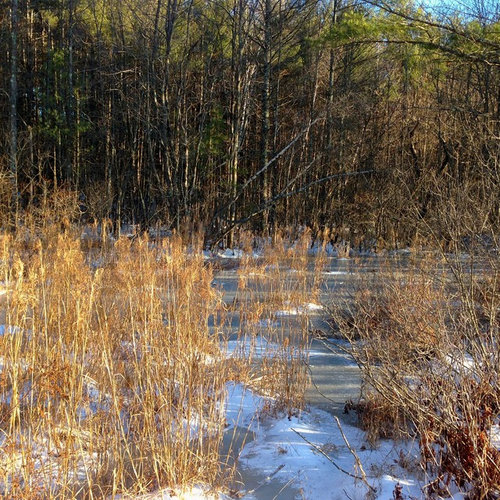
I enjoy the tans of leftover leaves and grasses, both cultivated and wild.

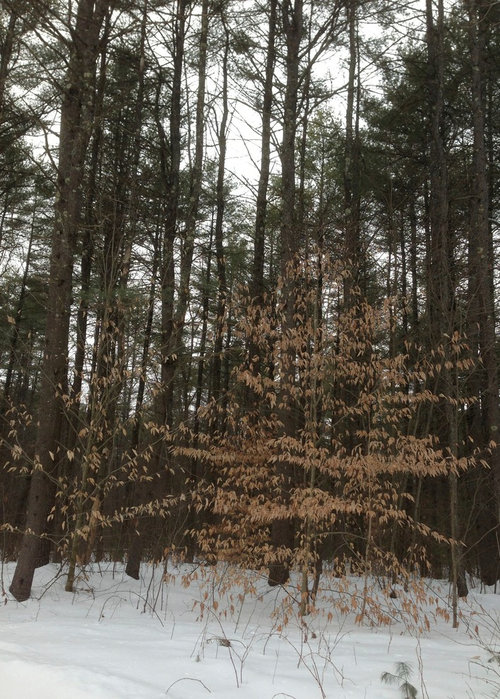
White oak and young beech beech hang on to their leaves all winter, providing a contrast to the stark white and almost black that most of the woods are limited to along with added sound when the wind blows.

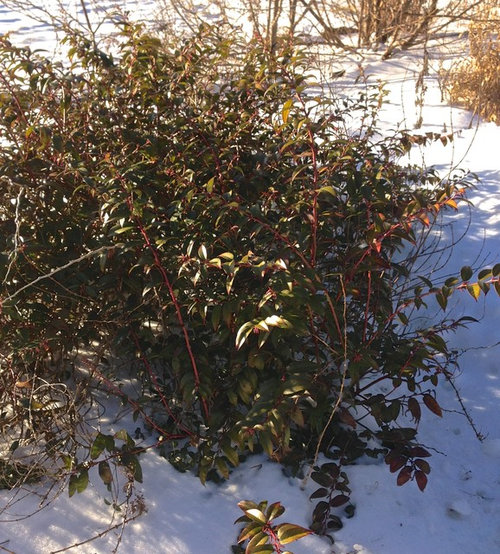
In the garden, Hakone grass ( just visible in the upper right) is strong enough to stand up to the first several snows and provides a good contrast to the red stems and green leaves of a nearby Leucathoe. I need to move both since they are now too exposed and sunny after the maple that shaded them died.

I want to add more berries since they attract the birds, providing us with great entertainment. At a previous house we had a crabapple that provided late winter fruit for grouse, waxwings, and robins, and I miss that acitivity in the garden. So I would particularly love to see some berried plants.

Comments (3)

  • 8 years ago

    For berries, I have a spreading cotoneaster by the walkway but with a lot of snow it is mostly covered and berries aren't visible. One year I saw a family of bluebirds eating the berries. Other years it has been a brazen chipmunk. We have two crabapples in different parts of the yard which I chose for very small fruit. One is a weeping crab and the other has dark leaves.

    At one time I had a viburnum next to the house by the walkway but it kept growing too tall. I had my husband move it and replaced it with a halo dogwood, later decided green leaves with white edges was not a good choice next to a white house. What I don't like is that it doesn't provide places for birds to perch while they wait a turn at the thistle feeders and suet feeder that hand from two garden hooks that get moved from the walkway to prime birdwatching spots in front of our windows. To keep the birds happy, my husband cuts a scraggly pine and sticks it into the ground between the two feeders.

    Christmas interest this year is the big plastic pot next to the front porch steps which now holds pine and hemlock branches plus a trio of red twinkly light branches and brand new lighted plastic candy canes (Ocean State Job Lots). At night the lights are red.

    From north windows we can see a wild winterberry bush at the edge of the woods. I've read that birds don't eat those berries until closer to spring.

    Right now we have juncos at the thistle and suet feeders which surprises us since we have always thought they were ground feeders. Birds are taking shelter in a large rhodie planted against the barn.


    NHBabs z4b-5a NH thanked defrost49
  • 8 years ago

    Ornamental grasses, of course, take over in winter. These are various miscanthus, some bought named, others self-seeded. Juniper 'Grey Owl' anchors the view.

    Pieris japonica is a great precursor to spring with its flower buds ready to go. That's 'Mountain Fire in the front and 'Little Heath behind it, with winterberry above.

    More Pieris:

    Osmanthus 'Goshiki' adds variegated evergreen foliage. The winterberry is still dominating the view but the birds will finish that soon.

    The leaves are best viewed up close:


    Rhododendron 'Anah Kruschke' has flower buds waiting, in between two miscanthus:

    Cones are more obvious now.

    Norway Spruce

    Pinus strobus 'Nivea'

    The little snow we had is gone again, which is common here on the coast in winter, so we don't have that white background to perk things up. That can change in a moment's notice (and often does). Most winters there's bare ground much of the time, but every four or five years we get socked with snow.

    Claire

    NHBabs z4b-5a NH thanked claireplymouth z6b coastal MA
  • 8 years ago

    I forgot the yellow American holly berries:

    Ilex opaca 'Goldie'

    Claire

    NHBabs z4b-5a NH thanked claireplymouth z6b coastal MA