Software
Houzz Logo Print
bleu_maples

Camellia sansaqua going brown

Hi all,

10 days ago, we purchased 6 beautiful, Monrovia grown, flowering sun camellias, in 5-gallon containers, from a very good local nursery (Green Thumb in Mission Viejo, CA). I placed them in their would-be permanent position and they stayed there for a week getting morning sun from about 8:30 - 11:30.

I am new to camellias. When I saw them at the nursery, these plants looked wonderful. Full of blooms and buds. Once at home, I was a bit disappointed to see that the blooms lasted in their beautiful perky shapes only a day; by nighttime, they'd lose their perkiness and look wilted and sad.

Nevertheless, on the eight day, we worked our butts off for 4 hours digging proper holes, enriching our (hard as rock) soil per nursery instructions, filled the holes with water, and called it a day. Next morning we put the camellias in their holes, trying not to disturb their root system. We only loosened the bottom 1", also as per instructions. The roots were in great shape, not bound at all.

Once the plants were in place, we sprinkled the soil acidifier around the drip line, watered and topped with cedar mulch.

The next day the plants already started to look different. The few remaning flowers where now facing down. The whole bunch looked very sad.

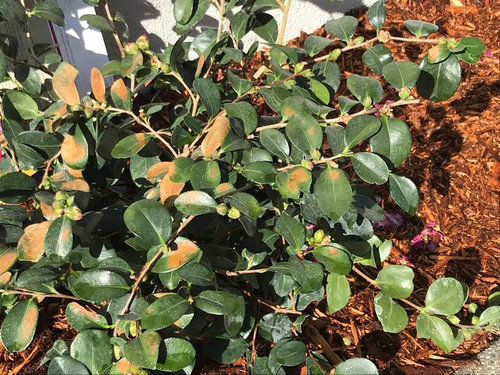
Today, four days later, one of the plants has many of its leaves turning brown.


Another plant is starting to show leave discoloration as well.

The products we've used:

G&B Soil building conditioner

Grow power plus with humic acid

Spoma organic soil acidifier

Garden time Cedar mulch


Please tell me what we've done wrong. And what, if anything, can we do to fix this?

Thank you.


Comments (21)

  • 8 years ago
    last modified: 8 years ago

    Looks pretty certain to be sun damage to me. They either came from the production nursery having been grown in shade, don't therefore have sun adapted leaves on them at this time - or your site is too hot for camellias to be in full sun. Even Sasanqua camellias.

    (If instead the browning seems to have come on too fast for this then maybe one of the products you used burned them).

    Look in the Sunset Western Garden Book for your Sunset climate zone and then see what zoning they show for Sasanquas, any remarks there might be about placement in regard to light exposure and geographical regions.

    Assuming the exposure is in fact the problem before there is any additional damage they should all be dug up and replanted in a different position, that is less sunny. This time loosen existing soil and plant in that, without incorporating organic amendments. Or if the existing soil seems really unsuitable then dig out a section of that - the bigger the better - and replace it with what appears to be good quality purchased topsoil.

    Another way an improved rooting environment can be provided for them is to dump purchased topsoil on top of the existing soil, plant in that - without mixing the two together. This avoids the excavation and removal of existing soil, but can only be done where having the bed go higher is possible.

    Individual, liberally amended planting holes or other small spaces such as narrow beds dug out of heavy soils are undesirable as the modified back-fill may make the holes or strips collection points for water during wet conditions, in the manner of a sump.

    Bleu (Zone 9b - So Cal) thanked Embothrium
  • 8 years ago
    last modified: 8 years ago

    Embothrium, if it's sun damage, then why didn't it happen sooner (these plants have been here for 10 days) and why is it not happening to the other four plants, which are in the same location?

    I specifically asked the nursery expert if the sansaquas would thrive in my garden. He said they only sell plants that tolerate SoCal climate and to be sure to plant them where they would get no more than 4 hours of morning sun and no afternoon sun. Which we did.

    Thanks.

  • 8 years ago

    Sun damage is not always immediate in its symptoms.....they can take several days, sometimes longer, before the actual damage becomes visible.

    In addition to the very poor suggestion to amend individual planting holes, I'd wonder how off your soil pH may be. SoCal is not known for having very acidic soils at all and any soil acidifier requires time to be effective in lowering pH. You need a pH of right around 6.0 for these shrubs to be happy. And it is not clear if the plants were watered as necessary before going into their holes and since the roots were not disturbed as they should have been (again, another very ill-advised recommendation from your nursery), you could have a very dry root ball surrounded by moister soil.

    I'd guess some sun damage, some planting shock and potentially some root dryness are all accounting for the browned, burnt looking foliage. And I would agree that digging up and replanting properly after the soil has been properly acidified is highly advised.

  • 8 years ago
    last modified: 8 years ago

    Embothrium, I really don't have any other place for these camellias. I thought they would be the ideal plant for this narrow bed. I guess I've wasted my money and effort. Very disappointing. Perhaps I should've bought roses...

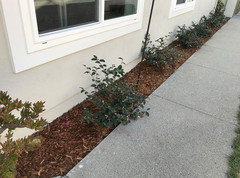
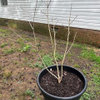
    This is the bed. The plant with browning is the fifth.

    Thanks, gardengal. I made sure the plants were watered as necessary. Incidentally, two of them had a few yellowing leaves (just the edges or two or three leaves) and I noticed this at the nursery but got the plants anyways because their shape was perfect and they seem otherwise healthy.


  • 8 years ago
    last modified: 8 years ago

    They will get far too large for that location anyway. Their shape now is not at all what they have the potential to become :-) The mature size of most varieties of sasanqua is 6-10' tall and 6-10' wide and many grow much larger.

    Bleu (Zone 9b - So Cal) thanked gardengal48 (PNW Z8/9)
  • 8 years ago
    last modified: 8 years ago

    You can see camellias in southern California at Descanso Gardens and the Huntington Botanical Garden. Also Nuccio's nursery - an internationally significant azalea and camellia specialist operation going back many years. The two display gardens will have old plants in numbers, give you a feeling for suitable long term situations and how big these plants get.

    Bleu (Zone 9b - So Cal) thanked Embothrium
  • 8 years ago
    last modified: 8 years ago

    Embothrium and gardengal48,

    What would happen if I were to move these sansaquas across from that bed where they'd probably get much less sun as that's the shadiest area of the garden. Would they still bloom? That really is the only other solution I can see, other than begging the nursery to let me exchange them for roses, which I don't think they'd do...

  • 8 years ago

    Depends on how heavy that shade is - filtered or all day dappled shade is fine. They may bloom less than if in more sun but they should still bloom. Heavy all day shade (no sunlight at all) will result in few, if any, blooms.

    Bleu (Zone 9b - So Cal) thanked gardengal48 (PNW Z8/9)
  • 8 years ago

    Thank you so very much. I learned a very good lesson here. Normally, I do lots of research before buying anything but, this time, the beautiful display of these handsome plants blinded me.

    I just saw a video taken at Descanso Gardens and another one from an Australian master gardener. These plants do indeed get very large. At the nursery, the sign describing the sansaquas said height: 4' and width 5' to 6' responding well to pruning.

    I guess that was what mislead me.

    Thank you, again.


  • 8 years ago

    Another P.S.

    Is it possible that the browning on the leaves could have been caused by ash from the fires in SoCal?

    Bleu (Zone 9b - So Cal) thanked User
  • 8 years ago

    Hi vmr423,

    I'm sorry to have missed your reply (I haven't changed any settings here but the notifications seem to have stopped). I hope you will this post.

    I purchased 4 Sansaqua and 2 Shishi Gashira.

    They will be able to grow at least 3' high and 5' wide sideways. I will have to prune them so that they don't go over the walkway.

    Thank you, Virginia, so very, very much for your very helpful reply. I wish you were my neighbor! :)

    Alas, it turns out that I don't have a shadier and larger spot for these camellias. They will have to adapt.

    I will test the soil in the camellia bed and keep it as acidic as they need it to be.

    About the browning, it happened shortly after I planted them and, no, the fires occurred several weeks later and we did not get ash in this area, thankfully.

    Can misting the leaves, when the noon sun shines on them, have caused the browning? I had been misting the plants in an effort to help the flowers last more than just a day. You see, these plants came with loads of buds. They would bloom profusely but each evening I would see many of the flowers wilt and they had just opened that same morning, even half-opened buds would wilt.

    I also see many dried buds on the plants even though the soil is not dry.

    My neighbor suggested I pluck some of the buds to help others bloom better, which I've been doing.

    The plants seem to be adapting even though the weather doesn't help (we've had a very warm and dry winter so far).

    I guess I could have chosen an easier plant to work with as a beginner California gardener! (I am a transplant from the northeast... The soft soil is all I miss, though.)

  • 8 years ago

    Sasanqua is just the species name....there would have been another, cultivar name associated with it. And pretty much any C. sasanqua will get to about twice the size as you outline.

    1. And just need to reemphasize that the pictured planting bed is not a great location for them, because of size, proximity to concrete and the apparent amount of sunlight they will receive.......noon sun should not be shining on them in a SoCal interior location!!
    2. Shrubs that are planted while in full bloom will often drop or abort a lot of flowers or flower buds. But, I'd guess the wilting and drying of unopened buds is more closely aligned with too much hot sun!
    Bleu (Zone 9b - So Cal) thanked gardengal48 (PNW Z8/9)
  • 8 years ago

    Okay, Gardengal, I get it. I just don't have any other place to put these plants and the nursery won't take them back so, at this point, what do you suggest I do? Should I say goodbye to the $300+ dollars I spent on them or see if they'll adapt to that spot?

  • 8 years ago
    last modified: 8 years ago

    To me, it looks like sun scald or very low humidity causing the leaf damage, especially if the leaf damage is on leaves in direct contact with the sun. This is not uncommon when sasanquas/japonicas are grown in green houses and then planted in environments they have not had a chance to adapt yet. When sasanquas flush new growth in Spring and drop old growth in June, it should hopefully acclimate themselves and grow leaves normally without new damage. At least that is what my sasanquas and japonicas have done in years past. Btw, the leaves in the first pic might be a japonica but unsure; they just look big but it may be due to the close up done to get the pic.

    At worst, the shrubs' leaves react looking orangey/brownish. At best, the leaves look bronzed. But it has been a temporary condition for me at least. The majority of camellias have had no issues or just a little bronzing. Your MJ weather seems similar to mine (maybe more humid) so it would be painfu$$ if they do not recover. We have sasanquas in full sun here in commercial shopping centers and they handle 100-degree temps but... require frequent frequent waterings. I noticed very little rainfall for MJ last quarter of 2017 so keep this in mind. The shrubs are not used to being outside so water & mulch them to keep the soil as evenly moist as possible.

    I try to give my camellias (japonicas & sasanquas) shade starting at 11am at the latest. Tweak as needed in MJ. You can give them dappled sun or less sun (say a few hours of direct sun). If I had browning or bronzing in the winter on camellias that were planted at the end of the year, I give them TLC in their first summer too (extra shade using chairs or umbrellas). Japonica leaves are more sun sensitive than sasanqua leaves. Note that camellia leaves last a couple of years (or so) in the plant. Feel free to cut the ones that look ugly if you want but, watch out for flower buds if there are any (there should be no blooms if these are early blooming sasanquas & some if late blooming sasanquas).

    I also look for areas with some wind protection (think Santa Ana winds in December; that can cause the problem with camellia leaves too).

    Bleu (Zone 9b - So Cal) thanked luis_pr
  • 8 years ago

    Thank you, Luis. Your post is very helpful.

    All of these camellias have flower buds in them.


  • 8 years ago
    last modified: 8 years ago

    Most early Fall blooming sasanquas, noooormally, should not have a lot of blooms at this time ( "a few" at most). Late sasanquas can. But speaking of that, this year, I had two -count again: two- delayed blooms on my Winter's Charm which blooms early; the blooms opened last week after a cold spell interrupted blooming in the Fall! Pretty rare. I am not complaining; just surprised as I did not even notice those leftover flower buds in Winter's Charm. I thought it was done blooming.

    Another, even colder spell in January killed/browned out a lot of buds in a nearby japonica so I am glad I saw WC & the japonica blooming side by side even if it was just two flowers in WC. Just enjoy the show anyways and post pictures!!! PS - Make notes in a wall calendar so you know when these guys bloom and pass the info from one calendar year to the next.

    Bleu (Zone 9b - So Cal) thanked luis_pr
  • 8 years ago

    I recently looked to purchase sasquana camellias from a nursery near me and all their leaves were a yellowish brown. I thought it was odd as they were right next to some Japonicas that were green and healthy looking. If I go back soon I will ask the nursery why the leaves may be yellowing and browning.

  • 8 years ago
    last modified: 8 years ago

    Hmmm. Strange at this time of the year as nurseries tend to water/care them well or else people will not buy them. We are getting to the end of the season for camellias so maybe they are not taking good care??? Hmmm...

    A little bronzing may mean that they are reacting to too much sun (compared to the little amt of sun they received when grown in greenhouses). I did hear from someone who once said their camellias had too much sun in the summer and were turning yellow but orangey-brown is more normal for me to see here. This issue would affect only leaves in direct contact with the sun (inside leaves would remain dark green). Winter damage may turns leaves brownish but you can prevent this with mulching and deep watering. Maybe it did not get watered ahead of a cold spell?

    Another possibility might be iron chlorosis... if the soil pH becomes too alkaline, the leaves can turn light green to yellow. Affects the whole shrub (eventually). A soil test can help determine if this is the case.

    Example of iron chlorosis (on the large leaves) and example of bronzing (on the smaller new leaves):

    https://1.bp.blogspot.com/-QLLpEFm__ag/U3IvqEgBj4I/AAAAAAAAYWQ/M2v9m4cPeN4/s1600/copyright+camellia+clorosis.jpg

    Canker might cause a whole section of the shrub to develop yellowing. But not random cases of yellowing thru the whole shrub. Example:

    https://camelliassww.blob.core.windows.net/assets/standard/PAGE/3390/large/Camellia%20Dieback%202.jpg

    It is normal on some camellia varieties to have yellow (but not brown); example of camellia rusticana:

    http://www.imageflora.com/images/camellia-rusticana-kinsekai2-4549.jpg

    It is too early for camellias to shed leaves too. The old leaves turn yellow in June-ish and fall.

    Last idea... I have seen some new ones develop yellow mottling due to a virus. Plants with a virus that causes this may be "ok" for sale but maybe not as vigorous. I try not to buy virused ones just in case.... However, some people like the look of the leaves with some yellow so, oh well. ;o) Ha.

    Example of virused look: http://www.nurseriesonline.com.au/wp-content/uploads/2016/07/yellow-leaves-camellia.jpg

  • 8 years ago

    Luis 2 of the plants looked most like the picture you posted of canker. Some of the leaves and stems were entirely brown and others were still green. One of the plants had just the edges of the leaves browning and some shriveling.

  • 8 years ago
    last modified: 8 years ago

    Curling can be caused by aphids, which suck liquids from the leaves and cause curling. Applying insecticides nearby can also affect leaves in this way.

    I have also read of over/under watering causing that... as well as 'winter' causing that injury. But I cannot vouch for those two as a reason as it has not happened to me personally. When I have underwatered them, the leaves have not curled; instead the leaves brown out. My winters are usually mild so I have not noticed winter injuries that do that (maybe winter has done that damage to leaves that are hidden and I have not noticed!). Ha.

Sponsored
More Discussions