Software
Houzz Logo Print
hzdeleted_19784549

Hedges as a Fence

8 years ago

Hi Folks. I've moved into a new house with plenty of land for gardening, yea! Down side is I'm on a corner lot with busy roads on both sides.

I'm considering using hedges as a fence for about 200 feet. It looks like buying everything at a nursery could run a few thousand dollars,

Any ideas or suggestions? I've been known to go into the woods and collect seeds and small plants but I don't know what I'm looking for to complete this project.

Thanks.

Comments (11)

  • 8 years ago

    Forsythia is easy to root from cuttings. Look on craigslist in the spring. There is someone always selling their starts. This year I bought a dz Rose of Sharon starts for really cheap. Even Aldis grocery store sells trees and bushes in the spring, but you have to go as soon as the add is out because they sell out fast. I got several from Aldis and they are doing well. The problem with starts is waiting for them to grow.

  • 8 years ago

    I was thinking of forsythia as well. I would probably recommend forsythia over the rose of Sharon because in many parts of the eastern half of the country, the RoS can seed around prolifically enough that some folks consider it a weed unless it is one of the sterile types. Forsythia grows densely enough to be pretty good at providing privacy even when leafless. Mine is more than 10' wide, though, so be sure you have the space.

    Hydrangea paniculatas are another possibility since you could buy a couple of the larger ones such as Quickfire and then start a bunch more from cuttings. My rooted cutting of QF only took about 5 years to get taller than I am.

    I found that Lindera benzoin/spicebush grew quickly from small seedlings as well, and you may find that some of the larger Rhododendrons might work if they are a type that doesn't get leggy at the bottom. If you can get ahold of some rooted cuttings of mock orange or ninebark, they have a similar dense twiggy form to forsythia.

    You wouldn't have to grow just one kind of plant. You could do a mixed shrub border as opposed to a hedge. Mine is a mix of evergreens (conifers and broadleaf) and relatively dense deciduous plants. I will see if I can find an available photo of mine, though the cover photo at the top of my Houzz page (click on my name to get there) has a photo of part of it in winter. A couple issues with having a same species hedge for that long a run for anything less than as iron clad as forsythia:

    if something damages one, you will have a mismatched plants, sizewise, which is less obvious with a mix

    if growing conditions change over the length (especially light and moisture), they will grow at different rates, again less obvious if they aren't all one kind

    on the rare occasion a disease or insect effects one species, you will still have the other plants in the mix and not have to start over again on the entire hedge.

    However, a single species looks a bit more formal and perhaps tidier.

  • 8 years ago

    I like the idea of using a mix of plants to form a hedge. I'm still learning the land here: where the wet spots are, how much road salt will wash in, those kinds of things. The only thing I know for sure is there's great sun.

  • 8 years ago

    I would first space evergreens *=(conifers and broadleaf evergreens, both trees and shrubs) throughout the length making a sketch of their estiimated sizes and shapes in ten years. Then fill in with the rest, but hold the image of the largely evergreen hedge in your mind for the years to come, making sure to cut back and even remove the others as they impinge on the development of the evergreens. Unless you discipline yourself to edit as you go, you will likely end up with a mess of tangled "growth." I suspect NHBabs is a ruthless editor and pruner because the beauty of her hedges is that while full and overlapping, each plant is discernible. A hedgerow to me is different. There the plants have been left to battle it out among themselves and the result is usually a bramble . This too can be attractive and a haven for birds. It may be dense enough to provide year round privacy from the headlights on your two roads. Two looks, best chosen at the outset. I find horticultural plants left to become hedgerows look more like blight. Like maple saplings growing out of privet hedges. If you want the bramble hedgerow look, choose plants suitable for that final outcome.

  • 8 years ago

    Thanks kitasei. I'm really only a vegetable gardener so picturing a hedge 10 years out was not a thought I had. I'm reluctant to grow trees as I'll have a vegetable garden within 5 feet of the hedge row and I don't want that level of root penetration in my beds.

    My in laws have a massive bunch of forsythia that has gone wild that I can dig up come Spring. So I imagine they will be in the mix.

  • 8 years ago
    last modified: 8 years ago

    Existing animal or human traffic routes in regular usage are not going to become discontinued due to the mere planting of some shrubs. Even fencing has to be of a certain minimal level of seriousness to stop this.

    On another subject you might want to have your site tested for vehicle generated contaminants* before doing a lot of food plantings directly into the existing earth, where bordered on two sides by busy streets. Especially if these routes have been present and in use for a long time.

    *Asbestos and lead for instance

  • 8 years ago
    last modified: 8 years ago

    "I'll have a vegetable garden within 5 feet of the hedge row"

    You might want to reconsider the hedge row as fence if you are looking at veggies 5' away. The hedge will create shade and roots can grow outside of the drip line of the hedge, competing for water and nutrients with the veggies. Suckering shrubs like forsythia are difficult to keep within a small footprint and IMO don't look ornamental when pruned for size.

    With regard to Embo's concern about toxins, asbestos isn't absorbed by plants to the best of my knowledge and is mainly a hazard as far as inhaling, but heavy metals like lead can be taken up by some plants and so is something to test for if you are planting near a road that was in use during the time period when lead was in gasoline. For instance, I live in an old house that was painted with lead paint for quite some time, so I won't grow edible plants near the house since I am certain that there is quite a bit of lead in the soil.

  • 8 years ago

    I fully agree about soil testing and I always have my soil tested. My sun should be excellent and I have about 3,000 sq feet to work with so even if there is shade I have plenty of plants to place there. To clarify I'm not trying to stop anything with a hedge except maybe my 2 year old son and the sight line to the street.

    I didn't think forsythia was a suckering shrub, nor did I anticipate that it may not look nice when trimmed to size. Thank you for the information. There's a lot to think about here.

  • 8 years ago
    last modified: 8 years ago

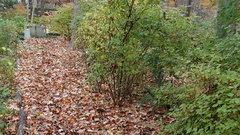
    a pic of my mixed hedge at the back of my property..when we moved in NO privacy..I planted a mix of cheap clearance shrubs..quite a few forsynthias..some viburnums..would like evergreens but we don't have sun..don't love hemlocks which might work..I left several feet behind them for maintenance..for now logs mark the line..was a great decision for us to plant these shrubs..we dump leaves there for weed control..looks fine since we live in a wooded area..you can see what was there before we mowed it down by glancing at the neighbor's yard in the left side of this pic..a weedy mess..

  • 8 years ago

    One thing that might help is to wander around somewhere with relatively mature plants to see how they might look in a few years. If you plan to prune to size, a single, more formal hedge might work better, but pruning 200 feet seems like a lot of work to me.

    Places that might have well grown specimens include Arboretums (including Arnold Arboretum in Boston), some garden centers have demo gardens, some zoos have an incredible range of plant material, and you can look as you drive or walk around for plants that appeal. If you find unlabeled plants, take photos both close of leaves, branches, fruit, and flowers and of the whole plant and post on the Name that Plant forum to get an ID.