Software
Houzz Logo Print
tristansgarden

Sandy Soil + Drought + Thirsty Tree

8 years ago
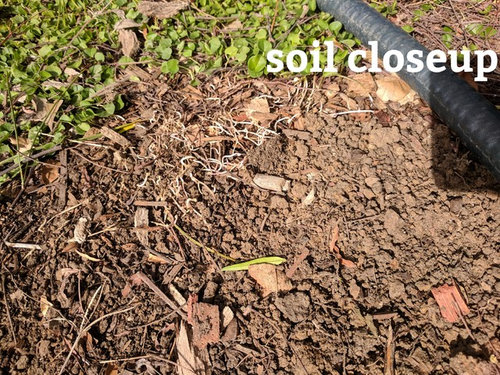
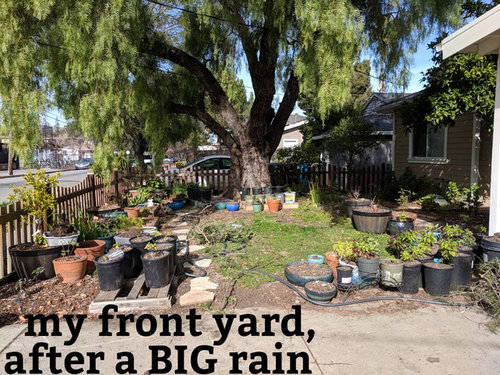
I need some help! It just hit 70 degrees in the zone 9 CA bay area, and I'm ready to focus my attention on my small (25x20sft) front yard. Over the past 3 years I've tried many kinds of plants and ground covers and while some do better than others, everything just *barely* stays alive. It's partially shady, but gets enough sun, and part of it gets full sun. I've had "success" growing beans, salvia, peas, geranium, vetch, dichondra, and succulents. However, no matter how long I water (I can leave the hose running lightly all night set straight on the ground) the soil never gets wet. I just realized that the soil in the front is not the same as the soil in the back. It's SANDY.


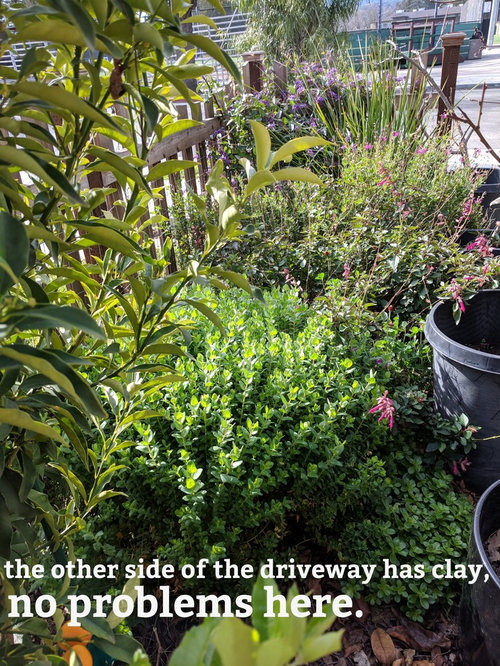
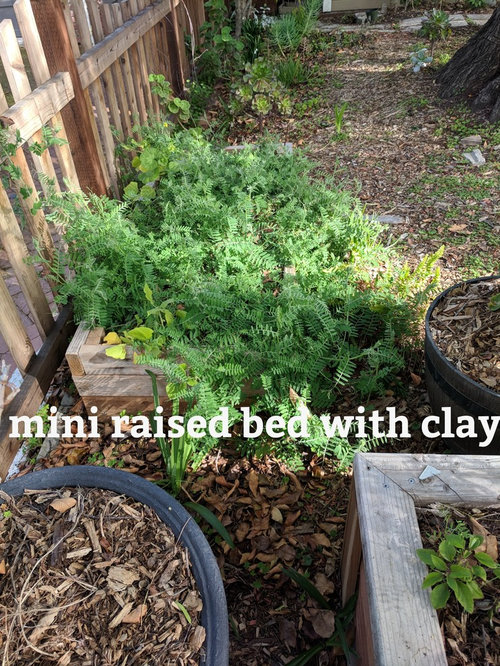
This is not our native soil either, it looks like whoever built the house trucked this soil in. A couple feet down the sand turns to heavy clay like the rest of the neighborhood. Sand + no rainfall + a tremendously thirsty pepper tree with horribly invasive roots, I can't keep water in the ground. After a week of storms the ground is dusty dry several feet down! We are still pretty droughty here and I don't have the option of irrigating a lot.


So I need a plan for this difficult dry soil. Here are my thoughts:


1. Dig out the entire front yard 2-3 feet down, being careful of tree roots, and build an in ground hugelkultur, replacing the sandy soil with clay from back yard + OM. Cover with dichondra, which survived the best of all the drought tolerant ground covers I tried.

-I'm worried that in this case, the clay will dry out too fast because of the thirsty tree roots, and turn into a brick that's even less likely to support life than the current sand.


2. Dig out the entire front yard 3 feet down and build an in ground hugelkultur, cover with mix of current sandy soil + OM. Cover with dichondra.


3. Dig down 4-6 inches and deep and put down a heavy mulch (I can't just lay it on top because it will spill onto my driveway and my neighbors driveway -- my front yard is mounded up much higher than the neighbors property.) Give up on having plants in the ground. To

make it green, cover with a container garden raised a few inches off the mulch to avoid invasive tree roots.


4. Put a large raised bed in the middle of the "lawn" and fill with nice soil. Understanding that I will have to empty the bed each year and remove massive tree roots.


These are just some preliminary thoughts. I'm happy to hear any and all suggestions. I don't care what goes there as long as I can make it green in some way, with ANY PLANTS AT ALL (I'm not fussy) I just hate having a brown front yard!


Comments (7)

  • 8 years ago
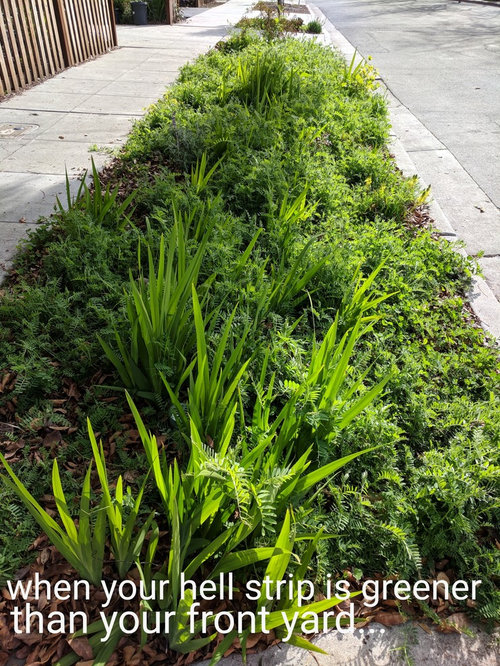
    wantonamara, that's a good guess! I believe the first owners had a rock garden out front. in the hell strip I excevated a very very ancient rock garden where most of the rocks had turned to sand. it was about 1 foot deep on top of our native heavy black clay. in the back yard I've also found pockets of decayed rock garden, and in the front yard I see evidence of that same type of rock.

    so it seems like your recommendation is organic matter + xeric plants. I've tried a few xeric plants. some succulents do ok out front right now. they get very brown during the summer though. I've tried rosemary in a few places, it fails to thrive.
  • 8 years ago
    last modified: 8 years ago

    I would start with a soil test. How hot does it get where you are. I grow rosemary in limestone rubble, decomposed granite sand and a bit of compost, and it gets NO water during the summer and does well in 100+ temps for months. I am on a hill of limestone rubble.Sometimes I break down and water it in the dead of summer once.... but usually never. I am 100% dependent on rainwater and that is a scarce commodity at times of the summer. I have a shelf of rock about 9" down and that might collect some water . I also use the limestone chunks that I remove as a rock mulch to preserve some moisture and keep the dirt cooler.. Are you mulching? The rocks that you removed might have been used for this purpose.. If it is pumice , it will absorb water and let it out slowly. Are you planting these plants in late spring? I do most of my plantings in fall because of the heat. If it gets hot where you are , sedums can burn up. I find that sedum palmerii will withstand Texas full sun in a pot of gravelly , sandy, perlite, soil with 1/3 humous added to the mix and weekly waterings. I grow it inground in partshade in granite sand and compost over limestone rubble. It lived through 5" of rain one year. I have amended the soil with compost where it is at.

    If you want to keep things at the same level , dig out some of the soil, but not the stuff on top , and take it back to a spot out back and use it to improve drainage back there ( but with compost). One could bring some clay from out back, up front and adde compost., But I would not use it in a clump , but all broken up finely and incorporated into the soil. It might be easier to add dry bagged clay and add it to the dirt. Bentonite is added to soil around here to improve water retention. It is a grey clay. I added some to my raised garden for that purpose. But theoretically, the dry and busted up clay from the back should improve water retention. ADD nutrients like nitrogen . I use rabbit pellets and rabbit pellet compost tea, rock dust.

  • 8 years ago

    I would pave it with flagstones for a nice sitting area and plant succulents and other things that really LIKE good drainage. And perhaps have a few things in large pots.

    But, I'm lazy.

  • 8 years ago

    I can't just lay it on top because it will spill onto my driveway and my neighbors driveway -- my front yard is mounded up much higher than the neighbors property

    Install edging or a wall to keep it in place - maintaining a substantial mulch is what you need to be doing.

  • 8 years ago

    Extra points for 'hell strip'. Haha!

  • 8 years ago

    "Hell Strip" is normal nomenclature down here for the strip of land by the street .. Isn't it where you are?