Software
Houzz Logo Print
hzdeleted_19707328

'Taters Gotta Sprout

8 years ago
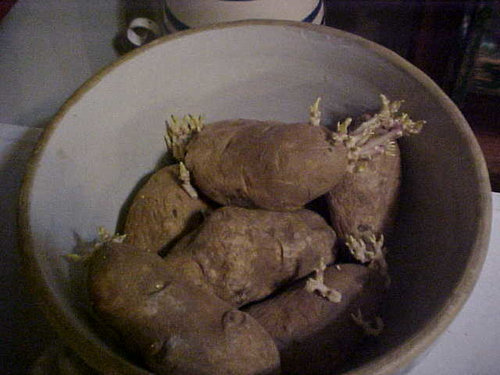
Hubs and I usually buy a 50# bag of potatoes at Homeland around Thanksgiving time. I take them out of the bag, use the ones that are bruised or cut into first, and lay the rest, one layer thick, in some cardboard trays that we bought strawberries in during the spring from Aldi. You don't even really need to buy strawberries there, just go there when they're having a sale on them and more than likely you can take your groceries that you do buy there home in the trays. I use these trays in a lot of ways.

But I'm getting off-track here.

Even with the best of care, potatoes won't last all winter. I don't have a root cellar. I was in hopes our storm shelter might make a good root cellar, but it didn't work out that way and I was really bummed when I found my sweet potatoes turning into mush after getting frozen solid and then defrosting down there. *Sigh*.

I met a man at Master Gardener class that said he digs a trench in the garden and buries all the turnips that he grows in the trench. And I've heard of people doing this with potatoes. I haven't tried it. It just seems like such a lot of back-breaking work, digging the trench, especially on RockWhisperer Hill.

So, I keep them in my pantry, which is a little windowless room on the bottom level of our tri-level. It's dark in there with the door closed, and in the winter we close off the ceiling vent that feeds in from the furnace. It never freezes in there, nor does our attached garage. And, since we had the garage doors replaced with one big one that doesn't have any windows in it, I think now the garage would be a better place. I'll try that next winter.

In the meantime we use the situation to our benefit.

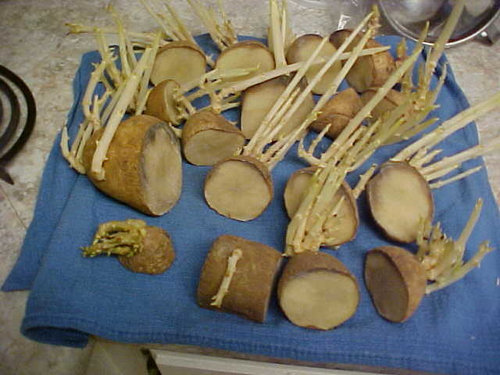
I don't want to waste the whole potato, but I don't want to waste a sprouted end, either. So the ends become seed potatoes.

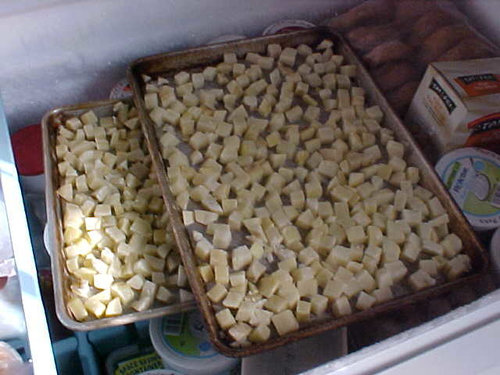
The rest of the potato gets peeled and boiled. When they are at the point where they are just "blanched" (heated through, but not soft yet), they become cubes or shreds for the freezer. I toss the frozen cubes into a skillet with a little bacon fat, some chopped onion and sweet pepper, and that's "Potatoes O'Brian".

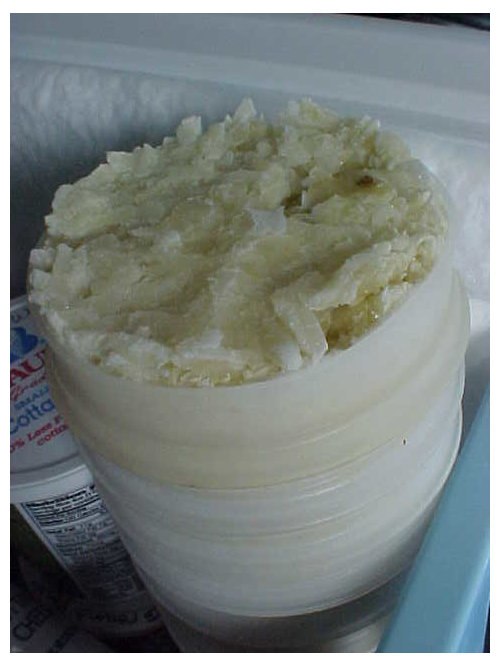
Pressed into some hamburger patty molds, and frozen, they make wonderful hash-browns, cooked in enough hot oil to keep them from sticking, crispy on the outside, potatoey on the inside.

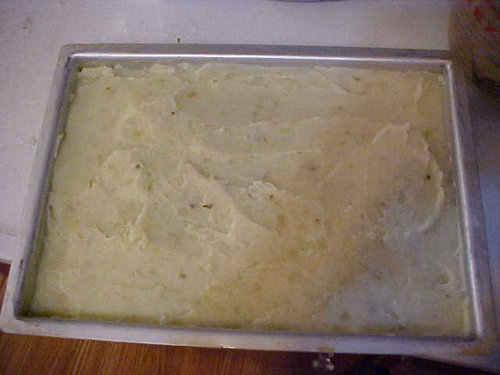
The ones I cook a little longer become mashed potatoes. I press it into a cake pan, refrigerate after it's cooled a little, and then I cut them into serving-size squares. After the pan is frozen the squares are frozen in a ziplock bag. Quick mashed potatoes for one or several, thawed and a little more milk stirred in, heated in the microwave or in the oven.

And the potato water? There's a batch of potato bread planned.

Meanwhile, the sweet potatoes wait.

Not very patiently, though.......

Comments (7)

  • 8 years ago

    I'd be throwing that potato water in my sourdough starter! The bacteria and yeasts love the sugar in it. Haha. That's a great idea, freezing mashed potatoes. It sure would help on busy nights when we don't have time to make them. Hashbrowns too. Love potatoes, usually eat 1 or 2 a day :-)

    I'm growing a lot this year. I'm the only one that really loves them and eats them, so I should have no problem growing enough to last me, the issue is, as you've mentioned, storage. I've seen some people bury trash cans in the ground, but I'd be afraid of issues with freezing once the ground freezes, as you had issues with in your storm shelter. I've seen many people who leave root vegetables such as turnips, carrots, swedes, parsnips, etc. in the ground all winter, covering them with a compact hay bale to keep the ground from freezing. They supposedly last the entire winter and into next spring, as the roots are still alive beneath. I'd wonder how this would work with potatoes, and I might try it. Have you ever canned potatoes?

    When are you planting your potatoes this year? I'm hoping to get mine in on March 20-22 weather and time permitting. Supposedly a fertile day in terms of the moon.

  • 8 years ago

    I'm thinking about growing them in pots this year. It is such a struggle for me to dig potatoes. And the grubworms!!!! So it wouldn't matter as much when to plant as to consider how many times I want to wheel them in and out of the garage....

    Oh, I'm a potato addict.

    Did you make your sourdough starter from scratch, or buy one?

  • 8 years ago

    Usually from scratch. Recently the weather has gotten it down. For some odd reason every time we approach a season change, it kind of slows down until it has adjusted. It comes back after a week of adjustment, but I didn't feed it for 2 weeks and it molded over. Oh well. Takes 5 days to make a new one. I just mix up flour and water, sometimes a little honey, and let it ferment for a few days. Then I feed it once it's gotten going, and after 5 or 6 days I have a usable starter. Do you bake with Sourdough?

    I had considered doing potatoes in containers. I may still. I've read earlies like Yukon Gold get better yield in the containers.

  • 8 years ago

    I have made sourdough starter before, but not in awhile. I have seen where some people buy the starter and they say it's better than what we can make in our kitchens, some of it comes from California and is said to be a descendant of the sourdough that gold miners used. But I suspect that's all just so much hype. Every now and then I think about mixing up a batch -- but then, it's something that has to be fed. I made Kombucha for awhile, and also milk Kefir, but the babysitting and the need to use what was produced got to be a bit of a burden. So I froze the Kefir grains and maybe the Kombucha is dead by now, I stuck it in the pantry and haven't looked at it in awhile.

    I do almost everything from scratch. Hubs has Celiac in his family, has lost two of his twelve sibs from it, none of them are very good at following special diets and we watched them literally starve to death because anything with gluten went right through them and took everything else they had in their stomachs with it. I believe it's all this genetic tinkering we do with our food, wheat in America has just been ruined for human consumption. I buy my wheat from farmers in Kansas, enough for a year at a time. They grow an old European variety called Turkey Red. When they have the wheat cleaned and ready for sale, they call me and we either meet up at the Farmer's Market or we go to their farm to get it. I put it in plastic tubs and freeze it for ten days to kill any larvae that might be in it, and then I vacuum pack it in half-gallon glass jars and they keep just fine until they are used. I have a NutriMill and I mill the flour from the berries right before I make it into bread. I have arthritis in my wrists and so I buy bread machines at garage sales, the kind that will make enough dough for a two-pound loaf, and I run two machines on bread-baking day, which is about twice a month. More, if we have company to feed. I don't like how bread machines leave a hole in the bottom of the loaf and the sides of the bread has too thick a crust, so I just use the dough cycle and then turn the machines off. The dough rises without any extra heat in the dough pans and then I take it out, form the dough into "hamburger buns", allow to rise on sheet pans and then bake. I can freeze the surplus. Bread does not keep well without all those preservatives in it, and refrigeration changes the texture. Oddly enough, freezing doesn't. We take out of the freezer what we think we will use in a day or two, and keep it in a ziplock bag on the counter. Homemade bread, when made into a loaf, tends not to slice very neatly but by trial and error we found that the hamburger bun shape, made with 3 oz of dough, is very versatile. It slices in half very well and then will fit into the toaster if toast is wanted. Untoasted, it makes a nice sandwich. To eat like a dinner roll, just heat a bun in the microwave for only a second or two. There is nothing better than toasted whole wheat bread with real butter. You cannot buy bread like this in the store. Anything called "wheat bread" is not "WHOLE wheat bread". It is made with enriched white flour (which can still be called "wheat flour") and caramel coloring and lots of additives. Even those breads that are "whole grain" and have the Wheat Council seal on the package have chemical additives, among which are cellulose (some say this can be stuff like sawdust and cotton fibers, not sure), and soy. Almost all soy in America is RoundUp grown. There is a little "hole in the wall" bakery in downtown Bartlesville called "The Rolling Pin" and Susan buys local wheat, sometimes from the same farmer that I do. She makes all kinds of REAL bread, fresh every day, without preservatives, for her sandwiches that she serves with homemade soups for the lunch crowd. I've gone and made myself hungry for soup, now.

    I love the breads that have all kinds of grains in them but Hubs is set in his ways and is not very much fun to cook for because there are so many things he just doesn't seem to like. That includes a lot of things that I like. For a long time, I just ate what I made for him, but I cannot eat that way. Too much meat, too fatty, too much sugar, not enough vegetables. So I make the things he likes and freeze the extra portions. Most days, he chooses what he wants to eat from the freezer and I have smoothies and salads and simple things like bread, cheese and fruit. Gradually, over the years since 2009, I have lost about 100 pounds and have my sugar addition under control.

    I am very, very concerned about the chemical poisons that are in our food chain. I don't like that there is fluoride in our drinking water, and I'm not so thrilled about the level of chlorine, either. I filtered water for quite awhile and then I learned that most of the filters remove particles but are not really very good at removing fluoride or chlorine. So now I distill the water that we drink and cook our foods in. There is always about a tablespoon of greenish-brown liquid and a film of calcium deposits left in the evaporator. It's a counter-top model that distills a gallon at a time. It has paid for itself in money and convenience. They are saying now that the bottled water that we buy is the biggest hoax there is, that it's just tap water from some other city. Might be filtered, might not. And the plastic bottles are becoming more of a concern now because there is some leaching out into the water. The people who produce our food lie to us all the time. It's all about the dollar for them. But don't get me started on a rant about that.

  • 8 years ago

    Well, what a great interesting conversation!

    Ilene, I am betting that new storage area will be great for most root vegetables.

    I haven't been growing potatoes lately....in fact, I haven't been gardening nearly as much of anything. I hope this year will be much improved! I have a real root cellar but haven't used it enough to know if it really works. I do know water runs in it and is very slow to leave. Maybe I should have someone check into that.

    Would you believe February was my month to try sourdough! I thought it was fascinating plus the bread keeps longer because of the more good bacteria and less of the bad that causes spoilage. I just basically followed King Arthur's steps and finally have ended up with about a pint that I keep in the fridge.

    I made one loaf of their Rustic Sourdough Bread and we loved it and it did keep out at room temperature without freezing at all. I do your method with most breads Ilene. But this week I tried another recipe of theirs and may give it to the chickens! Don't like taste or texture....it seems slickish to me. I am lucky Max will eat almost anything if it is not from the store. So far, I am keeping the starter fed. I have also made pancakes and waffles using the throwaway part. We could tell very little difference in them and regular ones.

    I wish I could get off the dime and buy the NutriMill and do the "from scratch" wheat flour. when you make bread do you do half unbleached white and half whole wheat or l00% whole wheat? I tried that and found it to be very heavy and dense.

    Anything you all know about sourdough, please discuss here. We can call it garden related because of the wheat seeds and plants..........

  • 8 years ago
    last modified: 8 years ago

    I love sourdough, gldorris. I use a fairly stiff mixture, almost like a very dry bread dough since it gives more strength to the dough, which is useful because my usual bread dough is VERY wet and sticky. I slap and fold mine rather than traditional kneading to contemplate that. Love love love sourdough though, I can clean a 1kg loaf in a couple days days easily.

    I'm always experimenting with whole grain, but usually use white flour. I only use whole grain if using a sourdough starter, as whole grains have various enzymes, like phytic acid, that leech out nutrients in your digestive track and prevent you from absorbing any in the flour....bad stuff.

    I tried sourdough pancakes one time! I think I let it ferment too long actually. It tasted like beer....to the chickens. Maybe I should give it another try.

  • 8 years ago

    How about starting a sourdough thread, Glenda?

    At first, I used 3.5 cups of whole wheat and 2 cups of enriched white flour. Then I went to only using 1 cup and now I am 100%. It needs a longer rise and I don't get the loft that you get with your gorgeous breads but it's not hard and chewy, either. I use my mom's recipe that she used with enriched flour and it does fine. It's 1/4 cup honey, 1/4 cup olive oil, 1 TB yeast (you got me started using SAF instant yeast and now I won't use anything BUT). I put that (minus the oil) in the bottom of the bread pan with 1 and 3/4 cups water. Then add the flour, all but the last cup, and I save that to add in as I watch the machine knead. Sometimes it needs that cup and more, sometimes just part of the cup, I think it depends on the humidity??

    I put 1 teasp salt (mom always used 2) on top of the flour and pour the 1/4 cup olive oil over all. Then I start the bread machines and watch them knead, adding the flour I held out till I'm satisfied with the the texture. I turn off the bread machines and just let it rise in the machine. It takes about an hour. Then turn out and shape my buns, the second rise is only about half an hour. I let it rise in my oven, covered with a tea towel, with the oven light on. Then I take the dough pans out and let the oven heat up to 350 and then put them back in. Doesn't take much time at all to bake rolls.

    I don't remember if you knew GrainLady, she had a "dough conditioner" recipe that was gluten, ascorbic acid, pectin, and lecithin that she added to 100% whole wheat flour to get a pretty rise. I did that for awhile and then got afraid adding that gluten in would be like adding chlorine and fluoride back in to the water I distill. Not doing THAT. And I'm not using the lecithin that's in the recipe. There's something about the ascorbic acid helping to condition the strands the dough needs to make but I have added a tsp of lemon juice or cider vinegar and had about same results. I think I still have GrainLady's dough conditioner recipe somewhere, I'll hunt it up if you want it. Come to think of it, I think King Arthur has a recipe for dough conditioner.

    Oh, I will have to go to King Arthur and find their recipe for sourdough starter.

    Yeah, I'd think that extra moisture in the root cellar would not be a good thing.


Sponsored
Industry Leading Landscape Contractors in Franklin County, Ohio